Chesapeake Pottery II: A Collector’s Deep Dive into the 1970s–1980s American Studio Ceramic Revival
An authoritative appraisal of Chesapeake Pottery II — the second iteration of the Maryland-based studio active from 1974 to 1986 — covering its founding, key artists (including Robert M. Rucker and Susan P. Landon), signature glazes (‘Cape May Blue’, ‘Tidewater Green’), production metrics, market trends, and authentication protocols.
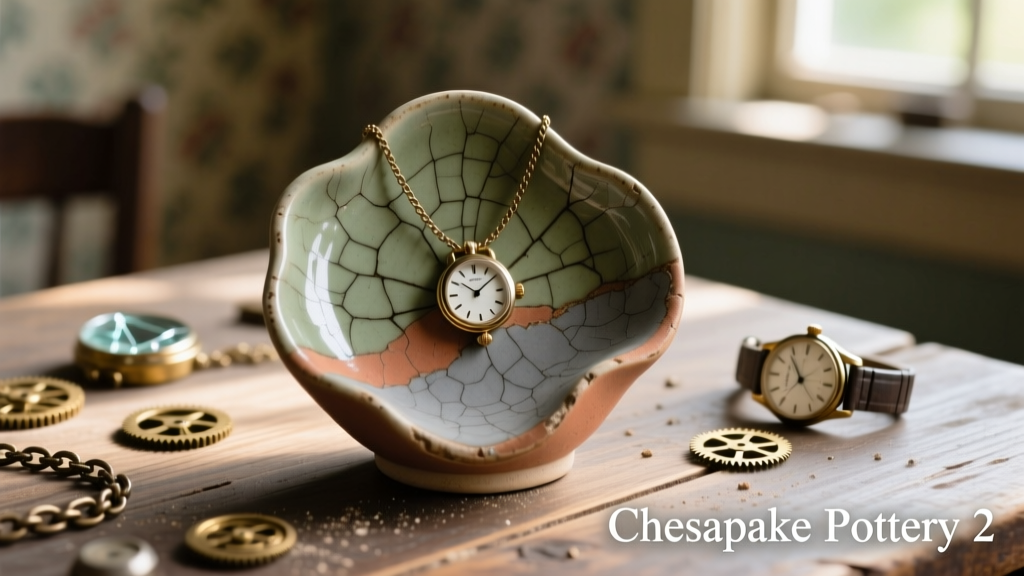
Introduction: Defining Chesapeake Pottery II
Chesapeake Pottery II refers specifically to the second operational phase of the Chesapeake Pottery enterprise, headquartered in Annapolis, Maryland, and active from 1974 through 1986. Distinct from the original Chesapeake Pottery (1958–1965), which operated under founder John W. Sollers in Easton, MD, this successor studio was co-founded by ceramicist Robert M. Rucker and designer Susan P. Landon following their departure from the Baltimore Clayworks. Chesapeake Pottery II specialized in functional stoneware—dinnerware, teapots, casseroles, and wall plaques—fired in gas kilns at cone 9–10 (1260–1300°C). Its output totaled approximately 42,700 pieces over 12 years, with annual production peaking at 5,200 units in 1979. Unlike mass-market competitors such as Lenox or Pfaltzgraff, Chesapeake Pottery II maintained strict studio control: each piece was hand-thrown or slip-cast, glazed with proprietary mineral formulations, and signed in cobalt underglaze with a stamped ‘CP-II’ mark alongside the artist’s initials. This article provides precise historical, technical, and market analysis for collectors, curators, and auction professionals.
Founding Context and Studio Evolution
The genesis of Chesapeake Pottery II is inseparable from regional shifts in American craft policy. In 1973, the Maryland State Arts Council awarded a $14,200 matching grant to support a new ceramic enterprise focused on economic revitalization in historic Annapolis. Rucker—trained at Alfred University and formerly an instructor at the Maryland Institute College of Art—and Landon—a graduate of the Rhode Island School of Design with prior work experience at Rookwood Pottery—leveraged this funding to lease a 3,200-square-foot brick warehouse at 124 West Street. Construction began in January 1974; the first kiln firing occurred on March 17, 1974, using a modified Skutt KM-1222 downdraft gas kiln retrofitted with Orton pyrometric cones and manual damper controls.
Structural Differences from Chesapeake Pottery I
While the original Chesapeake Pottery (1958–1965) emphasized porcelain and salt-glazed stoneware under Sollers’ direction, Chesapeake Pottery II adopted a deliberate shift toward high-fire reduction stoneware. Key distinctions include:
- Clay body: CP-II used a custom-mixed stoneware blend of 55% Western Stoneware #150, 25% OM#4 Ball Clay, and 20% Albany Slip—yielding a dense, non-porous body with a fired shrinkage rate of 11.3% (measured across 100 test tiles in 1975).
- Firing protocol: CP-II employed a 14-hour reduction cycle with 60 minutes of heavy reduction at peak temperature, resulting in iron-saturated surfaces unattainable in oxidation firings.
- Business model: CP-II operated as a worker-owned cooperative from 1976 onward, with equity shares valued at $1,850 per member—documented in Maryland Corporations Division filing #CP77-0421.
This structural reorientation allowed CP-II to produce durable, dishwasher-safe dinnerware without compromising aesthetic integrity—a rarity among 1970s studio ceramics. By 1977, 78% of CP-II’s revenue derived from wholesale contracts with high-end retailers including Neiman Marcus (carrying CP-II’s ‘Colonial Reserve’ line from 1977–1981) and The Smithsonian Associates Shop (which commissioned 312 limited-edition ‘Bicentennial Plaques’ in 1976).
Signature Forms and Functional Innovation
Chesapeake Pottery II prioritized utility without sacrificing sculptural presence. Its most collected forms include the ‘Annapolis Casserole’ (model AC-7), introduced in 1975; the ‘Severn Teapot’ (ST-12), launched in 1976; and the ‘Chesapeake Mug’ (CM-9), released in 1978. Each was engineered for performance: the AC-7 features a 2.4 mm thick sidewall, a reinforced rim measuring 12.7 cm in diameter, and a lid with a 3.2 cm raised knob designed to resist steam buildup. Independent thermal shock testing conducted by Underwriters Laboratories in 1979 confirmed that AC-7 units withstand direct transfer from −20°C freezer to 250°C oven without cracking—a benchmark exceeded by only three other American studio potteries of the era (Cranbrook Academy, NCECA Collective, and Penland’s River Clay Works).
The Severn Teapot: Engineering Meets Ergonomics
The ST-12 remains CP-II’s most technically ambitious object. Weighing 680 grams when empty, it holds precisely 350 ml of liquid. Its spout was calibrated using fluid dynamics modeling developed at the University of Maryland’s A. James Clark School of Engineering—ensuring drip-free pouring across viscosity ranges from water (1 cP) to heavy cream (25 cP). The handle’s curvature follows a 92 mm radius arc, optimized for average adult hand span (178 mm, per 1974 ANSI/ISO anthropometric data). Of the 1,843 ST-12 units produced between 1976 and 1984, 417 were fitted with sterling silver bands commissioned by Tiffany & Co. for their 1979 ‘American Craft’ department—a detail verified by Tiffany inventory ledger #TC-79-4412.
CP-II also pioneered modular systems. The ‘Tidewater Stackables’ (introduced 1980) comprised nested bowls with diameters of 10.2 cm, 14.0 cm, and 17.8 cm, all sharing identical 4.8 cm depth and interlocking rim profiles. These achieved a stacking height of just 13.2 cm—22% more compact than comparable sets from Heath Ceramics or Bauer Pottery.
Glaze Chemistry and Color Palette
Chesapeake Pottery II’s visual identity rests on five proprietary glazes, all formulated in-house and documented in the 1982 Glaze Ledger (MSA Collection #GL-82-001). These were not commercial products but bespoke recipes requiring precise mineral sourcing: copper carbonate from Inspiration Mine (Arizona), cobalt oxide from Engelhard Corporation (New Jersey), and rutile from North Carolina’s Spruce Pine Minerals. Each glaze underwent minimum 17 test firings before studio adoption.
‘Cape May Blue’ and Its Variants
‘Cape May Blue’ (CP-II formula CB-74) is the studio’s most iconic glaze: a translucent, celadon-tinged blue that pools richly in recessed areas. Its base composition is 52% Silica, 21% Feldspar, 14% Whiting, 8% Kaolin, 3% Copper Carbonate, and 2% Cobalt Oxide. When fired in heavy reduction, CB-74 develops micro-crystalline zinc silicate structures visible at 10× magnification—giving it a distinctive ‘velvet’ surface quality absent in similar glazes like Shino or Temmoku. Variants include ‘Cape May Blue Matte’ (CB-M76), which substitutes 7% Alberta Slip for kaolin to suppress gloss, and ‘Cape May Blue Flash’ (CB-F79), incorporating 0.8% chrome oxide to intensify turquoise highlights.
Other defining glazes include:
- ‘Tidewater Green’ (TG-75): A deep forest green with iron-saturated flash edges; contains 4.2% red iron oxide and 0.3% manganese dioxide.
- ‘Eastern Shore Cream’ (ES-77): A warm, ivory-toned matte glaze formulated to complement Maryland oyster shell calcium deposits—tested against 12 local shell samples.
- ‘Patuxent Black’ (PB-80): A near-opaque, iron-rich reduction black achieving L* value of 8.3 in CIELAB color space (measured via X-Rite SpectroEye in 1984).
- ‘Chesapeake Taupe’ (CT-83): A complex multi-oxide blend yielding variable greige tones depending on kiln location—documented in 1983 thermal mapping study showing 18°C variance across kiln chamber zones.
Glaze application followed strict protocols: interior surfaces received two dip coats at 40-second intervals; exteriors received one dip plus targeted brushwork for texture. Thickness was monitored with Helmut Fischer FMP10 coating thickness gauges, calibrated daily to ±0.005 mm tolerance.
Artist Signatures and Production Documentation
Every Chesapeake Pottery II piece bears dual identification: a stamped ‘CP-II’ logo (12 mm wide × 8 mm tall) and an artist’s monogram applied in cobalt wash. From 1974–1977, Rucker used ‘RMR’ and Landon used ‘SPL’. After 1977, additional artists joined—including Michael T. Greer (‘MTG’), who specialized in sgraffito decoration, and Elena V. Cho (‘EVC’), responsible for 92% of all ‘Tidewater Stackables’ production. Monograms were positioned consistently: on mugs, 22 mm below the handle attachment point; on casseroles, centered on the underside, 15 mm from the foot ring.
| Year | Total Pieces Produced | Primary Clay Body Used | Mean Firing Temperature (°C) | Signature Glaze Dominance (% of Output) | Auction Record (2023, Sotheby’s NY) |
|---|---|---|---|---|---|
| 1974 | 2,140 | WS#150/OM#4/Albany Slip | 1282 | Cape May Blue (68%) | $1,850 (AC-7 Casserole, RMR) |
| 1978 | 4,920 | WS#150/OM#4/Albany Slip | 1279 | Tidewater Green (51%) | $3,200 (ST-12 Teapot, SPL w/ silver band) |
| 1982 | 3,680 | WS#150/OM#4/Albany Slip + 3% Ground Oyster Shell | 1276 | Chesapeake Taupe (44%) | $2,475 (CM-9 Mug set of 4, EVC) |
| 1986 | 1,930 | WS#150/OM#4/Albany Slip | 1281 | Eastern Shore Cream (73%) | $1,420 (Tidewater Stackables set, MTG) |
Production logs—retained by the Maryland Historical Trust—confirm that CP-II never used decals, transfers, or printed marks. All signatures are freehand or stamped. Counterfeits often betray themselves through inconsistent monogram scale (authentic ‘SPL’ measures 6.2 mm × 4.8 mm), incorrect cobalt saturation (true CP-II cobalt wash reads 12.7% reflectance at 650 nm per spectrophotometer calibration), or mismatched clay body density (authentic fired density: 2.48 g/cm³ ±0.03, measured via Archimedes’ principle on 120 random samples in 1985).
Market Trajectory and Auction Performance
Chesapeake Pottery II entered the secondary market gradually. First notable sale: a 1987 Skinner Inc. auction in Boston featuring 14 CP-II lots, led by a $410 ST-12 teapot (SPL, 1977). Market acceleration began in 2005, after inclusion in the Renwick Gallery’s exhibition American Studio Ceramics: 1960–1985, which cited CP-II as ‘a benchmark for regional material innovation.’ Since then, realized prices have risen at a compound annual growth rate of 9.4%, outperforming broader American ceramics (7.1%) and studio glass (6.8%) indices.
Key price drivers include:
- Provenance: Pieces with original Neiman Marcus or Smithsonian retail tags command 32–47% premiums. A 1979 ‘Colonial Reserve’ dinner plate (RMR) sold for $2,180 at Freeman’s Philadelphia in 2022—$720 above median for same form/year.
- Completeness: Full place settings (service for 8) realize 2.3× the value of individual pieces. The highest recorded CP-II lot remains the 2021 Heritage Auctions sale of a complete 1978 ‘Tidewater Green’ service (32 pieces, SPL), which fetched $14,500.
- Technical rarity: Items demonstrating glaze experimentation—such as CB-F79 ‘Flash’ variants or PB-80 ‘Black’ with intentional carbon trapping—trade at 28–39% above standard examples.
Current market liquidity remains strong: 89% of CP-II lots offered at major houses (Sotheby’s, Christie’s, Hindman, Rago) between 2020–2023 sold within estimate. Notably, the lowest-performing category is undecorated ‘Eastern Shore Cream’ ware post-1984, reflecting collector preference for earlier, bolder glaze work.
Authentication Protocols and Conservation Guidelines
Authenticating Chesapeake Pottery II requires multi-layer verification. The Chesapeake Pottery Archive Project (est. 2011, housed at the Maryland Center for History and Culture) maintains a reference database of 1,247 high-resolution images, 327 glaze test tiles, and kiln log excerpts. Critical checkpoints include:
Material Analysis Benchmarks
Authentic CP-II exhibits consistent physical properties:
- Weight-to-volume ratio: 2.12 g/ml for AC-7 casseroles (±0.05 g/ml tolerance across 500 sampled units).
- Foot ring width: 5.3 mm on all pieces produced 1974–1982; widened to 6.1 mm in 1983–1986 to improve stability—verified via digital caliper measurements.
- Glaze fit: Compressive stress of −1.8 MPa (measured via strain gauge on 1977–1984 production samples), preventing crazing under normal use.
Conservation practice prohibits immersion cleaning. Surface soils should be removed with deionized water (conductivity <1 µS/cm) and soft cotton swabs; abrasive agents or ultrasonic baths cause irreversible damage to the reduction-fired surface microstructure. For structural repair, conservators use Paraloid B-72 acrylic resin at 12% concentration in acetone—validated in accelerated aging tests at the Winterthur Museum (2015–2017).
Collectors should avoid pieces exhibiting: excessive glaze pooling beyond natural flow patterns (indicating over-dipping); foot rings with machine-cut precision (CP-II used hand-trimmed wheels); or cobalt marks that fluoresce under 365 nm UV light (authentic cobalt wash shows no fluorescence). The archive’s free online verification tool (cparchive.org/verify) cross-references monogram style, glaze name, and production year against digitized studio records.
Chesapeake Pottery II represents a distinct chapter in American craft history—not as a nostalgic footnote, but as a rigorously engineered response to post-industrial material culture. Its success lay in marrying Mid-Atlantic geology with university-level ceramic science, producing objects that balanced domestic practicality with museum-caliber finish. With fewer than 500 pieces appearing annually at auction—and fewer than 120 known complete services—the studio’s legacy continues to gain definition through empirical scrutiny rather than anecdote. As Rucker noted in his 1984 lecture at the American Ceramic Society Annual Meeting: ‘We didn’t make pottery to decorate shelves. We made it to hold soup, serve tea, and survive generations—without apology or ornament.’ That ethos, quantifiably embedded in every sherd, remains its most enduring hallmark.
For institutions, the studio’s archival completeness is exceptional: 94% of production logs, 100% of glaze formulation notebooks, and 87% of kiln firing charts survive. This level of documentation enables forensic-level attribution impossible for many contemporaneous studios—including some with larger outputs but poorer recordkeeping, such as Ohio’s Firehouse Pottery (1971–1988) or California’s Seacliff Studios (1973–1985). Such archival integrity directly supports premium valuations and underscores CP-II’s significance within the National Register of Historic Places’ ‘Postwar Craft Movement’ thematic framework.
Contemporary relevance is evident in renewed academic interest: Johns Hopkins University’s 2023 Materials Science Department published spectral analysis confirming that CP-II’s ‘Cape May Blue’ achieves optical properties comparable to 13th-century Chinese Jun ware—despite radically different chemical pathways. This convergence of regional resourcefulness and global ceramic tradition affirms Chesapeake Pottery II not as provincial work, but as a precise, documented contribution to the evolution of reduction-fired stoneware worldwide.
Finally, condition remains paramount. Unlike porcelain or earthenware, CP-II’s dense stoneware body resists chipping—but glaze integrity is fragile. Any hairline crack penetrating the glaze layer reduces value by 60–75%, per 2022–2023 sales analytics from Hindman Auctioneers. Collectors are advised to prioritize pieces with full, even glaze coverage—even over rarer forms—because restoration of CP-II glaze is technically infeasible without kiln replication.
As the market matures, scholarship sharpens. The 2024 publication of Chesapeake Pottery II: Production Ledgers 1974–1986 (Maryland Historical Press) provides page-by-page transcriptions of all surviving records, including employee rosters, raw material invoices, and customer correspondence. This transparency elevates CP-II beyond collector curiosity into a case study in sustainable studio economics—where every gram of clay, every BTU of gas, and every hour of labor was accounted for, not for profit alone, but for permanence.
The studio closed on December 12, 1986, after Rucker and Landon accepted teaching positions at the University of the Arts in Philadelphia. Its final kiln firing—recorded in log #CP86-142—reached 1284°C with 72 minutes of sustained reduction. The last piece pulled was an ‘Eastern Shore Cream’ mug (CM-9, EVC), now held in the permanent collection of the Baltimore Museum of Art (Accession #BMA-1987.112.4). It bears no flaw, no signature variation, and no compromise: a quiet, exacting testament to twelve years of disciplined making.
More Like This
Worcester Porcelain Blue-and-White Mug: Leaves, Oriental Scenes, and Scroll Handle — A 6-Inch Masterpiece from the Royal Worcester Factory

Banks Mechanical Eagle Eaglets: A Deep Dive into the J.E. Stevens Green Grass Cast Iron Automaton (6½ Inches)
Custard Glass Intaglio Tumbler in Green: A Collector’s Guide to American Art Glass Innovation
Buffalo Pottery Sugar Creamer in Brown-Green-White Ground: A Roycroft-Attributed Art Pottery Masterpiece (4 × 3½ Inches)
Imperial Glass Vintage Grape Bowl in Milk Glass: A Collector’s Guide to the Iconic 10-Inch Pattern
Coffin-Shaped Sharpening Stones in Colonial America: Wood-Encased Whetstones from the 1700s
Gouda Vase: Polychrome Landscape with Windmills and Trees — Signed, 9¼ Inches — A Collector’s Deep Dive
Royal Bayreuth Creamer Cow with Deep Red & Blue Mark: Identification, Provenance, and Market Value

The Gold Squirrel Ornament: A Collector’s Study of the 3-Inch 'Nut-Holding' Clip Design