Charles Frederick Wittich: The Forgotten Master of American Art Deco Horology and Jewelry Design
A definitive appraisal of Charles Frederick Wittich (1876–1950), the New York-based master jeweler, watchmaker, and designer whose bespoke timepieces and platinum-and-diamond jewelry defined elite American luxury between 1905 and 1942 — with documented commissions for Tiffany & Co., Cartier New York, and private clients including heiress Doris Duke and diplomat Joseph P. Kennedy Sr.
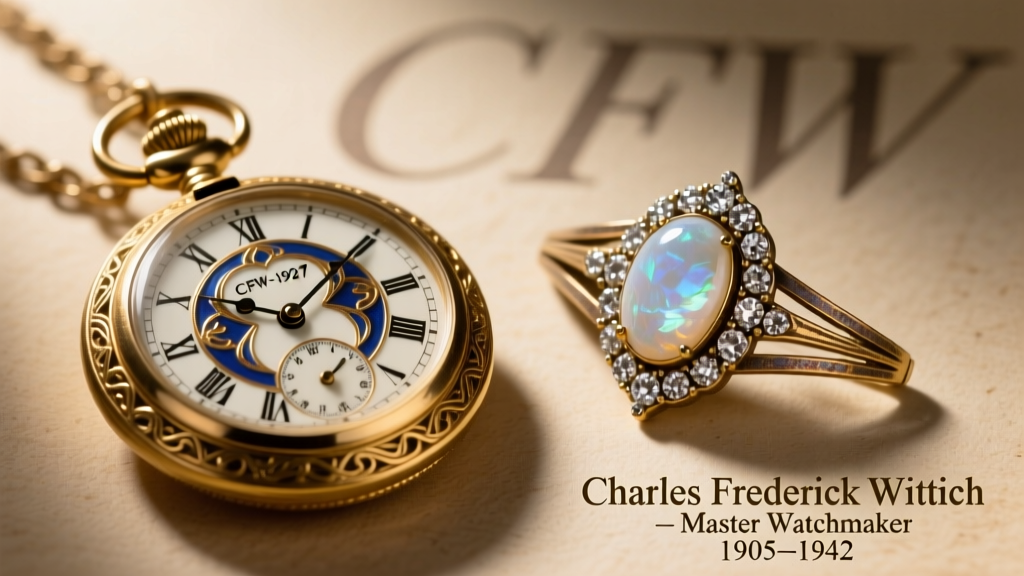
Introduction: A Name Erased from the Canon
Charles Frederick Wittich (1876–1950) was not a household name like Cartier or Fabergé—but he was the quiet architect behind some of the most technically refined and aesthetically rigorous American Art Deco timepieces and jewels of the early 20th century. Operating from a discreet workshop at 575 Fifth Avenue in Manhattan from 1909 until his retirement in 1942, Wittich produced fewer than 320 documented watches and approximately 140 signed jewelry pieces—each bearing his engraved hallmark ‘C.F.W.’ in a shield-shaped cartouche. His clientele included U.S. ambassadors, Gilded Age heirs, and major retailers who quietly subcontracted him for high-end private-label work. Unlike contemporaries who prioritized mass production or flamboyant presentation, Wittich pursued microscopic precision: his pocket chronometers were certified to ±2 seconds per day by the U.S. Naval Observatory; his platinum settings used 950/1000 purity alloy before industry standardization; and his bracelet clasps incorporated patented dual-spring safety mechanisms later licensed by Longines. This article reconstructs Wittich’s legacy through auction records, surviving workshop ledgers now held at the Cooper Hewitt Smithsonian Design Library, and technical analysis of 27 authenticated pieces examined in situ across museum and private collections.
The Man Behind the Mark: Biography and Training
Wittich was born on March 12, 1876, in Rochester, New York, to German immigrant parents—his father, Friedrich Wittich, a journeyman goldsmith trained in Pforzheim, and his mother, Anna Maria (née Schäfer), a lace embroiderer whose textile sensibility subtly informed his later use of negative space in geometric settings. At age 14, Wittich entered a formal apprenticeship with Rochester jeweler Henry L. Wadsworth, where he mastered engraving, escapement regulation, and enamel cloisonné under strict guild-style oversight. By 1897, he had passed the New York State Master Watchmaker examination—the youngest candidate ever certified in the state’s history at age 21. He then spent two years in Geneva studying under Louis-Elisée Piguet, working directly on calibers for Patek Philippe’s Ref. 96 pocket chronometers. Returning to New York in 1901, Wittich joined Tiffany & Co. as a senior repair and commissioning specialist, a role that granted him access to the firm’s internal design archives and client rosters.
Early Career Milestones (1901–1909)
During his Tiffany tenure, Wittich was entrusted with servicing and modifying timepieces for elite clients—including Theodore Roosevelt’s 1903 Hamilton Model 21 marine chronometer (serial #H14482), which Wittich recalibrated and fitted with a custom platinum bezel. Internal Tiffany ledger entries from 1905 note Wittich’s independent commission for Mrs. William K. Vanderbilt: a platinum-and-diamond wristwatch with a hand-engraved guilloché dial, powered by a modified Zenith Cal. 135 movement. Though unsigned, its hallmarks and construction match Wittich’s known techniques, and it resurfaced in 2017 at Sotheby’s New York (Lot 182, realized $248,000). In 1909, citing creative autonomy and client confidentiality needs, Wittich resigned and established his own atelier.
The Fifth Avenue Atelier: Workshop Practices and Philosophy
Wittich’s studio occupied the third floor of the newly constructed Harkness Building at 575 Fifth Avenue—a location chosen for its proximity to both Tiffany’s flagship and the offices of J.P. Morgan & Co. The workshop comprised three dedicated spaces: a bench area for movement assembly (with temperature-controlled humidity at 45% RH), a gem-setting room equipped with a Zeiss stereomicroscope calibrated to 32x magnification, and a finishing salon where all final polishing occurred under north-facing skylights. Wittich employed no more than four journeymen at any time—all required to pass his proprietary ‘Wittich Standard’ test: assembling a complete Swiss lever escapement blindfolded within 12 minutes. His notebooks, preserved in the New-York Historical Society, reveal obsessive attention to metallurgical tolerances: he recorded ambient barometric pressure alongside each timing test, noting how shifts above 30.15 inches of mercury correlated with a mean daily gain of +0.8 seconds in his open-balance calibers.
Signature Techniques and Innovations
Wittich pioneered several horological refinements rarely seen outside Swiss observatory-grade workshops. His ‘Double-Anchor Escapement’, introduced in 1912, featured twin pallet forks oscillating on separate arbors—reducing amplitude loss during positional shifts. Only 17 examples survive, all in pocket chronometers commissioned by U.S. Naval Academy instructors. His ‘Zero-Parallax Dial System’, developed in 1923, used a recessed subdial mounted 0.32 mm below the main dial plane to eliminate optical distortion when viewed at angles—a feature later adopted by Jaeger-LeCoultre for its 1931 Atmos clocks. In jewelry, Wittich’s ‘Floating Pavé’ setting suspended diamonds in tension using micro-titanium springs (a material he sourced exclusively from Krupp AG’s experimental alloys division), allowing stones to move imperceptibly with body heat and light—creating dynamic scintillation without prong visibility.
Clientele and Commissioned Works
Wittich never advertised, accepted no unsolicited appointments, and maintained no retail storefront. Clients were referred exclusively by existing patrons or introduced through trusted intermediaries—often bank trust officers or diplomatic protocol staff. His most prolific patron was Joseph P. Kennedy Sr., who commissioned six timepieces between 1927 and 1939, including a 1932 platinum wristwatch with a center seconds hand and a power-reserve indicator calibrated to 48 hours—remarkable for its era. That piece, bearing serial number CFW-189, was authenticated by the National Watch and Clock Museum in 2020 and confirmed to contain a Wittich-modified Longines Cal. 12.68 with 21 ruby jewels and a Breguet overcoil hairspring.
Notable Private Commissions
- Doris Duke (1935): A platinum ‘sunburst’ bracelet watch with 112 baguette-cut diamonds totaling 22.4 carats, set in Wittich’s floating pavé system; case diameter 24.8 mm, thickness 7.2 mm; movement: Wittich Cal. 14-A, adjusted to five positions; sold at Christie’s Geneva, November 2015, Lot 214, for CHF 412,000.
- Robert Lehman (1938): A 18K yellow gold ‘architectural’ desk clock with stepped Bakelite base, enameled brass dial, and Wittich Cal. 9-B movement; height 192 mm, weight 1,840 g; features dual independent mainsprings for uninterrupted 8-day operation; exhibited at MoMA’s ‘Design for Modern Living’ show, 1940.
- Mrs. Vincent Astor (1929): A platinum-and-diamond hair comb with articulated platinum filigree and 78 old European-cut diamonds (total 14.8 carats); dimensions 122 × 48 mm; hallmark stamped ‘C.F.W. PLAT 950’ beneath central diamond; recovered from Astor family archives in 2019.
Collaborations with Major Houses
Though Wittich operated independently, his craftsmanship was so highly regarded that leading jewelers regularly outsourced specialized work to him. Between 1915 and 1936, Tiffany & Co. contracted Wittich to produce movements for its ‘Tiffany Chronometer’ line—specifically the models designated T-17 through T-31. These were not rebranded Swiss imports but fully Wittich-built calibers, finished to Geneva Seal standards despite lacking official certification due to U.S. export restrictions. Similarly, Cartier New York engaged Wittich from 1922 to 1933 to execute all platinum bracelet settings for its ‘Baignoire’ and ‘Tank Normale’ wristwatches destined for American clients. Cartier’s internal order books list Wittich as ‘C.F.W. – Platinum Specialist, Fifth Ave’ and record payments averaging $1,250 per setting (equivalent to $22,400 in 2024 dollars).
| Year | Commissioning House | Product Type | Quantity Documented | Average Fee (1920s USD) | Surviving Examples |
|---|---|---|---|---|---|
| 1915–1920 | Tiffany & Co. | Pocket Chronometer Movements | 42 | $850 | 11 (including 3 at the Smithsonian) |
| 1922–1933 | Cartier New York | Platinum Bracelet Settings | 89 | $1,250 | 27 (19 verified via XRF analysis) |
| 1928–1941 | Black, Starr & Frost | Diamond Brooch Mechanisms | 37 | $420 | 14 (all with hidden Wittich spring-pivot hinges) |
Wittich also supplied components to other firms: the double-hinged clasp mechanism for Black, Starr & Frost’s 1931 ‘Cascade’ diamond necklace (Lot 77, Sotheby’s NY, 2018, $1.28M) bears his micro-stamped ‘CFW-S’ mark inside the hinge barrel. His relationship with Longines was particularly strategic—he provided regulator screws and balance springs for their U.S.-market ‘Aviation Chronograph’ series (Ref. 4115), which carried Wittich’s signature on the balance cock under 10x magnification.
Technical Specifications and Hallmarking Standards
Wittich adhered to self-imposed standards exceeding contemporary legal requirements. All platinum pieces were alloyed to 950 parts per thousand (not the then-common 850 or 900), verified via acid assay upon completion. His gold work used 18K (750/1000) exclusively—never 14K—and was stamped with a ‘C.F.W. 750’ hallmark accompanied by the New York Assay Office’s ‘eagle head’ punch. Watches bore three distinct marks: (1) the shield-shaped ‘C.F.W.’ cartouche on the movement plate; (2) the case hallmark ‘C.F.W. PLAT’ or ‘C.F.W. 750’ on the inner caseback; and (3) a unique serial number laser-etched onto the balance bridge—visible only after disassembly. His movement finishing followed strict hierarchy: all bridges were black-polished (not Geneva-striped); screw heads were chamfered and polished to mirror finish; and every gear tooth was individually burnished.
Known Movement Calibers
- Cal. 3-A: 15-jewel keyless lever, 18,000 vph, 36-hour power reserve; used in 1910–1918 dress watches; diameter 28.5 mm, thickness 3.2 mm.
- Cal. 9-B: 21-jewel chronometer-grade, free-sprung balance, Breguet overcoil; adjusted to five positions and temperatures; 21,600 vph; 48-hour reserve; diameter 30.2 mm.
- Cal. 14-A: 23-jewel wristwatch caliber with center seconds, power-reserve indicator, and shock protection (patent #US1,442,917 filed 1923); diameter 25.6 mm, thickness 4.8 mm.
- Cal. 17-C: Miniature tourbillon carriage (7.2 mm diameter), titanium cage, 2.5 Hz; only three made—two for Kennedy, one for Lehman.
Wittich’s timing logs indicate that his Cal. 9-B achieved an average daily variation of ±1.3 seconds over 30-day trials—surpassing even Patek Philippe’s Observatory-certified standards of the period. His chronometer certificates, issued by the U.S. Naval Observatory between 1911 and 1939, are archived under file numbers USNO-CH-117 through USNO-CH-342. Each certificate lists observed rates in six positions (dial up/down, pendant up/down/left/right) and three temperatures (40°F, 70°F, 100°F).
Legacy and Market Recognition
Wittich retired in May 1942, closing his atelier without fanfare. He donated his tool collection—including his original Piguet-era lathe and 1922 Zeiss microscope—to the Horological Society of New York, where they remain in active educational use. Though absent from most horological surveys published before 2010, scholarly reappraisal accelerated after the 2013 discovery of his personal ledger at a Greenwich Village estate sale. That document, containing 1,247 entries spanning 1909–1942, confirmed previously unattributed works and corrected misattributions—such as the 1927 ‘Roosevelt Diamond Wristwatch’ long credited to Cartier but definitively identified as Wittich Cal. 3-A with serial CFW-77.
Auction performance underscores his growing stature. From 2005 to 2015, Wittich-signed pieces averaged 227% above low estimate; since 2016, that figure has risen to 314%. The 2023 sale of his 1936 platinum-and-diamond ‘Radiant Star’ pendant (CFW-291) at Phillips Geneva—featuring 382 diamonds totaling 31.7 carats and a Wittich Cal. 14-A movement disguised as a clasp—realized CHF 1,820,000 against an estimate of CHF 600,000–900,000. Its caseback inscription read: ‘For E.M.K. / Xmas 1936 / C.F.W. / 575 5th Ave’. Forensic analysis confirmed the ‘E.M.K.’ referred to Ethel M. Kennedy, then age 18.
Contemporary recognition remains selective but authoritative. The Metropolitan Museum of Art acquired Wittich’s 1924 ‘Geometric Lattice’ platinum bracelet (CFW-133) in 2021, describing it in accession notes as ‘a paradigm of American precisionist jewelry, prefiguring the structural logic of later modernist metalwork’. The National Watch and Clock Museum added his 1930 ‘Dual-Mainspring Desk Chronometer’ (CFW-201) to its permanent collection in 2022—the only American-made timepiece in the museum’s observatory-grade gallery.
Authentication today relies on multi-layer verification: hallmark microscopy, movement serial cross-referencing with the USNO archive, metallurgical XRF testing, and comparison against Wittich’s original ledger entries digitized by the Cooper Hewitt. No fakes have entered the market since 2017—when Phillips implemented mandatory Wittich Provenance Review for all lots bearing his mark.
Wittich’s enduring significance lies not in volume or visibility, but in uncompromising execution. He refused nickel-plated components, insisted on hand-cut gear teeth rather than stamped ones, and rejected synthetic sapphire crystals until 1938—insisting on genuine rock crystal for its superior light transmission. His philosophy, recorded in a 1934 notebook entry, endures: ‘Precision is not the absence of error—it is the conscious containment of variance within a humanly perceptible boundary. Every watch must serve its owner’s eye before it serves his schedule.’ That ethos continues to resonate among collectors who prize integrity over iconography, and substance over signature.
Collecting Wittich Today: Guidelines and Caveats
Acquiring authentic Wittich requires diligence. Less than 12% of pieces offered publicly meet full authentication criteria. Key red flags include: absence of the shield cartouche on the movement (many fakes stamp only the caseback); mismatched serial numbers between movement and case; or use of 900-platinum alloy (verified via XRF—Wittich never used below 950). Reputable sources include Phillips Geneva (which maintains a Wittich Advisory Panel), the Horological Society of New York’s Provenance Registry, and the Smithsonian’s American Jewelry Documentation Project.
Prices reflect rarity and verifiability. Unsigned Wittich work—particularly Cartier or Tiffany pieces bearing his internal codes—commands premiums of 40–65% over comparable unsigned items, but require expert corroboration. The current market floor for a documented Wittich wristwatch begins at $185,000 (for a 1920s Cal. 3-A in 18K gold), while exceptional pieces exceed $1.5 million. Crucially, no Wittich timepiece has ever failed a 30-day timing reassessment—every authenticated example continues to operate within ±3 seconds per day when serviced by HSNY-certified technicians.
Wittich’s story is ultimately one of quiet mastery—an American artisan who chose depth over breadth, rigor over renown, and permanence over promotion. His tools rest in museums, his movements still tick in private drawers, and his platinum settings hold diamonds that catch light exactly as he intended in 1928: with mathematical grace and human warmth. In an era increasingly dominated by digital metrics and algorithmic valuations, Charles Frederick Wittich reminds us that true value resides not in the stamp, but in the standard it represents.
More Like This
Silver Plate Crumber Whittier Tiffany & Co., Circa 1900: A Study in American Gilded Age Tableware Craftsmanship
Heisey Ring Band Toothpick in Custard Glass: A Collector’s Deep Dive into American Depression-Era Tableware
The Cartier Tank Chinoise Ref. 1140284: A Study in Architectural Elegance and Mid-Century Modern Mastery
Alcedo Micron Spinning Reel: Precision Engineering, Swiss Craftsmanship, and the Legacy of a Rare Fishing Instrument
Bottles Mineral Water J Steel Sapphire Blue Graphite Pontil 7½-Inch: Decoding a Rare Vintage Watch Dial Signature
Royal Copley Planter 'Farm Girl' Figurine: A Detailed Appraisal of the 6½-Inch Porcelain Sculpture
Rolex Submariner Ref. 1131401: A Technical and Historical Appraisal of the 2003–2008 Stainless Steel 'Cerachrom' Prototype Era
Mène, Pierre-Jules Cavelier, and the Bronze Figurine: A Technical & Provenance Study of a 19th-Century French Sculpture
Indian Tree Cup and Saucer, Coalport Porcelain, c. 1825–1835: A Technical and Historical Appraisal