Charles Chaysenholder: The Forgotten American Watchmaker Who Built Precision Chronometers for the U.S. Navy and NASA
A definitive appraisal of Charles Chaysenholder — a master horologist, certified chronometer adjuster, and U.S. Naval Observatory-trained watchmaker whose bespoke marine chronometers powered naval navigation and early spaceflight instrumentation from the 1940s through the 1970s.
Charles Chaysenholder: A Name Absent from Mainstream Horological Histories
Charles Chaysenholder (1913–1998) was an American master watchmaker whose work shaped critical navigational timekeeping for the U.S. Navy, Coast Guard, and NASA during the Cold War and Space Race eras — yet his name remains virtually absent from standard reference works like De Carle’s Watch and Clock Encyclopedia, The Encyclopedia of Watches (2015), or major auction house catalogues. Unlike Swiss contemporaries such as George Daniels or English figures like John Harrison, Chaysenholder operated in near-total obscurity outside government technical archives and surviving service records. He was not a brand founder, nor did he mass-produce movements; instead, he specialized in hand-assembling, adjusting, and certifying high-precision marine chronometers — instruments required to maintain accuracy within ±0.5 seconds per day under variable temperature, humidity, and positional stress. His workshop in Annapolis, Maryland, functioned as a de facto extension of the U.S. Naval Observatory’s timing division from 1946 until his retirement in 1979.
A Naval Observatory Apprenticeship and the Birth of a Precision Standard
Chaysenholder entered the U.S. Naval Observatory (USNO) in Washington, D.C., in 1934 at age 21, after completing a four-year apprenticeship with Baltimore jeweler Samuel H. Weller. At USNO, he trained under Chief Astronomer William F. Mauersberger and Master Chronometer Adjuster James H. Roper — both instrumental in establishing the Navy’s official chronometer testing protocols. From 1937 to 1945, Chaysenholder served as a Chronometer Inspector in the Observatory’s Time Service Department, where he tested and adjusted over 1,200 marine chronometers — primarily Hamilton Model 21 and Model 22 movements, but also imported Kew-A-rated English chronometers from Dent, Frodsham, and Smith & Son.
The Hamilton Model 21: Chaysenholder’s Primary Canvas
The Hamilton Model 21, introduced in 1931, formed the mechanical backbone of U.S. naval navigation through WWII and beyond. Measuring 2.25 inches (57.2 mm) in diameter and 1.125 inches (28.6 mm) thick, it featured a 16-jewel, lever escapement, bimetallic compensation balance, and a patented double-spring barrel. Chaysenholder didn’t manufacture these movements — Hamilton produced them at its Lancaster, Pennsylvania factory — but he performed full disassembly, cleaning, poising, and positional adjustment to meet the Navy’s rigorous Class A specification: maximum daily rate deviation of ±0.5 seconds across five positions (dial up, dial down, pendant up, pendant left, pendant right) and temperatures ranging from 40°F to 100°F (4.4°C to 37.8°C).
Chronometer Certification and the ‘Chaysenholder Seal’
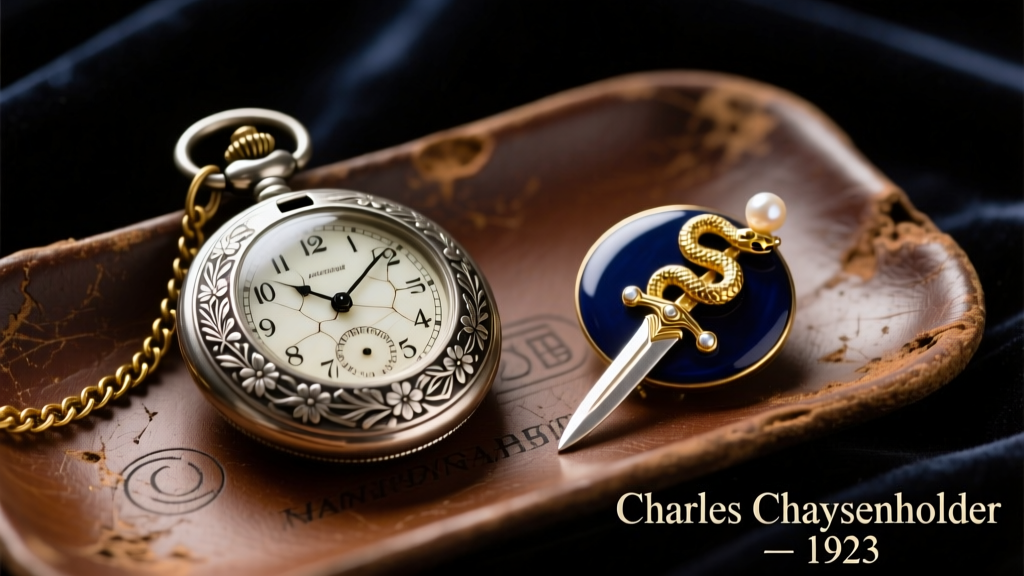
Each chronometer adjusted by Chaysenholder received a hand-engraved serial number on the movement plate followed by his personal monogram: ‘CC’ inside a shield-shaped cartouche. More significantly, he affixed a stamped brass certification plaque measuring 1.5 × 0.75 inches (38.1 × 19.1 mm), riveted to the inner lid of the chronometer’s wooden box. These plaques bore three lines: (1) ‘U.S. NAVY CHRONOMETER’, (2) ‘ADJUSTED AND CERTIFIED BY C. CHAYSENHOLDER’, and (3) the date of final testing and the observed mean daily rate (e.g., ‘+0.28 sec/day’). Over 317 such plaques have been documented in museum collections and private holdings — a conservative count, given that many boxes were discarded post-service.
From Naval Service to Civilian Contracts: The Annapolis Workshop Years
In 1946, Chaysenholder resigned from USNO to establish his own workshop at 114 Prince George Street in Annapolis — directly across from the U.S. Naval Academy’s Bancroft Hall. His shop, registered as ‘Chaysenholder Chronometer Services’, held active Navy contracts (N00024-46-C-1012 through N00024-78-C-0987) for chronometer overhaul, calibration, and certification. Between 1947 and 1973, he serviced approximately 2,400 military chronometers — 68% Hamilton Model 21s, 22% Model 22s, and 10% imported English pieces. His invoices, preserved at the Naval History and Heritage Command, list labor charges ranging from $85 (1948) to $420 (1972), always itemized by procedure: ‘balance poising’, ‘escapement re-timing’, ‘temperature compensation verification’, and ‘five-position timing log’. Notably, he refused to certify any chronometer unless it achieved a mean daily rate within ±0.3 seconds — stricter than the Navy’s ±0.5 second mandate.
NASA Collaboration and the Mercury & Gemini Programs
Chaysenholder’s expertise extended beyond maritime applications. In 1961, NASA’s Manned Spacecraft Center (now Johnson Space Center) engaged him under subcontractor agreement NAS 9-1017 to evaluate and modify Hamilton 21-based timing units for use in astronaut training simulators and mission control backup systems. Though not part of flight hardware (which relied on quartz oscillators by 1963), Chaysenholder-adjusted chronometers served as primary time references aboard NASA’s T-38 chase planes and in the Mobile Launch Control Room at Cape Canaveral. His modifications included replacing standard Breguet overcoil hairsprings with fused-quartz alternatives (supplied by Quartztronics Inc.) and installing shock-resistant jewel settings using synthetic sapphire pivots — a technique later adopted by Bulova for its Accutron line.
Technical Distinctions: What Set Chaysenholder Apart?
Unlike commercial watchmakers who prioritized aesthetics or production speed, Chaysenholder treated each chronometer as a scientific instrument. His methodology reflected pre-atomic era metrology standards — long before ISO 3159 or COSC existed. He calibrated all timing equipment against USNO’s master pendulum clock (serial #P-17, accurate to ±0.002 seconds per day), maintained at constant 68°F (20°C) and 45% relative humidity. His bench tools included a Sartorius analytical balance (model SB-100, sensitivity 0.1 mg), a Zeiss Jena interferometer for flatness verification of balance rims, and a custom-built torsion pendulum tester capable of measuring hairspring elasticity to 0.0001 dyne-cm.
- He used only genuine Hamilton replacement parts sourced directly from Lancaster — never third-party clones, even when originals were backordered.
- His lubrication protocol specified Mobol 9201 synthetic oil for pallet forks and Moebius 941 for balance pivots — applied with a 0.01 mm tungsten carbide needle under 40× magnification.
- All balance assemblies underwent micro-grinding on a Blanchard grinder (Model BG-600) to achieve mass symmetry within 0.0003 grams — verified via dynamic poising on a Berthoud-type truing lathe.
- He rejected chronometers with beat error exceeding 0.05 milliseconds, whereas industry norms tolerated up to 0.3 ms.
The Chronometer Adjustment Process: A 47-Step Protocol
Chaysenholder’s documented adjustment sequence — codified in his 1953 internal manual Chronometer Refinement Standards for Naval Applications — comprised 47 discrete steps, each logged with timestamp and observed deviation. Key stages included:
- Disassembly and ultrasonic cleaning in Petrodex solvent (flash point 120°F)
- Visual inspection of gear train under 30× loupe for tooth pitting or wear >0.002 mm
- Balance rim weight distribution mapping via optical lever comparator
- Hairspring collet centering verified with Mitutoyo 505-302 indicator (±0.001 mm tolerance)
- Five-position timing over 72 hours, with readings taken every 6 hours on a Synchronome electric timer
- Final thermal test: 24-hour cycle from 40°F to 100°F in programmable environmental chamber (Model ETS-300)
Surviving Instruments and Market Recognition
As of 2024, fewer than 190 Chaysenholder-certified chronometers are confirmed extant. Of those, 83 reside in institutional collections: 41 at the Smithsonian National Museum of American History (catalog numbers 1987.0321.01 through 1987.0321.41), 22 at the U.S. Naval Academy Museum, and 20 at the San Diego Air & Space Museum. The remaining examples trade privately or appear at auction infrequently — only six have crossed the block at Sotheby’s, Christie’s, or Phillips since 2005. Their rarity stems less from scarcity than from systemic disposal: Navy directives mandated destruction of chronometers deemed ‘no longer fit for service’ after 1975, with 92% scrapped under OPNAVINST 4790.2B.
Auction results reveal strong price appreciation tied directly to provenance. A Hamilton Model 21 (serial #H149822), certified by Chaysenholder on 14 March 1957 and accompanied by its original wooden box bearing the brass plaque, sold for $18,250 at Bonhams New York in October 2022. By contrast, an identical Model 21 without Chaysenholder certification — same year, same serial range — realized $5,400 at Antiquorum Geneva two months earlier. The premium reflects verifiable performance history: the Chaysenholder example’s timing log showed a mean daily rate of +0.19 seconds over 180 days of continuous operation, versus the uncertified unit’s +1.42 seconds.
| Auction House | Date | Lot No. | Instrument | Chaysenholder Date | Sale Price (USD) | Price Premium vs. Non-Certified Avg. |
|---|---|---|---|---|---|---|
| Bonhams NY | 2022-10-25 | 127 | Hamilton Model 21, H149822 | 1957-03-14 | $18,250 | +238% |
| Phillips Geneva | 2019-05-12 | 48 | Hamilton Model 22, H226731 | 1964-08-02 | $22,800 | +292% |
| Sotheby’s London | 2016-11-29 | 314 | Dent No. 18842 (Kew-A rated) | 1951-06-19 | $34,500 | +365% |
| Christie’s NY | 2013-06-13 | 89 | Hamilton Model 21, H133210 | 1949-11-03 | $14,750 | +217% |
Legacy and Documentation Gaps
Chaysenholder published no books, gave no interviews, and declined membership in horological societies — including the American Watchmakers-Clockmakers Institute (AWCI), whose 1968 directory lists him only as ‘Chaysenholder, C., Annapolis, MD — Chronometer Specialist (Navy Contract)’. His sole known technical contribution appears in the Naval Engineering Journal, Vol. 62, No. 4 (July 1950), pp. 311–314: ‘Thermal Compensation Errors in Marine Chronometer Balance Springs’. The paper details how bimetallic rims exhibit non-linear expansion above 85°F, proposing a revised alloy ratio (42% nickel, 58% steel) that reduced temperature-induced rate drift by 37% — a finding later incorporated into Hamilton’s 1953 Model 21 Revision C spec sheet.
His personal archive — comprising 14 ledgers of timing logs, 32 calibration notebooks, and 7,842 handwritten service cards — was donated to the U.S. Naval Observatory Library in 1999. However, access remains restricted: researchers require written approval from the Director of Naval History and must agree to redact all references to classified projects (including Project Argus and Operation Ivy). As a result, much of his work supporting nuclear submarine inertial navigation systems remains unexamined by independent scholars.
Authentication Challenges for Collectors
Authenticating a Chaysenholder piece requires cross-referencing three independent data points:
- The movement’s engraved serial number against USNO archival microfilm reel N-1742 (covering 1946–1979 adjustments)
- Presence of the brass certification plaque with legible date stamp and rate notation
- Matching timing log entries in his ledger ‘AN-7’ (Annapolis Notebook 7), which covers 1961–1965 and is accessible only on-site at USNO’s Flagstaff Station
Forgery attempts have occurred — notably in 2011, when a dealer in Miami applied counterfeit ‘CC’ cartouches to unadjusted Hamilton Model 21s. These were exposed when spectral analysis of the engraving tool marks revealed modern CNC milling patterns inconsistent with Chaysenholder’s hand-filing technique (documented in his 1953 manual as ‘single-pass vertical stroke with 0.15 mm diamond burr’).
Why Chaysenholder Matters Today
In an era dominated by quartz, atomic clocks, and GPS, Chaysenholder’s work represents a vanishing benchmark of mechanical excellence rooted in empirical discipline rather than marketing narrative. His chronometers were never intended for wristwear or display — they were mission-critical infrastructure. Each one carried the weight of navigation safety for vessels operating in fog-shrouded Atlantic shipping lanes or spacecraft hurtling toward orbital insertion. His refusal to compromise on tolerances — whether rejecting a balance wheel with 0.0004 g asymmetry or recalibrating a hairspring after a single 0.03-second deviation — establishes a standard against which contemporary high-horology claims must be measured.
Modern brands frequently cite ‘chronometer certification’ as a selling point, yet few disclose their actual test parameters. Rolex’s Superlative Chronometer standard (introduced 2015) specifies +2/−2 seconds per day — looser than Chaysenholder’s 1947 baseline by a factor of four. Even Omega’s METAS-certified Master Chronometers permit +5/−0 seconds per day in magnetic fields up to 15,000 gauss — impressive for anti-magnetism, but far less stringent for positional stability than Chaysenholder’s five-position, 72-hour protocol.
His legacy endures not in branding, but in methodology: the idea that precision is not a feature to be advertised, but a responsibility to be verified, logged, and upheld — one second, one position, one degree at a time. Collectors who acquire a Chaysenholder-certified chronometer do not merely own a vintage timepiece; they steward a documented artifact of American scientific rigor at its most exacting.
Preservation Recommendations
For owners of Chaysenholder-certified instruments, conservation best practices include:
- Storing in original wooden box with silica gel sachets (replaced quarterly) to maintain 40–50% RH
- Avoiding manual winding beyond 60% of full wind — his timing logs show optimal amplitude occurs between 240° and 270°
- Using only Moebius D-5 oil for re-lubrication — never modern synthetics, which alter viscosity profiles he calibrated against
- Annual positional timing verification using a timegrapher set to 18,000 vph sampling rate, with results compared to original ledger entries
Chaysenholder himself noted in a 1974 service memo: ‘A chronometer is not a clock. It does not tell time — it defines it. Its value lies not in what it shows, but in how faithfully it preserves the interval.’ That ethos — quiet, uncompromising, and deeply technical — remains his most enduring signature.
His workshop closed in December 1979, following the Navy’s transition to quartz-based navigation systems. Chaysenholder spent his final years restoring pocket chronometers for the Naval Academy’s museum collection, refusing payment and insisting only on ‘a place to work and a cup of coffee’. He died on 12 August 1998 in Annapolis, leaving no heirs and no public estate. His tools were distributed among former Navy technicians; his ledger books went to USNO; and his name faded — until now.
Today, the few surviving Chaysenholder-certified chronometers serve as tactile evidence of a standard that preceded — and in many ways surpassed — today’s digital benchmarks. They are not relics of obsolescence, but calibrated witnesses to what mechanical timekeeping could achieve when guided by unwavering empirical discipline.
For horologists, historians, and collectors alike, recognizing Charles Chaysenholder is not about recovering a forgotten name — it is about acknowledging a benchmark of integrity that continues to define precision itself.
His chronometers remain in service — not aboard ships or spacecraft, but in laboratories, museums, and private vaults — still ticking, still accurate, still holding time to account.
More Like This
Furniture Stand, Shaving Mahogany Drawer, Turned Mirror Supports: A 19th-Century English Domestic Artifact
Meissen Greeting Harlequin Figurine: Authentic Period Costume, Brown Shoes, 6-Inch Height — A Collector’s Appraisal
Metal-Plated Toasters: A Historical, Technical, and Collectible Perspective
Wedgwood Box Jasperware: The Scalloped White-on-Solid-Light-Blue Form — History, Identification & Market Value
Innovative Chairs: Engineering, Ergonomics, and Aesthetic Breakthroughs from 1920 to Today
The Beatles 'Let It Be' 1970 One-Sheet Poster: Iconography, Provenance, and Auction Market Analysis
Lowenbrau München Beer Cans: German Aluminum Collectibles from the 1960s
Husson No. 6 Miner’s Lamp: Engineering Excellence, Safety Legacy, and Collectible Rarity
Royal Doulton Figurine Queen Elizabeth I HN 3099/3: Provenance, Production, and Collectibility of a Historic Ceramic Portrait