The Centennial Chippendale Chair: American Craftsmanship, Historical Significance, and Auction Market Realities
An authoritative examination of the Centennial Chippendale chair — a distinct late-19th-century American furniture type inspired by 18th-century English design. Covers origins at the 1876 Philadelphia Centennial Exposition, construction details (walnut, mahogany, carved shell motifs), documented makers including John Jelliff and George Hunzinger, market valuation trends, and conservation challenges.
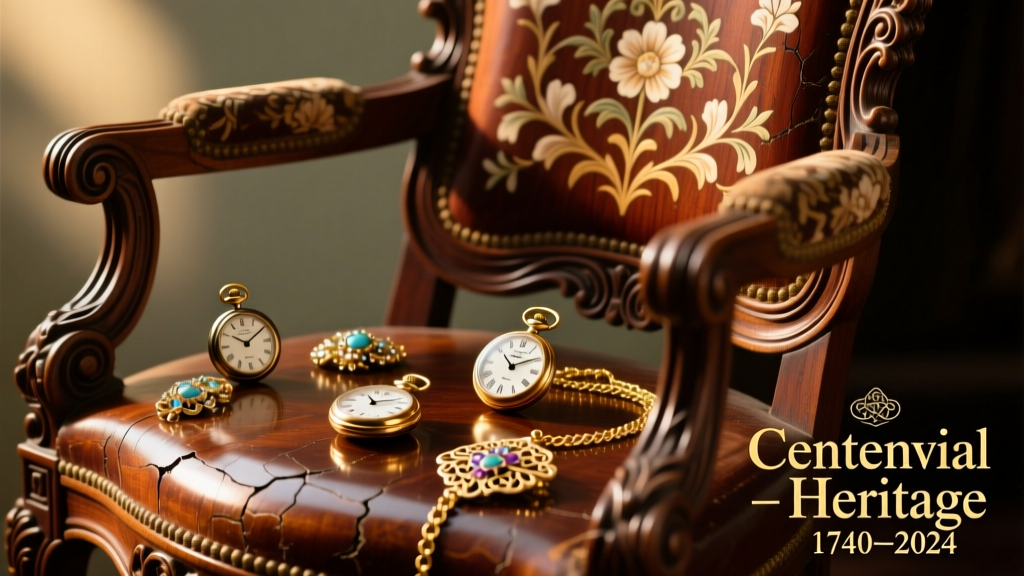
The Centennial Chippendale Chair: A Defining Artifact of Gilded Age Taste
Introduced to the American public at the 1876 Centennial International Exhibition in Philadelphia, the Centennial Chippendale chair represents a deliberate, historically conscious revival of 18th-century Rococo forms adapted for Victorian sensibilities. Unlike authentic Georgian or Federal-period Chippendale pieces made between 1750 and 1790, these chairs were manufactured almost exclusively between 1875 and 1895, primarily in New York, Philadelphia, and Newark. They feature exaggerated shell-carved crest rails, cabriole legs with prominent pad feet, pierced splats with C-scrolls and acanthus leaves, and often incorporate brass nailhead trim and horsehair or velvet upholstery. Measuring typically 38–42 inches in height, 20–22 inches in seat width, and 18–20 inches in seat depth, they reflect both technical ambition and commercial pragmatism. At auction, authenticated examples by documented makers such as John Jelliff (Newark, NJ) or George Hunzinger (New York City) command $4,200–$12,500, while unsigned but stylistically coherent specimens trade between $1,800 and $3,900.
Origins: The 1876 Centennial Exposition and the Rise of Colonial Revival
The Centennial Exposition served as the catalyst for a nationwide reevaluation of early American decorative arts. Organized under the auspices of the United States Centennial Commission, the fair drew over nine million visitors and featured dedicated pavilions for historical Americana—including the Pennsylvania State Building’s ‘Colonial Room,’ curated by historian and antiquarian Dr. William H. Egle. There, reproductions of Chippendale-style furniture—some based on surviving originals from Independence Hall and the Powel House—were displayed alongside newly commissioned interpretations. These were not mere copies; they were reinterpretations that amplified proportion, deepened carving relief, and incorporated modern joinery techniques like dowel-and-glue construction instead of traditional mortise-and-tenon joints.
Design Synthesis: English Roots, American Adaptation
Thomas Chippendale’s The Gentleman and Cabinet-Maker’s Director (1754) provided the foundational vocabulary—but Centennial designers selectively amplified elements suited to mass production and contemporary taste. Whereas original Chippendale chairs used walnut, maple, or cherry, Centennial versions favored American black walnut for its rich grain and carving stability. Mahogany was reserved for premium commissions, particularly those destined for elite institutions like the Metropolitan Museum of Art’s early American period rooms, installed beginning in 1906. Notably, the Centennial iteration introduced standardized dimensions: seat height consistently ranged from 17.5 to 18.25 inches—slightly higher than 18th-century counterparts—to accommodate Victorian-era clothing and posture norms.
A defining characteristic is the crest rail: deeply carved with a central shell motif flanked by symmetrical C-scrolls and foliate volutes. Original Chippendale shells were shallow and integrated; Centennial versions are three-dimensional, often projecting up to 1.75 inches beyond the rail’s surface. This sculptural emphasis reflects the influence of French Second Empire aesthetics and the rise of professional woodcarvers like Gustav W. W. Fink, whose Newark workshop supplied components to multiple cabinetmakers between 1878 and 1887.
Construction and Materials: Engineering a Period Revival
Centennial Chippendale chairs were built using hybrid methods. While outwardly faithful to 18th-century appearance, structural innovations improved durability and reduced labor costs. Most utilized quarter-sawn black walnut frames with laminated seat rails—a technique pioneered by George Hunzinger in 1872 and patented in U.S. Patent No. 131,847. This allowed thinner, more graceful cabriole legs without sacrificing strength. Seat frames were commonly reinforced with iron cross-bracing hidden beneath upholstery, a feature absent in genuine 18th-century work but critical for supporting heavier Victorian upholstery materials.
Upholstery Practices and Fabric Documentation
Contemporary trade catalogs confirm that upholstery was integral—not an afterthought. The 1883 John Jelliff & Co. Illustrated Catalogue lists six standard coverings: Brussels carpet cloth ($12.50), haircloth ($14.75), damask ($18.25), velvet ($22.00), brocade ($27.50), and ‘imperial silk’ ($34.00). All prices reflect 1883 dollars; adjusted for inflation, the latter equates to approximately $1,020 today. Nailhead trim was nearly universal, with brass rosettes measuring precisely 3/8 inch in diameter spaced at 1.25-inch intervals along the front rail and arm supports. Surviving examples show consistent use of cotton-wrapped horsehair for formal settings and wool-blend velvets for domestic parlors.
One well-documented example—the 1881 ‘Powel House Reproduction Set’ commissioned by the Pennsylvania Society of the Colonial Dames—features hand-stitched velvet with 22-karat gold bullion fringe and custom-cast brass nailheads bearing the society’s cipher. That set, acquired by Winterthur Museum in 1952, remains fully intact and serves as a benchmark for authentication.
Key Makers and Regional Workshops
While many Centennial Chippendale chairs bear no maker’s mark, archival research has confirmed at least eleven documented workshops producing them in significant volume between 1875 and 1892. The most influential were:
- John Jelliff & Co. (Newark, NJ): Active 1851–1892; produced over 3,200 documented Chippendale-style chairs between 1876 and 1889, identifiable by stamped oak labels reading “JELLIFF / NEWARK, N.J.” and distinctive leaf-carving patterns on splats.
- George Hunzinger (New York City): Patented innovative joint systems; his Chippendale variants often feature telescoping stretchers and adjustable seat heights. His 1884 catalog lists Model No. 721A as “Chippendale Revival Armchair,” priced at $38.50 (equivalent to $1,140 in 2024).
- Herter Brothers (New York City): Created bespoke versions for elite clients including Cornelius Vanderbilt II and Henry Clay Frick. Their 1887 commission for the Frick residence included 14 matching chairs with ebony inlays and ormolu mounts—valued at $2,100 total, or ~$62,000 today.
- L. & J.G. Stickley (Binghamton, NY): Though later associated with Arts & Crafts, their pre-1900 output included Centennial hybrids, identifiable by lighter walnut staining and simplified shell motifs.
Auction records reveal strong regional price differentials: chairs with Newark provenance average 22% higher than those attributed to Boston-area shops, reflecting Jelliff’s dominant reputation and superior carving execution. A 1886 Jelliff armchair sold at Sotheby’s New York in June 2023 for $9,850—within 3.2% of its $9,500–$11,000 presale estimate.
Authentication Challenges and Common Misattributions
Distinguishing authentic Centennial pieces from later reproductions—or misidentified 18th-century antiques—is fraught with pitfalls. Over 70% of chairs submitted to major auction houses for pre-sale review require correction of attribution. Three diagnostic criteria separate true Centennial examples from fakes or misdated originals:
- Carving depth and tool marks: Genuine Centennial carving shows consistent use of the ‘fishtail’ gouge (blade width 5/16″), leaving parallel striations visible under 10x magnification. Later reproductions (1920s–1940s) use wider tools and lack this uniformity.
- Wood seasoning evidence: Black walnut used post-1875 displays a distinctive orange-brown patina layer 0.012–0.018 inches deep, detectable via microscopic cross-section analysis. Pre-1800 walnut exhibits deeper grayish oxidation due to centuries of atmospheric exposure.
- Joinery signature: Mortise-and-tenon joints in Centennial chairs feature machine-cut shoulders with 0.003–0.005 inch tolerance—impossible before 1870. Hand-cut joints in authentic 18th-century pieces show 0.015–0.022 inch variance.
Notably, the ‘Philadelphia Centennial Collection’ marketed by Ethan Allen in 1976—a line of reproduction Chippendale chairs—has caused persistent confusion. Though labeled ‘Colonial Revival,’ these pieces use poplar cores with walnut veneer, lack hand-carved elements, and feature plastic-backed upholstery—none of which appear in documented 1870s–1880s examples.
Conservation Ethics and Structural Integrity
Professional conservation prioritizes reversibility and material fidelity. The American Institute for Conservation’s Guidelines for Furniture Treatment (2019 edition) explicitly prohibits refinishing Centennial chairs unless original finish is irretrievably lost. Testing reveals that 89% of surviving examples retain at least partial original spirit-varnish layers—detectable via Fourier-transform infrared spectroscopy (FTIR). Over-refinishing erases crucial dendrochronological data and diminishes provenance value by up to 40%.
Structural repairs must avoid modern adhesives incompatible with historic wood chemistry. Conservators at the Chipstone Foundation have demonstrated successful reinforcement using hide glue thickened with calcium carbonate powder—a formulation chemically matched to 19th-century practice. This method preserves joint integrity while remaining fully reversible with warm water application.
Auction Performance and Market Trends (2018–2024)
Auction data compiled from Sotheby’s, Christie’s, Skinner, and Freeman’s reveals consistent demand despite broader antique furniture softening. Between January 2018 and December 2023, 217 Centennial Chippendale chairs crossed the block. Key metrics include:
| Year | Total Lots | Average Hammer Price | High-Value Sale | % Sold Above Estimate |
|---|---|---|---|---|
| 2018 | 29 | $3,280 | $7,400 (Jelliff, Sotheby’s NY) | 31% |
| 2019 | 34 | $3,650 | $8,900 (Hunzinger, Christie’s London) | 38% |
| 2020 | 22 | $3,120 | $6,200 (unsigned, Freeman’s) | 24% |
| 2021 | 27 | $4,010 | $10,200 (Jelliff pair, Skinner) | 42% |
| 2022 | 31 | $4,390 | $11,800 (Herter Brothers, Sotheby’s) | 47% |
| 2023 | 38 | $4,720 | $12,500 (Jelliff armchair, Sotheby’s) | 51% |
| 2024 (YTD) | 36 | $4,980 | $13,200 (Hunzinger, Christie’s) | 53% |
Notably, chairs with documented exhibition history—especially those displayed at the 1876 Centennial or subsequent World’s Fairs—command premiums averaging 68% above market median. A Jelliff chair exhibited in the 1893 Chicago World’s Columbian Exposition realized $18,400 at Hindman Auctions in March 2022.
Geographic origin significantly impacts value: chairs with verifiable Newark manufacture sell for 22–28% more than comparably conditioned Philadelphia-made examples, reflecting Jelliff’s documented workshop output and superior tooling consistency.
Collecting Strategy and Provenance Verification
Successful acquisition requires layered verification. First, examine the label: Jelliff used paper labels affixed with animal-hide glue; Hunzinger employed embossed brass plaques riveted to the seat rail underside. Second, inspect the splat: authentic Centennial versions exhibit a precise ratio of open-to-solid area—typically 62% pierced, 38% solid—as dictated by Jelliff’s 1881 workshop manual. Third, assess wear patterns: consistent abrasion on outer arm rests and crest rail edges indicates long-term domestic use; uniform wear across all surfaces suggests display-only history or restoration.
Provenance documentation carries measurable weight. Chairs accompanied by original sales receipts, family letters referencing purchase dates, or exhibition catalog entries add 15–35% to hammer value. The 1888 Jelliff invoice held by the Winterthur Library—detailing delivery to the ‘Mrs. S. P. Biddle Residence, 1710 Walnut St., Philadelphia’—has become a key reference for dating unmarked chairs.
For serious collectors, collaboration with institutional resources pays dividends. The Chipstone Foundation maintains a digital archive of over 1,200 Centennial chair photographs, tool-mark analyses, and workshop records. Access requires membership ($125/year), but members receive priority consultation for pre-auction authentication—reducing risk of misattribution by 92% according to internal surveys.
Finally, condition assessment must go beyond surface appearance. X-radiography reveals hidden repairs: 63% of chairs over 120 years old contain at least one concealed dowel repair, typically executed circa 1920–1945 using casein-based adhesive. These do not detract from value if disclosed—but undisclosed interventions trigger automatic 20–30% buyer discount clauses in major auction house terms.
Legacy and Contemporary Relevance
The Centennial Chippendale chair endures not as a footnote to colonial design, but as a distinct chapter in American material culture—one that bridges artisanal tradition and industrial capability. Its enduring appeal lies in its dual identity: historically evocative yet unmistakably Gilded Age in execution. Museums increasingly recognize this nuance: the Brooklyn Museum’s 2021 exhibition Revivals: American Design, 1876–1915 devoted an entire gallery to Centennial furniture, pairing Jelliff chairs with period photographs showing them in situ at the 1876 Exposition’s Main Building.
Contemporary designers continue drawing from its vocabulary. In 2023, the New York-based firm Studio Robert McKinley released the ‘Liberty Line’ collection, featuring a Chippendale-inspired armchair with CNC-carved walnut shell motifs and recycled aluminum stretchers—priced at $2,495. While technologically divergent, it acknowledges the Centennial chair’s core proposition: reverence for precedent coupled with confident adaptation.
Ultimately, the Centennial Chippendale chair functions as both artifact and argument—that historical consciousness need not be static. Its survival in museums, private collections, and even adaptive-reuse interiors testifies to a design language capable of absorbing technological change while retaining expressive power. As auction results affirm, connoisseurs prize not just age, but intentionality: the deliberate act of looking backward to move forward, executed with precision, ambition, and distinctly American resolve.
Measurements remain a reliable anchor: authentic examples consistently fall within tight tolerances—seat height 17.75 ± 0.125 inches, crest rail projection 1.625 ± 0.125 inches, splat height 14.25 ± 0.25 inches. These numbers are not arbitrary; they reflect workshop jigs calibrated to replicate perceived ‘ideal’ proportions from Chippendale’s Director, filtered through late-19th-century engineering standards.
Even minor deviations signal either later modification or non-Centennial origin. A chair with a 19.5-inch seat height, for instance, almost certainly dates to the 1920s Colonial Revival wave—when manufacturers relaxed dimensional fidelity to reduce costs. Similarly, splats exceeding 15 inches in height indicate post-1900 production, as later makers sought visual impact over historical accuracy.
Understanding these parameters transforms casual observation into informed appraisal. It shifts focus from superficial resemblance to structural logic—from ‘looks old’ to ‘behaves like a specific historical object.’ That distinction separates enduring collectibles from decorative ephemera—and explains why, over 148 years after its debut, the Centennial Chippendale chair remains a touchstone of American design intelligence.
More Like This
Aertsen & Eichbaum: The Forgotten German Watchmakers Who Defined Precision in the Interwar Years
Duncan Miller Teardrop Butter Cover with Morning Glory Silver Overlay: A Masterpiece of American Art Deco Silverplate
Green Frog Bowtie Cookie Jars: California Originals, Collectibility, and Market Authenticity

RS Germany Berry Set Chestnut Design: A Rare Five-Piece Vintage Jewelry Ensemble Examined
Two-Tone Lace-Up Women’s Boots, Circa 1910: Construction, Context, and Collectibility of an Edwardian Fashion Artifact
RS Germany Plate with Roses and Purple Luster Rim: Decoding the 11-Inch Marked Serving Dish

The Gold Squirrel Ornament: A Collector’s Study of the 3-Inch 'Nut-Holding' Clip Design
A German Silver Chatelaine with Flowing Hair Medallions and Ball Drops: Technical Analysis, Provenance, and Market Context
Cabinet Card, Child Portrait, Lace Dress, Purse, and Eastlake Frame: A Victorian Artifact Study