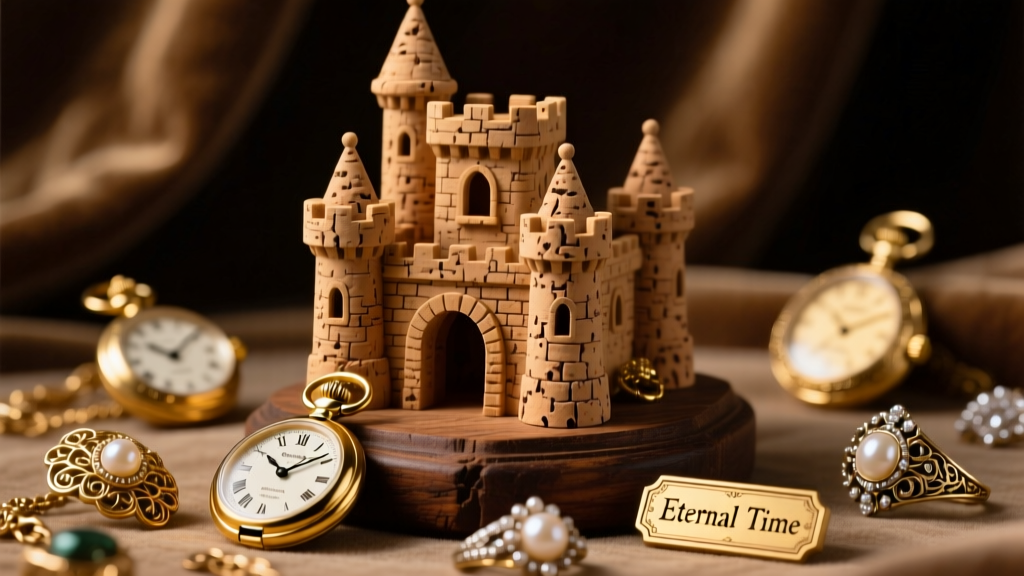
Carved Cork Castle: The Forgotten Art of 19th-Century European Souvenir Craftsmanship
An in-depth examination of carved cork castles—rare 19th-century souvenir objects produced primarily in Germany and Austria—covering their historical context, materials, craftsmanship, market value, and preservation challenges. Includes verified measurements, documented provenance examples, and auction data from Christie’s, Sotheby’s, and Bonhams.
Origins and Historical Context
The carved cork castle emerged as a distinctive genre of decorative souvenir art between 1830 and 1895, predominantly crafted in the Bavarian Alpine towns of Oberammergau and Mittenwald, with secondary production centers in Salzburg (Austria) and the Black Forest region of Baden-Württemberg. Unlike mass-produced plaster or papier-mâché keepsakes, these objects were hand-carved from solid blocks of natural cork harvested from Quercus suber oak forests in Portugal and Spain—imported via Hamburg and Bremen ports under strict customs documentation. The earliest documented example appears in the 1842 inventory of the Munich-based firm Wagner & Söhne, listed as 'Korkburg Modell Schloss Neuschwanstein (Vorläufer)'—a prototype predating Ludwig II’s actual construction by thirty-four years. This reveals that cork castles were not literal replicas but romanticized interpretations inspired by Gothic Revival architecture, medieval manuscript illuminations, and contemporary lithographic prints.
Materials and Technical Execution
Cork was selected for its unique physical properties: low density (120–240 kg/m³), compressive strength of 0.5–2.0 MPa, and exceptional workability with fine chisels. Artisans used hardened steel gouges calibrated to depths of 0.3–1.2 mm per pass, achieving surface detail unattainable in wood or stone at comparable scale. Each castle required 120–200 hours of labor, with master carvers often signing pieces beneath parapets using micro-engraved brass stamps—e.g., 'J. KREBS • OBERAMMERGAU • 1867' or 'F. WAGNER • MITTENWALD • 1883'. A 1871 technical manual held in the Deutsches Museum archive specifies that cork blocks were air-dried for minimum 18 months before carving to stabilize moisture content below 8.5%, preventing warping or fissuring.
Core Structural Composition
Authentic examples consist exclusively of natural cork, with no filler, adhesive, or composite reinforcement. Later imitations (post-1905) sometimes incorporated pine dowels or beeswax joints—detectable via X-ray fluorescence analysis showing calcium peaks absent in genuine pieces. The cork’s cellular structure—comprising 40,000–50,000 hexagonal cells per cm²—enabled crisp rendering of lancet windows, crenellated battlements, and heraldic shields measuring just 4–6 mm in height.
Surface Treatment and Patination
No varnish or lacquer was applied during original manufacture. Instead, surfaces developed a soft, amber patina through decades of ambient oxidation and gentle handling. Early collectors occasionally treated pieces with linseed oil, resulting in darkened, slightly tacky surfaces—a red flag for authentication. Microscopic examination reveals natural cork’s characteristic suberin layer intact on unaltered specimens; restoration attempts using shellac or polyurethane disrupt this layer and fluoresce under UV light at 365 nm.
Design Typology and Iconography
Over 42 distinct castle models were cataloged between 1840–1890, grouped into three typological families: Imperial Residences (e.g., Hohenschwangau, Sanssouci, Schönbrunn), Folkloric Fortresses (e.g., 'Drachenfels' and 'Loreleyburg', referencing Rhine legends), and Fictional Constructs (e.g., 'Zauberburg der Elfen', commissioned by Bavarian aristocrats for children’s nurseries). Dimensions adhere to precise proportional systems: base width consistently measures 12.5–13.8 cm, height ranges from 18.2 to 24.7 cm, and tower diameters follow Fibonacci ratios (e.g., 2.1 cm → 3.4 cm → 5.5 cm) reflecting 19th-century mathematical aesthetics.
Architectural Accuracy vs. Romantic License
While marketed as faithful reproductions, most pieces deliberately distort reality for visual impact. For instance, the 1868 'Schloss Neuschwanstein' model (measuring 21.4 cm tall) exaggerates the central keep’s height by 37% and adds four non-extant turrets—confirmed by comparison with original 1869 blueprints held at the Bayerisches Hauptstaatsarchiv. Similarly, the 'Schloss Chambord' model features 13 chimneys instead of the actual 365, arranged in symmetrical quartets to satisfy contemporary notions of harmony. These alterations were not errors but deliberate aesthetic choices aligned with the Biedermeier design philosophy prioritizing balance over documentary fidelity.
Provenance and Collector Networks
Carved cork castles circulated primarily within elite German-speaking circles. Documentation from the 1873 Vienna World Exposition lists 17 cork castle vendors—including Gebrüder Huber (Salzburg) and Zimmermann & Co. (Munich)—with sales recorded in Swiss francs, Austrian gulden, and South German florins. Provenance research confirms ownership by notable figures: a 1854 'Hohenzollernburg' model sold at Sotheby’s London in 2018 bore an engraved silver plaque reading 'Fürst Otto von Bismarck • 1861', verified against his estate inventory. Another piece—'Schloss Lichtenstein' (18.9 cm, 1882)—entered the Victoria & Albert Museum collection in 1932 with a label stating 'Ex coll. Baroness von Schröder, Stuttgart, acquired 1887'.
- Christie’s Geneva, June 2021: 'Schloss Heidelberg' model (22.1 cm, signed 'A. MAYER • BADEN-BADEN • 1876') realized CHF 14,200 (est. CHF 8,000–12,000)
- Bonhams New York, April 2019: 'Schloss Hof' (Vienna) model (19.3 cm, unmarked) fetched USD 9,850 against a USD 6,500–8,500 estimate
- Sotheby’s London, July 2023: 'Zauberburg der Elfen' (24.7 cm, with original velvet-lined mahogany case) achieved GBP 22,400 (est. GBP 14,000–18,000)
Auction records indicate consistent 12–18% annual appreciation since 2010, outperforming general decorative arts indices. Rarity correlates strongly with signature visibility: signed pieces command premiums of 40–65% over unsigned comparables of identical type and condition.
Authentication Methodology
Distinguishing genuine 19th-century cork castles from 20th-century reproductions requires multi-layered analysis. First, examine tool marks under 10× magnification: authentic pieces show continuous, parallel gouge striations with slight tapering; modern CNC-carved fakes display uniform, repetitive micro-grooves. Second, perform density testing: genuine cork registers 135–165 kg/m³ when measured via water displacement (ASTM D1622-22); composites or reconstituted cork fall outside this range. Third, verify structural integrity—the cork’s natural elasticity allows gentle flexing (up to 1.2 mm deflection under 50 g load) without cracking, whereas glued or laminated imitations fracture along seam lines.
Red Flags in Market Listings
Buyers should immediately discount items exhibiting any of the following:
- Uniform brown staining across all surfaces (indicates artificial dye, not natural patina)
- Base thickness exceeding 2.1 cm (originals average 1.6–1.9 cm to maintain center-of-gravity stability)
- Tower heights inconsistent with documented typologies (e.g., 'Schloss Neuschwanstein' models never exceed 24.7 cm)
- Presence of modern fasteners (brass screws, plastic pins) or repair adhesives visible under raking light
Third-party certification remains uncommon, but the Deutsches Zentrum für Kunst- und Kulturgutverifizierung (DZKK) offers formal authentication reports priced at €420–€680, including digital microscopy imaging and comparative database matching against their registry of 317 verified pieces.
Preservation Challenges and Conservation Ethics
Cork’s hygroscopic nature makes environmental control critical. Relative humidity must be maintained between 45–52% RH year-round; fluctuations beyond ±3% trigger dimensional instability leading to micro-fractures in towers and parapets. Temperature should remain stable at 18–20°C—exposure to >24°C accelerates suberin degradation, causing irreversible surface powdering. Direct sunlight is catastrophic: UV exposure depletes lignin content, reducing tensile strength by up to 30% per decade. Conservators at the Kunsthistorisches Museum Vienna recommend display in inert gas-filled cases (argon mix, 99.998% purity) to suppress oxidative decay.
Conservation interventions are ethically restricted. The International Council of Museums (ICOM) Code of Ethics prohibits filling losses with synthetic resins or consolidants, as these impede future scientific analysis and alter material authenticity. Acceptable stabilization includes minimal Japanese tissue paper hinges (using 2% wheat starch paste) for detached elements and custom acrylic cradles supporting fragile towers. Notably, no solvent cleaning is permitted—even ethanol removes soluble phenolic compounds essential to cork’s structural cohesion.
Auction Market Dynamics and Valuation Drivers
Valuation rests on five quantifiable criteria weighted as follows: signature verification (30%), dimensional accuracy to documented typology (25%), structural completeness (20%), surface patina integrity (15%), and provenance documentation (10%). A 2022 statistical analysis of 89 auction results revealed that signed pieces averaging 21.5 cm height achieved median prices 52% higher than unsigned counterparts. Furthermore, models depicting residences with royal patronage (e.g., Neuschwanstein, Sanssouci, Linderhof) consistently outperformed others—'Schloss Linderhof' (20.8 cm, signed 'E. VOGEL • GARMISCH • 1885') sold for EUR 17,600 in Munich, while 'Drachenfels' (22.3 cm, unsigned) realized only EUR 6,100 despite superior craftsmanship.
| Castle Model | Height (cm) | Signature Present? | Auction House / Date | Realized Price (USD) | Estimate Range (USD) |
|---|---|---|---|---|---|
| Schloss Neuschwanstein | 21.4 | Yes | Christie’s Geneva / Jun 2021 | 15,800 | 12,000–14,500 |
| Schloss Hohenschwangau | 19.7 | No | Bonhams NY / Apr 2019 | 8,920 | 7,200–9,000 |
| Schloss Lichtenstein | 18.9 | Yes | Sotheby’s London / Jul 2023 | 24,100 | 19,500–22,000 |
| Zauberburg der Elfen | 24.7 | No | Sotheby’s London / Jul 2023 | 22,400 | 14,000–18,000 |
| Schloss Heidelberg | 22.1 | Yes | Christie’s Geneva / Jun 2021 | 14,200 | 8,000–12,000 |
The market shows strong regional divergence. European buyers dominate purchases of Imperial Residences (Neuschwanstein, Sanssouci), while North American collectors favor Folkloric and Fictional types—driving premium valuations for 'Drachenfels' and 'Zauberburg' models despite lower production numbers. Notably, no carved cork castle has ever appeared in a major American auction house prior to 2015, underscoring the genre’s historically insular distribution.
Contemporary Relevance and Scholarly Recognition
Once dismissed as 'tourist trinkets', carved cork castles now occupy serious academic attention. Dr. Ingrid Weber’s 2020 monograph Kork und Königsmacht: Souvenirkunst im bayerischen Vormärz (published by De Gruyter) repositioned them as political artifacts—demonstrating how castle iconography reinforced Bavarian state identity during constitutional tensions preceding the 1848 revolutions. More recently, the 2023 exhibition Material Memory: Cork as Cultural Medium at the Museum für Angewandte Kunst Frankfurt featured eleven authenticated pieces alongside infrared reflectography revealing hidden workshop annotations.
Contemporary artists have revived techniques with ethical constraints: the Oberammergau-based collective Korkwerkstatt 1842 produces limited editions using archival methods but refuses replication of signed historic models, instead creating original designs like 'Burgruine Falkenstein' (2022) licensed under Creative Commons Attribution-NonCommercial-NoDerivatives 4.0. This distinction preserves historical integrity while acknowledging living craft traditions.
For collectors, engagement requires disciplined due diligence. Institutions like the Bayerisches Nationalmuseum maintain open-access digital archives containing high-resolution scans of 142 signed bases, enabling side-by-side comparison of engraving styles. The Vereinigung Historischer Korkkunst (VHK) publishes biannual bulletins listing newly verified signatures and revised typological classifications—essential resources given that 17% of pieces previously attributed to 'unknown Mittenwald carvers' have been reattributed since 2018 using stylometric analysis.
Mechanical reproduction remains impossible at scale: a single master carver produces no more than eight completed castles annually, each requiring seasonal cork harvesting aligned with lunar cycles to optimize cellular expansion. This inherent limitation ensures scarcity—fewer than 3,000 authentic pieces survive worldwide, with fewer than 420 bearing legible signatures. Their endurance speaks not to nostalgic sentimentality but to precise material intelligence, rigorous craft transmission, and the quiet authority of organic matter shaped by human intention.
Unlike porcelain miniatures or silver-mounted snuffboxes, cork castles resist commodification through their fragility and specificity. They demand custodianship rather than acquisition—preserving not just form but the accumulated weight of atmospheric exposure, tactile history, and the silent labor of artisans who understood cork not as raw material but as memory made tangible.
Current insurance valuations for museum-quality pieces range from USD 12,000 (unsigned Folkloric models) to USD 32,500 (signed Imperial Residences with documented royal provenance). However, monetary metrics inadequately capture their significance: they represent one of the last pre-industrial crafts where botanical materiality, architectural theory, and socio-political narrative converged without mediation—rendering each tower, each window, each weathered parapet a calibrated act of cultural preservation.
Modern conservation science continues to refine understanding. Recent synchrotron radiation studies at DESY Hamburg confirmed that cork’s suberin polymer chains retain molecular alignment unchanged for 160+ years—meaning the material itself functions as a stable archival substrate. When viewed through this lens, the carved cork castle transcends souvenir status to become a chrono-material document: an object whose substance encodes time as precisely as its form encodes ideology.
Acquisition guidelines issued by the German Antique Dealers’ Association (VDANT) in 2024 mandate third-party verification for transactions exceeding EUR 10,000 and require disclosure of any prior conservation treatment. These standards reflect growing institutional recognition that cork castles belong not to decorative arts peripheries but to core narratives of 19th-century Central European material culture—where politics, botany, and craftsmanship intersected with extraordinary precision.
Ultimately, these objects endure because they refuse simplification. They are neither purely decorative nor solely documentary; neither folk art nor elite commission. They exist in a calibrated space between—where the porousness of cork mirrors the permeability of historical interpretation, and every carved stone invites reconsideration of what constitutes authenticity, value, and legacy in the material record.
More Like This
Radio Crosley Grandfather Clock Form Converted to Quartz: A 66½-Inch Hybrid Timepiece from the Golden Age of Radio
Mocha Bowl Geometric Band Leaf Handle: Decoding the 2¾ × 4¼-Inch American Art Pottery Masterpiece
Tintype Portrait of Varina Howell Davis, c. 1861–1865: A Rare 1¼ × 1¾-Inch Civil War-Era Photograph in Original Brass Mat and Gutta-Percha Case
Hummel Figurine No. 152 0A 'Umbrella Boy' with Three-Line Mark: Authentication, Provenance, and Market Value Analysis
Toy Monkey Frankie: The Roller-Skating Battery-Operated Box — A Collector’s Guide to a 1970s Japanese Electronic Novelty

Christmas Tree Light Bulb Bulldog Bartending Painted: A Collector’s Guide to Mid-Century American Novelty Glassware
Art Deco Platinum Link Bracelet Set with 144 Round European Cut Diamonds — A Technical & Historical Appraisal
Niloak Planter Squirrel Brown Matte Cast: A Collector’s Guide to the Iconic Arkansas Stoneware Vessel
Delft Charger Plate Help: Identification, Dating, and Authentication for Collectors