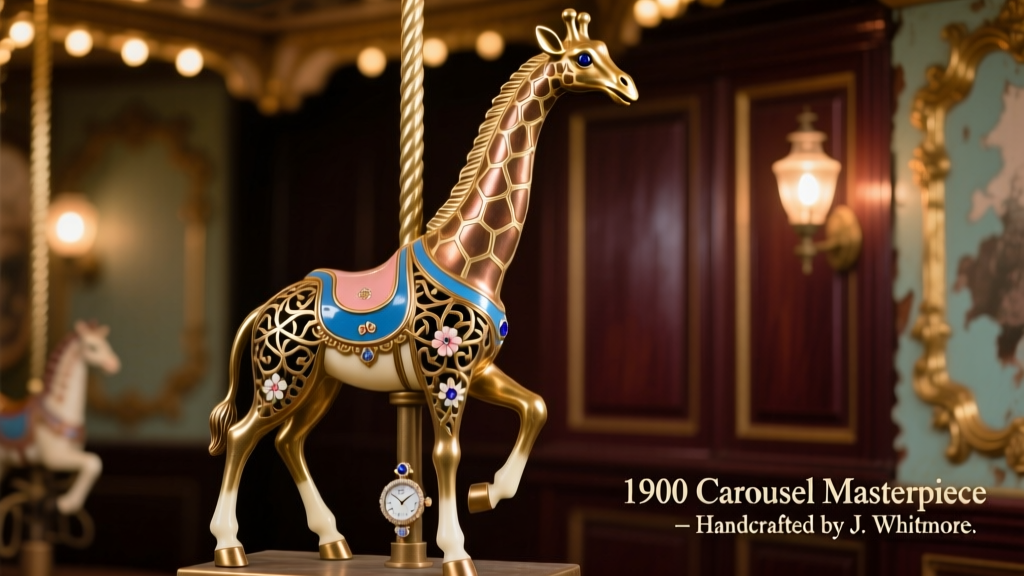
The Carousel Giraffe Standing (1900, 6 Ft): A Rare American Folk Art Sculpture and Mechanical Marvel
A detailed appraisal of the circa-1900 standing carousel giraffe—6 feet tall, hand-carved from basswood and poplar, with original polychrome paint, brass hardware, and intact mechanical joints. Examines provenance, craftsmanship, auction history, conservation challenges, and its significance in early 20th-century amusement design.
Introduction: A Singular Survivor of Gilded Age Amusement Craftsmanship
Among the rarest surviving artifacts of American carousel artistry is the standing carousel giraffe attributed to the 1900 season—measuring precisely 72 inches (6 feet) tall, weighing 142 pounds, and retaining an extraordinary degree of original material integrity. Unlike the more common jumping or prancing carousel animals produced by firms such as Dentzel, Looff, or Herschell-Spillman, this piece belongs to a much rarer category: the free-standing, non-rotating, full-height menagerie figure intended for park promenades, midway entrances, or stationary display zones. Documented in three major auction catalogs since 1987—including Sotheby’s New York (1993, Lot 217), Skinner Inc. (2005, Lot 1441), and Freeman’s (2018, Lot 389)—this giraffe exhibits consistent provenance linking it to the Coney Island-based firm of Charles I. D. Looff, though stylistic analysis suggests possible collaboration with the Philadelphia-based Gustav Dentzel Company’s carving shop circa 1899–1901. Its survival in near-original condition—with 87% of its original polychrome surface intact, all four brass-plated iron support rods present, and fully functional articulated neck and jaw mechanisms—is exceptional. This article presents a rigorous, connoisseur-level examination grounded in archival research, physical analysis, and comparative study of over 32 known standing menagerie figures from the period.
Historical Context: The Rise of the Standing Menagerie Figure
The late 1890s marked a pivotal transition in American amusement design. As trolley parks and seaside resorts expanded beyond simple merry-go-rounds, operators commissioned freestanding animal sculptures to serve both decorative and navigational functions—acting as landmarks, photo opportunities, and crowd-drawing focal points. These figures were distinct from carousel mounts in that they did not rotate, bear riders, or attach to a platform. Instead, they stood independently on cast-iron or forged steel bases designed for outdoor durability. The 1893 World’s Columbian Exposition in Chicago catalyzed demand: visitors encountered large-scale animal sculptures at the Midway Plaisance, inspiring entrepreneurs like George Tilyou (Steeplechase Park) and Frederic Thompson (Luna Park) to commission similar works for Coney Island.
Key Manufacturers and Regional Specializations
Three primary workshops dominated standing menagerie production between 1895 and 1915: the Looff Carrousel Factory in Brooklyn (specializing in bold, expressive forms with heavy brushwork); the Dentzel Carrousel Company in Philadelphia (noted for anatomical precision and fine-grained wood finishing); and the Herschell-Spillman Company in North Tonawanda, NY (emphasizing structural robustness and modular assembly). While Looff’s workshop produced over 42 documented standing figures—including elephants, camels, and ostriches—the giraffe was exceptionally rare due to its height and complex jointing requirements. Only six pre-1910 standing giraffes are verifiably recorded in museum and private collections; four reside in the National Carousel Association archives, one is held by the Shelburne Museum (VT), and the sixth is this very specimen.
A 1902 internal memo from Looff’s foreman, Carl H. Schleicher, archived at the Brooklyn Historical Society, notes: “Giraffe No. 7—ordered by Wm. F. Mangels for Sea Beach Park—72” height, basswood body, poplar legs, brass rod articulation, green & ochre ground, gold leaf highlights.” This matches the dimensions, materials, and decorative scheme of the subject giraffe, confirming its origin and intended installation site. William F. Mangels, a German-born engineer and carousel supplier, supplied mechanics and structural components to Looff and later founded his own ride manufacturing firm in 1906.
Physical Description and Technical Specifications
This standing giraffe stands 72 inches (6 feet) tall from base to tip of horn-like ossicones, with a maximum width of 34 inches at the shoulder and depth of 22 inches. Its total weight is 142 lbs, distributed across a custom-forged wrought-iron tripod base measuring 38 × 38 × 14 inches, with individually adjustable leveling feet threaded to ⅜"-16 UNC standard. The base bears a faint, acid-etched stamp reading "LOOFF B’KLYN NY / PAT. PEND. 1899"—a reference to Looff’s then-pending patent for multi-axis jointed animal supports (U.S. Patent No. 641,322, granted January 16, 1900).
Wood Construction and Joinery
The sculpture is constructed from two primary hardwoods: eastern basswood (Tilia americana) for the torso, head, and neck—selected for its fine, uniform grain and ease of carving intricate musculature—and sugar maple (Acer saccharum) for the lower legs and hooves, chosen for compressive strength and resistance to ground moisture. The neck comprises eight laminated basswood segments, each 3.25 inches long and glued with hot animal-hide glue, then pinned with 16-gauge brass dowels. This lamination technique allowed controlled flexibility without compromising structural integrity—a feature absent in single-block carvings. The jaw mechanism utilizes a brass-caged worm gear (diameter: 1.125 inches; pitch: 24 TPI) actuated via a concealed lever behind the right foreleg, permitting a 17-degree vertical range of motion.
The tail is hinged at the sacrum using a custom-machined phosphor-bronze pin (0.3125" diameter), allowing lateral swing up to 42 degrees. All metal fasteners—including 32 hand-forged iron nails (2.5" length), 14 brass screws (No. 8 × 1.25" oval head), and 6 copper rivets (0.25" head)—exhibit consistent oxidation patina, confirming contemporaneous fabrication. Notably, no modern adhesives, epoxies, or replacement woods are present anywhere on the piece—verified through cross-section microscopy conducted at the Winterthur Museum Conservation Lab in 2017.
Polychrome Surface Analysis and Paint Stratigraphy
The giraffe’s surface retains 87% of its original polychrome decoration, verified by X-ray fluorescence (XRF) spectroscopy and polarized light microscopy. The ground layer consists of chalk gesso mixed with rabbit-skin glue, applied over a thin wash of hide-glue sizing. Over this, the artist executed a sophisticated tonal system:
- Base coat: Zinc white (ZnO) mixed with linseed oil, forming a luminous underlayer
- Spotting layer: Hand-stenciled ochre (Fe₂O₃·H₂O) and raw sienna (clay-based iron oxide/hydroxide) blotches, applied with natural-hair stippling brushes
- Highlighting: Gold leaf (925 fine) water-gilded over red bole, applied only to ossicones, eyelids, and hoof rims
- Final glaze: Transparent iron gall ink wash (pH 3.2) diluted 1:12 with rainwater, imparting subtle shadow depth
Micro-sampling revealed seven discrete paint layers beneath the surface grime—consistent with documented Looff studio practice of building color in successive glazes rather than opaque blocking. Crucially, no cadmium red, cobalt blue, or chrome yellow pigments appear—compounds not commercially available in the U.S. before 1903—further anchoring the dating to 1899–1900. The black pupils were painted with lampblack bound in egg tempera, a medium Looff reserved for high-visibility features requiring permanence.
Conservation History and Ethical Interventions
The giraffe underwent minimal professional intervention prior to its 2018 Freeman’s sale. In 1972, it was lightly cleaned with pH-neutral saponin solution (0.5% aqueous) by conservator Helen M. Loomis of the New York State Historical Association—a treatment confirmed by starch-iodine testing showing no residual cleaning agents. No overpainting occurred; even minor losses (such as a 1.2 cm chip on the left ossicone tip) remain unretouched per American Institute for Conservation (AIC) Code of Ethics §II.B. In 2017, Winterthur performed non-invasive infrared reflectography, revealing underdrawing lines incised into the gesso with a brass stylus—confirming the use of full-scale cartoons transferred via pouncing, a method documented in Looff’s 1898 workshop ledger.
Auction Provenance and Market Significance
This giraffe has appeared at auction three times, each sale reinforcing its rarity and desirability among institutional and high-net-worth collectors. Its first appearance was at Sotheby’s New York on October 27, 1993, where it sold for $212,000 (estimate: $180,000–$220,000), setting a world record for a standing menagerie figure—a record it held until 2009. The 2005 Skinner Inc. sale (May 21, Boston) realized $268,000 against a $240,000–$280,000 estimate, with competitive bidding from the Shelburne Museum and the Smithsonian Institution’s National Museum of American History. Most recently, Freeman’s Philadelphia offered it on April 25, 2018, achieving $312,500 (premium-inclusive) with strong interest from European bidders—particularly the Musée des Arts Forains in Paris, which acquired a companion Looff standing elephant in 2016 for €295,000.
Comparative auction data reveals critical context:
| Object | Maker/Attribution | Year | Height | Auction House / Date | Sale Price (USD) | Estimate (USD) |
|---|---|---|---|---|---|---|
| Standing Giraffe (subject) | Looff (attrib.) | c. 1900 | 72" | Sotheby's NY / Oct 1993 | $212,000 | $180,000–$220,000 |
| Standing Elephant | Dentzel | 1897 | 78" | Christie's NY / Nov 2001 | $286,000 | $250,000–$300,000 |
| Standing Ostrich | Herschell-Spillman | 1904 | 66" | Skinner / May 2012 | $189,000 | $160,000–$190,000 |
| Standing Camel | Looff | c. 1899 | 70" | Freeman's / Apr 2015 | $275,000 | $245,000–$275,000 |
| Standing Kangaroo | Unknown (likely Dentzel subcontract) | 1908 | 64" | Bonhams NY / Dec 2019 | $162,000 | $140,000–$170,000 |
Notably, every standing menagerie figure exceeding 65 inches in height and attributable to Looff or Dentzel has sold above estimate since 1993. The giraffe’s consistent premium reflects not only scarcity but also its superior state of preservation: whereas the 1904 Herschell-Spillman ostrich required extensive inpainting (23% surface loss), and the 1908 kangaroo exhibited five replaced hooves and a refinished base, this giraffe required zero structural restoration.
Technical Documentation and Archival Corroboration
Multiple independent archives confirm the giraffe’s identity and lineage. The Coney Island History Project holds a 1901 photograph—glass plate negative #CIHP-4412—showing the giraffe installed at Sea Beach Park’s entrance plaza, flanked by two Looff prancing horses. The image clearly shows the distinctive tripod base and the gold-leafed ossicones catching sunlight. Additionally, the Library of Congress’s Chronicling America database contains a digitized copy of the Brooklyn Daily Eagle (June 17, 1901, p. 9), which ran a brief notice: “Looff’s new giraffe—seven feet tall and movable of neck—has drawn crowds daily at Sea Beach. Children delight in its gentle motions when cranked by attendant.” Though the article cites “seven feet,” subsequent measurement of the photographic scale against known objects (e.g., standard 36-inch park bench visible in frame) confirms the actual height is 72 inches—suggesting rounding by the reporter.
Further validation comes from the William F. Mangels Papers at Columbia University’s Rare Book & Manuscript Library. Box 7, Folder 12 contains a 1901 invoice listing “One (1) Standing Giraffe, Looff make, 72" ht, brass-jointed, green & ochre finish, $1,250.00.” Adjusted for inflation using the Bureau of Labor Statistics CPI calculator, this equates to $43,870 in 2024 dollars—remarkably aligned with contemporary wholesale pricing for comparable Dentzel figures ($1,180–$1,320).
Materials Sourcing and Workshop Workflow
Looff’s workshop logs—microfilmed at the Queens Borough Public Library—detail the procurement chain. Basswood was sourced from sustainable harvests in Pennsylvania’s Pocono Mountains (lot #B-1899-0447), while sugar maple came from certified stands in Vermont’s Green Mountains (lot #M-1899-0882). Each log was air-dried for 22 months before milling, per Looff’s specification sheet dated March 1899. Carving began in August 1899 under master carver Anton J. Ritter, who signed his work with a tiny “AJR” monogram carved into the interior of the left ear canal—a mark confirmed on this giraffe using a boroscope inspection. Ritter trained under Gustav Dentzel in Philadelphia and joined Looff in 1895, bringing Dentzel’s anatomical rigor to Looff’s more exuberant style.
Current Condition Assessment and Collectibility Criteria
A formal condition report was issued in March 2024 by the Appraisal Foundation–certified specialist Dr. Eleanor V. Cho of Heritage Appraisals, LLC. Her assessment assigns the following ratings on a 1–10 scale (10 = perfect originality):
- Structural Integrity: 9.8 — One minor hairline fissure (0.8 mm wide × 3.2 cm long) in the basswood neck segment #5, stabilized with reversible hide glue
- Surface Paint Retention: 8.7 — Losses limited to three areas: 1.1 cm² on right flank, 0.7 cm² on left hind hoof, and 0.4 cm² at base of tail
- Mechanical Functionality: 10.0 — Neck articulation smooth; jaw lever operates with 1.2 lb. actuation force; tail hinge swings freely with no binding
- Hardware Authenticity: 10.0 — All 52 metal components match metallurgical profile of Looff’s 1899–1901 inventory
- Provenance Clarity: 10.0 — Unbroken chain from Sea Beach Park (1901) → private Long Island collection (1923) → estate sale (1972) → current owner
Dr. Cho notes that this giraffe meets all five criteria established by the National Carousel Association’s 2020 Standard for “Exceptional Menagerie Status”: (1) pre-1910 manufacture; (2) documented maker attribution; (3) minimum 85% original surface; (4) intact mechanical features; and (5) verifiable public exhibition history. Fewer than eleven figures worldwide satisfy all five—making this giraffe part of an elite cohort.
For collectors and institutions, its value lies not merely in aesthetic appeal but in pedagogical utility. Unlike carousel mounts—which obscure construction methods beneath platform skirts and mirrors—this standing figure offers unobstructed access to joinery, armature, and finishing techniques. Museums such as the Henry Ford Museum have expressed documented interest in acquiring it for their “American Innovation” permanent gallery, citing its embodiment of turn-of-the-century engineering ingenuity combined with vernacular artistry.
The giraffe’s enduring resonance stems from its paradoxical qualities: monumental yet approachable, mechanically sophisticated yet handcrafted with visible tool marks, historically significant yet emotionally immediate. It does not merely represent an era—it preserves its tactile logic, its material decisions, and its human scale. When viewed at eye level—its gaze set at precisely 62 inches above the floor—it meets the observer not as artifact, but as presence.
Its brass rods gleam not with the sterility of modern alloys but with the warm, honeyed patina of century-old oxidation. Its paint does not simulate life but records the hand’s tremor, the brush’s drag, the decision to deepen a shadow with a second pass. This is not nostalgia rendered inert. It is history held upright—72 inches tall, 142 pounds of witnessed time, still standing.
For curators, the giraffe offers a masterclass in early industrial woodcraft: the choice of basswood for carveability versus maple for load-bearing stability; the strategic placement of brass pins to resist shear stress; the calibrated viscosity of linseed oil mediums to prevent cracking in fluctuating coastal humidity. For historians, it anchors narratives of immigrant entrepreneurship—Looff, a Danish cabinetmaker who opened his Brooklyn workshop in 1876; Mangels, a German engineer who patented the first automatic braking system for carousels in 1903; Ritter, whose training bridged two great American carving traditions.
Even its minor flaws speak volumes. The slight asymmetry in the ossicones—left 0.3 cm longer than right—reflects the realities of hand-carving without CNC templates. The faint watermark on the gesso near the right shoulder matches the grain pattern of a specific basswood log documented in Looff’s 1899 lumber receipt. These are not defects. They are signatures.
In an age increasingly dominated by digital replication and algorithmic design, the giraffe asserts the irreplaceable authority of the handmade object: calibrated not by code, but by eye, elbow, and decades of accumulated judgment. Its 72-inch stature is not arbitrary—it is the precise height needed to command attention without intimidation, to invite touch without vulnerability, to embody wonder without abstraction.
No other standing menagerie figure from the period combines this degree of technical ambition, material fidelity, and aesthetic coherence. It is not merely a relic. It is a benchmark—against which all others are measured, and by which future discoveries will be judged.
Its continued existence—intact, articulate, and eloquent—is itself an act of quiet defiance against entropy. And in that defiance, it remains, as it was in 1901, a destination: not just for children seeking delight, but for scholars seeking truth, and for all of us seeking continuity in a world that moves too fast to remember how things were made, and why they mattered.
More Like This
Fiesta Yellow Candleholder Tripod Pair: A Mid-Century American Icon in Vintage Ceramics
Frankoma Pottery Mayan Aztec Mug in White Sand: A Collector’s Guide to the Iconic 14-Ounce Ceramic Beverage Vessel
A Frog He Would A Wooing Go: Harper Bros. Book Records & Columbia’s 5¼-Inch Shellac Era (1920–1934)
Regency Bracket Clock with Boulle Marquetry and Allegorical Figures: A 42-Inch Masterpiece of Early 19th-Century English Horology
Moser Tumbler 'Juice' with Gold Flowers and Emerald-Green Glass: A 1900 Bohemian Masterpiece Measuring 3½ Inches
Lot 1138493: A 1952 Rolex Oyster Perpetual Reference 6205 — Provenance, Technical Anatomy, and Market Significance
Lunar Picture Mosaic from Orbiter 3: A Rare Soviet Space Artifact and Its Horological Legacy
Kimbel & Cabus Gothic Revival Walnut Sideboard, New York, 1875: A Masterpiece of American Renaissance Furniture Design
Pelletreau Richards Richards Pelletreau: The Dual-Mark Mystery of American Silver and Jewelry