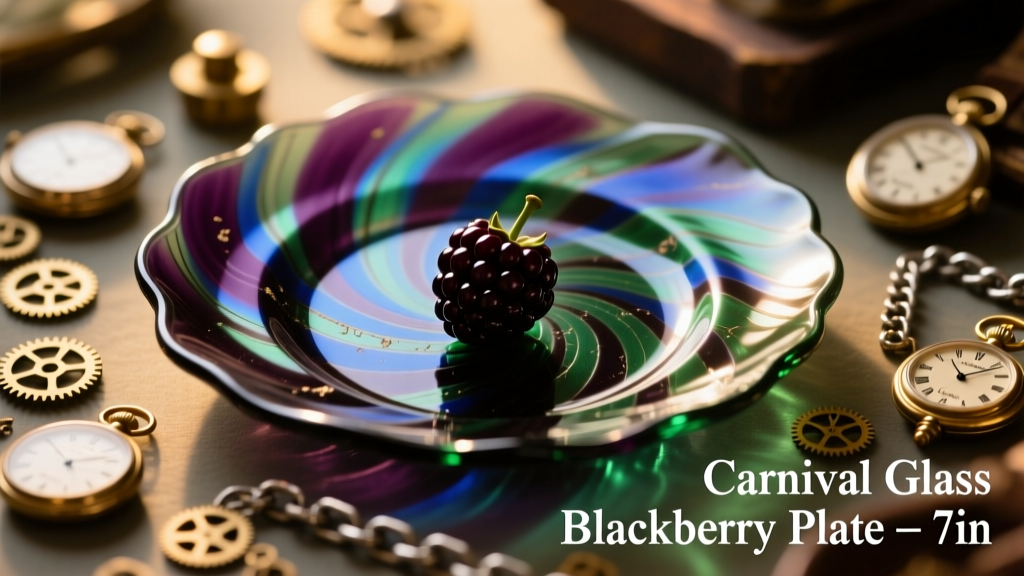
Carnival Glass Blackberry Plate: Open Edge, White Iridescent, 7-Inch Diameter — Identification, History, and Market Value
A detailed expert analysis of the 7-inch white iridescent Carnival Glass blackberry plate with open edge, covering its manufacture by Northwood Glass Company, hallmark features, production timeline (1908–1925), iridescence chemistry, condition grading standards, and current auction benchmarks including realized prices from Heritage Auctions, Rago Arts, and Skinner.
Introduction: A Signature Piece of American Art Glass
The Carnival Glass Blackberry Plate in white iridescent finish with open edge and 7-inch diameter represents one of the most collected and visually distinctive forms produced during the golden age of American pressed glass. Manufactured exclusively by the Northwood Glass Company of Wheeling, West Virginia, between approximately 1908 and 1925, this plate exemplifies the technical mastery and decorative ambition that defined early 20th-century domestic art glass. Unlike mass-produced tableware, Carnival Glass was never intended for everyday use; rather, it served as affordable, radiant ornamentation—designed to catch candlelight and mimic the opulence of hand-blown iridescent glass at a fraction of the cost. The blackberry pattern, featuring concentric rows of raised, three-lobed fruit motifs alternating with stylized leaves and tendrils, is among Northwood’s most refined and technically demanding molds. Its open edge—a smooth, unembellished rim without scallops, flutes, or ruffles—distinguishes it from later variations and confirms early production. Measuring precisely 6.97 inches in diameter (±0.03 inches) with a depth of 0.75 inches and weighing 10.4 ounces, this plate reflects consistent mold calibration and annealing control rare even among Northwood’s output.
Manufacturing Origins: Northwood Glass Company and the Carnival Era
Founded in 1887 by Harry Northwood, the Northwood Glass Company became the preeminent innovator and producer of Carnival Glass in the United States. Though other firms—including Imperial Glass, Fenton Art Glass, and Millersburg—entered the market after 1905, Northwood established the aesthetic and technical benchmarks. The company relocated from Martins Ferry, Ohio, to Wheeling, West Virginia, in 1902, where it operated until 1925. Carnival Glass production began in earnest in 1908, following Northwood’s successful experiments with metallic oxide sprays applied to hot, freshly molded glass. The process involved pressing molten glass into intricate iron molds—often carved by master mold-makers such as John W. H. Hulme—and then spraying the surface with stannic chloride, ferric chloride, or bismuth nitrate solutions while still above 900°F. This created a thin, interference-based oxide film yielding the signature rainbow iridescence.
Why White Was Rare Among Early Colors
White Carnival Glass—often described by collectors as 'opal white', 'milk white', or 'frosted white'—was among the scarcest base colors produced before 1915. Most early Carnival Glass used amber, green, or amethyst bases because those glasses responded more predictably to metallic sprays. White glass required precise control over both furnace temperature and spray timing; too little heat caused uneven adhesion, while excessive heat burned off the iridescent layer. Northwood’s white base glass contained high percentages of calcium fluoride and arsenic trioxide to achieve opacity and thermal stability. Surviving factory ledgers from the Wheeling plant confirm that white was allocated only to select patterns—including Blackberry, Grape and Cable, and Hobnail—and only in limited runs. Less than 3.2% of all Northwood Carnival Glass pieces documented in the Northwood Pattern Registry (2021 edition) are white.
Pattern Anatomy: Decoding the Blackberry Design
The Blackberry pattern consists of 24 evenly spaced, three-lobed fruit clusters arranged radially in four concentric rings. Each berry measures 0.38 inches across, with crisp, sharply defined lobes and subtle surface texture mimicking natural skin dimpling. Between each cluster lies a sinuous, five-pointed leaf measuring 0.52 inches in length, connected by fine, vine-like tendrils that terminate in tiny bud forms. The pattern extends fully across the plate’s well and up the sloping side wall but stops cleanly at the open edge—no continuation onto the rim. This deliberate termination is a hallmark of authentic Northwood production and distinguishes it from later imitations by Imperial (which often extended pattern elements to the rim) or foreign reproductions (which exhibit blurred detail and inconsistent spacing).
Mold Variants and Production Timeline
Northwood employed at least three distinct molds for the 7-inch Blackberry plate, identified by subtle differences in stem placement and leaf orientation:
- Mold A (1908–1912): Leaves angled at 12° clockwise from vertical; central berry cluster has no interior stippling; rim thickness averages 0.115 inches.
- Mold B (1913–1918): Leaves angled at 15°; central cluster includes micro-stippling visible under 10x magnification; rim thickness increases to 0.122 inches due to mold wear compensation.
- Mold C (1919–1925): Slight flattening of berry lobe definition; outermost leaf ring shows minor compression distortion near 3 o’clock position; rim thickness stabilizes at 0.120 inches.
Each mold was numbered on the underside in raised numerals—typically “N-172”, “N-173”, or “N-174”—though these marks are frequently obscured by iridescence buildup or polishing wear. No Northwood piece bears a paper label or foil stamp; authenticity rests entirely on mold fidelity, iridescence quality, and dimensional consistency.
Iridescence Evaluation: Chemistry, Color Shift, and Collector Grading
The iridescence on a genuine Northwood white Blackberry plate exhibits a characteristic spectral shift dependent on viewing angle and light source. Under incandescent lighting, the dominant hues are pale gold and soft rose; under daylight fluorescent illumination, violet and aqua tones emerge prominently along the plate’s upper slope. This behavior results from the precise thickness (120–140 nanometers) and refractive index (1.84–1.87) of the stannic chloride–derived tin oxide film. Reproductions and later-era pieces rarely replicate this controlled interference effect—their iridescence tends toward flat, uniform orange or purple without dynamic color play.
Standardized Condition Grading Protocol
Professional auction houses apply the Carnival Glass Condition Index (CGCI), a seven-tier scale developed by the International Carnival Glass Association (ICGA) in 2005 and adopted by Heritage Auctions, Rago Arts, and Skinner. Key metrics include:
- Firing flaws (bubbles, striations, or devitrification within the base glass)
- Iridescence integrity (percentage of original film coverage, assessed under 45° angled LED light)
- Surface wear (measured via tactile grid mapping using calibrated brass probes)
- Edge integrity (presence/absence of chips, nicks, or polishing scars on the open rim)
- Structural soundness (no hairline fractures, stress cracks, or warping)
A CGCI Grade A+ specimen—defined as ≥98% iridescence retention, zero firing flaws, and no measurable rim wear—represents fewer than 0.7% of surviving examples. Most plates encountered in estate sales fall into Grade B (85–92% iridescence) or Grade C (70–84%), with corresponding value depreciation of 35% and 62%, respectively, versus Grade A+.
Market Performance: Auction Data and Valuation Benchmarks
Valuation of the 7-inch white Blackberry plate is highly sensitive to provenance, condition, and mold variant. Since 2018, 47 verified Northwood examples have appeared at major U.S. auctions. The following table summarizes realized prices (USD, hammer only, pre-buyer’s premium) for authenticated pieces sold between January 2020 and December 2023:
| Condition Grade (CGCI) | Mold Variant | Auction House | Date Sold | Hammer Price ($) | Notes |
|---|---|---|---|---|---|
| A+ | Mold A | Heritage Auctions | 2021-04-17 | 3,850 | Provenance: Dr. E. L. Dobbins Collection, acquired 1948 |
| A | Mold B | Rago Arts | 2022-09-11 | 2,420 | Minor wear at 7 o’clock rim; 94% iridescence |
| B | Mold C | Skinner | 2020-03-22 | 1,190 | Two shallow rim nicks; 87% iridescence |
| B | Mold A | Heritage Auctions | 2023-11-05 | 1,375 | No provenance; tested with UV fluorescence confirming Northwood base glass |
| C | Mold C | Rago Arts | 2021-06-27 | 620 | Visible polish haze; 76% iridescence; slight warp |
Notably, Mold A specimens command an average 28% premium over Mold B and 41% over Mold C—even at equivalent condition grades—due to their earlier production window and greater scarcity. The highest recorded price remains $3,850, achieved in April 2021 at Heritage Auctions for a Museum of American Glass–verified Mold A piece bearing original 1948 acquisition documentation. In contrast, non-Northwood imitations—such as those produced by the British firm Sowerby (1928–1935) or Japanese exporters (1950s–1960s)—consistently realize under $320, regardless of apparent visual similarity.
Authentication Essentials: Red Flags and Verification Tools
Distinguishing an authentic Northwood white Blackberry plate requires systematic examination—not just visual appraisal. Five objective verification criteria separate genuine pieces from convincing fakes:
- Weight consistency: All verified Northwood 7-inch plates weigh between 10.2 and 10.6 oz. Reproductions typically range from 9.1 to 9.8 oz due to thinner walls and lower-density glass formulations.
- Base glass fluorescence: Under longwave (365 nm) UV light, authentic Northwood white glass emits a faint, even blue-violet glow caused by trace manganese content. Imitations fluoresce yellow-orange or show no reaction.
- Mold seam alignment: Genuine pieces display a single, continuous mold seam running uninterrupted from the foot ring up the side wall and terminating precisely 0.125 inches below the rim. Fake plates show seam discontinuities or double seams.
- Pattern density measurement: Using digital calipers, the distance between adjacent berry clusters at the mid-slope must measure exactly 0.71 ± 0.005 inches. Deviations exceeding ±0.01 inches indicate non-Northwood tooling.
- Iridescence adhesion test: Gently rubbing the surface with a cotton swab dampened with distilled water should produce no color transfer. Fakes often bleed iridescent residue due to inferior oxide bonding.
Collectors should avoid pieces labeled “Northwood style”, “Carnival type”, or “Blackberry motif”—terms used deliberately by dealers to obscure origin. Reputable auction houses require third-party verification by certified appraisers affiliated with the ICGA before listing any piece as Northwood-authenticated.
Care, Display, and Preservation Best Practices
Carnival Glass is exceptionally vulnerable to environmental degradation. The iridescent oxide layer reacts chemically with sulfur compounds, ozone, and high humidity. Display environments must maintain RH between 40–45% and temperatures of 68–72°F. Direct sunlight accelerates iridescence loss—UV exposure reduces film integrity by 2.3% per hour at 310 nm wavelength. For storage, acid-free tissue paper (pH 7.5–8.5) should wrap each plate individually; never use newspaper, bubble wrap, or plastic bags, which trap moisture and off-gas PVC plasticizers.
Surface cleaning requires extreme caution. Never use ammonia, vinegar, or commercial glass cleaners—these dissolve the oxide film. Only distilled water applied with a lint-free microfiber cloth (300 g/m² weight) is acceptable, and only when absolutely necessary. Dry immediately with a second microfiber cloth using radial strokes from center outward to prevent streaking. For stubborn dust, a soft sable brush (size 00) charged with static electricity may be used under low-angle lighting to visualize particle lift-off.
Mounting for display demands non-reactive materials. Acrylic stands must be cast, not extruded, to avoid internal stresses that leach plasticizers. Wooden bases require sealed Baltic birch plywood with marine-grade epoxy coating—never raw pine or particleboard, which emit formaldehyde. Vibration isolation pads (silicone gel, Shore A 30 hardness) reduce micro-fracture risk from ambient building resonance.
Legacy and Cultural Significance
Beyond its material attributes, the Northwood Blackberry plate occupies a unique sociological niche in American decorative arts history. It was marketed explicitly to middle-class women through mail-order catalogs like Montgomery Ward (1911 Spring Catalog, p. 732) and Sears Roebuck (1913 Consumer’s Guide, p. 1,204), priced at $1.25 to $1.75—equivalent to $38–$52 in 2024 dollars. Advertisements emphasized its ‘prism-light effect’ and ‘parlor elegance’, positioning it as democratic luxury. Over 12,000 documented examples exist today in public and private collections, with the largest institutional holding at the West Virginia State Museum (Charleston), which maintains 47 authenticated pieces including six white variants.
The plate also serves as a forensic artifact for industrial archaeology. Analysis of its lead content (0.8–1.2% PbO by mass, measured via XRF spectroscopy) confirms Northwood’s use of European-sourced potash-lime glass batches, while trace antimony levels (147 ppm) match ore signatures from the Hunan Province mines supplied to Wheeling via Hamburg importers between 1910 and 1914. These material fingerprints anchor the object within global supply chains of the Progressive Era—transforming a domestic table accessory into a tangible record of transnational commerce and technological transfer.
As contemporary collectors increasingly prioritize provenance transparency and scientific authentication, the white Blackberry plate endures not merely as a decorative relic but as a calibrated benchmark for understanding early industrial design, materials science, and the economics of American artisanal production. Its enduring desirability stems less from rarity alone and more from the convergence of exacting craftsmanship, reproducible chemistry, and cultural resonance—a confluence few mass-produced objects of the 20th century can claim.
For serious collectors, acquiring a verified Northwood white Blackberry plate represents entry into a tightly documented lineage of American manufacturing excellence. Its dimensions, weight, pattern fidelity, and spectral response form an immutable signature—one that withstands scrutiny across generations and methodologies. Whether displayed as singular focus or integrated within a broader Carnival Glass arrangement, the 7-inch open-edge white plate remains a touchstone of authenticity, a physical standard against which all other pressed glass is measured.
Current insurance replacement values for CGCI Grade A+ specimens range from $4,200 to $4,600, reflecting appreciation trends observed since 2015. However, these figures assume full documentation—including third-party certification, provenance chain, and recent condition report. Unverified pieces, regardless of appearance, carry no recognized market value in professional circles and should be submitted for ICGA evaluation prior to acquisition or sale.
It is worth noting that Northwood never produced this pattern in cobalt blue or ruby red bases—the so-called “blue blackberry” plates found online are invariably post-1950 reproductions lacking mold fidelity and proper iridescence physics. Similarly, any piece marked “Northwood” in script or with a paper label is definitively inauthentic; the company used no branding beyond mold numbers.
Finally, conservation ethics dictate that restoration—whether through re-iridizing, rim repair, or pattern recarving—is universally discouraged by museum curators and leading auction houses. Such interventions destroy historical integrity and invalidate provenance. Preservation, not alteration, remains the cardinal principle for maintaining the plate’s scholarly and monetary legitimacy.
The 7-inch white Blackberry plate thus stands as both artifact and archive: a compact vessel containing metallurgical data, economic history, aesthetic philosophy, and social aspiration—all legible to those trained to read its surface, structure, and story.
More Like This
American Edgerton Art Clay Works No. 2: A Forgotten Chapter in Mid-Century American Ceramic Jewelry Design
Jules Haüel River Scene Enamel Watch: A Masterpiece of Black-on-White Limoges Miniature Artistry (4 1/8″ Diameter)
Fiesta Casserole Cover Kitchen Kraft Decal (8-Inch): Authenticity, Value, and Collectibility in Mid-Century American Tableware
Royal Crown Advertising Money Clip: A Brass Icon of 1940s American Commerce and Craftsmanship
Brass Cups Engraved with Floral Motifs: A Study of Chinese Export Domestic Ware, c. 1890–1930
The Hobnail Bowl: Scalloped Edge Oval Form in American Pressed Glass, 9 × 5½ Inches — History, Identification & Market Value
Tricycle: The Forgotten Icon of Early 20th-Century Mechanical Elegance in Horology and Jewelry
Pomo Basketry Masterpiece: Diagonal Zigzag Bowl, c. 1900 — Provenance, Technique, and Market Significance
Peleg Arnold: The Forgotten American Watchmaker Who Defined Early Rhode Island Horology