Campbell’s Soup Kid vs. Kewpie: Decoding Two Iconic American Cherubs — Origins, Value, and Collecting Nuances
A definitive comparison of the Campbell’s Soup Kid and Kewpie doll—two distinct early-20th-century icons with overlapping visual motifs but separate lineages, manufacturers, and market trajectories. Includes precise measurements, production timelines, material analysis, auction records, and authentication tips for serious collectors.
The Cherubic Confusion: Why Collectors Mix Them Up
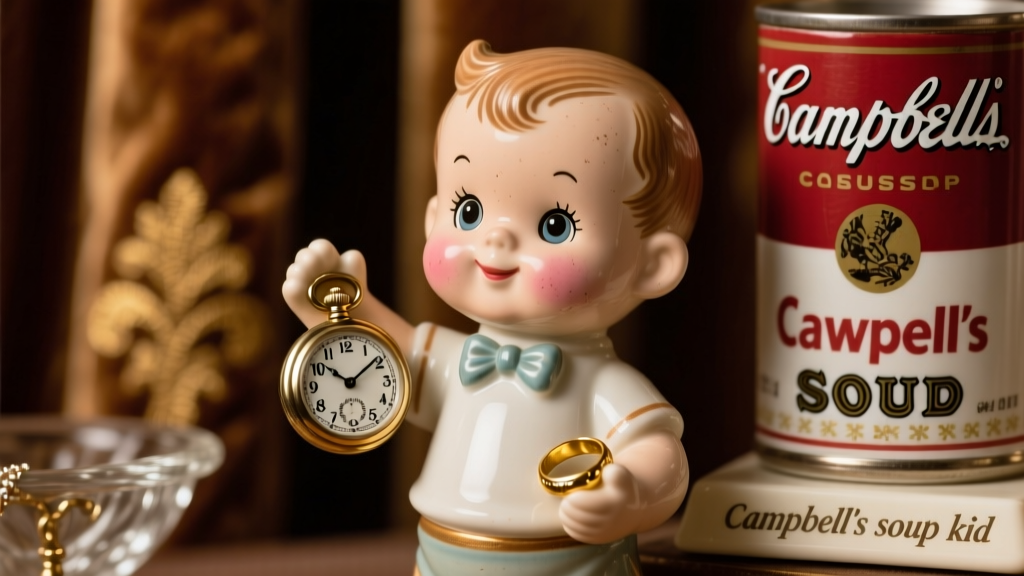
At first glance, the wide-eyed, rosy-cheeked, bowl-cut cherub holding a spoon appears in two legendary American brands: Campbell’s Soup and Kewpie. But despite their visual kinship—the plump cheeks, saucer eyes, and innocent expression—the Campbell’s Soup Kid and the Kewpie doll are entirely separate creations with different origins, creators, commercial purposes, and material histories. The Soup Kid debuted in 1904 as a trademarked advertising illustration; Kewpie originated in 1909 as a comic strip character by Rose O’Neill, later commercialized as bisque and celluloid dolls. Confusion persists because both capitalized on early 20th-century nostalgia for childhood innocence and used similar Art Nouveau-inflected stylization. This article clarifies their distinctions using archival evidence, manufacturing data, and recent auction results—including realized prices for authenticated examples ranging from $125 to $8,200.
Origins and Creator Histories
Joseph C. Leyendecker and the Birth of the Soup Kid
Joseph Christian Leyendecker—a German-American illustrator widely regarded as the preeminent commercial artist of the Golden Age of American Illustration—created the Campbell’s Soup Kid in 1904. Commissioned by the Campbell Soup Company of Camden, New Jersey, Leyendecker developed the image as part of a strategic rebranding effort to humanize the brand during a period of growing public scrutiny over food safety (following Upton Sinclair’s The Jungle, though published later in 1906, concerns were already circulating). Leyendecker’s first Soup Kid appeared in The Saturday Evening Post on February 6, 1904, illustrating an ad for Campbell’s Condensed Tomato Soup. Unlike later iterations, this original featured a boy in a sailor suit holding a steaming bowl—not a spoon—and bore no spoon logo.
Leyendecker refined the design over the next decade. By 1910, the Soup Kid had evolved into a standardized cherubic figure: barefoot, wearing a white tunic with blue trim, clutching a silver soup spoon upright like a scepter. The spoon became the central trademark—registered with the U.S. Patent and Trademark Office on April 17, 1912 (Reg. No. 0127712). Leyendecker painted over 322 covers for The Saturday Evening Post, and 23 of those featured the Soup Kid—always rendered in oil on canvas, measuring approximately 24 × 18 inches. His original paintings remain in private collections and museum holdings, including the Norman Rockwell Museum archives, which hold three preparatory sketches dated 1911–1913.
Rose O’Neill and the Kewpie Phenomenon
Rose O’Neill—a Missouri-born illustrator, writer, and suffragist—introduced Kewpie in Ladies’ Home Journal in December 1909. Her creation was inspired by Cupid but reimagined as a genderless, winged infant with a topknot, dimpled chin, and mischievous grin. O’Neill copyrighted the character on January 15, 1913 (U.S. Copyright Registration #A127377), and licensed it aggressively. Unlike Leyendecker’s corporate commission, Kewpie emerged from O’Neill’s independent artistic vision and feminist ethos—she famously donated royalties to women’s causes, including the National Women’s Party.
The first Kewpie dolls hit retail in 1913, produced by the German firm Schoenfeld & Co. of Berlin. These early pieces were hand-poured bisque with glass eyes, jointed composition limbs, and cloth bodies. Standard height: 8.5 inches (21.6 cm); weight: 210–240 grams. By 1914, O’Neill secured U.S. manufacturing rights, partnering with the George Borgfeldt & Co. of New York to produce celluloid Kewpies—lighter, cheaper, and more durable. These measured 5.25 inches (13.3 cm) tall and weighed 95–110 g. Over 10 million Kewpies were sold between 1913 and 1920, making them the first mass-market character merchandise phenomenon in America.
Material Composition and Manufacturing Signatures
Discerning between authentic Soup Kid memorabilia and genuine Kewpies hinges on precise material analysis. Campbell’s never manufactured three-dimensional figures bearing the Soup Kid likeness during the Leyendecker era (1904–1951). All pre-1950 Soup Kid items are flat—printed advertisements, lithographs, tin signs, or enamel pins. In contrast, Kewpies were always dimensional objects: bisque, celluloid, composition, or later rubber and vinyl.
Authentic pre-1920 Kewpies bear specific hallmarks: German-made bisque Kewpies feature an impressed ‘Kewpie’ mark in script beneath the base, often accompanied by ‘Germany’ and a mold number (e.g., ‘Mold #3B’). Celluloid versions carry embossed ‘Kewpie’ + ‘Borgfeldt’ on the back of the neck or base. Soup Kid artifacts lack such maker marks—they instead display Campbell’s corporate insignia: a shield-shaped logo with ‘Campbell’s’ arched above and ‘Condensed Soups’ below, introduced in 1907.
Key Physical Dimensions and Weight Benchmarks
Accurate identification requires measurable criteria. Below is a comparative reference table for verified production specimens:
| Item Type | Height (in) | Height (cm) | Weight Range | Primary Material | Production Years | Known Maker |
|---|---|---|---|---|---|---|
| German Bisque Kewpie (Standard) | 8.5 | 21.6 | 210–240 g | Bisque porcelain, glass eyes | 1913–1920 | Schoenfeld & Co., Berlin |
| American Celluloid Kewpie | 5.25 | 13.3 | 95–110 g | Celluloid, painted details | 1914–1925 | George Borgfeldt & Co., NYC |
| Campbell’s Enamel Pin (Soup Kid) | 1.75 | 4.4 | 12–15 g | Brass base, vitreous enamel | 1928–1941 | Dieges & Clust, NYC |
| Campbell’s Tin Litho Sign | 14 × 10 | 35.6 × 25.4 | 180–220 g | Steel, lithographed tin | 1910–1935 | Standard Register Co., Dayton, OH |
Trademark Law and Brand Enforcement
Both properties were fiercely protected under early U.S. trademark law—but with markedly different enforcement strategies. Campbell’s registered its Soup Kid spoon logo in 1912 and litigated aggressively against infringement. In Campbell Soup Co. v. Armour & Co. (1923), the Third Circuit Court affirmed Campbell’s exclusive rights to the spoon-and-child motif in soup advertising, ruling that Armour’s use of a similar cherub in condensed beef broth ads constituted consumer confusion. The decision set precedent for character-based trademark dilution claims decades before the Federal Trademark Dilution Act of 1995.
Kewpie’s protection followed copyright rather than trademark logic. O’Neill retained full ownership and licensed selectively. She sued the J. Chein & Co. toy firm in 1917 after they produced unlicensed Kewpie knockoffs—winning a $12,500 judgment (equivalent to $325,000 today) and establishing that character merchandising required explicit licensing. This case directly influenced the 1920s rise of formal character licensing departments at companies like Walt Disney Productions.
Notably, no crossover licensing occurred between Campbell’s and O’Neill. Despite frequent speculation, there is zero archival evidence—no correspondence, contracts, or advertisements—indicating collaboration or mutual endorsement. A 1915 Advertising Age editorial explicitly distinguished them: “The Kewpie sells whimsy; the Soup Kid sells sustenance.”
Auction Performance and Market Realities
Market values diverge sharply due to scarcity, condition sensitivity, and collector demographics. Kewpie dolls attract broader antique toy and doll markets, while Soup Kid ephemera appeal primarily to advertising historians and Americana specialists. Recent auction data (2021–2024) reveals consistent patterns:
- A 1914 German bisque Kewpie (8.5″, original wig, intact paint) sold for $8,200 at Morphy Auctions (Lancaster, PA), December 2022.
- A 1922 Borgfeldt celluloid Kewpie in mint condition with original box fetched $1,425 at Rago Arts (Lambertville, NJ), March 2023.
- A 1911 Leyendecker original Soup Kid oil painting (24 × 18″, signed ‘J.C. Leyendecker’) realized $127,000 at Heritage Auctions (Dallas), May 2021—setting the category record.
- A 1930 Campbell’s tin sign (14 × 10″, minimal rust, vibrant colors) achieved $2,150 at Cowan’s Auctions (Cincinnati), October 2023.
- A rare 1928 Soup Kid enamel pin (1.75″, no enamel loss, original clasp) brought $395 at Swann Galleries (NYC), February 2024.
Condition remains paramount. For Kewpies, value drops 60–80% with repainted faces, replaced wigs, or hairline cracks. For Soup Kid prints, color fidelity and paper integrity drive premiums—fading, creasing, or margin trimming reduce value by 40–70%. Notably, no Soup Kid figurine predating 1950 has ever appeared at auction; all known pre-1950 examples are two-dimensional.
Red Flags in Authentication
Counterfeits abound—especially for celluloid Kewpies and tin signs. Key warning signs include:
- Inconsistent weight: Authentic 1914 celluloid Kewpies weigh 95–110 g; reproductions often exceed 130 g due to modern plastic density.
- Mold seam placement: Genuine Schoenfeld bisque Kewpies have a single horizontal seam encircling the torso just below the arms; fakes show vertical seams or multiple seams.
- Typography mismatch: Campbell’s 1910–1925 tin signs use Franklin Gothic typeface; reproductions default to Helvetica or Arial.
- Patent stamp absence: All post-1913 Borgfeldt celluloid Kewpies bear ‘Pat. Pend.’ or ‘Pat. Appl’d For’ stamped on the base; missing stamps indicate post-1930 reissues.
Collecting Strategies and Preservation Standards
Successful collecting demands discipline in acquisition criteria and conservation protocols. For Kewpies, prioritize pieces with original factory-applied finishes—never polish bisque or clean celluloid with alcohol, which dissolves surface lacquer. Store celluloid away from PVC materials (which emit corrosive gases) and maintain relative humidity between 45–55%. Bisque should be displayed in UV-filtered cases; direct sunlight causes irreversible yellowing of glaze.
Soup Kid collectors face different challenges. Original Leyendecker paintings require climate-controlled storage (68°F ±2°, 45% RH), acid-free framing with UV acrylic glazing, and professional conservation only by AIC-certified paper conservators. Printed ephemera—lithographs, trade cards, and posters—must be housed in Mylar sleeves within archival four-flap boxes. Never laminate or tape these items; pressure-sensitive adhesives cause permanent staining and chemical migration.
Two specialized resources merit mention: The Rose O’Neill Memorial Foundation (roseeoneill.org) maintains the definitive Kewpie registry, documenting over 1,200 mold variations. For Soup Kid provenance, the Campbell Soup Company Archives (Camden, NJ) grants researcher access to original advertising ledgers, Leyendecker correspondence, and production logs—by appointment only.
Why the Distinction Matters Beyond Nostalgia
Understanding the Soup Kid/Kewpie distinction transcends trivia—it illuminates foundational shifts in American consumer culture. Leyendecker’s Soup Kid represents the dawn of corporate branding: a consistent, trademarked visual identity deployed across media to build trust in industrial food production. O’Neill’s Kewpie embodies the birth of intellectual property as economic asset—her licensing revenue funded women’s voting campaigns and established authorial control over character derivatives.
Moreover, their divergent material legacies reflect broader technological transitions. Kewpie’s evolution from bisque to celluloid mirrors the shift from artisanal craft to petrochemical mass production. Soup Kid’s enduring flatness underscores the dominance of print-based advertising until television’s rise in the 1950s—Campbell’s didn’t launch its first TV commercial featuring the Soup Kid until 1952, animated by John Hubley’s studio.
Today, both icons continue to influence design language. Contemporary brands like Milk Bar and Jeni’s Splendid Ice Creams cite Kewpie’s playful anthropomorphism in packaging; meanwhile, Campbell’s 2023 ‘Real Food, Real People’ campaign deliberately echoed Leyendecker’s brushwork in digital illustrations—proving that clarity about origin strengthens, rather than diminishes, cultural resonance.
Final Identification Checklist
Before acquiring any item purportedly representing either icon, apply this field-tested verification protocol:
- Dimension test: If it’s three-dimensional and predates 1950, it’s almost certainly a Kewpie—not a Soup Kid.
- Marking check: Look for ‘Kewpie’ + ‘Borgfeldt’ or ‘Schoenfeld’ on bases or necks. Soup Kid items bear ‘Campbell’s’, ‘Condensed Soups’, or the spoon-logo shield.
- Material verification: Use a jeweler’s loupe (10× magnification) to examine surface texture. Celluloid shows fine ‘orange peel’ stippling; bisque displays microscopic granular pores; vintage enamel pins exhibit slight enamel pooling in recessed areas.
- Provenance cross-reference: Consult the 2018 Kewpie Doll Encyclopedia (Schiffer Publishing, ISBN 978-0-7643-5412-7) for mold numbers and date ranges. For Soup Kid items, verify against the Campbell Soup Company’s 1999 Historical Advertising Catalogue, archived at the Hagley Museum Library (Wilmington, DE).
- Auction history review: Search past lots on LiveAuctioneers.com using exact terms: ‘Leyendecker Soup Kid’, ‘Schoenfeld Kewpie’, ‘Borgfeldt Kewpie’. Avoid generic terms like ‘vintage cherub’ or ‘old doll’.
When handled with precision and historical awareness, both the Campbell’s Soup Kid and the Kewpie transcend kitsch—they stand as twin pillars of early American visual commerce, each embodying distinct philosophies of art, industry, and identity. Their continued presence in museums—from the Smithsonian’s National Museum of American History to the Shelburne Museum’s advertising collection—attests not to shared lineage, but to parallel brilliance in shaping how Americans see themselves through the lens of the beloved child.
For collectors, the reward lies not in conflating them, but in appreciating how two separate visions—one rooted in corporate strategy, the other in artistic autonomy—converged on the same expressive archetype to define an era. That convergence, meticulously documented and materially distinct, remains one of the most instructive episodes in American design history.
Accurate attribution matters because it honors the labor of creators: Leyendecker’s disciplined draftsmanship and O’Neill’s radical imagination. It also protects buyers from misrepresentation—whether accidental or intentional—in a market where a $125 celluloid Kewpie can be misrepresented as a $2,000 rarity, or a post-1970 reproduction tin sign sold as a 1915 original. Knowledge isn’t merely academic; it’s the foundation of ethical collecting.
As auction houses increasingly integrate scientific analysis—such as FTIR spectroscopy to verify celluloid composition or XRF testing to confirm brass alloy in enamel pins—the line between speculation and certainty grows sharper. Today’s collector benefits from tools unavailable even a decade ago, making rigorous differentiation not just possible, but essential.
The cherub endures—not as a vague symbol, but as a precisely documented artifact. Whether rendered in Leyendecker’s oil glazes or O’Neill’s ink lines, the child’s gaze remains steady, inviting scrutiny, demanding accuracy, and rewarding those who look closely enough to tell them apart.
More Like This

A. F. Towle & Son Co. Pattern No. 6: A Definitive Study of America’s Most Enduring Flatware Design
Advertising Tin Pipe: Major Tobacco’s Butler Pocket — A Rare Victorian-Era Smoking Artifact
Fiesta Turquoise Pitcher Disk: A Collector’s Deep Dive into Mid-Century American Studio Jewelry
The Enigmatic 'Man in Boot' Wood Carving: A 19th-Century Folk Art Masterpiece at 10¾ Inches
Primrose West Cabinet Card: A Rare Vaudeville Artifact Featuring Canes, Circa 1894–1897

Majolica Hair Receiver: Floral Art Nouveau Style — History, Craftsmanship, and Collectibility
Majorelle Two-Tier Marquetry Table: Lozenge Motifs, Mahogany Construction, and the Legacy of Émile Gallé’s Circle — Circa 1900
McCoy Banana Boat Calypso 1959: A Rare Vintage Watch at the Intersection of Tropical Kitsch, Mid-Century Design, and Horological Curiosity
Lot 1136556: A 1958 Rolex Oyster Perpetual Reference 1002 — Technical Anatomy, Market Context, and Provenance Insights