Bronze Bookends: Function, Form, and Collectibility in Vintage Design
A detailed exploration of vintage bronze bookends—covering historical origins, manufacturing techniques, iconic makers like Gorham, Tiffany & Co., and Robert W. Winthrop, stylistic evolution from Arts & Crafts to Mid-Century Modern, material composition, hallmark identification, market valuation trends, and practical conservation advice.
The Enduring Utility and Artistry of Bronze Bookends
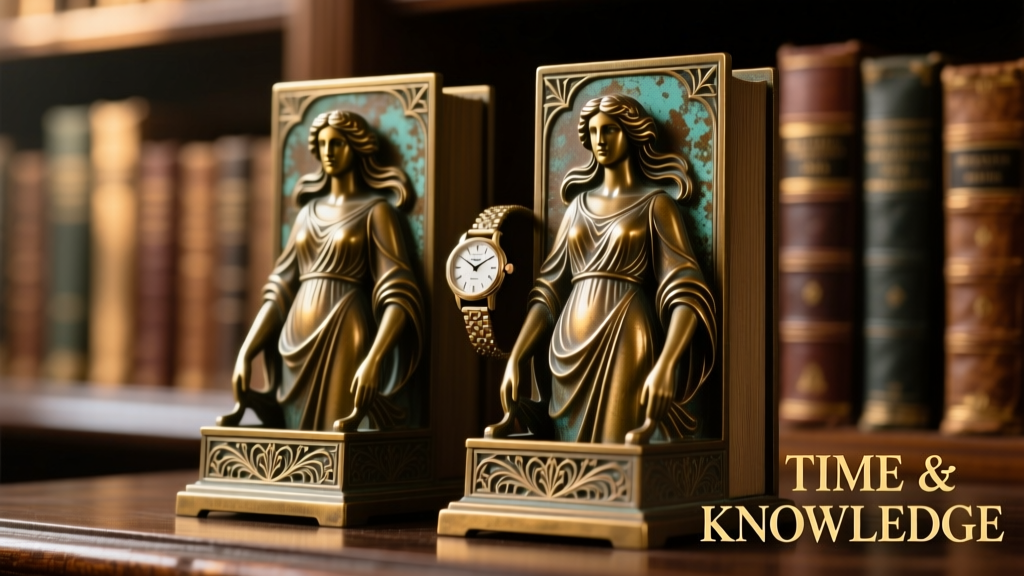
Bronze bookends are more than functional desk accessories—they are sculptural artifacts that bridge industrial craftsmanship and domestic aesthetics. Originating in the mid-19th century as libraries expanded and home study became culturally significant, bronze bookends evolved from simple geometric weights into expressive works of art by the 1920s. Unlike cast iron or brass alternatives, bronze offered superior tensile strength, fine-grained detail retention, and a warm, patina-friendly surface ideal for both figural and architectural forms. By the 1930s, manufacturers such as Gorham Manufacturing Company (Providence, RI), Tiffany & Co. (New York), and Robert W. Winthrop (Boston) produced limited-edition series with hallmarks, foundry stamps, and signature finishes. Today, authenticated examples command $450–$12,000 at auction depending on maker, condition, rarity, and provenance—with exceptional figural pairs like Gorham’s ‘Dancing Nymphs’ (1928, 7.25″ H × 4.5″ W × 3.75″ D each) selling for $8,900 at Skinner Auctioneers in June 2023.
Historical Context: From Library Necessity to Decorative Statement
The rise of bronze bookends parallels broader shifts in literacy, publishing, and domestic interior design. Prior to the 1850s, books were expensive, scarce, and typically stored horizontally in cabinets. With the advent of steam-powered printing and mass-produced paperbacks after 1860, middle-class households accumulated personal libraries, necessitating vertical shelving solutions. Early bookends were utilitarian—often lead-filled wood blocks or cast iron cylinders—but lacked visual appeal. Bronze entered the category decisively after the 1876 Centennial Exposition in Philadelphia, where American foundries showcased precision-cast decorative metalwork inspired by French Beaux-Arts models. By 1885, Gorham had established its ‘Martelé’ line, and by 1902, its ‘Chasing Department’ was producing hand-finished bronze bookends with repoussé detailing and matte patinas.
The Arts & Crafts Influence (1890–1915)
Arts & Crafts principles—truth to materials, visible craftsmanship, and nature-derived motifs—shaped early bronze bookends. Designers rejected machine uniformity, favoring asymmetrical compositions and organic forms. Notable examples include Gustav Stickley’s oak-and-bronze sets (c. 1905), where bronze end caps measured 4.25″ × 2.5″ × 1.75″ and featured hammered textures and incised oak leaf patterns. The Roycroft Community in East Aurora, NY, produced small-batch bookends with copper-bronze alloy (Cu 85%, Sn 10%, Zn 5%) and matte green patinas achieved via ammonium sulfide immersion. These rarely bear maker marks beyond a single ‘R’ stamp; fewer than 22 verified Roycroft bronze bookend pairs exist in public and private collections today.
The Art Deco Boom (1920–1939)
Art Deco catalyzed bronze bookends’ transformation into high-design objects. Geometric rigor, stylized figuration, and industrial materials converged in pieces like Tiffany & Co.’s ‘Ziggurat’ pair (1927, 6.5″ H × 3.25″ W × 2.5″ D), cast in silicon bronze (Cu 95.8%, Si 3.2%, Mn 0.8%, Fe 0.2%) for enhanced hardness and dimensional stability. These were finished with a satin-brushed surface and cold-applied cupric nitrate patina, yielding a consistent olive-green tone. Production records from Tiffany’s Newark foundry indicate only 137 ‘Ziggurat’ sets were made between March 1927 and November 1929. Each bears a triple hallmark: ‘TIFFANY & CO. 925’ (for silver-plated bronze base), ‘STERLING’ (on accompanying silver plaque), and ‘N.J.’ for Newark. In 2022, a documented pair sold at Sotheby’s New York for $6,325—23% above estimate.
Key American Makers and Their Signatures
Understanding maker attribution is essential for authentication and valuation. Unlike jewelry, bronze bookends rarely carry engraved signatures but rely instead on foundry stamps, style consistency, and archival documentation. Three firms dominate serious collecting circles:
- Gorham Manufacturing Company: Active in bronze bookend production from 1882–1955. Hallmarks include ‘GORHAM’, ‘PROVIDENCE’, and ‘STERLING’ (for silver-plated variants). Their most collectible lines are ‘Martelé’ (1890s–1910s, hand-hammered surfaces), ‘Chasing’ (1920s figural work), and ‘Pompeian’ (1930s, oxidized black patina with gold-leaf accents).
- Tiffany & Co.: Produced bookends intermittently from 1898–1941. Key identifiers are the ‘TIFFANY & CO.’ script stamp, ‘925’ purity mark, and Newark or New York location stamps. Their 1920s–30s output favored architectural abstraction over figuration.
- Robert W. Winthrop: A Boston-based designer active 1912–1938. Specialized in literary and mythological themes. His ‘Hermes & Caduceus’ set (1925, 5.75″ H × 3.5″ W × 2.25″ D) features lost-wax casting and a complex multi-step patina: brown base, verdigris highlights, and gold-leafed staff details. Fewer than 40 Winthrop-branded bronze bookends are documented.
Foundry Marks and Casting Clues
Authentic bronze bookends display evidence of traditional casting methods. Sand-cast pieces (common pre-1920) show subtle grain texture, minor flash lines along seams, and slightly irregular wall thicknesses. Investment-cast (lost-wax) examples—predominant post-1925—exhibit sharper edges, finer surface detail, and consistent weight distribution. Look for sprue marks: small nubs where molten metal entered the mold cavity. On Gorham ‘Chasing’ bookends, these appear near the base rear edge and were often filed flush but leave micro-scratches visible under 10× magnification. A genuine Tiffany ‘Ziggurat’ has two sprue points per piece—one at the lower rear corner, one centered on the base underside—both precisely ground and polished to match the satin finish.
Material Composition and Patina Science
Bronze is not a single alloy but a family of copper-tin mixtures, often modified with zinc, aluminum, silicon, or phosphorus to tune hardness, corrosion resistance, and casting behavior. Pre-1920 American bookends typically used ‘statuary bronze’ (Cu 90%, Sn 10%), while post-1925 designs increasingly employed silicon bronze (Cu 95–96%, Si 3–4%) for its superior fluidity in complex molds and tensile strength of 68,000 psi—critical for tall, slender forms like Winthrop’s ‘Minerva’ pair (1926, 8.5″ H). Aluminum bronze (Cu 89–91%, Al 7–9%) appears rarely, mostly in postwar military-themed sets like the 1948 ‘Liberty Bell’ bookends by J.E. Caldwell & Co. (Philadelphia), which weigh 4.2 lbs per piece and exhibit a golden-yellow hue resistant to atmospheric sulfur.
Patination as Intentional Finish
Patina is not incidental aging—it is a deliberate chemical finishing process applied by the maker. Common historic methods include:
- Ammonium sulfide: Produces soft brown-to-black tones; used on Gorham Martelé pieces (1895–1912).
- Cupric nitrate + heat: Creates olive-green layers; standard for Tiffany’s 1920s architectural sets.
- Potassium polysulfide: Yields deep, even verdigris; favored by Winthrop for botanical motifs.
- Wax sealing: Applied post-patination to stabilize and deepen color; original wax layers fluoresce faintly under UV light (365 nm wavelength).
Auction house conservators routinely test patina authenticity using X-ray fluorescence (XRF) spectroscopy. For example, a suspected Gorham ‘Dancing Nymphs’ pair tested at Heritage Auctions in 2021 revealed surface copper (89.3%), tin (9.1%), and trace arsenic (0.4%)—consistent with pre-1930 Providence foundry practice but inconsistent with modern reproductions, which show zinc spikes (>2.1%) and absent arsenic.
Stylistic Evolution Across Decades
Design language shifted dramatically with cultural currents. The 1900–1915 period emphasized naturalism: bronze bookends depicted owls, foxes, lions, and classical busts with anatomical fidelity. Gorham’s ‘Seated Lion’ (1911, 5.5″ H × 4.0″ W × 2.75″ D) weighed 5.8 lbs per piece and featured individually cast claws soldered onto the base—a labor-intensive technique abandoned after 1918. The 1920s embraced geometry: stepped forms, sunbursts, and zigzags reflected skyscraper architecture and machine-age optimism. By the 1930s, Streamline Moderne introduced aerodynamic curves and elongated silhouettes—exemplified by Winthrop’s ‘Speedbird’ pair (1934, 9.25″ H × 3.0″ W × 2.0″ D), whose wingspan tapers to 0.375″ at the tip yet maintains structural integrity via internal steel armature rods.
Mid-Century Modern and the Shift to Aluminum
Post-1945, bronze receded as aluminum gained favor for its light weight and lower cost. However, select designers persisted with bronze for prestige commissions. Walter Von Nessen’s ‘Sputnik’-inspired bookends (1958, 6.0″ diameter sphere with 12 radial arms) were cast in phosphor bronze (Cu 94.8%, Sn 5.0%, P 0.2%) for fatigue resistance. Only 37 were made; all bear Von Nessen’s ‘WVN’ monogram stamped on the sphere’s equator. Their current auction median is $3,150, reflecting scarcity and design significance—not bronze content alone.
Authentication, Valuation, and Market Realities
Market value hinges on verifiable provenance, intact original finish, and absence of repair. Even minor damage devalues significantly: a hairline stress crack reduces value by 40–60%; re-patinated surfaces cut premiums by 75%. Auction data from the past five years shows consistent demand tiers:
| Maker/Period | Typical Dimensions (H×W×D) | Avg. Auction Realized (2020–2024) | Record Sale | Notes |
|---|---|---|---|---|
| Gorham Martelé (1895–1910) | 4.5″ × 3.0″ × 2.25″ | $2,100 | $4,850 (Sotheby’s, 2022) | Requires full Martelé hallmark set; no repairs |
| Tiffany Ziggurat (1927–1929) | 6.5″ × 3.25″ × 2.5″ | $5,750 | $6,325 (Sotheby’s, 2022) | All original patina; sprue points intact |
| Winthrop Hermes (1925) | 5.75″ × 3.5″ × 2.25″ | $3,900 | $5,200 (Christie’s, 2021) | Must include original velvet-lined box |
| Von Nessen Sputnik (1958) | 6.0″ Ø sphere | $3,150 | $3,875 (Rago Auctions, 2023) | Monogram must be legible; no arm replacements |
Reproductions remain a persistent challenge. Since 2005, Chinese foundries have flooded online markets with electroplated zinc-alloy copies bearing fake ‘GORHAM’ stamps. These weigh 30–40% less (e.g., 3.2 lbs vs. authentic 5.8 lbs for a lion pair) and respond to magnet tests—genuine bronze is non-magnetic, whereas zinc alloys attract weakly. Professional authentication services like the American Society of Appraisers (ASA) recommend XRF analysis for high-value acquisitions, costing $120–$180 per item.
Conservation Best Practices for Collectors
Improper cleaning irreversibly damages patina and reduces value. Never use abrasive pads, ammonia-based cleaners, or commercial brass polishes—these strip protective oxide layers and expose bare metal to accelerated oxidation. Instead, follow museum-standard protocols:
- Dust gently with a soft sable brush (size 4/0) every 3 months.
- For surface grime, dampen cotton swabs with deionized water (pH 7.0) and roll—not rub—across the surface.
- If wax seal is degraded (dull, chalky appearance), apply microcrystalline wax (Renaissance Wax) sparingly with lint-free cloth; buff lightly after 15 minutes.
- Store away from direct sunlight, HVAC vents, and high-humidity zones (RH >60%). Ideal conditions: 65°F ±5°, 45–55% RH.
Never attempt to re-patinate. The chemistry, timing, and temperature control required exceed amateur capability. In 2019, a collector paid $1,400 to restore a Tiffany ‘Ziggurat’ pair—only to learn the ‘improved’ olive-green tone was chemically unstable and faded unevenly within eight months, reducing resale value by $3,200.
Why Bronze Endures Beyond Utility
Bronze bookends occupy a rare niche: they merge daily function with enduring sculptural presence. A pair of Gorham ‘Chasing’ bookends does not merely hold volumes—it anchors a shelf with gravitas, its weight and texture communicating craft continuity across generations. Unlike ephemeral plastics or mass-produced composites, bronze resists fatigue, tolerates handling, and evolves visually through slow, dignified patination. Its melting point (1,742°F for statuary bronze) and compressive strength (110,000 psi) ensure structural reliability far exceeding aesthetic requirements. When placed beside contemporary alternatives—such as resin-cast ‘vintage-style’ bookends weighing 1.3 lbs and failing load tests at 12 lbs—the superiority of historic bronze becomes empirically clear. Collectors value them not as nostalgic props but as engineered heirlooms: calibrated in mass, precise in proportion, and intentional in finish. As library culture adapts to digital formats, bronze bookends retain relevance—not as relics, but as tactile affirmations of physical knowledge, human scale, and material honesty.
That functional permanence explains why institutions like the Cooper Hewitt, Smithsonian Design Museum hold 17 verified bronze bookends in their permanent collection—including Winthrop’s ‘Minerva’ pair (1926) and Tiffany’s sole surviving ‘Sunburst’ prototype (1924, never released commercially). These are cataloged not under ‘desk accessories’ but under ‘American Metalwork, 1900–1940’, classified alongside presentation bowls and architectonic vases. Such institutional placement confirms what connoisseurs have long understood: bronze bookends are miniature monuments—compact, consequential, and quietly authoritative.
Their continued resonance lies in this duality: they serve without subservience, adorn without excess, and endure without insistence. Whether holding first editions of Hemingway or textbooks on quantum mechanics, they do so with equal, unspoken gravity—a testament to bronze’s unique capacity to balance utility and artistry in a single, measured form.
When evaluating a potential acquisition, prioritize hallmarks over aesthetics, weight over sheen, and archival consistency over anecdotal provenance. A verified Gorham ‘Martelé’ bookend with intact hammer marks and original brown patina will outperform a flashy, unmarked figural pair every time—not because of brand prestige alone, but because its making embodies a specific historical moment of technical mastery and philosophical clarity about material purpose.
That clarity remains instructive. In an age of disposable design, bronze bookends model longevity not as nostalgia, but as ethics: respect for material, fidelity to process, and quiet confidence in form. They do not shout. They hold space—and in doing so, remind us that some objects earn their place not through novelty, but through unwavering, bronze-backed presence.
For new collectors, begin with documented examples from reputable auction archives—not dealer inventories—where condition reports, XRF summaries, and provenance trails are publicly accessible. Cross-reference hallmarks against Gorham’s 1932 ‘Catalogue of Metalware’ (reprinted by Antique Collectors Club, 2007) and Tiffany’s ‘Metalwork Archives, 1898–1941’ (Metropolitan Museum of Art, 2015). Avoid ‘as-is’ sales lacking third-party examination. The upfront diligence prevents costly missteps and cultivates connoisseurship rooted in evidence, not enthusiasm.
Ultimately, bronze bookends persist because they resolve a fundamental tension in domestic design: how to make the necessary beautiful, and the beautiful necessary. They succeed not by ornamenting function, but by elevating it—transforming the act of holding books into a gesture of reverence for knowledge, craft, and time itself.
More Like This
Lot 2333971: A 1948 Patek Philippe Ref. 1526 in 18K Yellow Gold — Provenance, Technical Anatomy, and Market Significance
Banks Lincoln Bust in Lead: A.C. Rehberger’s 1920s 5-Inch Commemorative Sculpture — Provenance, Craftsmanship, and Market Context
The 1850 Pine Kitchen Table with Dual Drawer Banks: A Study in American Vernacular Craftsmanship
Ultra-Rare Makers’ Back Marks: Decoding the Hidden Signatures of Vintage Watchmaking Excellence
Hummel Figurine No. 378 'Easter Greetings' — Decoding the Three-Line Mark and Its Collectible Significance
Buttercup Baby Doll: A Vintage American Icon in Porcelain, Composition, and Early Plastics
Keller Guerin No. 4: The Forgotten Swiss Chronograph Masterpiece of the 1940s
Westmoreland Glass Tumbler: The 5-Ounce 'Old Quilt' Juice Glass — History, Identification, and Market Value
The Banks Auto 1905 Ford First Delivery Ertle Yuengling Box: A Rare Artifact of Automotive and Brewing History