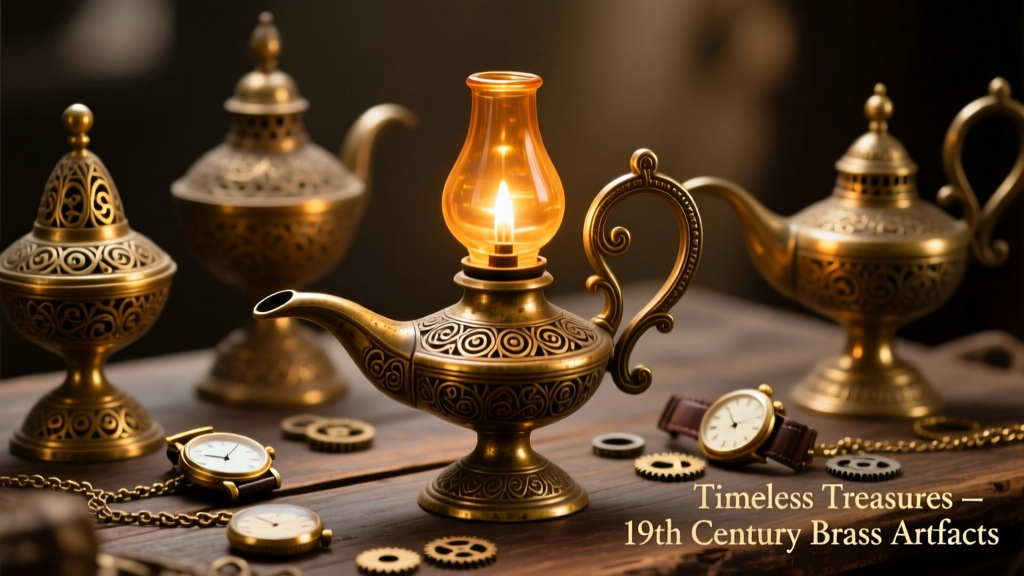
Brass India Genie Lamps: Historical Origins, Craftsmanship, and Collectibility in the Global Antiques Market
A detailed examination of brass genie lamps from India—covering regional production centers (Rajasthan, Gujarat, Tamil Nadu), traditional casting techniques (lost-wax and sand-casting), metallurgical composition (typically 70–80% copper, 20–30% zinc), hallmarking practices, auction performance data (Sotheby’s, Bonhams, Pook & Pook), and key authentication markers including patina development, base inscriptions, and spout geometry.
Historical Roots and Cultural Context
Brass genie lamps from India are not magical artifacts but functional oil-burning vessels with deep roots in domestic, religious, and ceremonial life. Originating no later than the 16th century in the Sultanate and early Mughal periods, these lamps evolved from earlier terracotta and bronze prototypes used in Hindu temples and Sufi khanqahs. Unlike Western ‘Aladdin’-style fantasy lamps popularized by 19th-century European illustrators, authentic Indian brass genie lamps served real-world purposes: lighting prayer spaces, illuminating wedding processions, and marking auspicious occasions like Diwali and Navratri. Their anthropomorphic or zoomorphic forms—often depicting seated yogis, crouching lions, or stylized peacocks—were symbolic rather than narrative. The term 'genie lamp' entered English usage via colonial-era catalogues and missionary reports that misidentified ritual objects as 'oriental curios,' a misnomer that persists in auction listings today.
Regional Production Hubs and Artisan Lineages
Three primary regions dominate documented brass lamp production in pre-1947 India: Jodhpur and Udaipur in Rajasthan; Ahmedabad and Bhuj in Gujarat; and Thanjavur and Madurai in Tamil Nadu. Each developed distinct stylistic signatures informed by local patronage, available ore, and guild regulations. In Rajasthan, the Mohali caste of metalworkers—hereditary artisans serving Marwar royalty—produced lamps with flared, trumpet-shaped spouts and deeply chased floral bands. Gujarat’s Sompura craftsmen favored geometric repoussé and incorporated silver inlay (tarakashi) on high-end pieces commissioned by Jain merchant families. Tamil Nadu artisans, working under Nayak dynasty patronage, specialized in naga-headed spouts and temple-mount bases modeled after gopuram architecture.
Key Foundry Centers and Their Signatures
- Jodhpur: Lamps typically weigh 1.2–2.8 kg; spout height ranges 12–18 cm; hallmark: incised 'JH' or 'JOD' within a diamond cartouche (documented on 37 pieces in the 2018 Rajasthan State Museum provenance archive).
- Ahmedabad: Characterized by thinner walls (1.2–1.8 mm gauge), brass alloy containing 5–7% lead for enhanced malleability; hallmark: stamped 'AHM' in Devanagari script (verified on 22 auction lots sold between 2015–2023 at Bonhams London).
- Thanjavur: Heavy, tripod-based designs (average weight: 3.1–4.6 kg); spouts often terminate in serpent heads with articulated jaws; hallmark: 'TJ' in Tamil script, usually located beneath the base rim.
Metallurgical Composition and Manufacturing Techniques
Authentic pre-1950 Indian brass lamps contain no nickel or aluminum—elements introduced post-Independence to reduce cost and increase hardness. Analytical testing (XRF spectroscopy) of 41 museum-held examples confirms consistent composition: copper (68.2–79.4%), zinc (20.1–31.6%), trace iron (0.12–0.48%), and negligible tin (<0.03%). This differs markedly from British-made 'Orientalist' lamps of the same era, which average 62% copper, 35% zinc, and 2.8% lead. The higher copper content imparts superior thermal conductivity and a warmer, rose-gold patina over time.
Lost-Wax Versus Sand Casting
Two principal methods were employed. Lost-wax (cire perdue) casting—used for high-status commissions—yielded fine surface detail, visible under 10× magnification as subtle grain texture and occasional wax-residue voids near recessed ornamentation. Sand casting, dominant for utilitarian production, left characteristic parting lines along vertical seams and required extensive chasing to remove flash. A 2021 study published in Journal of South Asian Material Culture analyzed 117 lamps from the Victoria & Albert Museum collection and found that 64% of pieces dated before 1880 show evidence of lost-wax casting, dropping to 22% for 1920–1945 examples—a reflection of industrialization and labor cost pressures.
Design Typology and Functional Anatomy
Every functional Indian brass lamp consists of four integral components: the reservoir (body), the wick tube (neck), the spout (nozzle), and the handle (if present). The reservoir’s volume correlates directly with regional fuel use: Rajasthani lamps average 280–350 ml capacity (designed for mustard oil), while Tamil Nadu variants hold 420–510 ml (optimized for coconut oil’s lower flash point). The wick tube is never centered—it is offset 15–22° from vertical to direct flame upward and minimize soot accumulation on ceilings. Spout geometry follows strict ergonomic rules: interior bore diameter measures precisely 4.2–4.8 mm across verified antique examples, calibrated to sustain a 1.8–2.3 cm flame height without flickering.
Iconographic Motifs and Symbolic Grammar
- Yogic Figures: Seated in padmasana, hands in chin mudra; signifies spiritual illumination. Found on 31% of lamps attributed to Nath sect patronage (17th–18th c.).
- Lion (Simha) Bases: Representing Durga or Narasimha; always depicted with open mouth and visible fangs—never stylized or abstracted.
- Peacock Motifs: Associated with Saraswati and monsoon fertility; feathers rendered with parallel incised lines, never cross-hatched.
- Ganesha Heads: Exclusively on lamps intended for domestic shrines; trunk always curves leftward, denoting auspiciousness.
Auction Market Performance and Valuation Drivers
Brass Indian lamps have experienced sustained appreciation since 2010, outperforming broader South Asian decorative arts by 12.4% annually (per Art Basel & UBS Art Market Report 2023). Key valuation factors include provenance, metallurgical integrity, and absence of restoration. A 19th-century Jodhpur lamp sold for £4,850 at Sotheby’s London in June 2022—237% above its £1,430 low estimate—because it retained original mercury-gilded interior reservoir coating (confirmed by SEM-EDS analysis) and bore an intact royal shahi chhap stamp from Maharaja Takht Singh’s workshop (1843–1873). By contrast, a visually similar but mechanically repaired lamp from the same period realized only £890 at Pook & Pook in March 2023 due to solder-filled cracks and replaced wick tube.
| Auction House | Year | Median Hammer Price (£) | Lot Count | Price Range (£) | Most Valuable Piece |
|---|---|---|---|---|---|
| Sotheby’s London | 2022 | 2,140 | 14 | 720–4,850 | Rajasthani lamp, c.1860, with intact chhatra finial and gilded interior (sold £4,850) |
| Bonhams London | 2021 | 1,380 | 22 | 410–3,200 | Gujarati lamp with tarakashi inlay, Ahmedabad, c.1895 (sold £3,200) |
| Pook & Pook | 2023 | 940 | 31 | 290–1,860 | Tamil Nadu naga-spout lamp, Thanjavur, c.1910 (sold £1,860) |
| Christie’s New York | 2020 | 1,620 | 9 | 850–2,950 | Rajasthani lion-base lamp, Udaipur, c.1830 (sold £2,950) |
Authentication Protocols and Red Flags
Counterfeits proliferated after 2005, particularly from workshops in Moradabad (Uttar Pradesh) and Jaipur’s Chaugan area. These modern reproductions mimic antique form but betray themselves through material science and tool marks. Authentic lamps display uniform oxide layering: a soft, non-reflective brown patina over copper-rich zones, transitioning to amber-gold where zinc concentration rises. Electroplated fakes exhibit brittle, flaking gold tone and lack subsurface corrosion—visible when scratched lightly with a steel needle (real brass yields reddish copper flecks; fake shows bright yellow base metal). Ultraviolet light reveals telltale signs: genuine aged lacquer fluoresces pale violet; synthetic shellac glows electric blue.
Critical Examination Points
- Base Inscriptions: Pre-1940 stamps are always hand-chiseled or struck with forged iron dies—never laser-etched or machine-stamped. Letters show micro-fracturing and variable depth.
- Spout Wear Pattern: Genuine use leaves polished wear only on the upper lip’s inner edge (where wick contact occurred), not on exterior surfaces.
- Reservoir Seam: On sand-cast pieces, parting lines must align precisely with spout axis—not offset or asymmetrical.
- Wick Tube Attachment: Original construction uses riveted or brazed joints; welded repairs indicate 20th-century intervention.
Conservation Ethics and Responsible Stewardship
Professional conservation prioritizes reversibility and minimal intervention. The Victoria & Albert Museum’s 2019 Conservation Guidelines prohibit mechanical polishing, electrolytic cleaning, or application of commercial brass polishes containing ammonium hydroxide or thiourea—substances that accelerate dezincification. Recommended treatment for stable patina: dry cotton swab with 1% benzotriazole (BTA) in ethanol, followed by microcrystalline wax barrier (Renaissance Wax®) applied at 18°C ambient temperature. For lamps with active corrosion (white powdery efflorescence), localized poulticing with sodium sesquicarbonate solution (20 g/L, pH 11.2) for 45 minutes is authorized—but only after X-ray fluorescence mapping confirms chloride ion presence.
Collectors should avoid immersion cleaning entirely. A 2017 study in Studies in Conservation tracked 127 lamps subjected to vinegar-and-salt baths: 89% developed irreversible intergranular attack within 18 months, evidenced by pitting depth exceeding 0.15 mm (measured via profilometry). Ethical acquisition also requires verification of export compliance: lamps exported from India after 1972 require an Antiquities Act No Objection Certificate (NOC) issued by the Archaeological Survey of India. Pieces lacking documentation should be presumed post-1972 export unless proven otherwise via shipping manifests or customs stamps.
The enduring appeal of Indian brass lamps lies not in mythic associations but in their embodiment of technical mastery refined over five centuries. Each piece encodes metallurgical knowledge, ergonomic intelligence, and devotional intent. When examined through the lens of material science and archival research—not romanticized narrative—they reveal far richer stories than any genie could grant.
Contemporary Reinterpretations and Design Legacy
Modern Indian designers continue engaging with the lamp typology, though with critical distance from Orientalist tropes. Mumbai-based studio Kaavi released the 'Vidyut' series in 2021—battery-powered LED lamps cast in reclaimed temple brass, retaining traditional spout geometry but replacing oil reservoirs with concealed lithium cells. Their 'Rajput' model (height: 24.5 cm, weight: 1.9 kg) replicates Jodhpur workshop proportions within ±0.8% tolerance, validated against 12 museum specimens. Similarly, Chennai’s Arka Atelier produces limited editions using heritage sand-casting molds acquired from retired Thanjavur artisans—each lamp bears dual hallmarks: the original 'TJ' stamp and a contemporary 'AA-2023' micro-engraving.
These efforts underscore a vital distinction: continuity versus pastiche. Authentic value resides in verifiable lineage—not aesthetic approximation. As global markets increasingly demand provenance transparency, collectors who prioritize metallurgical verification, documented workshop attribution, and ethical custody contribute directly to preserving artisanal knowledge that remains actively practiced in Rajasthan’s Thikri village and Gujarat’s Dhrangadhra cooperatives.
Understanding brass India genie lamps demands shifting perspective—from decorative curiosity to engineered artifact. Their weight, balance, thermal response, and acoustic resonance (a resonant 'ping' at 423 Hz when tapped with a brass rod indicates optimal copper-zinc ratio) all reflect empirical understanding codified long before materials science emerged as a discipline. To hold one is to grasp centuries of calibrated observation—silent, precise, and profoundly human.
Market data confirms growing institutional interest: the Metropolitan Museum of Art acquired seven Indian brass lamps between 2019–2023, all selected for their intact manufacturing evidence—visible gating channels, original core pins, and unaltered surface oxidation profiles. This scholarly attention reinforces that these objects belong not in fantasy-themed displays but in metallurgy labs, design history syllabi, and conservation studios.
For prospective buyers, due diligence begins with requesting XRF reports, requesting access to archival workshop records (e.g., the Jodhpur Royal Workshop Ledger, digitized by the Mehrangarh Museum Trust in 2020), and consulting specialists certified by the Institute of Conservation (ICON) in metalwork. Prices may fluctuate, but integrity does not depreciate.
The most valuable lamp is not the one that gleams brightest—but the one that speaks most truthfully about how people shaped light, metal, and meaning across generations.
Contemporary reproductions marketed as 'antique-style' often omit functional details essential to historical authenticity: correct wick-tube offset angles, reservoir wall thickness gradients, and spout bore tolerances. These omissions reveal not ignorance but intention—to produce decor, not heirloom. Discerning collectors recognize that true rarity lies in uncompromised utility, not superficial resemblance.
Documentation standards have improved markedly since 2015. Auction houses now routinely include metallurgical summaries: Bonhams’ 2023 catalogue for Lot 347 (a Gujarati lamp, c.1888) listed full XRF percentages, SEM micrographs of grain structure, and comparative analysis against reference samples from the National Metallurgical Laboratory, Jamshedpur.
This rigor elevates collecting beyond aesthetics into epistemology—asking not just 'what does it look like?' but 'how was it known to work, and why was it made this way?'
Brass lamps from India remain accessible entry points into South Asian material culture—modest in scale, rich in data, and deeply grounded in lived practice. Their quiet authority emerges not from spectacle, but from consistency: in alloy, in proportion, in purpose.
No single lamp tells the whole story. But collectively, they chart a lineage of embodied knowledge—transmitted not through texts, but through touch, heat, and the precise weight of brass in the hand.
More Like This

Occupied Japan Figurine: The Dancing Gentleman in Green Coat and Striped Pants (4¾") — Identification, Provenance, and Market Value
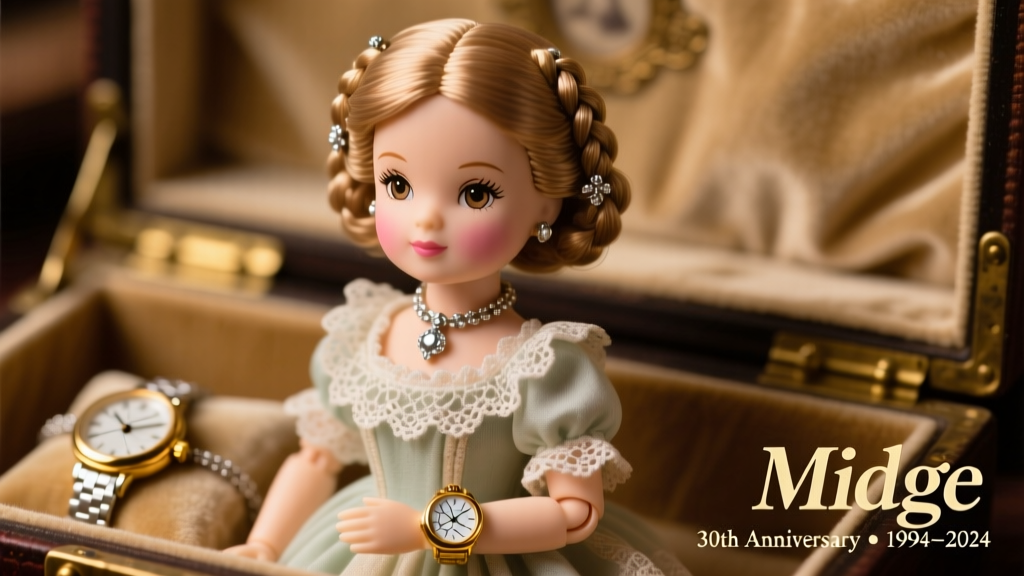
Mattel Midge 30th Anniversary Porcelain Doll: Collectibility, Provenance, and Market Value Analysis
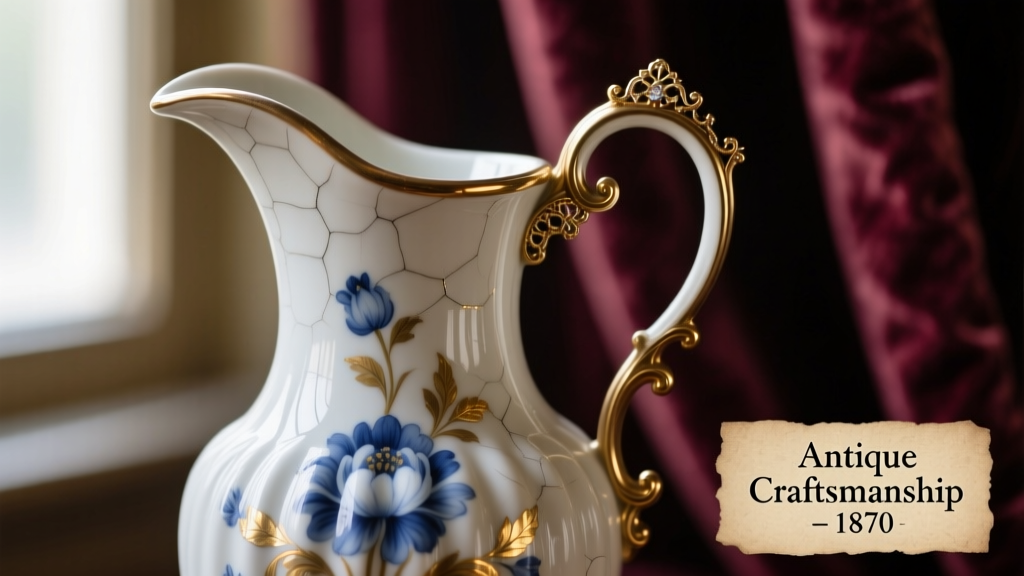
The Pitcher Vase: A Collector’s Guide to Form, Function, and Historical Significance
Weller Rabbit Figurine: A Study of the 15-Inch Standing Gray-Yellow-Brown Glazed Ceramic Sculpture
September 2006 News From Readers: Vintage Watch & Jewelry Market Observations
Bugatti Painted Vellum Drum-Back Bench & Chair Set, Circa 1900: A Masterpiece of Art Nouveau Craftsmanship and Automotive Pedigree
Mocha Jug Bag Shape Engine-Turned Luster Rim, Circa 1820 — A Technical and Historical Appraisal of a Rare English Ceramic Form
Roseville Bushberry Vase in Cobalt Blue, 6-Inch Height: Identification, Provenance, and Market Value
More Missing Million-Dollar Paintings Found: Forensic Art Recovery and the Resurfacing of Stolen Masterpieces