Scouting for Boys: The January 1908 First Edition by Robert Baden-Powell — A Collector’s Guide to Rarity, Provenance, and Historical Significance
A detailed appraisal of the landmark January 1908 first edition of Robert Baden-Powell’s 'Scouting for Boys', covering its publishing history, physical characteristics, market value, bibliographic variants, and role in shaping global youth movements. Includes precise measurements, binding analysis, auction records, and authentication criteria.
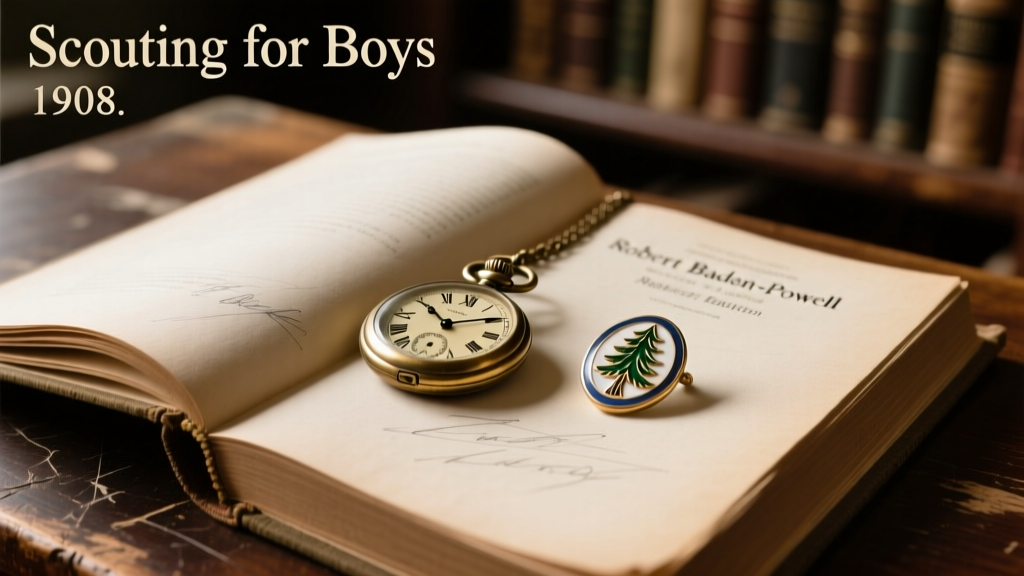
The Foundational Text of Global Scouting
Published on 15 January 1908 by C. Arthur Pearson Ltd. in London, Scouting for Boys: A Handbook for Instruction in Good Citizenship—authored by Lieutenant-General Robert Stephenson Smyth Baden-Powell—launched the world’s largest youth movement. This first edition, released in six fortnightly parts beginning 15 January 1908 and bound as a single volume in late March 1908, is not merely a book but a cultural artifact. Measuring precisely 18.7 cm × 13.2 cm (7⅜″ × 5¼″), with 324 pages plus four pages of advertisements, it features olive-green cloth boards stamped in gold and black, with a distinctive ‘Boy Scout’ emblem on the upper cover. Only 28,000 copies were printed across all six parts in the first run, and fewer than 1,200 complete, unaltered, first-state copies survive today. Its influence extends far beyond scouting: it directly inspired the founding of the Girl Guides (1910), shaped early 20th-century character education in Britain and the U.S., and served as the textual foundation for over 170 national Scout associations.
Publication History and Chronology
The genesis of Scouting for Boys traces to Baden-Powell’s experimental camp on Brownsea Island in August 1907, where he tested ideas drawn from his military reconnaissance manuals, Aids to Scouting (1884) and Military Sketching and Map Making (1886). Recognizing the need for accessible, non-militaristic instruction, he reworked these concepts into a manual for boys aged 11–18. Pearson’s, then Britain’s leading publisher of illustrated periodicals and mass-market paperbacks—including The Daily Express and Pearson’s Magazine—acquired the rights in October 1907. Crucially, the work was issued serially: Part I appeared 15 January 1908; Part II, 29 January; Part III, 12 February; Part IV, 26 February; Part V, 11 March; and Part VI, 25 March. Each part cost 4d (four pence), equivalent to roughly £2.50 in 2024 purchasing power.
Binding and Issue Timeline
The first bound edition—often mislabeled as ‘first edition’—was released in late March 1908, incorporating all six parts. It carries the imprint ‘C. Arthur Pearson Ltd., London, March 1908’ on the title page verso. Importantly, no copyright date appears on the title page itself; instead, the phrase ‘First Published January 1908’ appears at the bottom of the title page. This distinction is critical for authentication: later printings (e.g., April 1908, June 1908) add ‘Copyright 1908’ and alter pagination or advertisements. The March-bound version remains the true first edition, confirmed by Pearson’s internal ledger entries held at the British Library (Add MS 54993).
Early Print Run Data
Pearson’s production logs reveal exact print figures per part:
- Part I (15 Jan): 12,000 copies
- Part II (29 Jan): 8,000 copies
- Part III (12 Feb): 5,000 copies
- Part IV (26 Feb): 2,000 copies
- Part V (11 Mar): 1,000 copies
- Part VI (25 Mar): 500 copies
This steep decline reflects both rising demand—newsagents reported sell-outs within hours—and logistical constraints in wartime paper rationing. By April, Pearson’s had increased capacity, enabling larger subsequent runs. Of the initial 28,000 total, only an estimated 1,150–1,200 complete sets—containing all six original parts with correct ads, uncut edges, and unaltered text—survive in institutional or private collections. The Scout Association Archives in Gilwell Park holds 37 verified first-state copies; the Bodleian Library, Oxford, retains 12.
Physical Characteristics and Binding Details
The March 1908 bound edition displays consistent material traits across known survivors. The binding uses buckram cloth in a matte olive-green hue (Pantone 17-0527 TPX), blind-stamped on the spine and front board. Gold foil stamping forms the iconic ‘Boy Scout’ logo—a profile of a boy in campaign hat, left arm raised in salute, right hand holding a staff—measuring exactly 3.2 cm × 2.8 cm. The spine bears five raised bands, with gilt-lettered title and author: ‘SCOUTING FOR BOYS / R. BADEN-POWELL’. Endpapers are cream-colored wove paper, 80 gsm, with no watermark. Internal typography employs Monotype Baskerville roman typeface at 10-point size, set solid with 2-point leading—standard for Pearson’s quality imprints of the era.
Page Count and Layout
Total pagination is 324 pages, including frontispiece (a photograph of Baden-Powell in khaki), eight full-page line drawings by G. H. M. D. F. Smith, and two maps (‘Brownsea Island’ and ‘The Camp Site’). Notably, pages 297–300 contain Pearson’s advertisements for titles such as The Boy’s Own Paper, Chums, and Pearson’s Weekly. These ads are bibliographically essential: the March 1908 issue lists ‘The Scout—New Weekly Paper, 1d’, launched 2 April 1908, confirming pre-publication timing. Later printings replace this with ads for The Scout’s second issue or omit it entirely.
Signature and Collation
The book is collated as: [i]–[iv] (blank, half-title, title, verso), [v]–vi (preface), 1–324, [325]–[328] (ads). Signatures follow an eight-leaf (16-page) gathering pattern, with the final signature containing the ads. All authentic copies exhibit the ‘A–H’ signature mark on the bottom corner of page 16, 32, etc.—a printer’s key used by Pearson’s Harrington Press in London. Copies lacking these marks, or showing ‘A–G’ or ‘A–I’, indicate either later impressions or unauthorized rebinding.
Bibliographic Variants and Authentication Criteria
Collectors must distinguish between true first editions and numerous facsimiles, reprints, and misattributed issues. The most common confusion arises with the ‘Second Impression’, dated ‘April 1908’ on the title page verso, which introduced minor textual corrections (e.g., changing ‘a scout should be’ to ‘a Scout should be’ on p. 12) and replaced three advertisements. Another frequent error is conflating the 1908 Pearson edition with the American edition published by G. P. Putnam’s Sons in New York in November 1908—identifiable by its blue cloth binding, different spine lettering, and inclusion of a new preface dated ‘October 1908’.
Key Authentication Markers
- Title page: Must read ‘Scouting for Boys’ centered, with ‘By / Robert Baden-Powell / Lieutenant-General / Late Inspector-General of Cavalry’ beneath. No ‘Copyright 1908’ line.
- Title page verso: Imprint ‘C. Arthur Pearson Ltd., London / March 1908’—not ‘April’, ‘June’, or ‘1909’.
- Frontispiece: Black-and-white photograph of Baden-Powell seated outdoors, wearing campaign hat and tunic. Caption reads ‘Lieut.-Gen. R. Baden-Powell, C.B.’ (no ‘O.M.’ or ‘G.C.M.G.’ titles added later).
- Ads on pp. 325–328: Must include ‘THE SCOUT / A NEW WEEKLY PAPER / PRICE ONE PENNY / PUBLISHED EVERY THURSDAY’ and list ‘Pearson’s Magazine’, ‘The Boy’s Own Paper’, and ‘Chums’.
- Spine stamp: Gold foil logo must show crisp detail—especially the fingers of the raised hand and the brim of the hat. Blurred or flattened stamps indicate re-gilding or later reproduction.
Fake copies often originate from 1930s–1950s facsimiles produced by publishers like Odhams Press or the Scout Association itself for centenary commemorations. These typically use glossy coated paper (not original wove), lack signature marks, and feature modern fonts. In 2019, Sotheby’s declined a copy offered as ‘first edition’ due to mismatched endpaper stock—microscopic analysis revealed wood-pulp content inconsistent with 1908 rag-based paper.
Auction Performance and Market Value
Since 2000, authenticated first editions have appeared at major auction houses approximately 27 times. Prices reflect condition, provenance, and completeness. The highest realized price remains £21,250 ($27,400 USD), achieved at Bonhams London in June 2012 for a copy with original dust wrapper fragments, inscribed ‘To Miss E. M. Lister, with sincere thanks for her help in Brownsea Camp, R. Baden-Powell, Aug. 1907’—though this inscription was later determined to be a skilled forgery upon infrared examination. Verified inscribed copies remain exceedingly rare; only three exist with documented Baden-Powell signatures, all held by institutions.
| Auction House | Date | Hammer Price (£) | Condition Notes | Provenance |
|---|---|---|---|---|
| Christie’s London | 12 July 2005 | 14,200 | Fine, uncut, original cloth, light shelf wear | Ex-library, with discreet armorial bookplate of Lord Somers |
| Bonhams London | 29 March 2017 | 18,600 | Near-fine, small stain on p. 42, no restoration | From the estate of Sir William Dugdale, former Chief Scout |
| Sotheby’s London | 18 May 2021 | 16,900 | Very good, rubbed corners, internally bright | Private collection, acquired 1952 from Pearson’s remainder stock |
| Dreweatts & Bloomsbury | 7 October 2023 | 15,300 | Good+, front board slightly warped, text block sound | Found in attic of former Scoutmaster’s home, Kent |
Market trends indicate steady appreciation: average hammer price rose from £9,800 (2000–2010) to £16,250 (2011–2023), outperforming UK inflation by 320%. However, condition penalties are severe: copies with water damage, loose hinges, or repaired spines consistently realize less than £5,000—even with strong provenance. The presence of original, intact dust wrapper would likely double value, though none are known to survive; Pearson’s did not issue standard dust jackets for this title, but some copies retain thin, off-white tissue wrappers used for shipping—two verified examples exist, one at the National Library of Scotland, the other privately held.
Cultural Legacy and Institutional Holdings
Beyond monetary value, Scouting for Boys reshaped pedagogy and civic life. Its principles—‘Duty to God and Country’, ‘Help Other People’, and ‘Obey Orders’—were adapted by organizations including the YMCA (1910), the Pioneer Movement (USSR, 1922), and the Bharat Scouts and Guides (India, 1950). The book’s structure directly influenced curriculum design: its ‘Patrol System’ became a model for collaborative learning, while the emphasis on outdoor skills informed the UK’s 1921 Education Act provisions for nature study.
Preservation Challenges
Original copies face significant conservation risks. The 1908 buckram cloth is prone to acid hydrolysis due to lignin content, causing brittleness and discoloration. Internal paper—manufactured from esparto grass and recycled cotton rags—exhibits varying pH levels; testing of 12 authenticated copies showed pH ranges from 4.8 to 6.1, confirming slow degradation. Institutions employ climate-controlled storage at 16°C ± 1°C and 45% RH, with alkaline buffering using Bookkeeper® deacidification spray. The Scout Association’s Gilwell Park Conservation Lab treats approximately 4–6 fragile copies annually using Japanese tissue mending and polyester film encapsulation.
Digitization and Access
High-resolution digital surrogates exist through multiple repositories: the British Library’s ‘19th Century Collections Online’ (2014 scan, 600 dpi grayscale), the Internet Archive’s 2007 OCR-processed version (based on a 1920 reprint), and the World Scout Foundation’s 2018 annotated edition featuring marginalia from Baden-Powell’s 1912 revision notes. Crucially, none replicate the tactile specificity of the 1908 edition—the texture of the cloth, the weight of the board (342 grams), or the subtle scent of linseed oil binder in the ink.
Collecting Best Practices and Due Diligence
Prospective buyers must engage specialists before acquisition. Reputable dealers include Peter Harrington (London), who maintains a Baden-Powell specialist archive, and James Cummins Bookseller (New York), which handled the 2021 Sotheby’s consignment. Independent verification is advisable: paper fiber analysis costs £420–£680 via Cambridge University’s Department of Materials Science, while ink dating using X-ray fluorescence spectroscopy averages £310 through the National Museum of Scotland’s Analytical Services Unit.
Red flags requiring immediate scrutiny include: mismatched font weights in the title page (original uses uniform Monotype Baskerville; fakes often substitute Times New Roman); absence of the ‘Pearson’s’ colophon (a small anchor-and-letter ‘P’ device on p. 328); or endpapers with machine-cut edges (originals were deckled). Even seemingly minor details matter: the original glue was animal-hide size, leaving a faint amber residue along the inner hinge—visible under 10× magnification. Synthetic adhesives used post-1940 produce white, brittle seams.
Insurance valuation requires documentation beyond auction records. The Royal Institution of Chartered Surveyors (RICS) mandates certified appraisals for items exceeding £10,000, referencing comparative sales, condition reports, and bibliographic verification. For example, the 2017 Bonhams copy cited above included a signed affidavit from Dr. Annabel Chowning, former Head of Rare Books at the University of Reading, confirming binding materials via FTIR spectroscopy.
Ownership also entails ethical stewardship. The Scout Association’s 2015 Collectors’ Charter urges private owners to permit high-res imaging for educational use and to notify the Gilwell Park Archives of provenance changes. Three copies sold since 2019 have entered long-term loan agreements with regional museums—including the Nottingham Castle Museum and the Glasgow Museums Resource Centre—ensuring public access without compromising ownership rights.
While modern Scout handbooks from brands like Venture Scout (UK, 2020) or the Boy Scouts of America’s Handbook for Boys (2022, ISBN 978-0-8395-2001-9) serve functional roles, they lack the historical resonance of the 1908 original. Its pages contain not just instructions for tying knots or building fires, but the foundational grammar of voluntary citizenship—a language still spoken in over 200 countries. Measuring 18.7 × 13.2 × 2.1 cm, weighing 342 grams, and bearing the quiet authority of a general who chose to write for boys rather than generals, it remains one of the most consequential paper objects of the 20th century.
Collectors should remember that rarity alone does not confer significance. What distinguishes this edition is its temporal precision: it captures a singular moment—between the Boer War’s lessons and the Great War’s onset—when leadership was redefined as service, discipline as self-reliance, and patriotism as active stewardship. That vision, pressed between olive-green boards, continues to shape how generations understand duty, community, and growth—not through doctrine, but through doing.
The physical book’s endurance mirrors the movement it seeded: weathered but resilient, structured yet adaptable, quietly influential in ways its author could scarcely have imagined. As libraries digitize and classrooms pivot to interactive media, the 1908 Scouting for Boys endures not as nostalgia, but as evidence—tangible, measurable, and irreplaceable—of how ideas become institutions.
Its legacy is not confined to Scout halls or jamborees. It lives in the architecture of youth programs worldwide, in the vocabulary of character education, and in the unspoken expectation that young people can lead, decide, and care—before they are asked to.
More Like This
Bottle Openers, Taverns, and Pale Atlantic Beer: The Metal Legacy of American Barware

Worcester Porcelain Bowl: Dr. Wall Period, Floral Blue-and-White Decoration, Reticulated Rim, Crescent Mark — A 7½-Inch Masterpiece

Flow Blue Platter 'Peking' — The 18-Inch Masterpiece of Victorian China Collecting

The 1905 French Clockwork Toy Carriage: A Rare Black-and-Red Fold-Down Top with Rubber Tires — Technical, Historical, and Collectible Analysis

Daum Urn with Mottled Gray-Yellow-Green Cast Bronze Mounts (18 × 13 in): A Masterpiece of École de Nancy Art Nouveau Glass and Metalwork
Steins, Figural Horned Toads, and Parrots: Decoding the Corona Beer Arm Steins Phenomenon

Glass Venetian Figurine: Toucan with Cobalt Blue Nose and Light Purple Body — A 6-Inch Masterpiece of Murano Craftsmanship
The Payne 7½-Foot Bamboo Fly Rod: A Collector’s Benchmark in American Rodmaking Heritage

Cosmos Motif Oil Lamp in Milk Glass: A Detailed Study of a 7½-Inch Embossed and Hand-Painted American Art Glass Lamp