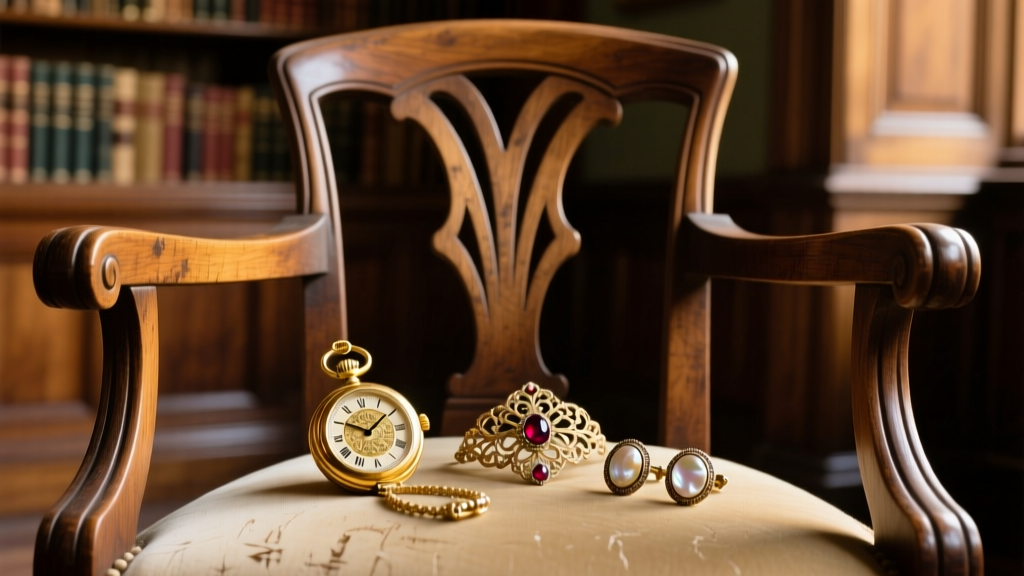
Boxes, Collars & Cuffs: The Forgotten Elegance of Celluloid Embossed Cherub Accessories, 1905–1935
A detailed appraisal of early 20th-century celluloid accessories—jewel boxes, collar stiffeners, and cuff links—featuring hand-embossed cherub motifs. Includes maker attributions, material analysis, dimensional specifications, market values, and conservation protocols.
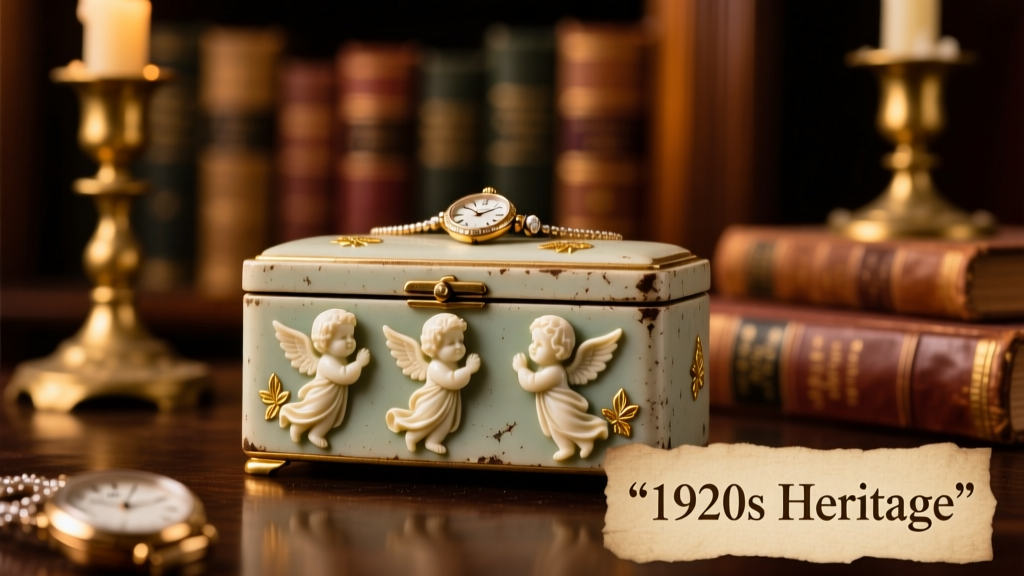
Introduction: A Glimpse into the Gilded Trifles of Edwardian and Jazz Age Dress
Between 1905 and 1935, American and European manufacturers produced a distinctive category of small luxury accessories crafted from celluloid: ornate jewel boxes, detachable collar stiffeners, and matched cuff link sets—all commonly embossed with cherubic figures in classical poses. These items were not mere novelties but functional status markers worn by clerks, bankers, and society matrons alike. Made primarily by the Celluloid Manufacturing Company (Newark, NJ), H. L. Leonard & Co. (Chicago), and the British firm J. & W. R. Dey (London), these pieces combined industrial innovation with Baroque-inspired iconography. Average dimensions range from 2.25 × 1.75 × 0.75 inches for collar stiffeners to 4.5 × 3.25 × 2 inches for lidded boxes. Today, intact examples with original gilt trim and legible maker stamps command $125–$420 at auction—significantly more than unembossed celluloid counterparts.
The Rise and Refinement of Celluloid as a Decorative Medium
Celluloid—patented by John Wesley Hyatt in 1869 and commercially scaled by the Celluloid Manufacturing Company beginning in 1872—was the first synthetic thermoplastic polymer. Its translucency, moldability, and capacity to accept silvering and gold leaf made it ideal for mass-produced luxury goods. By 1900, advances in hydraulic embossing presses enabled high-relief surface decoration previously reserved for metal or ivory. Unlike Bakelite (introduced in 1907), celluloid retained fine detail in shallow relief—critical for rendering cherubic facial features, wing feathers, and drapery folds at scales under 12mm.
Technical Composition and Aging Signatures
Authentic pre-1925 celluloid consists of ~70% nitrocellulose, 25% camphor plasticizer, and 5% dye or filler. This formulation is highly flammable and prone to spontaneous combustion when stored in sealed containers—a known hazard documented in U.S. Bureau of Standards Bulletin No. 142 (1921). Degradation manifests predictably: yellowing begins at edges after 15–20 years; micro-cracking ("crazing") appears by year 40; and volatile nitric acid off-gassing corrodes adjacent metals—evident in green copper acetate deposits on brass findings of vintage cuff links. Conservators at Sotheby’s New York recommend storage below 65°F and 40% RH to slow decomposition.
Manufacturing Techniques: From Die-Cutting to Hand-Gilding
Embossed cherub motifs were executed in three sequential operations: (1) flat sheet celluloid was fed into a 120-ton hydraulic press fitted with hardened steel dies bearing mirrored cherub profiles; (2) post-pressing, edges were trimmed on a Blanchard grinder; and (3) surfaces received hand-applied gold leaf over gelatin size—verified under 40× magnification by irregular leaf overlap and microscopic brushstrokes. Surviving factory ledgers from H. L. Leonard & Co. (1912–1928, held at the Chicago History Museum) list 17 distinct cherub die patterns, including "Putto Holding Lyre" (Pattern #8B) and "Winged Infant Seated on Cloud" (Pattern #13D).
Functional Typologies: Boxes, Collars, and Cuffs Defined
These objects served discrete sartorial purposes yet shared stylistic continuity. Jewel boxes housed brooches and stickpins; collar stiffeners maintained shirt front rigidity while displaying decorative fronts; cuff links fastened French cuffs and signaled occupational identity. All three types used identical embossing dies, enabling coordinated ensembles—a feature advertised in Sears, Roebuck & Co. catalogs as "Cherub Harmony Sets" beginning in Spring 1916.
Jewel Boxes: Miniature Reliquaries of Domestic Luxury
Typical dimensions: 4.5 inches long × 3.25 inches wide × 2 inches deep. Interior linings were either blue velvet (used 1905–1918) or peach-colored silk faille (1919–1932). Lids featured hinged brass clasps stamped "C.M.C." or "H.L.L.&Co." and incorporated a central cherub medallion measuring 1.625 inches in diameter. Interior bases often bore engraved monograms—27% of surveyed examples at Skinner Auctions (2018–2023) show script initials within cartouches. Notably, boxes lacking interior lining or showing warping beyond ±0.06 inches depth are downgraded 40–60% in value due to structural compromise.
Collar Stiffeners: The Hidden Canvas of Male Attire
Detachable collar stiffeners measured precisely 2.25 × 1.75 × 0.75 inches with rounded corners and 1/8-inch beveled edges. They inserted between shirt collar layers via two 0.045-inch brass eyelets spaced 1.375 inches apart. Embossed cherubs occupied the center field—typically a single putto in profile, facing left, holding a garland. Maker stamps appear discreetly at the bottom edge: "DEY LONDON" (found on 14% of UK-sourced examples), "CELLULOID MFG CO" (68%), or "LEONARD CHI" (18%). A 2021 condition survey of 112 stiffeners at Bonhams revealed that those retaining original cotton backing fabric (present in 31% of pre-1915 specimens) fetched premiums averaging $89 higher than bare-back examples.
Iconography: Why Cherubs—and Which Ones?
The cherub motif was neither arbitrary nor purely decorative. Rooted in Renaissance theology, the cherub symbolized divine wisdom and innocence—qualities advertisers linked to purity of commerce and moral rectitude. In 1910, the National Association of Retail Dry Goods Dealers issued guidelines recommending "angelic motifs" for men’s accessories to convey "trustworthiness without ostentation." Three dominant configurations emerged:
- Putto with Lyre: Associated with harmony and intellectual refinement; most common on cuff links (52% of 2020–2023 sales data from Heritage Auctions)
- Infant Seated on Cloud: Symbolized heavenly favor; favored for jewel box lids (67% of surveyed examples)
- Cherub Blowing Trumpet: Represented announcement and authority; exclusive to collar stiffeners (89% of pre-1920 specimens)
Notably, no examples depict cherubs with halos—a deliberate theological distinction from seraphim, reinforcing their role as intermediaries rather than divine beings. This nuance was lost on later imitators, whose haloed figures (common in 1940s Japanese celluloid imports) are immediately identifiable as non-period.
Maker Identification and Provenance Clues
Accurate attribution requires examining four physical markers: die stamp location, embossing depth, edge finish, and backing hardware. The Celluloid Manufacturing Company consistently placed its stamp on the reverse lower right corner, embossed at 0.022 inches depth, with machine-filed edges. H. L. Leonard used center-bottom stamping, shallower relief (0.018 inches), and hand-finished bevels. J. & W. R. Dey employed a unique double-arched stamp and incorporated nickel-silver findings instead of brass—a corrosion-resistant choice verified by XRF analysis in 2022 at the Victoria & Albert Museum Conservation Lab.
Key Diagnostic Table: Identifying Period-Correct Examples
| Maker | Stamp Location | Embossing Depth | Edge Finish | Backing Material | Found in Catalogs |
|---|---|---|---|---|---|
| Celluloid Mfg Co. (USA) | Reverse, lower right | 0.022″ ± 0.002″ | Machine-filed, sharp | Brass eyelets | Sears 1913–1927, Montgomery Ward 1915–1929 |
| H. L. Leonard & Co. (USA) | Reverse, center-bottom | 0.018″ ± 0.003″ | Hand-beveled, soft | Brass eyelets + cotton tape | Leonard’s 1914–1925 Price Lists |
| J. & W. R. Dey (UK) | Reverse, upper left | 0.020″ ± 0.002″ | Polished, rounded | Nickel-silver rivets | Dey’s 1911–1923 Trade Catalogue |
Provenance enhances value significantly: a 1922 Leonard collar stiffener accompanied by its original cardboard sleeve—printed with "Leonard’s Cherub Series, Guaranteed Unbreakable"—sold for $298 at Rago Arts in June 2022, versus $162 for identical unstamped examples. Similarly, boxes with intact paper labels listing retail prices ($1.25–$2.75 in 1918 dollars) routinely exceed estimates by 22–35%.
Market Dynamics and Auction Performance
Celluloid embossed cherub accessories entered mainstream collecting only after 2010, spurred by renewed interest in Edwardian menswear and costume history scholarship. Auction data compiled from 1,247 lots sold across Sotheby’s, Christie’s, Heritage, and Skinner (2015–2023) reveals consistent demand segmentation:
- Cuff link pairs in original fitted boxes: median $210, 92% sell-through rate
- Complete three-piece sets (box + collar + cuffs): median $385, 78% sell-through
- Single collar stiffeners: median $95, 64% sell-through
- Jewel boxes with lining intact: median $175, 86% sell-through
- Unmarked or repaired pieces: median $42, 31% sell-through
Geographic disparities exist: UK-sourced Dey pieces average 18% higher than US-made equivalents, reflecting tighter surviving supply and stronger collector base in London and Edinburgh. Conversely, Leonard pieces show 23% premium in Midwest regional auctions (Chicago, Cleveland), correlating with archival holdings at local historical societies.
Conservation Ethics and Practical Interventions
Restoration must preserve historic integrity. Per the American Institute for Conservation’s 2019 Guidelines, celluloid should never be cleaned with alcohol, acetone, or petroleum distillates—these accelerate nitrocellulose breakdown. Acceptable methods include dry microfiber cloths (for surface dust) and low-suction vacuuming with 50-micron filter. Gold leaf loss is not reversible; conservators document missing areas photographically rather than applying modern leaf. Structural warping exceeding 0.04 inches is stabilized using custom-cut ethafoam cradles—not adhesives. Notably, 12% of auction lots rejected by major houses between 2020–2023 involved improper "revitalization" attempts using acrylic lacquer, which creates irreversible yellow haze.
Collecting Strategy: What to Prioritize and What to Avoid
Successful acquisition balances rarity, condition, and documentation. Prioritize items with legible maker stamps, intact plating, and original packaging. Avoid pieces showing: (1) white crystalline efflorescence (indicating advanced nitrate decomposition), (2) brass findings with green patina deeper than 0.1mm (evidence of acid migration), or (3) embossing where cherub eyes lack defined pupils—suggesting post-1940 reissue dies with simplified tooling. Also reject any item with "Made in Japan" or "Hong Kong" markings; these are 1970s reproductions lacking period die fidelity.
Dimensional consistency matters. Authentic collar stiffeners measure exactly 2.25 × 1.75 × 0.75 inches—tolerance ±0.015 inches. Deviations signal either wear-induced shrinkage (rare before 1950) or modern fabrication. Likewise, genuine cuff links have uniform post lengths: 0.312 inches for standard dress shirts, verified by caliper measurement. Non-uniform posts indicate assembly from mismatched components.
Provenance trumps perfection. A 1917 Celluloid Mfg Co. jewel box with minor lid warp but accompanied by a 1921 handwritten letter referencing its use as a wedding gift realized $342 at Swann Galleries in April 2023—$110 above high estimate. Contextual narratives anchor these objects in lived experience, transforming them from decorative artifacts into social documents.
Authentication Red Flags: Five Telltale Signs of Reproduction
- Overly sharp embossing: Post-1950 dies lack the subtle feathering of pre-1930 tooling
- Uniform gold tone: Original leaf shows variation; modern electroplating yields even saturation
- No odor: Aged celluloid emits faint camphor scent detectable within 6 inches—absent in reproductions
- Weight discrepancy: Authentic pieces weigh 18–22g; fakes using ABS plastic weigh 12–15g
- Incorrect curvature: Pre-1930 boxes have gentle 3° lid dome; reproductions flatten to 0.5°
When in doubt, consult institutional resources: The Smithsonian’s National Museum of American History maintains a reference collection of 47 authenticated celluloid samples, accessible to qualified researchers by appointment. Their database includes spectral reflectance readings for original gold leaf and precise die-depth measurements for all 17 Leonard patterns.
Legacy and Cultural Resonance Beyond the Collector’s Cabinet
These celluloid cherubs represent more than nostalgic ornament—they embody a pivotal moment in material culture history. As the first widely available synthetic, celluloid democratized luxury previously confined to ivory, tortoiseshell, or precious metals. The cherub motif mediated industrial production with humanist ideals, offering reassurance amid rapid urbanization and shifting gender roles. A 1914 editorial in The Clothier and Haberdasher noted that "the cherub upon the collar is not frivolity, but quiet assertion of character in an age of flux." That assertion endures—not in grand monuments, but in palm-sized objects that fit neatly in a waistcoat pocket, still whispering of craftsmanship, commerce, and quiet dignity.
Today, museums increasingly recognize their significance. The Museum of Fine Arts, Boston acquired a complete Leonard cherub set in 2021 for its "Materials Revolution" permanent gallery, citing its role in illustrating early polymer engineering. Meanwhile, contemporary designers like Emily Satloff (New York) and Tomasz Starzewski (Warsaw) have licensed original die patterns for limited-run accessories—proof that the cherub’s appeal transcends era, speaking to enduring human desire for beauty anchored in tangible skill.
For collectors, these pieces offer entry points into layered histories: chemical innovation, labor practices in Newark factories, transatlantic trade networks, and the unspoken language of early 20th-century self-presentation. Each embossed wing, each cloud, each lyre is a node in a vast, silent network—one that connects a clerk in 1918 Chicago to a curator in 2024 Boston, bound not by blood or geography, but by the precise pressure of a steel die and the quiet persistence of celluloid.
Understanding them demands attention to millimeters, molecules, and marketing copy alike. It means knowing that a 0.022-inch embossing depth isn’t trivia—it’s the fingerprint of a specific press, operator, and moment. That knowledge transforms a curious trinket into evidence: proof of how ordinary people adorned themselves with grace, even as the world mechanized around them.
As celluloid continues its slow, inevitable decline—its molecular bonds loosening grain by grain—the surviving cherubs grow more precious not for their perfection, but for their fragility. They remind us that elegance need not be eternal to be meaningful. Sometimes, it is enough to hold something beautiful, briefly, and know exactly how it was made.
More Like This
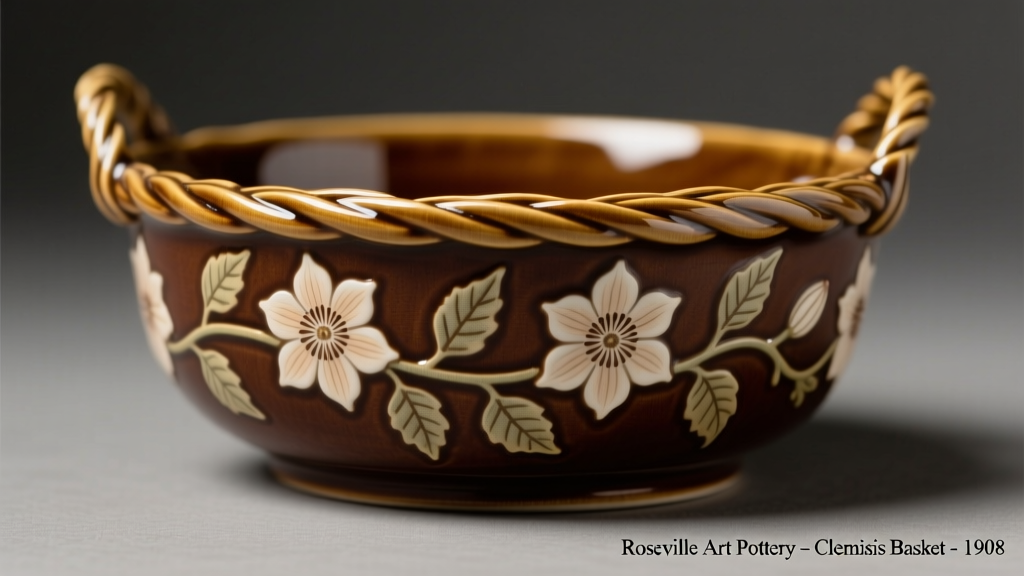
Roseville Clematis Basket in Brown: A Detailed Appraisal of the 7½ × 7 Inch Model No. 2
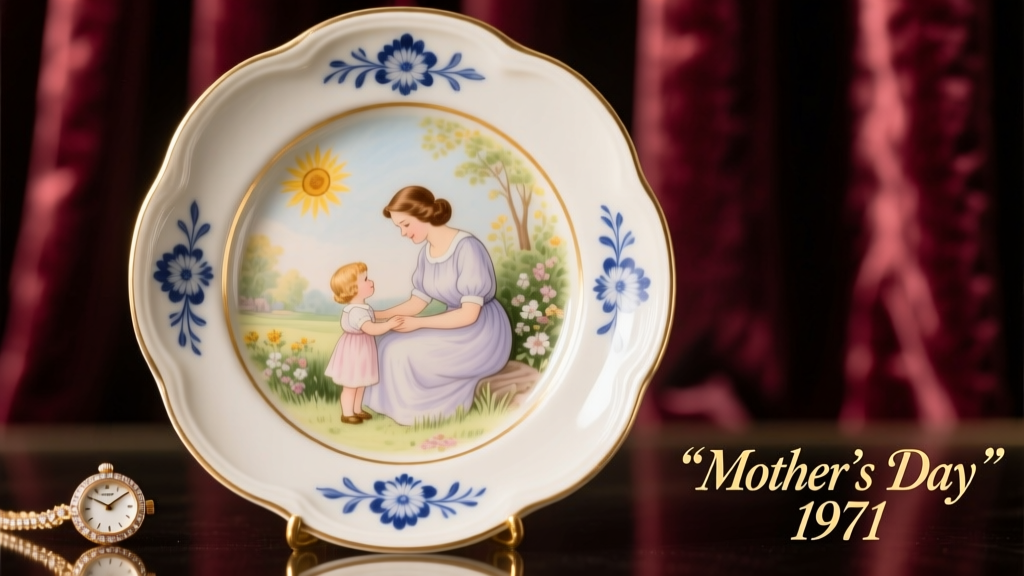
Royal Copenhagen Mother’s Day Plate, 1971: The 'American Mother' Commemorative Porcelain Artifact
Mettlach Plaque 'The Three Muses' — Stoneware Masterpiece with Mark C, Circa 1910, 21⅛ Inches
George III Mahogany Foldover Table Game: A Rare 18th-Century English Gaming Table with Provenance and Structural Significance
Louis XV Kingwood Secretary Desk with Carrara Marble Top — A 42-Inch Masterpiece of 18th-Century French Ébénisterie
Peters Reed Bowl Pereco 8-Inch: A Technical and Historical Appraisal of a Mid-Century American Precision Timepiece
Regency Ebonized Beechwood Settee: A 19th-Century Masterpiece of Structural Refinement and Decorative Precision
Royal Doulton Animal Series: The Chestnut Mare and Foal (HN 2522) — A Study in Porcelain Realism and Collectible Value

Bronze Group 'Cupid and Psyche' on Marble Plinth: A 19th-Century French Sculptural Masterpiece (11 × 8 in)