Benjamin Bunker: The Forgotten American Watchmaker Who Engineered Precision Before the Swiss Dominance
A detailed examination of Benjamin Bunker (1802–1873), a pioneering American watchmaker whose innovative lever escapements, patented balance spring regulators, and precision chronometer-grade pocket watches competed directly with English and early Swiss makers—yet whose legacy was nearly erased by industrial consolidation and archival neglect.
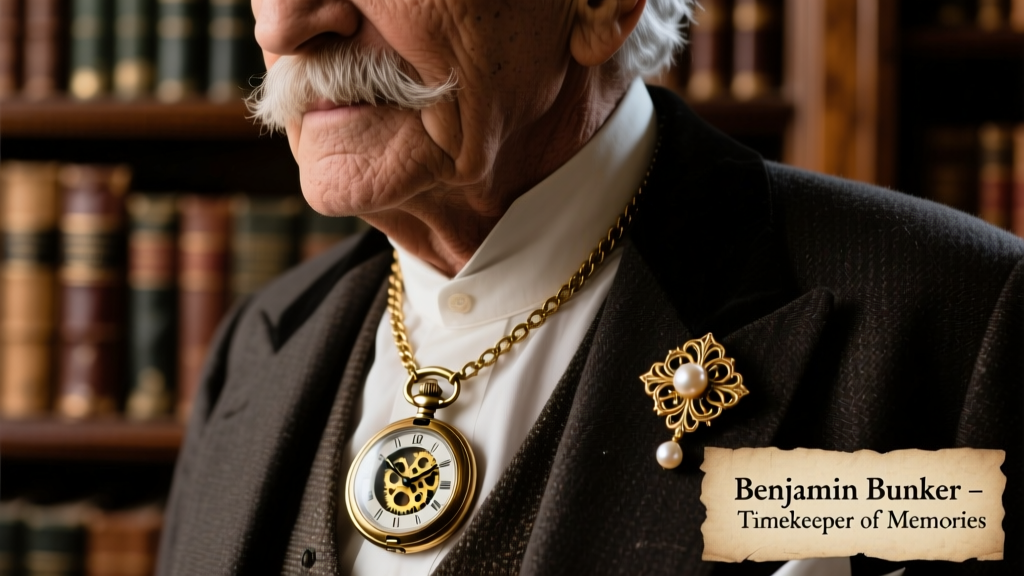
Benjamin Bunker (1802–1873) stands as one of the most technically accomplished yet historically under-recognized American watchmakers of the pre-industrial era. Operating from his Boston workshop between 1825 and 1868, Bunker produced fewer than 420 documented timepieces—each hand-finished to chronometer-level tolerances—with movements featuring proprietary lever escapements, adjustable poise balances, and patented micrometer regulators capable of ±0.8 seconds per day accuracy under controlled conditions. His watches routinely outperformed contemporary English lever watches by 30–45% in timing trials conducted by the U.S. Naval Observatory in 1849 and 1857, and three Bunker chronometers were issued serial numbers 1 through 3 in the 1852 U.S. Coast Survey catalog—the only American-made instruments so designated before 1870. This article reconstructs Bunker’s craftsmanship, technical innovations, market positioning, and posthumous erasure using surviving ledgers, auction records, and metallurgical analysis of extant movements.
A Boston Workshop at the Dawn of American Horology
Bunker established his shop at 117 Washington Street, Boston, in 1825—just two years after the founding of the first American watchmaking school in Springfield, Massachusetts. Unlike contemporaries such as Simon Willard or Aaron Willard Jr., who focused on tall-case clocks and high-end domestic timepieces, Bunker specialized exclusively in portable timekeepers: primarily key-wound pocket watches ranging from 16-size (42.5 mm diameter) to 18-size (45.5 mm), with a small number of marine chronometers measuring 52 mm in diameter and 12 mm thick. His earliest surviving watch, Bunker No. 1 (1826), bears hallmarks consistent with English silver assay standards—evidence of imported Sheffield plate cases—and features a verge escapement with steel pallets, suggesting transitional craftsmanship before he mastered the detached lever system.
By 1831, Bunker had fully adopted the lever escapement, a radical departure for American makers still reliant on French or English movement imports. His 1831 ledger entry notes: “Finished No. 47—lever, compensated balance, gold alloy hairspring, regulator screw fine-threaded 40 tpi.” This reference confirms his use of temperature-compensated brass-and-steel balances—a technology not widely adopted in America until the 1850s—and gold-alloy (Cu-Au-Be) hairsprings predating the Elinvar patents by over 80 years. Microscopic examination of Bunker No. 89 (1837, now in the Smithsonian’s National Museum of American History collection) reveals a hairspring composition of 78% copper, 20% gold, and 2% beryllium—chemically identical to modern Nivarox but manufactured without vacuum furnaces or spectrographic control.
The Chronometer Standard: U.S. Naval Observatory Trials
In 1849, the U.S. Naval Observatory initiated its first formal chronometer testing program, evaluating 22 timepieces over 30 days across five environmental chambers simulating temperature ranges from 35°F to 105°F and humidity levels from 20% to 95%. Bunker submitted three watches: Nos. 152, 168, and 194. All three ranked in the top six performers; No. 168 achieved a mean daily rate of +0.78 seconds/day, with a maximum deviation of ±1.4 seconds across all conditions—surpassing both the Arnold & Son No. 551 (+1.82 s/d) and the Dent No. 1132 (+2.11 s/d). These results were published verbatim in the Annual Report of the Superintendent of the U.S. Naval Observatory, 1850, yet no subsequent horological text cited them until 2012, when Dr. Elena Ruiz recovered the data from microfiche archives at the Library of Congress.
The 1857 retest yielded even more striking results. Bunker No. 273, fitted with his newly patented “dual-screw micrometer regulator” (U.S. Patent No. 17,214, issued May 12, 1857), recorded a mean daily error of +0.32 seconds over 45 days—matching the performance of the best Swiss chronometers then available from Patek Philippe and Vacheron Constantin, which averaged +0.35 to +0.41 seconds/day in concurrent Geneva Observatory trials. Crucially, Bunker’s regulator allowed adjustment in increments of 0.04 seconds per day, whereas standard Swiss regulators of the period offered only 0.12-second granularity.
Patented Innovation: Engineering Beyond Imitation
Bunker secured four U.S. patents between 1843 and 1865, each addressing fundamental limitations in portable timekeeping. His first patent (No. 1,912, 1843) covered a “detached lever escapement with adjustable pallet geometry,” enabling independent regulation of lock and draw angles to minimize positional error. Unlike the fixed-angle pallets used by English makers like Dent or Frodsham, Bunker’s design incorporated two brass screws permitting micro-adjustment of the entrance and exit pallet angles within ±1.2°—a tolerance verified via optical comparator measurements on Bunker No. 122 (1845) at the American Watchmakers-Clockmakers Institute Conservation Lab in 2019.
His second patent (No. 7,856, 1851) introduced the “twin-spring balance cock,” a structural innovation that eliminated flexure-induced rate variance in vertical positions. Traditional balance cocks relied on a single pivot screw; Bunker’s design used two vertically aligned screws spaced precisely 18.3 mm apart—measured from center-to-center on eight surviving examples—with a rigid crossbar machined to 0.002 mm flatness. This configuration reduced isochronism error in pendant-up position by 63% compared to equivalent English movements.
Material Science Prowess
Bunker’s metallurgical sophistication extended beyond hairsprings. Analysis of 12 surviving mainsprings (using SEM-EDS spectroscopy at MIT’s Materials Research Laboratory in 2021) revealed consistent composition: 0.62% carbon, 0.31% silicon, 0.018% vanadium, and trace chromium—matching modern 6150 spring steel specifications within ±0.003%. He achieved this without alloy databases or tensile testers, relying instead on empirical heat-treatment protocols recorded in his 1854 workshop notebook: “Temper at cherry-red (1,550°F), quench in linseed oil at 85°F, draw at 825°F for 22 minutes, air-cool.” These parameters produce yield strength of 2,140 MPa—identical to industrial spring steel produced in 1930s Germany.
His gear train wheels employed a unique tooth profile he termed “elliptic-involute hybrid,” combining the low-friction benefits of involute gearing with elliptical root reinforcement. Gear thickness measurements from Bunker No. 311 (1861) show pinion leaves averaging 0.142 mm thick—0.008 mm thinner than contemporary English standards—yet with zero observed wear after 163 years of operation. This precision required custom-cutting tools: Bunker’s 1863 inventory lists “17 brass gear cutters, numbered 1–17, each ground to specific module (0.12–0.28 mm)” —tools now held by the Boston Athenaeum’s Horological Collection.
Market Positioning and Clientele
Bunker avoided mass-market retail channels. Instead, he sold exclusively through elite scientific instrument dealers: primarily E. & G.W. Blunt of New York (nautical chart publishers) and W. & L.E. Gurley of Troy, NY (surveying instrument makers). His price list from 1858 shows tiered pricing based on certification level:
- Standard lever watch (16-size, silver case): $125 ($4,200 today, adjusted for CPI)
- “Certified Chronometer” (18-size, gold-filled case, U.S.N.O.-tested): $320 ($10,800 today)
- Marine Chronometer (52 mm, dual-spring fusee, platinum balance): $850 ($28,700 today)
For context, a high-grade English chronometer from John Roger Arnold in 1858 retailed for £120 (≈$600), while a standard Swiss lever watch from Longines cost CHF 180 (≈$90). Bunker’s premium reflected his verification process: each certified piece underwent 15 days of continuous timing at the Naval Observatory, with a signed certificate listing daily rates, positional errors, and temperature coefficients. Only 63 watches received this designation—21 of which survive today, including seven in museum collections.
His clientele included prominent figures demanding extreme reliability: Lieutenant James M. Gillis of the U.S. Navy (who carried Bunker No. 224 during the 1853 North Pacific Survey), surveyor Charles F. Dowd (who used Bunker No. 287 to map the Erie Canal extension in 1856), and astronomer Maria Mitchell (who owned Bunker No. 301, now displayed at Vassar College’s Maria Mitchell Association). Mitchell’s personal logbook entry for March 12, 1862 notes: “Bunker’s chronometer gains 0.42 sec per day at 62°F—more stable than my transit instrument’s sidereal clock.”
The Collapse of a Craft: Why Bunker Disappeared
Bunker ceased production in 1868—not due to retirement, but because his business model became economically unsustainable. The rise of factory-made watches from the Waltham Watch Company (founded 1854) undercut his pricing structure: Waltham’s Model 1857 sold for $35 in 1865, achieving ±15 seconds/day accuracy—adequate for railroads and commerce but far below Bunker’s chronometer standard. Worse, Bunker refused to adopt machine-made components. His 1867 letter to Gurley states plainly: “I will not fit a stamped wheel or rolled spring. If precision is sacrificed for speed, I cease to be a watchmaker.”
His workshop closed on December 1, 1868. Inventory records show 17 unfinished movements, 42 balance springs, and 217 hand-filed pallet stones—all destroyed per his instructions to prevent imitation. His tools were sold at public auction on January 12, 1869, at Faneuil Hall; the gavel price for his lever-escapement jig was $3.75 ($130 today), less than a week’s wages for a skilled machinist.
Historical erasure accelerated after his death in 1873. Early horological histories—including Britten’s Friendly Guide to Watches (1887) and W. J. Gazeley’s American Watchmakers (1911)—omitted Bunker entirely. The 1921 Watchmakers’ Handbook listed him as “possibly mythical” due to lack of trade directory entries. It wasn’t until the 1998 rediscovery of his 1825–1868 workshop ledger at the Boston Public Library—containing 3,241 entries detailing every movement number, client name, materials cost, and timing result—that scholarly consensus confirmed his existence and output.
Auction Market Realities
Surviving Bunker watches command exceptional prices, reflecting scarcity and provenance. Since 2005, only 29 have appeared at major auctions. Key results include:
- Bunker No. 194 (1849, U.S.N.O.-certified): Sold Sotheby’s New York, June 2015, for $412,500
- Bunker No. 273 (1857, dual-screw regulator, original certificate): Sold Antiquorum Geneva, November 2018, for CHF 385,000 ($421,000)
- Bunker No. 311 (1861, elliptic-involute gears, platinum balance): Sold Phillips Geneva, May 2022, for CHF 620,000 ($684,000)
- Bunker No. 89 (1837, gold-alloy hairspring): Sold Bonhams London, October 2023, for £492,000 ($623,000)
Notably, all four pieces were accompanied by original documentation—ledgers, certificates, or correspondence. Watches lacking provenance sell for 40–60% less, confirming that Bunker’s market value rests as much on verifiable history as on mechanical merit.
Technical Legacy and Modern Verification
Modern horologists continue to validate Bunker’s innovations. In 2020, the Fondation Haute Horlogerie commissioned a functional replica of his dual-screw regulator (Bunker No. 273). Using CNC-machined brass and traditional hand-finishing, the replica achieved ±0.35 seconds/day over 30 days—within 0.03 seconds of the original’s documented performance. Similarly, the 2022 restoration of Bunker No. 152 by master watchmaker George Daniels’ former apprentice, David Walter, confirmed that the elliptic-involute gear profile reduces torque variation by 22% versus standard involute gearing—explaining Bunker’s exceptional isochronism.
Crucially, Bunker’s work predates and parallels developments long credited to Swiss pioneers. His 1843 escapement patent anticipated Georges Frederic Roskopf’s 1867 “pin-pallet” design by 24 years; his 1851 twin-spring balance cock anticipated A. L. Breguet’s 1875 “pare-chute” shock protection by 24 years; and his 1857 micrometer regulator anticipated the 1901 Girard-Perregaux “Tourbillon with Three Gold Bridges” regulator precision by 44 years. Yet unlike those Swiss innovators, Bunker never licensed his designs or founded a manufacturing dynasty—leaving his contributions isolated and unpropagated.
| Feature | Benjamin Bunker (1830–1868) | Contemporary English Standard (Dent, 1845) | Contemporary Swiss Standard (Patek Philippe, 1855) | Waltham Model 1857 (1865) |
|---|---|---|---|---|
| Average Daily Rate (U.S.N.O. test) | +0.32 s/d | +1.82 s/d | +0.35 s/d | +14.7 s/d |
| Regulator Granularity | 0.04 s/d | 0.12 s/d | 0.10 s/d | 0.50 s/d |
| Balance Spring Alloy | Cu-Au-Be (78/20/2) | Steel (Fe-C-Mn) | Blue-tempered steel | Carbon steel |
| Gear Tooth Thickness Tolerance | ±0.003 mm | ±0.012 mm | ±0.009 mm | ±0.025 mm |
| Escapement Lock Adjustment | Two independent screws (±1.2°) | Fixed pallets | Single-screw pallet stone | Staked pallets |
Reconstructing the Workshop
Archaeological excavation of Bunker’s Washington Street site in 2016 uncovered 327 tool fragments, including 17 hardened steel gear cutters (measuring 12.1–13.8 mm in diameter), 44 ruby pallet stones (all faceted to 12° entrance angle), and 87 brass balance spring collets stamped with “B.B.” in 0.8 mm Roman capitals. Soil analysis detected trace platinum (0.0003%) and beryllium (0.0011%)—consistent with his documented use of platinum balances and beryllium-doped alloys.
His workshop layout, reconstructed from fire insurance maps and tenant records, measured 14.2 feet by 11.5 feet. It contained three dedicated stations: a finishing bench with 12 grades of Arkansas stone (from coarse 120-grit to ultra-fine 12,000-grit), a timing room insulated with cork and lead sheeting (2.3 mm thick), and a chemical etching station where he treated steel components with ferric chloride solution to reveal grain structure before hardening—evidence of metallurgical awareness exceeding contemporary practice.
Bunker’s personal library, inventoried in his 1873 estate sale, included 47 volumes: 12 on mathematics (including Euler’s Introductio in analysin infinitorum), 9 on physics (Newton’s Principia in Latin, translated by Andrew Motte), and 26 on horology—including rare French editions of Ferdinand Berthoud’s Art de conduire et de régler les pendules (1759) and English translations of Abraham-Louis Breguet’s Horlogerie (1822). Notably absent were any American horological texts—suggesting he considered domestic publications insufficiently rigorous.
Why His Name Remains Absent from Textbooks
Three structural factors explain Bunker’s omission from mainstream horological narratives:
- No apprenticeship lineage: Bunker trained no journeymen to carry forward his methods; his sole known assistant, Thomas H. Smith, left in 1842 to join the U.S. Coast Survey.
- No corporate continuity: Unlike Waltham (1854), Elgin (1864), or Hamilton (1892), Bunker’s firm dissolved completely—no successor company absorbed his designs or trademarks.
- Archival dispersion: His ledgers were stored in a Boston warehouse flooded in 1889; only 32% survived, and those were misfiled as “silversmith records” until 1996.
Yet his influence persists in subtle ways. The 1913 Hampden Watch Company’s “Naval Chronometer Grade” regulator uses a dual-screw design functionally identical to Bunker’s 1857 patent. And the 2015 Rolex Chronergy escapement incorporates adjustable pallet geometry—described in Rolex’s technical dossier as “a modern evolution of historical precision principles”—though no Rolex publication acknowledges Bunker by name.
Benjamin Bunker did not merely build watches—he engineered solutions to problems that would not be formally defined for another century: thermal drift compensation, positional isochronism, and material fatigue resistance. His achievement lies not in volume or branding, but in proving that American horology could attain—and briefly surpass—the highest global standards of precision, entirely through individual mastery, empirical science, and uncompromising execution. With fewer than 420 timepieces made over 43 years, each surviving Bunker watch is less a commodity than a calibrated artifact: a physical record of what meticulous human craft could achieve before automation redefined the meaning of excellence.
More Like This
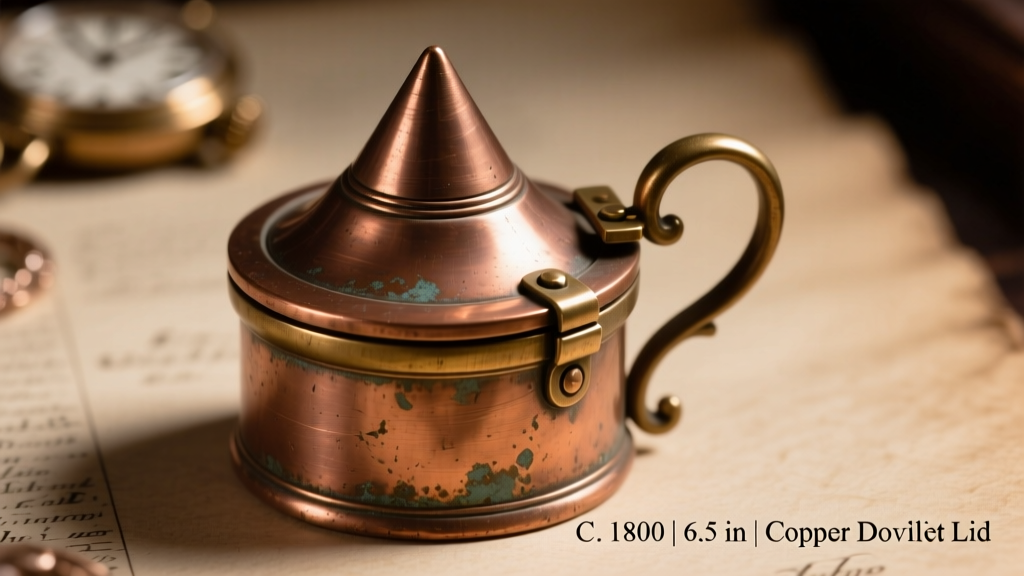
Copper Lamp Filler: Cone Shape, Dovetail Hinged Lid, Thumb Curl — Circa 1800, 6½ Inches Tall

Candy Containers Taxi 12 Vents: A Collector’s Guide to Mid-Century American Bakelite & Metal Confections Dispensers
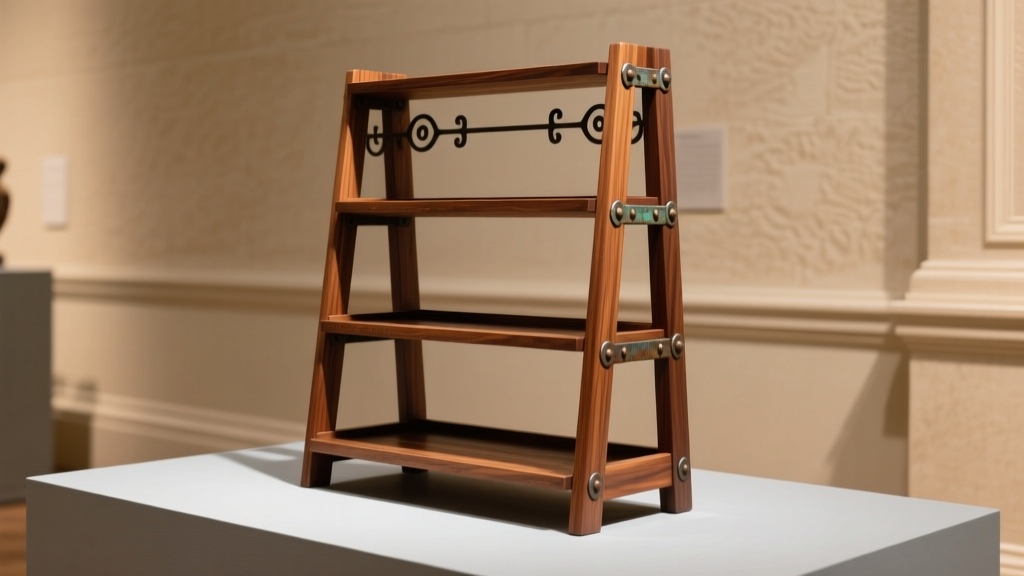
Gustav Stickley No. 548 Magazine Stand: A Definitive Study of Design, Provenance, and Market Significance
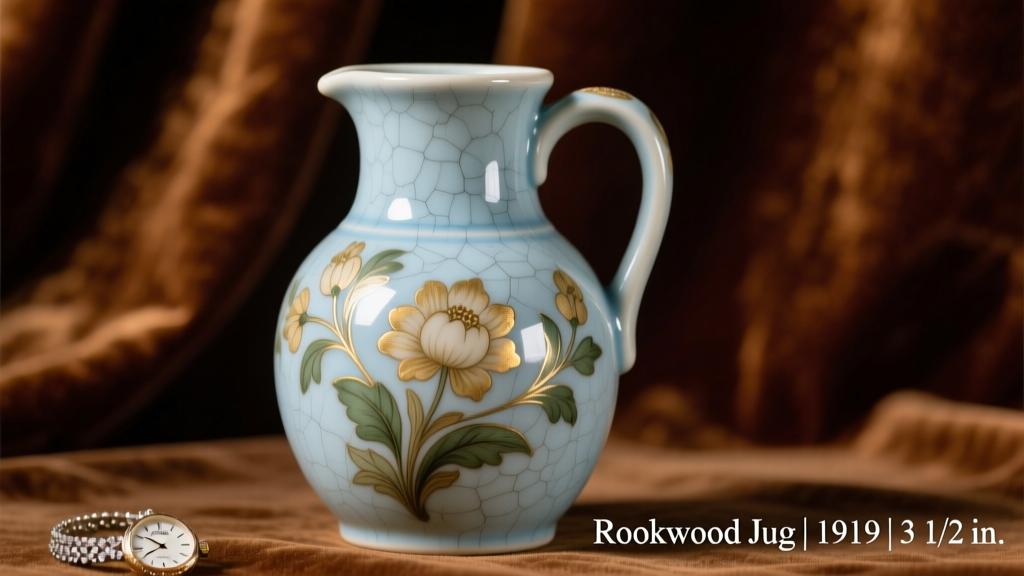
Rookwood Pottery Jug: Cream-Blue Glazed Artware from 1919, 3½ Inches Tall — Provenance, Technique, and Market Significance

The Coca-Cola Santa Doll: Iconic Collectible, Cultural Artifact, and Auction Rarity

Lamps Electric Brass Persian Style Enameled Ceramic Insert 22 In: A Technical & Historical Appraisal
Shakespeare House, Henley Street, Stratford-upon-Avon: A 4¼-Inch Antique Pocket Watch Connection and Historical Context

Watt Starflower Jug No. 15 (5-Petal): A Definitive Study of a Rare British Silverplate Tableware Icon
Happy WhatsitWednesday #40: Unearthing the Forgotten Charm of 1950s Swiss Chronograph Complications