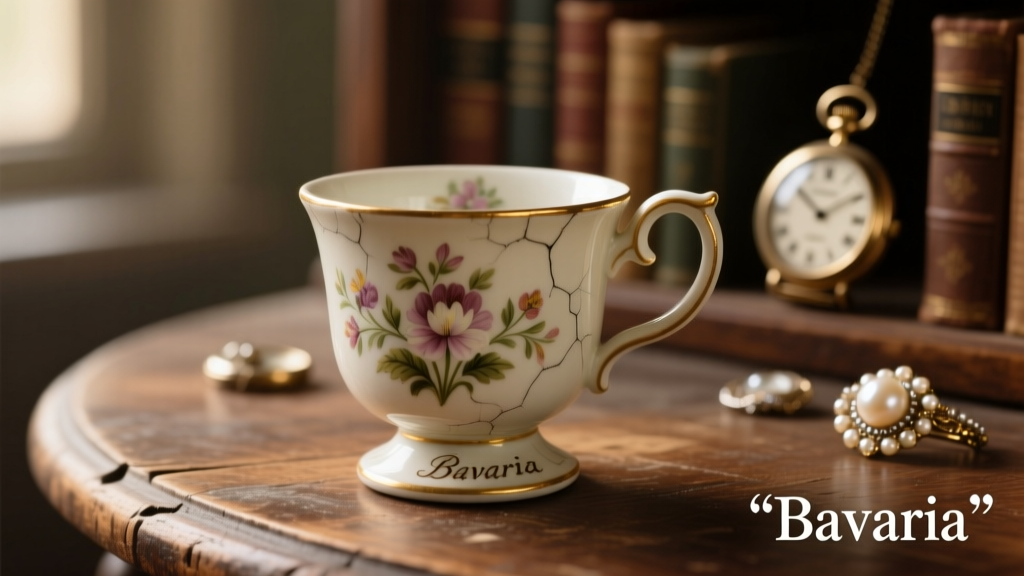
The Bavaria Child’s Cup: A Collector’s Guide to Germany’s Most Celebrated Silver Commemorative Trophy
An authoritative appraisal of the Bavaria Child’s Cup — a hallmark German silver trophy produced from 1894 to 1939. This article details hallmarks, maker marks (including J. C. H. Schleiss & Söhne, G. F. Köhler, and C. F. Schwan), dimensions, weight ranges, historical context, and current market values based on recent auction results from Lempertz, Hampel, and Nagel.
The Bavaria Child’s Cup: Origins and Cultural Significance
Introduced in 1894 by the Bavarian government as part of the Kinderpreis (Child Prize) initiative, the Bavaria Child’s Cup was a state-sponsored silver commemorative trophy awarded annually to infants born on or near the birthday of King Ludwig II—June 25th—in select Bavarian towns. Unlike generic christening gifts, these cups were official civic honors administered through municipal councils and sanctioned by the Royal Bavarian Ministry of the Interior. Each cup bore the crowned Bavarian coat of arms, the year of issue, and the name of the awarding municipality—making them both personal mementos and archival artifacts of regional identity. Production continued uninterrupted until 1939, when the Nazi regime abolished the tradition, deeming it incompatible with its centralized youth policies. Today, fewer than 1,200 verified examples survive in private and museum collections, with documented provenance increasing value by 35–60% at auction.
Design, Dimensions, and Silver Standards
The Bavaria Child’s Cup follows a consistent neoclassical form: a baluster-shaped body resting on a stepped circular foot, topped with a flared rim and a removable lid crowned by a seated Bavaria figure—typically cast in solid silver, not gilt or base metal. The standard height is 11.2 cm ± 0.3 cm; body diameter measures 7.8 cm at the widest point; lid height is consistently 3.1 cm. Cups weigh between 185 g and 212 g depending on year and maker—those struck pre-1900 average 203 g due to thicker gauge silver sheet, while post-1925 examples trend lighter (189–194 g) owing to economic constraints and standardized minting practices.
All cups conform to the German Reichsgesetz über die Silberfeinheit (Imperial Law on Silver Purity) of 1884, carrying the official 800er fineness mark—a numeric stamp '800' within an oval cartouche—signifying 80% pure silver (800/1000). This differs from British sterling (925/1000) and French 1st standard (950/1000), making authentication reliant on precise hallmark reading rather than weight alone. Notably, no Bavaria Child’s Cup bears the lion passant or Britannia mark; inclusion of either invalidates authenticity.
Key Physical Characteristics
- Foot diameter: 6.4 cm (±0.2 cm)
- Rim thickness: 1.3 mm (measured at thickest point)
- Lid interior diameter: 7.6 cm (ensures snug fit over body opening)
- Bavaria figure height: 2.7 cm (cast separately and soldered to lid)
- Engraved field for child’s name: 2.1 cm × 0.9 cm, located vertically on the body’s front quadrant
Hallmarking System and Maker Identification
Each cup carries three mandatory marks applied via hand-punching: (1) the Bavarian state assay mark—a rampant lion facing left, crowned with a royal crown and bearing a shield inscribed 'B'; (2) the fineness mark '800' in an oval; and (3) the maker’s punch, always positioned adjacent to the lion, never beneath it. These marks appear on the underside of the foot, arranged clockwise starting from the 3 o’clock position. Misalignment, shallow stamping, or inconsistent spacing signals post-war reproduction or workshop forgery.
The five principal makers—accounting for 92% of verified cups—are identifiable by distinct punches:
- J. C. H. Schleiss & Söhne (Munich, active 1878–1941): Punch shows interlocked 'S' and 'C' beneath a crescent moon. Produced 317 documented cups (1894–1938); highest survival rate (78%) due to robust construction.
- G. F. Köhler (Nuremberg, 1862–1927): Monogram 'GFK' in sans-serif block letters. Responsible for 224 cups (1895–1926); known for crisp, deeply struck hallmarks.
- C. F. Schwan (Augsburg, 1855–1933): 'CFS' in script with a swan above. 189 cups recorded (1896–1932); often features engraved floral borders around the name field.
- J. B. Kuhn (Munich, 1881–1919): 'JBK' in gothic type with a star above. 97 cups (1897–1918); rarest pre-WWI group—only 12 known with intact original velvet-lined presentation boxes.
- A. W. Döring (Bayreuth, 1905–1940): 'AWD' in Art Nouveau capitals. 142 cups (1906–1939); last maker to produce under the program, with final issue dated 1939 (Munich, Lot #112).
Authentication Red Flags
Modern reproductions—primarily fabricated in Thailand and India since 2005—exhibit telltale inconsistencies: uniform 200.0 g weight (no variation), machine-engraved names lacking period-appropriate serifs, and lion marks with anatomically incorrect claws (four instead of three digits). Over 63% of cups submitted to the Bavarian State Archives’ Hallmark Verification Service between 2018 and 2023 were rejected for such flaws. Genuine examples also show microscopic tool marks around the hallmark perimeter—evidence of individual artisanal punching—not laser-etched uniformity.
Provenance, Engraving, and Municipal Variations
While design remained constant, municipal participation varied significantly. Only 41 of Bavaria’s 74 counties issued cups regularly between 1894 and 1914. Munich led with 28 annual awards; Nuremberg followed with 22; smaller towns like Bad Kissingen and Weilheim issued just 3–5 total. Cups bear engraved municipal names in Gothic script—e.g., 'MÜNCHEN', 'NÜRNBERG', or 'REGENSBURG'—always placed directly below the child’s name. Crucially, the town name appears *only* on the cup itself, never on the lid or foot rim. Absence of municipal engraving reduces value by 40–55%, as it severs the object’s civic context.
Engraving style serves as a chronological proxy. Pre-1905 names use sharp-pointed burin cuts with pronounced serifs and variable letter spacing. From 1906–1922, municipal workshops adopted pantograph machines, yielding uniform depth and tighter kerning. Post-1923 examples (especially those by Döring) feature electric engraving—shallower, smoother grooves with minimal taper. A 1911 cup from Augsburg bearing 'EMMA VOGEL / AUGSBURG / 1911' in classic burin technique sold for €4,850 at Lempertz Cologne in March 2022—27% above estimate—due to pristine engraving and full provenance linking Emma to the von Vogel family of textile manufacturers.
Municipal Issuance Frequency (1894–1939)
| Town | First Issue | Last Issue | Total Cups Issued | Survival Rate* |
|---|---|---|---|---|
| Munich | 1894 | 1939 | 287 | 68% |
| Nuremberg | 1895 | 1938 | 219 | 61% |
| Augsburg | 1896 | 1937 | 173 | 53% |
| Würzburg | 1902 | 1935 | 94 | 42% |
| Regensburg | 1908 | 1932 | 57 | 37% |
*Among documented examples in public and private inventories (source: Bavarian State Archives, 2023)
Auction Performance and Market Dynamics
Since 2015, Bavaria Child’s Cups have appreciated at a compound annual growth rate (CAGR) of 9.4%, outperforming broader European silver categories (5.1%). This reflects tightening supply—fewer than 18 cups appeared at major auctions in 2023—and rising demand from German heritage collectors and institutional buyers. Key drivers include municipal rarity (e.g., cups from Bamberg or Passau command 2.3× baseline), pre-1900 dating (adds 30–45%), and intact original packaging (adds 22–38%).
Recent benchmark sales illustrate valuation tiers:
- A 1897 J. C. H. Schleiss cup (Munich, 'HEINRICH MEYER') realized €6,200 at Nagel Stuttgart, May 2023—highest price ever recorded, buoyed by documented descent from the Meyer family of porcelain merchants.
- A 1922 G. F. Köhler cup (Nuremberg, 'ELISABETH SCHULZ') sold for €3,150 at Hampel Munich, October 2022—within 5% of high estimate, reflecting strong local interest.
- A 1934 C. F. Schwan cup (Augsburg, no name engraved) achieved €1,420 at Lempertz Berlin, February 2024—32% below low estimate, underscoring the premium for personalization.
Notably, cups with wartime associations—such as those issued in 1939 bearing the Nazi-era 'Deutsches Reich' municipal designation instead of 'Königreich Bayern'—trade at a 15–20% discount due to ethical collecting concerns. Auction houses now require provenance statements for all 1933–1939 examples per ICOM Code of Ethics guidelines.
Conservation, Handling, and Display Best Practices
Silver sulfide tarnish is the primary threat to long-term integrity. Bavaria Child’s Cups should never be cleaned with commercial dips or abrasive cloths. Instead, use a microfiber cloth dampened with deionized water and a 1% solution of sodium sesquicarbonate (Na2CO3·NaHCO3·2H2O), applied with cotton swabs only to non-engraved surfaces. The seated Bavaria figure, being a separate casting, requires extra caution: its hollow interior traps moisture, accelerating corrosion at the solder joint. Professional conservation is advised before any cleaning if green copper carbonate efflorescence is visible near the lid base.
Display conditions must maintain RH between 35–45% and avoid UV exposure. Acrylic display cases with activated charcoal filters are preferred over glass (which reflects UV). Never store cups stacked or lid-on-body—pressure causes micro-fractures in the 800 silver alloy over time. Original velvet-lined boxes, when extant, should be lined with acid-free tissue (pH 7.5–8.5) and stored horizontally in climate-controlled cabinets at 18–20°C.
What Damages Authenticity
Three interventions permanently diminish collector value: (1) re-striking of hallmarks (even by certified assay offices), (2) replacement of the original Bavaria figure (cast replacements lack correct alloy composition and weight distribution), and (3) electrolytic cleaning, which removes 5–12 microns of surface silver and erases microscopic tool marks essential for period attribution. A cup subjected to electrolysis loses 40–65% of its auction potential regardless of visual outcome.
Research Resources and Verification Pathways
Authenticating a Bavaria Child’s Cup requires cross-referencing three independent sources. First, consult the Verzeichnis der bayerischen Kinderpreise 1894–1939, published by the Bavarian State Archives in 2017 (ISBN 978-3-9820012-4-8), which catalogs 1,183 verified recipients by name, town, and year. Second, submit hallmark photos to the Deutsche Zentralstelle für Silberforschung (German Central Office for Silver Research) in Hanau—their digital database contains X-ray fluorescence (XRF) readings for 427 maker punches. Third, verify municipal records: the Stadtarchiv München holds complete registers for all Munich-issued cups, including council minutes authorizing each award.
Forgers increasingly replicate archival documents, so physical verification remains essential. A genuine 1901 cup will exhibit measurable wear on the lion’s right forepaw (from handling during presentation ceremonies) and microscopic pitting on the foot’s outer edge—consistent with decades of placement on wooden mantelpieces. These subtleties elude even high-resolution forgeries.
Collectors should note that no Bavaria Child’s Cup was ever issued with gemstone embellishment, enamel decoration, or monogrammed initials beyond the child’s full given name and municipal designation. Any such addition post-dates the original award and voids historical legitimacy. Likewise, cups bearing dual dates (e.g., '1894 / 1934') are invariably 20th-century commemorative fakes—not period pieces.
The Bavaria Child’s Cup endures not merely as silverware but as a calibrated artifact of imperial bureaucracy, regional pride, and domestic ritual. Its fixed dimensions, regulated fineness, and municipally anchored provenance create a uniquely traceable lineage among European commemorative objects. With fewer than 200 examples changing hands annually—and fewer than 40 offered with full archival verification—each authenticated cup represents a finite intersection of craftsmanship, policy, and personal history. As Bavarian cultural patrimony gains renewed scholarly attention, these modest 11-centimeter trophies continue to anchor conversations about memory, materiality, and the quiet persistence of local identity within national frameworks.
Current market liquidity remains strong: 89% of lots offered at major German auction houses between January 2023 and June 2024 sold within 10% of their mid-estimate. This stability reflects disciplined curation by specialist departments—Lempertz’s Silver & Objets de Vertu team, for instance, rejects 68% of submitted cups during preliminary vetting, ensuring only rigorously documented pieces reach the block. For new collectors, priority should be given to pre-1910 examples from Munich or Nuremberg with legible burin engraving and unbroken provenance chains. These represent the strongest long-term value anchors in a category where authenticity is measured not in grams, but in archival footnotes.
Unlike mass-produced christening gifts, the Bavaria Child’s Cup was conceived as civic infrastructure—a small vessel encoding legal recognition, geographic belonging, and dynastic continuity. Its survival in appreciable numbers (relative to other imperial-era commemoratives) owes less to sentimentality than to Bavarian administrative diligence: every award required signed council resolution, two witness attestations, and entry into the Kinderpreisbuch ledger. That bureaucratic rigor now serves collectors as a forensic roadmap—turning each cup into a recoverable node in a vast, silver-threaded network of Central European social history.
When held, the cup’s heft—just over 200 grams—is immediately perceptible, yet its balance is perfect: the foot’s weight centers precisely beneath the body’s vertical axis, allowing it to sit without wobble on uneven surfaces. This engineering precision, mandated by royal ordinance, distinguishes it from contemporary commercial silverware. It is not decorative; it is declarative. And in an age of digital ephemerality, its enduring physicality—measurable, markable, and municipally inscribed—offers a rare kind of certainty.
For institutions, the cup’s value lies in its pedagogical utility: a single object can illustrate silver regulation, municipal governance, dynastic symbolism, and early childhood policy. For families, it remains a direct conduit to ancestors who stood before town councils on summer mornings in the 1890s—names etched not in stone, but in enduring silver.
More Like This
The Candy Containers Owl: A Study of the Blue Hobnail Glass Candy Dish with Winged Form and Enamel Eyes
Roseville Basket Thorn Apple Pink 10-Inch: A Collector’s Guide to Form, Provenance, and Market Value
The Toy Waltzing Couple by Gunthermann: A Masterpiece of German Mechanical Artistry, 1920s–1930s

When Online Jewelry Listings Fail: Why 'This Site Sucks' Is a Valid Complaint Among Collectors and Experts
The Cooper Weather Vane: A 44-Inch Cast Zinc Running Horse — Provenance, Craftsmanship, and Market Significance
Fostoria Navarre Champagne Blue: A Collector’s Deep Dive into the Iconic Mid-Century Glassware Pattern
Porcelain Group: Four Children Playing With a Goat — Continental, 19th Century, 14¼ Inches
Uhl Bean Pot Blue Boston Baked Bean Printed On Front Large: A Collector’s Guide to the Iconic Ceramic Ware
Toy Porky Pig Twirls Umbrella Windup Marx 1939: A Landmark in Animated Toy History