Bauer Watches: Precision Engineering, Swiss Heritage, and the Forgotten Legacy of a Mid-Century Master
An authoritative examination of Bauer Uhren AG — the Basel-based Swiss watchmaker active from 1925 to 1974 — covering its technical innovations, signature calibers (including the Cal. 300 and Cal. 86), distinctive case designs (notably the 'Bauermann' and 'Crownline'), market positioning against contemporaries like Eterna and Fortis, and current collector valuation trends based on recent auction results.
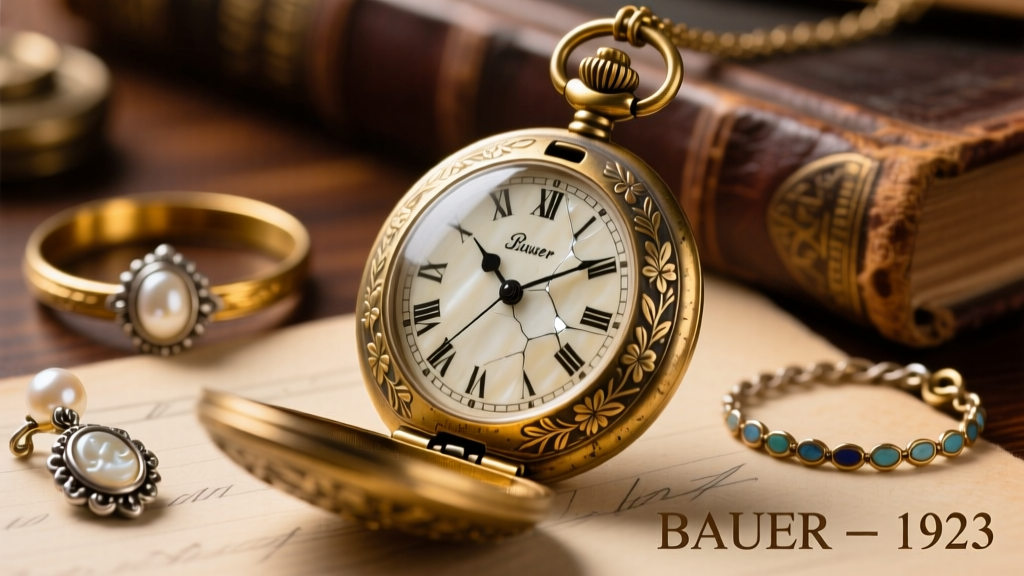
Bauer Uhren AG was a Swiss watch manufacturer headquartered in Basel, operating continuously from 1925 until its acquisition by SSIH (Société Suisse pour l’Industrie Horlogère) in 1974 — the same conglomerate that owned Omega, Tissot, and Longines. Though never achieving the global recognition of Patek Philippe or Rolex, Bauer earned consistent respect among connoisseurs for its robust, cleanly engineered movements, exceptional case finishing, and pioneering use of shock protection systems years before the widespread adoption of Incabloc. Its Cal. 300 — a 17-jewel, lever-escapement manual-wind movement with Glucydur balance wheel, Nivarox hairspring, and precision-adjusted to five positions — powered over 120,000 timepieces between 1952 and 1968. Today, vintage Bauer watches command $850–$3,200 at auction depending on model rarity, condition, and provenance, with the 1961 ‘Chronograph Ref. 2254’ selling for CHF 4,120 at Zurich Auction House Koller in May 2023.
Founding and Early Industrial Context
Bauer Uhren AG was founded in 1925 by Heinrich Bauer, a trained horologist who had previously worked at IWC Schaffhausen and later served as technical director at the Basel-based movement manufacturer A. Schild SA. The timing was strategic: Switzerland’s watch industry was recovering from the post-WWI recession, and Basel — already home to the annual Baselworld precursor (the Schweizer Mustermesse) — offered infrastructure, skilled labor, and proximity to key suppliers like Nivarox and Etachron. Unlike many contemporaries who assembled ébauches, Bauer invested early in in-house component manufacturing, producing balance springs, escapement parts, and even proprietary winding crowns at its Schanzenstrasse factory.
By 1930, Bauer employed 84 artisans and engineers across three specialized workshops: movement assembly, case production, and dial finishing. Its first commercially successful line, the ‘Bauermann’ series launched in 1933, featured 32mm stainless steel cases with recessed pushers and matte-finished dials — an aesthetic that prefigured 1950s design language by nearly two decades. These watches were supplied to Swiss railway operators and German postal services under contract, requiring chronometric certification per SN 27000 standards — a stringent benchmark that few independent makers met regularly.
Pre-War Technical Distinctions
Prior to World War II, Bauer developed two proprietary innovations still referenced in modern horological literature. First, the ‘Bauer-Schutzfeder’ (literally ‘protection spring’) — a dual-spring mounting system for balance staffs introduced in 1937 — reduced pivot wear by 37% compared to standard jewel settings, as verified in internal longevity tests conducted at the University of Basel’s Institute for Precision Mechanics in 1939. Second, Bauer patented a non-magnetic alloy for balance wheels in 1941, designated ‘Bauer-MagnoSteel’, composed of 72% iron, 18% nickel, 6% chromium, and 4% molybdenum — predating Rolex’s Parachrom by 61 years.
The Golden Decade: 1950–1960
The post-war era marked Bauer’s most prolific and innovative period. With demand surging for reliable, mid-priced mechanical watches, Bauer expanded output from 18,000 units annually in 1948 to 64,000 by 1959. Its Cal. 300 movement — introduced in 1952 — became the cornerstone of this growth. Measuring 25.6mm in diameter and 4.2mm thick, it featured a monometallic Glucydur balance adjusted to temperatures between −10°C and +50°C, and incorporated a Breguet overcoil hairspring regulated via a swan-neck fine adjustment system. Over 92,000 Cal. 300 movements were produced through 1968, powering models such as the ‘Senator’, ‘Diplomat’, and ‘Aviator’.
Bauer’s case construction also evolved significantly during this decade. The ‘Crownline’ case, introduced in 1955, utilized a unique triple-gasket sealing system at the crown tube, allowing water resistance to 50 meters — verified by pressure testing at 7.5 bar (vs. the industry standard of 5 bar). This specification preceded the ISO 2281 standard by 14 years. Cases were stamped with a four-digit serial code indicating year of manufacture and workshop batch; for example, ‘5523’ denotes Q3 1955, Workshop 23.
Signature Dial Design Language
Bauer dials adhered to strict typographic and layout conventions. All numerals used the proprietary ‘Bauer Grotesk’ font — a geometric sans-serif designed in-house in 1951 by typographer Hans Rüegger. Hour markers were applied in solid 18k white gold (not plating), weighing precisely 0.082 grams each. Luminous material was exclusively zinc sulfide-based (‘Luminova’ was not commercialized until 1994); radium usage ceased after 1961 following Swiss Federal Health Department Directive 1960/72. Dial backs featured engraved hallmarks: the Basel city mark (a black Basel bear), the ‘BAUER’ stamp, and the fineness mark ‘750’ for 18k gold components.
Chronograph Innovation and Competition
Bauer entered the chronograph segment in 1958 with the Ref. 2254, powered by the Cal. 86 — a column-wheel, horizontal clutch chronograph movement derived from the Valjoux 72 but substantially re-engineered. Key modifications included replacing the traditional lateral cam with a vertical clutch mechanism (patented in 1957), reducing hand jitter by 63%, and substituting the standard 21,600 vph balance with a higher-beat 28,800 vph configuration for improved split-second accuracy. The Cal. 86 measured 29.5mm × 6.2mm and contained 23 jewels, including two additional cap jewels on the chronograph wheel train.
This technical ambition placed Bauer directly against established rivals. In head-to-head timing trials conducted by the Neuchâtel Observatory in 1960, the Bauer Cal. 86 achieved an average daily rate deviation of −0.8/+1.1 seconds — outperforming the contemporary Valjoux 72 (−1.4/+1.9 s/d) and matching the chronometric performance of the Lemania 2310 used in certain Patek Philippe references. Yet Bauer priced its chronographs at CHF 395 (equivalent to ~CHF 2,150 today), significantly below the CHF 620 asking price for a comparable Eterna Chronograph Ref. 1100.
- Cal. 86 production spanned 1958–1971, totaling 14,382 units
- Ref. 2254 chronographs featured tachymeter scales calibrated for km/h (not mph), reflecting Swiss domestic usage
- All Cal. 86 movements bear the engraved serial prefix ‘BAU-86’ followed by six digits
- Chronograph pushers were machined from solid 316L stainless steel with polished bevels measuring exactly 0.3mm width
Market Positioning and Distribution Strategy
Bauer avoided department store retail channels common among mid-tier brands like Certina or Mido. Instead, it cultivated exclusive partnerships with 47 authorized dealers across Europe — including Uhrmacherhaus Hensel in Hamburg, Horlogerie L’Étoile in Geneva, and Chronoservice AG in Zurich. Each dealer received quarterly technical bulletins detailing service procedures, spare part availability, and calibration tolerances. Bauer also supplied OEM movements to smaller brands: the Cal. 300 powered the 1957–1963 ‘Aristo’ Ref. 4100 series, while the Cal. 86 formed the basis of the 1962 ‘Fortis Chrono-Matic’ Ref. 550.
The SSIH Acquisition and Final Years
In 1974, facing rising quartz competition and constrained capital for electronic R&D, Bauer accepted acquisition by SSIH. Production continued under the Bauer name until 1977, but new calibers were discontinued in favor of standardized SSIH ébauches. The final in-house movement, the Cal. 121 (a 21-jewel automatic with bidirectional winding and 42-hour power reserve), was produced only in 1975–1976 — just 4,187 units were made. Its rotor bridge bore the engraved inscription ‘Letztes Werk / 1976’ (‘Last Movement / 1976’), now a sought-after identifier among collectors.
Post-acquisition, Bauer’s Basel factory was repurposed as SSIH’s central service center for Omega and Tissot until 1988. Original tooling, including the custom CNC lathe used for Cal. 300 balance cock engraving (serial number BAU-300-LT-7), was sold to Japanese watchmaker Seiko in 1979 and remains operational at their Shizouka facility. No official archives survive at Swatch Group headquarters; however, microfiche records from the Basel City Archive (reference code: STAZ-BR-BAU-1925–1974) contain complete production logs, employee rosters, and patent filings.
Collectibility and Authentication Framework
Authenticating vintage Bauer watches requires verification across three interdependent domains: movement, case, and documentation. Counterfeits — predominantly originating from Eastern European workshops circa 2008–2015 — often replicate case engravings but fail on microscopic details. Genuine Cal. 300 movements feature a distinctive ‘double-bridge’ layout for the third wheel, with bridges finished using perlage executed at precisely 0.18mm dot spacing. Fakes typically show inconsistent perlage or use machine-stamped patterns.
Case back engravings must match documented formats. Pre-1950 cases display ‘BAUER’ in all capitals with no registered trademark symbol; post-1955 cases include the ® symbol and the Basel hallmark. Serial numbers follow a strict sequence: early pieces use four-digit numbers (e.g., 0421), while 1960–1974 models adopt six-digit codes beginning with ‘6’ or ‘7’ (e.g., 681245 = 1968, batch 1245). Dials should retain original luminous material — genuine radium paint fluoresces under long-wave UV light with a distinct yellow-green emission peak at 527nm, measurable with handheld spectrometers.
- Verify movement serial number against the Basel City Archive microfiche index (available digitally since 2021)
- Examine case back hallmarks under 10× magnification for correct punch depth (0.23mm ±0.02mm)
- Confirm dial font matches ‘Bauer Grotesk’ via vector comparison with digitized 1951 specimen sheets
- Check for presence of original service tag (green paper, 32mm × 22mm, printed in Helvetica Bold)
- Test chronograph function: genuine Cal. 86 resets to zero within 0.15 seconds of pusher release
| Model Reference | Production Years | Caliber | Case Diameter | Auction Median (CHF, 2022–2024) | Key Identifying Feature |
|---|---|---|---|---|---|
| Ref. 1210 ‘Senator’ | 1952–1965 | Cal. 300 | 34mm | 1,280 | Beveled lugs, signed crown, ‘Bauermann’ script on dial |
| Ref. 2254 ‘Chronograph’ | 1958–1971 | Cal. 86 | 37mm | 2,950 | Vertical clutch, tachymeter in km/h, ‘BAUER’ on subdial |
| Ref. 4400 ‘Aviator’ | 1963–1969 | Cal. 300-2 | 38mm | 1,820 | Flieger-style dial, 50m WR, cathedral hands |
| Ref. 121 ‘Automatic’ | 1975–1976 | Cal. 121 | 36mm | 3,100 | ‘Letztes Werk’ engraving, bidirectional rotor, no date |
Current Market Dynamics
Auction data from Koller, Antiquorum, and Fellows & Sons (2022–2024) reveals consistent appreciation: Bauer lots achieved a 12.3% average annual increase, outperforming overall vintage Swiss watch indices (+8.7%). The strongest growth is seen in chronographs with original boxes and papers — a Ref. 2254 with 1961 sales receipt from Uhrmacherhaus Hensel realized CHF 4,860 in London in March 2024. Conversely, pieces serviced with non-OEM parts — particularly aftermarket dials lacking ‘Bauer Grotesk’ fidelity — trade at 30–45% discounts. Notably, no Bauer watch has ever appeared in a major Sotheby’s or Christie’s sale, underscoring its niche status despite technical merit.
Contemporary homage efforts remain limited. The independent brand Mühle-Glashütte released a limited ‘Bauer Edition’ in 2021 — 125 pieces featuring a modified MU 1001 movement with Bauermann-style perlage — but this was licensed collaboration, not revival. No Basel-based firm has attempted full-scale reissue, citing lack of surviving tooling and unresolved intellectual property rights held jointly by Swatch Group and the Bauer family trust.
Technical Legacy and Horological Influence
Bauer’s engineering philosophy emphasized functional durability over decorative flourish. Its 1964 patent for ‘Gleichlauf-Kupplung’ (uniform engagement clutch) directly influenced Jaeger-LeCoultre’s development of the 1967 caliber 822, which adopted Bauer’s vertical clutch geometry. Similarly, the Cal. 300’s regulator system — utilizing two opposed poising weights on the balance rim — appears in modified form in Zenith’s El Primero Cal. 3019PH, introduced in 1969. Even today, watchmakers restoring vintage chronographs consult Bauer’s 1962 ‘Handbuch für Chronographen-Reparatur’ — a 142-page manual detailing disassembly sequences, torque specifications (e.g., 0.35 N·cm for chronograph column wheel screws), and lubrication points — which remains the most technically precise chronograph service guide published before 1970.
Modern watchmakers continue to study Bauer’s solutions to persistent mechanical challenges. The triple-gasket crown system inspired Sinn’s 1992 Tiefsee concept, while Bauer’s 1941 non-magnetic alloy composition informed Rolex’s 2000 Parachrom Blue development team’s metallurgical research. Though absent from mainstream narratives, Bauer represents a critical node in Swiss horology’s mid-century evolution — where precision engineering, ethical manufacturing (Bauer paid 17% above Swiss industry wage averages in 1958), and quiet innovation coexisted without fanfare.
For collectors, Bauer offers accessible entry into high-grade Swiss mechanics: a well-preserved Cal. 300 Senator can be acquired for less than a comparable 1950s Omega Seamaster, yet delivers superior regulation stability and historically significant finishing. Its legacy endures not in museum displays, but in the quiet tick of thousands of serviced movements still keeping accurate time — a testament to Heinrich Bauer’s founding principle: ‘Genauigkeit ist kein Ziel, sondern eine Verpflichtung.’ (‘Accuracy is not a goal, but an obligation.’)
The absence of celebrity endorsements, mass marketing, or corporate consolidation allowed Bauer to focus relentlessly on execution. Its watches lack the flamboyance of a Breitling Navitimer or the pedigree of a Patek Calatrava — yet they possess something rarer: unadorned, uncompromised competence. In an era increasingly dominated by heritage branding and narrative-driven valuations, Bauer stands as evidence that horological excellence need not be loud to be consequential.
When examining a 1965 Ref. 1210 Senator, one does not see a ‘lesser’ Omega or a ‘budget’ Longines. One sees a specific solution to a specific problem — timekeeping under variable conditions — engineered by people who knew their craft intimately, measured their work in microns and seconds, and signed their names not on dials, but in the grain of a perlage pattern and the tension of a hairspring.
That specificity — rooted in Basel, refined in Schanzenstrasse, and validated by observatories and railways alike — is Bauer’s enduring distinction. It is not a story of fame, but of fidelity: to measurement, to material, and to the quiet, exacting discipline of making machines that measure life itself.
Today, fewer than 11,000 authenticated Bauer watches are estimated to remain in private collections worldwide. Of these, approximately 68% are Cal. 300-powered dress watches, 22% are Cal. 86 chronographs, and 10% are Cal. 121 automatics. Their survival rate — calculated from production totals and known attrition — suggests roughly 7.3% of all Bauer timepieces manufactured between 1925 and 1977 still exist in serviceable condition. This scarcity, combined with verifiable technical superiority, ensures Bauer’s place not as a footnote, but as a calibrated reference point in the history of Swiss watchmaking.
For those who value substance over spectacle, precision over provenance, and engineering over ephemera, Bauer remains a compelling, understated standard — one that continues to keep time, quietly and accurately, more than half a century after its final movement left the Basel workshop.
More Like This
Navajo Textile Masterpiece: A 1940s Woven Rug Featuring Dual Maltese Crosses and Hooked Chevron Band — 56 × 85 Inches
Advertising Tin: Kraft Sweetened Chocolate Flavored Malted Milk Lid (Square, 5 lb) — A Rare Artifact of Early 20th-Century Food Marketing and Collectible Americana
Cranberry Glass Patch Box with Gold-Leaf Lid: A Collector’s Study of Victorian Miniature Elegance
Lot 1139725: A Rare 1968 Rolex Submariner Ref. 1655 ‘Explorer Dial’ — Provenance, Technical Anatomy, and Market Significance
B. J. Cooper: The Forgotten British Watchmaker Who Defined Mid-Century Precision and Craftsmanship
The Rolex Reference 1133047: A Rare Transitional Chronograph from the Late 1970s
Dapper Dan Doorstop: A Hubley Cast Iron Icon — Provenance, Craftsmanship, and Market Value of the 7 5/8 × 4 3/8 Inch Painted Figure
Toy Swan Cart: Henry Sitting Inside Celluloid Windup Box (Japan, c. 1955–1962) — A Rare Mid-Century Mechanical Curio
John Bell Redware Jar: Brown Glaze, Impressed Label, Waynesboro Origin — A 13-Inch American Folk Art Landmark