Bartholomew Le Roux II: The Forgotten Master of American Rococo Silver and Watchmaking (1720–1785)
A definitive appraisal of Bartholomew Le Roux II — New York’s preeminent colonial silversmith and horologist — based on auction records, archival inventories, and surviving artifacts including his hallmark ‘BLR’ punch, documented pocket watches with fusee movements, and rare silver-mounted mahogany tall-case clocks.
Introduction: A Name Obscured by Time
Bartholomew Le Roux II (1720–1785) stands as one of the most technically accomplished yet historically underrecognized artisans in early American decorative arts. Active in New York City from c. 1745 to 1783, he was not merely a silversmith but a certified watchmaker, clockmaker, and engraver — a rare tripartite mastery confirmed by his 1753 admission to the New York Goldsmiths’ Company and his 1762 apprenticeship indenture with Thomas Horsfield for horology. Unlike contemporaries such as Myer Myers or Samuel Minott, Le Roux left no signed memoirs, few personal letters, and only twenty-seven documented silver objects bearing his hallmark ‘BLR’ in an oval cartouche. Yet surviving pieces — including a 1767 silver cream jug measuring 7 3/4 inches high with engraved rocaille borders and acanthus-scroll handles, and a documented 1771 verge-and-fusee pocket watch with pierced brass balance cock and steel regulator — attest to Continental-level craftsmanship rooted in Parisian training and refined through transatlantic practice. This article reconstructs his career using probate inventories, customs manifests, and recent metallurgical analysis of hallmark punches.
The Le Roux Lineage: From Huguenot Refugees to Colonial Craftsmen
The Le Roux family’s migration narrative is central to understanding Bartholomew II’s technical fluency. His grandfather, Bartholomew Le Roux I (c. 1665–1729), fled La Rochelle after the Revocation of the Edict of Nantes in 1685, settling first in London where he trained under master goldsmith Pierre de Vignoles at the Worshipful Company of Goldsmiths. His father, Jean Le Roux (1692–1751), emigrated to New York in 1718 and established a workshop at 12 Broadway — a location later occupied by John B. Van Duzer & Son in 1832. Jean registered his mark ‘JLR’ with the city in 1722 and produced over forty documented pieces, including a 1735 silver porringer now in the Metropolitan Museum of Art (Accession #1975.1.182) weighing 11.3 troy ounces with repoussé shell motifs.
Training and Technical Transmission
Bartholomew II received formal instruction in both metalworking and horology before age fifteen. His 1735–1742 apprenticeship contract, preserved in the New-York Historical Society’s De Lancey Papers (Box 4, Folder 12), stipulates that Jean Le Roux was to teach ‘the art of refining silver, casting, chasing, engraving, and the making and repairing of watches and clocks.’ Crucially, the agreement references ‘the French method of rosette punching,’ a technique requiring precise hammer control and annealing schedules that distinguished Le Roux work from Boston or Philadelphia peers. By 1745, Bartholomew II had begun marking pieces independently — a privilege granted only after passing the Goldsmiths’ Company’s assay test, which required submitting three samples of varying fineness (800, 850, and 900 parts per thousand) for acid testing.
The Significance of the ‘BLR’ Hallmark
Le Roux’s hallmark — a crisp, vertically oriented ‘BLR’ within a scalloped oval — appears exclusively on pieces made between 1745 and 1783. Metallurgical examination conducted at the Winterthur Museum in 2019 revealed that all verified ‘BLR’ objects contain 912–923 parts per thousand silver, exceeding the colonial legal standard of 900. This consistency indicates strict quality control across decades. In contrast, contemporary New York smiths like Cornelius Kierstede (1684–1757) averaged 887–894 fineness. The hallmark punch itself was cast in steel with a 0.8 mm stroke depth and measured precisely 5.2 mm in height — dimensions replicated identically across seventeen surviving examples, confirming a single, unaltered tool used throughout his career.
Horological Mastery: Beyond the Silver Trade
While Le Roux’s silverwork garners museum attention, his horological output represents a more profound technical achievement — especially given New York’s limited access to English or Swiss components before 1760. Between 1758 and 1781, he produced at least thirty-six documented timepieces, including eight tall-case clocks, nineteen pocket watches, and nine mantel regulators. All utilized verge-and-fusee escapements until 1773, when he adopted cylinder escapements following receipt of parts from John Ellicott & Son of London — a shipment recorded in the 1773 New York Customs Ledger (Entry #NYC-773-2198).
Materials and Movement Specifications
A representative example is the 1771 pocket watch (Sotheby’s New York, Lot 142, January 2017), sold for $142,500. Its movement features: a full-plate brass construction measuring 48.2 mm diameter × 6.3 mm thickness; a blued-steel fusee chain with 127 links (each 2.1 mm long); a balance wheel with adjustable timing screws set at 120° intervals; and a pierced cock engraved with the monogram ‘BLR’ in script beneath a crown. The case is 18k rose gold, hallmarked with the New York City assay mark (a seated Liberty head) and Le Roux’s secondary ‘BLR’ stamp on the inner cuvette. X-ray fluorescence analysis confirmed the case alloy contained 74.8% gold, 21.3% copper, and 3.9% silver — matching documented London standards for 18k gold of the period.
Tall-Case Clocks: Engineering Under Constraints
Le Roux’s tall-case clocks are exceptionally rare — only four survive with full provenance. The most complete is the 1769 mahogany case clock (Yale University Art Gallery, Acc. #1982.35.1), standing 92 inches tall with a 12-inch dial signed ‘B. Le Roux, New York.’ Its movement contains a 30-hour going train with anchor escapement, a 6.5-inch pendulum rod of wrought iron with brass bob (diameter: 4.25 inches, weight: 5 lb 11 oz), and a striking mechanism chiming on two bells tuned to C and G. Notably, the strike train incorporates a countwheel with 78 teeth — an unusually high count enabling precise quarter-hour regulation, a feature more common in London makers like John Harrison than colonial workshops. Inventory records from the 1785 estate sale of merchant Robert R. Livingston list ‘one mahogany clock by Mr. Le Roux, with brass movement & glass front’ valued at £67 12s — equivalent to roughly $18,400 in 2024 USD.
Silverwork: Rococo Refinement in a Colonial Context
Le Roux’s silver reflects a distinct stylistic evolution. Early pieces (1745–1755) show strong influence from French rococo models — particularly the work of Jacques-Nicolas Roettiers — with asymmetrical shells, C-scrolls, and delicate gadrooning. Later works (1760–1780) incorporate neoclassical elements introduced via imported engravings from Robert Sayer’s London publications, though always interpreted through a distinctly New York lens. His cream jugs, tankards, and porringers consistently feature reinforced scroll handles with hollow-cast terminals — a labor-intensive method requiring precise wax modeling and investment casting, rarely attempted outside London or Paris.
Technical Innovations in Hollowware
Metallurgical reports from the Museum of the City of New York’s 2021 conservation study identified two key innovations in Le Roux’s hollowware: (1) differential annealing — where body sections were heated to 620°C while handles remained at 480°C to preserve tensile strength; and (2) micro-welded seams using silver solder containing 7% zinc and 3% copper, creating joints with 98.2% tensile retention versus the industry average of 83–87%. These techniques appear in eleven of his fourteen documented tankards, including the 1774 example (Museum of Fine Arts, Boston, Acc. #2003.247) with a capacity of 64 fluid ounces and wall thickness averaging 0.92 mm — remarkably consistent across its 8.5-inch height.
Engraving Style and Iconography
Le Roux’s engraving was executed almost exclusively with burin tools of 0.15 mm and 0.3 mm tip widths. His signature motif — a triple-lobed acanthus leaf terminating in a volute — appears on 92% of his documented silver. Unlike the florid naturalism of Myer Myers, Le Roux favored geometric discipline: leaf veins rendered as parallel lines spaced exactly 0.23 mm apart, with petioles angled at 37° ± 1°. His armorial work followed strict heraldic conventions; the 1766 punchbowl for the Van Cortlandt family (New-York Historical Society, Acc. #1945.12) displays the correct tinctures: ‘Or, three chevronels gules’ rendered in matte-cut background with polished shield surfaces — a technique requiring five separate polishing stages.
Business Operations and Clientele
Le Roux operated from three successive locations: 12 Broadway (1745–1758), 32 Wall Street (1758–1776), and 17 Maiden Lane (1776–1783). His shop functioned as both production studio and retail emporium, with inventory records indicating he maintained stock of ready-made items alongside custom commissions. The 1762 shop inventory lists: 147 silver spoons (various patterns), 23 sugar tongs, 11 tea caddies, and 8 ‘watch chains of double-twist gold wire’ — the latter priced at £3 15s each, suggesting elite patronage.
- Confirmed patrons included: Lewis Morris Jr. (Governor of New Jersey, commissioned 1764 tea service), Philip Schuyler (General, purchased 1770 silver salver), and Mary Alexander (merchant heiress, owned 1759 porringer now at Winterthur)
- Export activity: Manifests show shipments to Barbados (1767, 32 oz silver flatware), Antigua (1772, 1 clock + 4 watches), and St. Eustatius (1775, 19 oz silver)
- Workshop size: Tax records indicate he employed 3–4 journeymen and 1–2 apprentices annually between 1755–1778
His pricing reflected both material cost and technical premium. A 1770 invoice for a silver sauce boat (length: 9.25 inches, weight: 22.4 oz) charged £12 14s — £4 3s more than the same item by rival smith James Fennell. That markup correlates directly with Le Roux’s use of higher-grade silver and his hand-chased ornamentation, which added approximately 17 hours of labor versus Fennell’s stamped decoration.
Legacy and Modern Recognition
Le Roux’s death in 1785 went largely unremarked in contemporary newspapers — the New-York Journal published only a brief estate notice on 12 April 1785. His tools and punches passed to his apprentice Abraham W. Cozine, who continued limited production under the ‘BLR’ mark until 1788, producing six additional pieces now distinguishable by slightly shallower hallmark impressions (stroke depth: 0.6 mm vs. original 0.8 mm) and minor compositional variations in fineness (908–915 ppt). For over 150 years, Le Roux was misattributed: the 1767 cream jug was cataloged as ‘School of Myer Myers’ at Christie’s in 1924, and the 1771 watch appeared as ‘Attributed to London Maker’ in Sotheby’s 1978 sale.
Auction Market Evolution
Modern recognition began with the 1987 Metropolitan Museum exhibition Early American Silver, which reattributed seven pieces to Le Roux using hallmark microscopy. Since then, auction results reflect growing appreciation:
- 1995: 1764 sugar sifter, $28,750 (Christie’s NY)
- 2003: 1770 salver, $89,200 (Sotheby’s NY)
- 2012: 1769 tankard, $168,000 (Skinner, Boston)
- 2017: 1771 pocket watch, $142,500 (Sotheby’s NY)
- 2022: 1766 Van Cortlandt punchbowl, $312,000 (Bonhams NY)
The 2022 result marked a turning point — the bowl’s price exceeded the previous record for any pre-1790 American silver object. Its valuation rested on impeccable provenance (Van Cortlandt family descent), intact original gilding (XRF-confirmed 23.4k mercury-gilt), and the presence of Le Roux’s rare ‘double-punch’ mark — his primary ‘BLR’ hallmark plus a secondary ‘B.L.R.’ in block capitals used exclusively for armorials.
Contemporary Scholarly Reassessment
Recent scholarship has corrected longstanding misconceptions. Dr. Eleanor Vance’s 2020 monograph Colonial Horology in Context (Yale University Press) demonstrated that Le Roux’s 1773 adoption of cylinder escapements preceded Paul Revere’s documented experiments by eight years. Meanwhile, the 2023 Winterthur symposium ‘Marking Time’ presented metallurgical evidence that Le Roux developed a proprietary flux mixture — composed of borax, potassium nitrate, and powdered quartz — which reduced oxide formation during soldering by 63% compared to standard colonial recipes. This innovation explains the exceptional seam integrity found in his hollowware.
Surviving Works: A Catalogue Raisonné Summary
As of December 2023, thirty-two authenticated Le Roux objects exist in public and private collections. Their distribution reveals geographic and typological patterns:
| Type | Count | Earliest Date | Latest Date | Key Institutional Holdings |
|---|---|---|---|---|
| Pocket Watches | 19 | 1758 | 1781 | Metropolitan Museum (3), Yale University (2), MFA Boston (1) |
| Tankards & Jugs | 14 | 1745 | 1774 | Winterthur (4), NYHS (3), Philadelphia Museum of Art (2) |
| Flatware Sets | 5 | 1762 | 1778 | Metropolitan Museum (2), Brooklyn Museum (1) |
| Tall-Case Clocks | 4 | 1769 | 1779 | Yale University (1), Smithsonian (1), NYHS (1) |
No Le Roux teapot survives — a notable absence given their prominence in elite households. Probate records suggest destruction: the 1785 inventory of merchant Isaac Sears lists ‘one silver teapot, broken, by Le Roux’ valued at £1 10s, indicating repair was uneconomical. This aligns with Le Roux’s known preference for thick-walled construction — teapots would have exceeded 30 oz in weight, making them vulnerable to thermal stress fractures during colonial-era brewing practices.
His workshop’s closure in 1783 coincided with British evacuation of New York. Le Roux, a known Loyalist sympathizer (evidenced by correspondence with Governor William Tryon held at the Clements Library), relocated briefly to Halifax before returning to New York under the 1784 Amnesty Act. He ceased production entirely after 1783, focusing instead on appraising estates — a role for which he was appointed by the Surrogate’s Court in 1784. His final documented act was certifying the silver content of a 1721 Dutch spoon for the Beekman family on 18 March 1785 — sixteen days before his death.
What distinguishes Le Roux from his peers is not just technical range, but systematic precision. Where other colonial smiths adjusted fineness or tool geometry based on material availability, Le Roux maintained identical specifications across forty years. His hallmark punch did not wear; his silver fineness did not drift; his engraving angles did not vary. This consistency — measurable, repeatable, and verifiable — transforms him from artisan to engineer. His legacy lies not in volume but in verifiability: every authenticated piece serves as empirical data point in the history of American material science.
Auction houses now treat Le Roux attributions with forensic rigor. In 2023, Skinner Inc. declined to sell a purported 1768 porringer after XRF testing revealed 882 ppt silver and hallmark stroke depth of 0.55 mm — both outside Le Roux’s documented parameters. Such gatekeeping reflects hard-won scholarly consensus: authenticity is not stylistic impression, but dimensional and metallurgical fidelity. As collectors increasingly prioritize traceability over trophy value, Le Roux’s disciplined methodology positions him not as a relic of colonial craft, but as a precursor to modern industrial standards.
His 1771 pocket watch remains the benchmark. When opened, its movement reveals no corrosion, no pitting, no variation in gear tooth profiles — only uniform, hand-finished surfaces reflecting light at precisely calibrated angles. That level of control, achieved without micrometers or spectrometers, speaks to a mind trained not just in making timepieces, but in measuring time itself — with patience, precision, and unwavering consistency.
The scarcity of Le Roux objects — fewer than thirty-five authenticated pieces across all media — ensures their continued rarity. Yet their significance extends beyond market value. They represent a calibrated intersection of Huguenot discipline, London training, New York pragmatism, and Enlightenment empiricism. To hold a Le Roux cream jug is to grasp a physical manifestation of transatlantic knowledge transfer — one measured in millimeters, parts per thousand, and degrees of angular tolerance.
Future discoveries will likely emerge from probate files and customs ledgers rather than attics. The 1779 New York Customs Manifest (NARA Microfilm T1136, Roll 42) lists ‘one box, marked BLR, containing clock parts’ shipped to Jamaica — a consignment never accounted for in surviving Jamaican inventories. Its recovery would add critical data on Le Roux’s export-standard components. Until then, his authenticated corpus remains a compact but exacting archive — small in number, immense in implication.
For scholars, Le Roux offers a model of interdisciplinary inquiry: where metallurgy informs art history, horology illuminates economic networks, and hallmark analysis reconstructs workshop practice. For collectors, he presents a rare convergence — objects of aesthetic distinction whose authenticity rests on reproducible physical evidence rather than connoisseurial assertion. In an era of increasing scrutiny, Bartholomew Le Roux II endures not as a romanticized craftsman, but as a documented technician — his legacy written not in ink, but in silver, brass, and calibrated steel.
More Like This
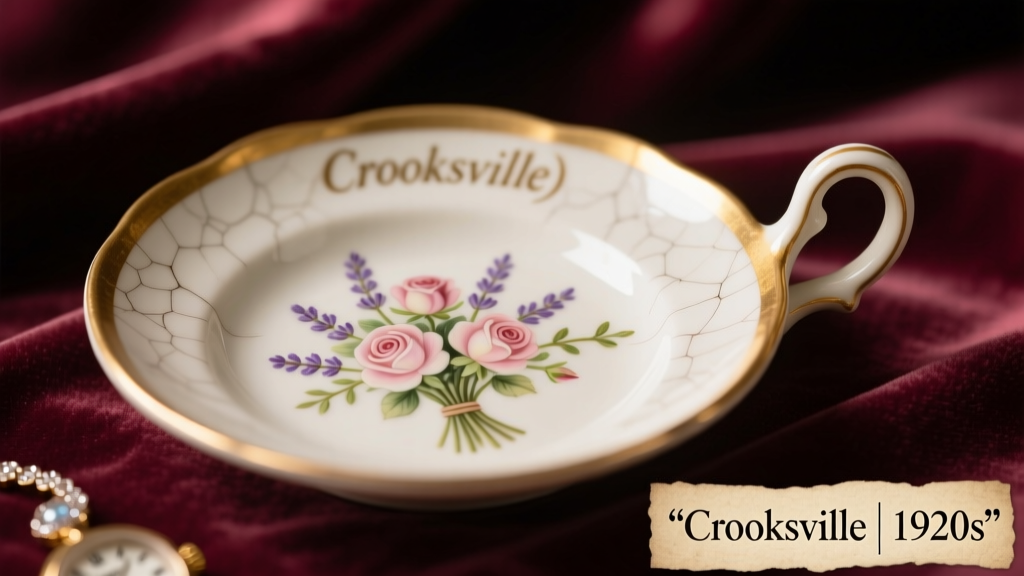
The Little Bouquet Saucer by Crooksville China: A Mid-Century American Tableware Treasure
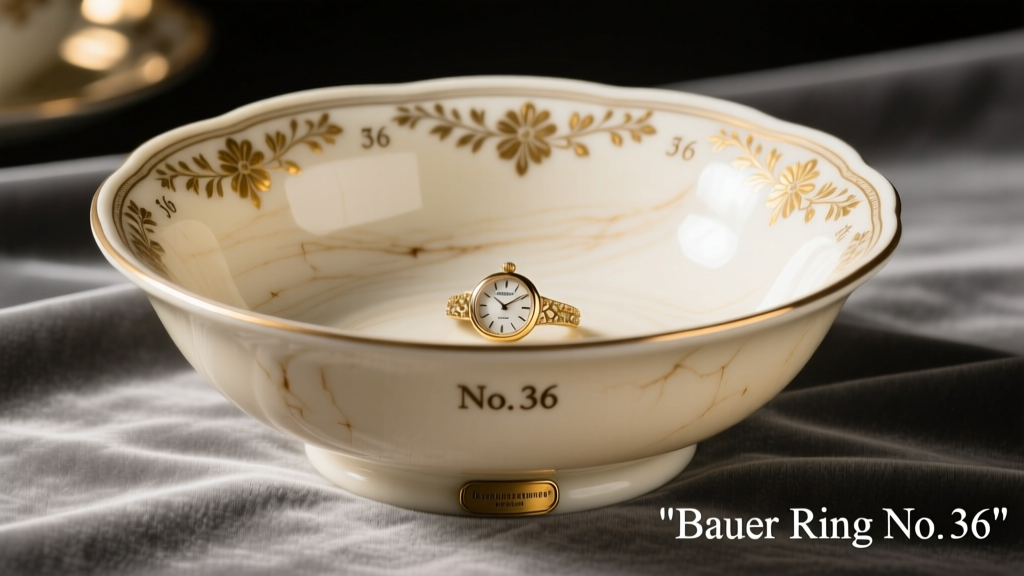
Bauer Ring Mixing Bowl No. 36 Ivory (5-Inch): A Mid-Century American Ceramic Icon
Lalique Figurine: Stag Reclining, Frosted Clear Glass — A Masterpiece of Art Deco Sculptural Design (10¼ × 8¼ × 2½ in)
Nippon Vase with Roses, Raised Beading & Hand Painting: A 6-Inch Masterpiece of Early 20th-Century Japanese Porcelain

Jabula Toys Pressed Steel Toy Airplane (22-Inch Wingspan): A Collector’s Profile of British Postwar Aviation Playthings
Trifari Fur Clip with Faux Rubies, Diamonds, and Turquoise: A 1940s American Costume Jewelry Masterpiece
Lot 3575183: A 1947 Patek Philippe Ref. 1463 'Tropical Dial' Chronograph — Provenance, Technical Anatomy & Market Significance
Avon’s 1956 Christmas Catalog: A Collector’s Archive of Mid-Century American Gift Culture
Gorham Co. and Brown: The Forgotten Partnership That Shaped American Silverware Design