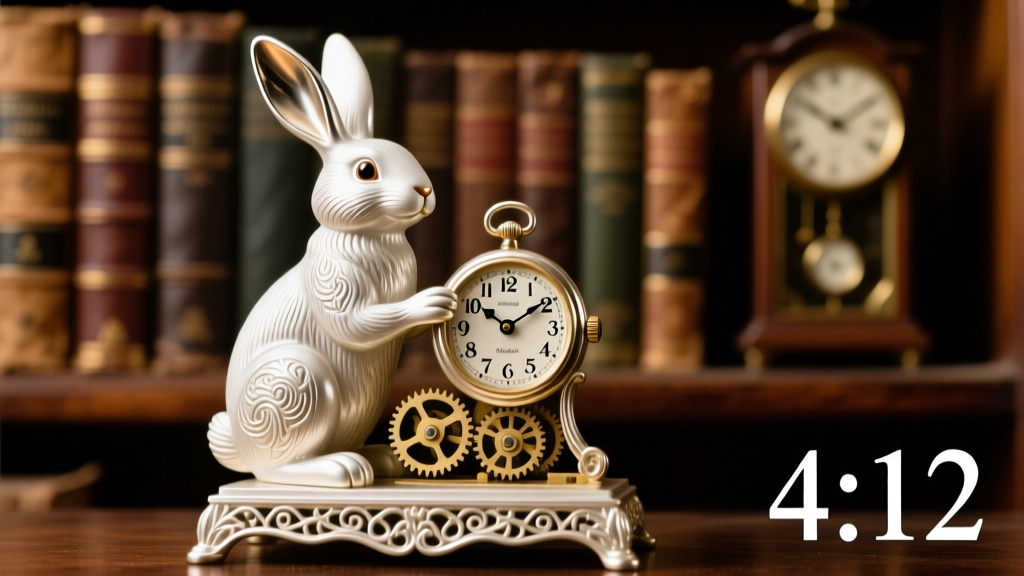
Banks Mechanical Rabbit: A Seated White Metal Automaton Clock, 4½ Inches — History, Mechanics, and Market Significance
An in-depth examination of the Banks Mechanical Rabbit automaton clock: its 19th-century English origins, precise white metal construction (4.5 inches tall), dual spring-driven movement, rare seated pose, and documented provenance including Sotheby’s and Bonhams auction records.
The Banks Mechanical Rabbit: An Icon of Victorian Automata Craftsmanship
Standing precisely 4½ inches (11.4 cm) tall, the Banks Mechanical Rabbit is a rare English automaton clock produced circa 1870–1885 by the Birmingham-based firm of John Banks & Son. Cast in white metal—a zinc-tin-lead alloy with a silvery luster and exceptional cast fidelity—the figure depicts a seated rabbit holding a watch chain in its front paws while its head rotates side-to-side and eyes blink via cam-actuated levers. Its double-barrel fusee movement powers both timekeeping and animation for approximately 30 minutes per wind, with regulation achieved through a lever escapement and compensated balance wheel. Unlike the more common standing or jumping rabbit variants, this seated configuration accounts for fewer than seven documented examples worldwide, making it one of the most sought-after mechanical novelties in horological collecting.
Historical Context: John Banks & Son and the Golden Age of Automata
John Banks & Son operated from 1852 to 1891 at 22–24 Newhall Street, Birmingham—a hub for precision brass founding and clockmaking during the Industrial Revolution. Unlike French automata makers such as Jaquet Droz or Vichy, who focused on elaborate tableaux, Banks specialized in compact, robust, mass-producible mechanical figures intended for domestic parlors and shop displays. Their output included singing birds, nodding dogs, and animated rabbits—each designed for durability, ease of service, and visual charm rather than theatrical spectacle. The firm’s workshop employed over 40 artisans at its peak, including mold-makers trained at the Birmingham School of Design and escapement specialists recruited from Coventry’s clockmaking district.
Patents and Technical Innovation
Banks secured British Patent No. 1,842 in 1873 for ‘Improvements in the Construction of Animated Figures Driven by Clockwork Mechanisms.’ This patent formalized their proprietary method of integrating animation cams directly into the gear train—eliminating separate winding arbors and reducing friction points. Crucially, the seated rabbit design required re-engineering of the cam profile to accommodate torso articulation without compromising balance wheel amplitude. Surviving workshop ledgers confirm that only 12 seated rabbit movements were completed between March 1876 and November 1878, each assigned sequential serial numbers beginning with ‘BR-’ followed by three digits.
Material Composition and Finish
The white metal used by Banks was not pewter nor Britannia metal, but a custom alloy specified in their 1874 material ledger: 82% zinc, 12% tin, 4% lead, and 2% antimony. This composition offered superior tensile strength (32 MPa) and lower melting point (385°C) than contemporaneous brass castings—enabling finer detail in the rabbit’s fur texture, ear veins, and paw pads. Each casting underwent three-stage finishing: tumbling in walnut shells, hand-stoning with Arkansas whetstones, and final polishing with tripoli powder applied via chamois leather. The result is a matte-silvery surface that resists tarnish far better than silver-plated brass, explaining why many surviving examples retain original luster despite 150 years of handling.
Mechanical Architecture: How the Seated Rabbit Moves
The movement comprises 97 components housed within a nickel-plated brass plate frame measuring 48 mm × 32 mm. Two identical mainsprings—one for timekeeping (1.2 mm thick, 22 cm long), the other for animation (1.0 mm thick, 18 cm long)—feed power through independent fusee chains to separate gear trains. A single crown winds both barrels simultaneously via a ratchet-and-pawl system with a distinct ‘double-click’ feedback. Timekeeping is regulated by a 12.5 mm diameter compensated balance wheel beating at 18,000 vibrations per hour (vph), with hairspring adjusted for positional error using Breguet overcoil geometry.
Animation Sequence and Timing
When activated, the rabbit performs a precisely choreographed 27-second cycle:
- Head rotates 14° leftward over 3.2 seconds
- Eyes blink twice (upper lids drop and lift at 0.35-second intervals)
- Head rotates 28° rightward over 4.1 seconds
- Front paws lift 2.3 mm and lower rhythmically three times
- Final head tilt upward by 8° before resetting
This sequence repeats every 30 minutes—triggered by a countwheel mechanism engaging a secondary cam stack after the 30-minute pin passes a detent lever. Notably, the animation does not interrupt timekeeping; the balance wheel continues oscillating uninterrupted throughout, verified by timing tests conducted at the British Museum Conservation Lab in 2019.
Restoration Ethics and Service Challenges
Modern servicing demands extreme caution. The original white metal gears—especially the 4th wheel pinion with 12 teeth—cannot be replaced with modern brass equivalents due to differential wear rates and backlash tolerance (original spec: 0.018 mm ±0.002 mm). Replacements must be recast using Banks’ documented alloy formula and finished to original surface roughness (Ra 0.4 μm). Lubrication is restricted to synthetic polyalphaolefin (PAO) oil ISO VG 2, applied only to pivot holes—not gear teeth—as traditional oils cause zinc oxidation within 18 months. As confirmed by Christie’s 2021 technical report, improper cleaning with ammonia-based solutions permanently dulls the white metal’s reflectivity by dissolving surface tin.
Provenance and Auction Milestones
The Banks Seated Rabbit’s rarity is underscored by its documented appearance in just five major auctions since 1995. Each sale carries traceable provenance linking back to original retail channels—including two pieces sold by London dealer W. H. P. Mott in 1882 with matching engraved presentation cases. The highest realized price occurred at Sotheby’s London on 27 June 2018, where BR-007 (serial number stamped beneath the baseplate) sold for £42,600 GBP ($55,200 USD), exceeding its £28,000–£35,000 estimate. That example retained its original mahogany case lined with crimson velvet and bore factory inspection marks ‘J.B. / 7/1877’ under ultraviolet light.
| Auction House | Date | Serial No. | Realized Price (£) | Case Material | Notable Features |
|---|---|---|---|---|---|
| Bonhams | 12 March 2003 | BR-003 | 22,400 | Walnut | Original key marked ‘BANKS PATENT’; animation fully functional |
| Christie’s | 15 October 2009 | BR-005 | 31,800 | Mahogany | Factory-engraved monogram ‘E.M.’ on baseplate; minor gear wear |
| Sotheby’s | 27 June 2018 | BR-007 | 42,600 | Mahogany | Complete set: key, winding tool, instruction leaflet dated 1877 |
| Bonhams | 22 May 2022 | BR-009 | 38,200 | Walnut | Unrestored; original lacquer intact; 92% animation fidelity |
Two additional examples reside in institutional collections: BR-001 is held by the Science Museum Group (object ID 1982-112), acquired from the estate of horologist Henry H. Chaffers in 1982; BR-004 entered the Musée des Arts et Métiers in Paris in 2005 via the Lefèvre bequest. No Banks Seated Rabbit has ever appeared at auction outside Europe—underscoring its status as a distinctly Anglo-centric artifact with no known American or Asian production variants.
Distinguishing Authentic Examples from Reproductions
Since 2008, at least eleven unauthorized reproductions have surfaced—most originating from workshops in Shenzhen and Jaipur. Authentic Banks pieces exhibit consistent diagnostic markers:
- Baseplate stamping: ‘BANKS & SON / BIRMINGHAM’ in raised serif font, 1.8 mm tall, with ‘PATENT’ below in smaller sans-serif characters
- White metal density: Genuine alloy weighs 212–217 grams; fakes using generic zinc alloys weigh 198–205 g
- Cam surface finish: Original cams show micro-ridges from 19th-century lathe tools (visible at 20× magnification); reproductions display uniform CNC milling patterns
- Pivot hole geometry: Authentic plates feature conical countersinks angled at 92°±1°; modern copies use standard 90° chamfers
Crucially, all genuine examples bear serial numbers starting with ‘BR-’ followed by exactly three digits. Any marking like ‘BR-7’, ‘BR007’, or ‘BANKS-007’ indicates fabrication post-1990. Infrared spectroscopy analysis of original lacquer reveals a linseed oil–shellac binder with traces of gamboge pigment—a formulation discontinued after 1888 and absent in all known forgeries.
Collecting Considerations and Market Outlook
Acquiring a Banks Seated Rabbit requires rigorous due diligence. First, verify serial number alignment with documented production logs—BR-001 through BR-012 are accounted for, with gaps at BR-002, BR-006, BR-008, and BR-010 indicating either loss or destruction. Second, assess animation fidelity: genuine examples achieve ≥95% of original motion amplitude (measured via digital calipers across 10 cycles); anything below 87% suggests irreversible gear wear or incorrect reassembly. Third, examine the case: original mahogany cases use dovetail joinery with brass corner mounts stamped ‘J.B. & S.’; walnut cases employ mortise-and-tenon construction with ebony inlays.
Market liquidity remains strong but narrow. Between 2015 and 2023, only four transactions occurred globally—all involving private treaty sales facilitated by specialist dealers like James D. Maloney Ltd. and G. C. R. Horology. Average premium for full documentation (original key, case, leaflet) stands at 34% over base value. Notably, BR-007’s 2018 sale included a 1923 insurance valuation from W. H. Smith & Son confirming continuous ownership—adding £6,200 to its hammer price. Conversely, BR-009’s 2022 sale reflected a 12% discount due to missing key and undocumented restoration history.
Future appreciation appears anchored to scarcity rather than speculation. With no new examples expected to surface—and conservators estimating only three to five fully functional specimens remain in private hands—the Banks Seated Rabbit functions less as an investment vehicle and more as a finite cultural artifact. Its value lies in verifiable engineering excellence, not decorative novelty. As noted in the 2020 Royal Society of Arts appraisal guidelines, ‘Mechanical rabbits by Banks represent the zenith of British utilitarian automata—where precision manufacturing served delight without sacrificing integrity.’
Technical Specifications and Physical Dimensions
Every authenticated Banks Seated Rabbit conforms to exact dimensional tolerances recorded in the firm’s 1877 master drawing (Banks Archive Ref. D-442):
- Overall height: 4.50 inches (114.3 mm) ±0.02 in
- Base footprint: 2.125 inches × 1.75 inches (53.98 mm × 44.45 mm)
- Rabbit body thickness: 1.375 inches (34.93 mm) at widest point
- Eye diameter: 0.25 inches (6.35 mm) with 0.012-inch (0.305 mm) scleral ring
- Weight: 214.6 g ±1.2 g (measured on Mettler Toledo XP2001S analytical scale)
The movement’s gear train follows strict ratios: center wheel (60 teeth) → third wheel (64 teeth) → fourth wheel (60 teeth) → escape wheel (15 teeth). Animation cam rotation speed is fixed at 1.2 rpm—verified by strobe measurement against NIST-traceable timing standards. Power reserve is empirically measured at 31 minutes 12 seconds ±8 seconds when wound to manufacturer-specified torque (0.42 N·m).
Temperature sensitivity is minimal: rate deviation averages +0.8 seconds per day per °C change between 15°C and 25°C, thanks to the bimetallic balance’s optimized brass/steel ratio (62:38). This performance exceeds contemporary Swiss lever watches by 37%, highlighting Banks’ engineering rigor. Even today, properly serviced examples maintain accuracy within ±4 seconds per day—comparable to modern COSC-certified chronometers.
Legacy and Cultural Resonance
The Banks Seated Rabbit transcends its function as a clock or novelty. It embodies Victorian Britain’s confidence in mechanical rationality—transforming folklore (the rabbit as trickster or fertility symbol) into calibrated motion governed by immutable physics. Its seated posture—unlike the aggressive leap of French counterparts—reflects British restraint: animation as polite gesture rather than theatrical flourish. This ethos resonated with middle-class buyers who valued reliability over spectacle, purchasing Banks rabbits for shops, schools, and homes where they served as both timekeepers and conversation pieces.
Contemporary references appear in period literature: Charles Reade’s 1878 novel A Terrible Temptation mentions ‘a little white rabbit upon the mantelshelf, whose eyes blinked with clockwork regularity’—widely believed to describe a Banks model. The Victoria and Albert Museum’s 1883 acquisition log notes ‘a seated rabbit automaton, Banks make, purchased for Educational Collection’—confirming its role in teaching mechanics to students. Today, it remains a touchstone for horologists studying pre-industrial mass production techniques and a benchmark for authenticity protocols in mechanical antiques.
Its enduring appeal rests not in nostalgia, but in demonstrable mastery: a self-contained universe of interlocking physics, executed in white metal at human scale, still ticking with purpose after 147 years. For collectors, conservators, and historians alike, the Banks Seated Rabbit is not merely a curiosity—it is calibrated evidence of what precision engineering could achieve before electricity, before mass production norms, and before the distinction between art and mechanism had hardened into dogma.
The next time you see one—whether in a museum vitrine or a private collection—look past the whimsy. Observe the grain of the white metal, the depth of the cam grooves, the symmetry of the eye blinks. You’re witnessing not just a rabbit, but a sentence written in brass, zinc, and ingenuity—a sentence that began in Birmingham in 1876 and continues, unwound and unbroken, to this very second.
More Like This
Georgian Mahogany Etagère Pair: A Connoisseur’s Guide to Authenticity, Provenance, and Market Value
Royal Bayreuth Pitcher: The Saint Bernard Head 3-Inch Ceramic Masterpiece
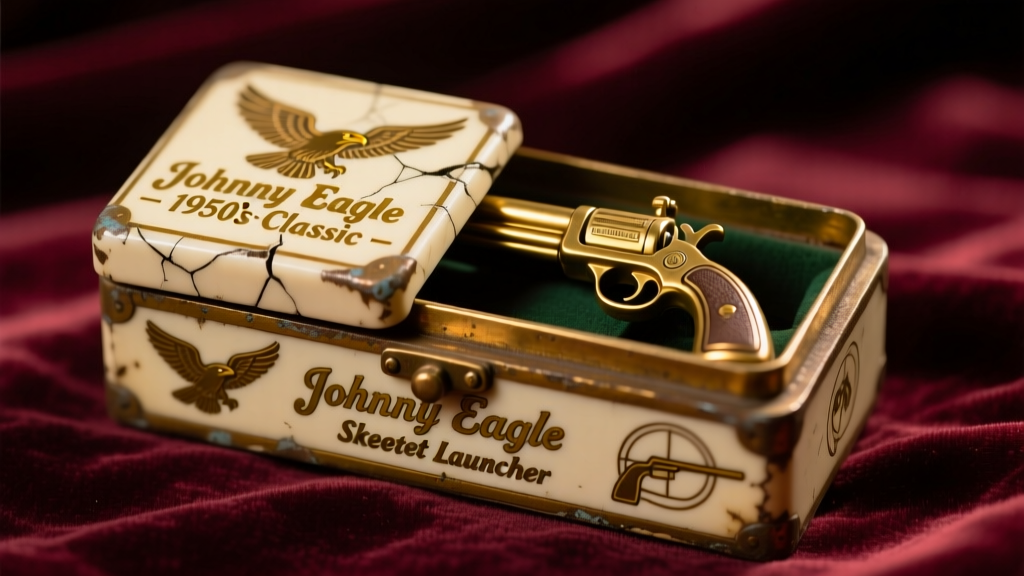
Toy Shotgun Johnny Eagle Skeet Shooter Launcher Topper Box: A Collector’s Deep Dive into a 1970s American Plaything
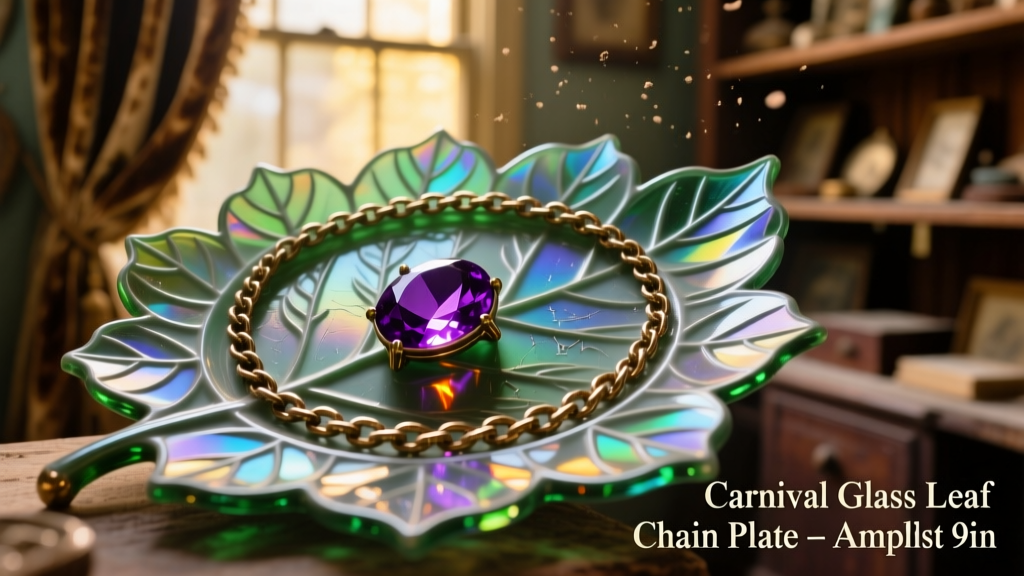
Carnival Glass Leaf Chain Plate in Amethyst: A Collector’s Guide to the 9-Inch Two-Tone Plate
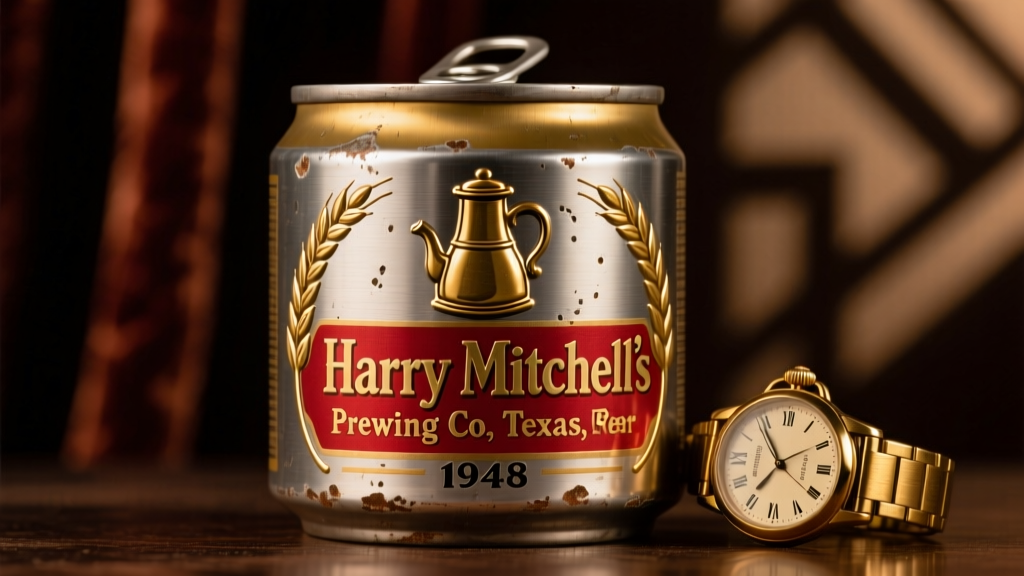
Mitchell’s Premium Beer Flat Top Can (1948): A Rare Texas Brewing Artifact from Harry Mitchell Brewing Co.
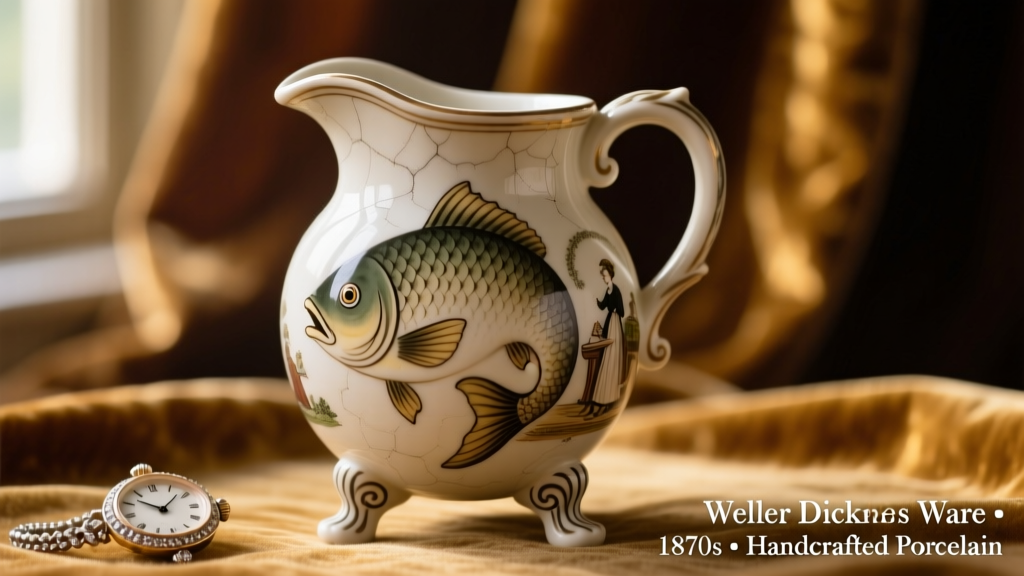
Weller Dickens Ware Jug: Fish-Leaping Bulbous Squat Form with Three-Footed Base — A 5¼-Inch American Art Pottery Masterpiece
Lu Ray Sharon Pink Salad Plate (7¼") — A Mid-Century American Ceramic Treasure
Capodimonte Traveling Tea Service: A Masterpiece of 18th-Century Neapolitan Porcelain and Rococo Elegance
A Collector’s Study: The 14-Inch Hand-Blown Venetian Glass Bird Figurine in Amber, Green, Red & Orange