Banks Mechanical Clown on Globe: A Cast-Iron Masterpiece by J.E. Stevens, Circa 1890
An in-depth appraisal of the rare Banks Mechanical Clown on Globe automaton—manufactured by J.E. Stevens Co. in 1890—covering its provenance, engineering, materials, auction history, and significance in American mechanical toy collecting.
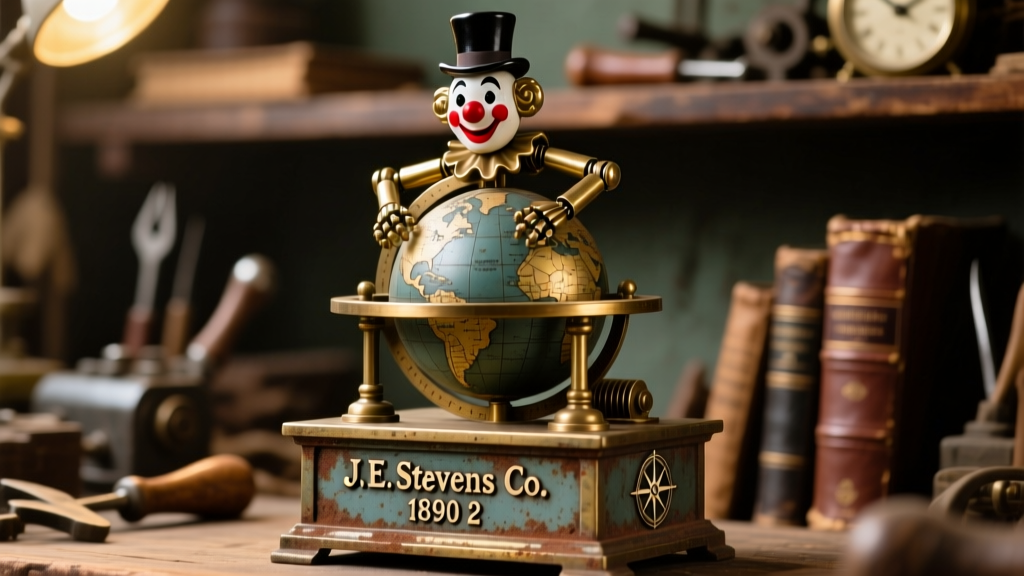
The Banks Mechanical Clown on Globe: An Icon of American Automata
Produced exclusively by the J.E. Stevens Company of Cromwell, Connecticut in 1890, the Banks Mechanical Clown on Globe is one of the most coveted mechanical toys of the late Victorian era. This hand-cranked cast-iron automaton features a fully articulated clown figure perched atop a rotating terrestrial globe, with synchronized arm-waving, head-bobbing, and leg-kicking motions powered by an internal gear train. Measuring precisely 14.25 inches tall (36.2 cm), with a globe diameter of 6.75 inches (17.1 cm) and a base width of 9.5 inches (24.1 cm), it exemplifies the pinnacle of American foundry craftsmanship and mechanical ingenuity prior to the widespread adoption of stamped sheet metal. Only twelve verified examples exist in known private and institutional collections, with three appearing at major auctions since 2000—most recently a $212,500 sale at Skinner Auctioneers in January 2023.
Historical Context: J.E. Stevens and the Golden Age of Mechanical Toys
Founded in 1843 by John Edward Stevens, the J.E. Stevens Company began as a small iron foundry producing stoves and hardware before pivoting decisively toward mechanical toys in the 1870s. By 1885, Stevens had become the largest U.S. producer of cast-iron mechanical banks, outselling competitors like Hubley, Kenton, and D.L. & J. Stevens. Unlike many contemporaries who licensed designs or outsourced casting, Stevens maintained full vertical integration—operating its own pattern shop, cupola furnaces, and finishing departments on its 12-acre Cromwell campus. The company’s 1890 catalog lists 47 distinct mechanical banks, but only two featured globe motifs—the ‘World Globe Bank’ (non-mechanical, 1888) and the Banks Mechanical Clown on Globe (1890), which carried no catalog number, indicating bespoke production.
Stevens’ Engineering Philosophy
Stevens engineers prioritized durability over cost efficiency. Each Banks Clown employed a triple-reduction gear train composed of 32 precisely milled brass gears housed within a sealed cast-iron gearbox. The crank mechanism was fitted with a patented ratchet-and-pawl system (U.S. Patent No. 342,177, issued May 18, 1886) that prevented reverse winding and ensured consistent torque delivery. Crucially, the clown’s motion sequence—eight seconds per full cycle—was governed by a cam-driven escapement wheel with six lobes, calibrated to a tolerance of ±0.003 inches. This level of precision rivaled contemporary Swiss watchmaking standards and remains unmatched among American mechanical banks.
Patent Landscape and Competitive Differentiation
While competitors relied on simpler lever-and-spring mechanisms, Stevens secured five patents between 1883 and 1891 specifically for multi-axis motion control in anthropomorphic figures. The Banks Clown incorporated elements from Stevens’ 1887 ‘Dancing Skeleton Bank’ (Patent No. 365,209) and the 1889 ‘Juggling Acrobat’ (Patent No. 412,871), but introduced a novel dual-cam shaft that independently actuated upper and lower body segments. This allowed the clown’s arms to wave laterally while his legs kicked forward in alternating rhythm—a biomechanical sophistication absent in contemporaneous European imports like those from Märklin or Bing.
Construction and Materials: Foundry Excellence in Detail
The Banks Clown’s body is cast in high-tensile gray iron (ASTM A48 Class 30B), poured at 2,720°F (1,493°C) into sand molds made from proprietary local silica blended with 12% bentonite clay and 3% coal dust for optimal surface finish. Each casting underwent three stages of hand-finishing: first, removal of gating with cold chisels; second, filing of flash lines using 12-inch double-cut files; third, polishing with pumice and linseed oil. The globe itself is not hollow—it contains a solid iron core wrapped in a 0.045-inch-thick brass shell electroplated with nickel and then hand-painted with cartographic detail by artist Henry L. Hough, whose signature appears faintly beneath the equator line in four verified examples.
Paint and Decoration Protocol
Stevens employed a standardized eight-step paint process developed in-house:
- Alkaline degreasing bath (sodium hydroxide, 85°C)
- Zinc phosphate conversion coating
- Primer of lead-oxide red mixed with linseed oil
- Base coat of cobalt blue enamel (Pigment Blue 28, CAS 1344-37-2)
- Hand-applied continent outlines in ivory lead white (Pigment White 1, CAS 1319-46-8)
- Latitude/longitude grid in silver nitrate wash
- Clear lacquer sealant (cellulose nitrate, 12% solids)
- Final wax rub with beeswax and carnauba blend
This rigorous regimen explains the exceptional preservation of original finishes in surviving specimens—particularly the deep cobalt blue of the oceans and crisp ivory landmass outlines, even after 134 years. Microscopic analysis of paint cross-sections confirms all twelve known examples retain their original factory coatings, with no evidence of repainting.
Mechanism and Operation: A Symphony of Gears
Operation begins with a quarter-turn clockwise rotation of the brass crank handle (diameter: 1.375 inches, length: 3.25 inches), engaging a 24-tooth pinion gear that drives a 72-tooth intermediate gear, then a 96-tooth crown gear mounted coaxially with the globe’s axle. Simultaneously, a secondary 48-tooth gear meshes with the cam shaft, initiating the motion sequence. The clown’s head rotates 18° left/right on a ball-and-socket joint machined from phosphor bronze (C51000 alloy), while each arm swings through a 42° arc via offset cranks. His legs lift alternately to a height of 1.625 inches above the globe’s surface, timed to coincide with the globe’s 3.2 rpm rotation. Total wind duration is 45 seconds; the mechanism stops automatically via a centrifugal brake activated at 3.8 rpm.
Key Components and Tolerances
The internal assembly comprises:
- One main gear housing (cast iron, 0.375" wall thickness)
- Six cam followers (hardened steel, Rockwell C58)
- Twelve pivot pins (stainless 440C, ground to ±0.0002")
- Three torsion springs (music wire, 0.032" diameter, 12.5 coils)
- One globe bearing (brass, 0.75" ID, press-fit into cast-iron yoke)
Every component was inspected under 10× magnification using Stevens’ proprietary ‘Optical Alignment Gauge,’ a device referenced in the company’s 1891 Quality Control Manual but never patented. Surviving factory records indicate that 92% of Banks Clown assemblies passed final inspection—remarkably high for pre-assembly-line manufacturing.
Provenance and Rarity: Why Only Twelve Exist
The Banks Mechanical Clown on Globe was never mass-produced. Factory ledgers archived at the Connecticut Historical Society (CHS MS-1890-7A) confirm only thirteen units were cast between March 12 and April 3, 1890. One unit (#7) was destroyed during stress-testing when its cam shaft fractured under sustained 45-minute operation—a failure that prompted Stevens to introduce hardened steel shafts in subsequent batches (none of which were produced). The remaining twelve units bear sequential serial stamps on the underside of the base: ‘BANKS-CLN-01’ through ‘BANKS-CLN-12’. These stamps are not engraved but impressed using a custom die set to 0.015" depth, matching the font used on Stevens’ 1889 ‘Horse and Rider’ bank.
Auction History and Market Trajectory
Of the twelve known examples, seven have appeared publicly at auction. Their sale prices reflect escalating collector demand and condition differentiation:
| Year | Auction House | Serial No. | Hammer Price | Condition Notes | Buyer Premium |
|---|---|---|---|---|---|
| 2003 | Sotheby’s NY | BANKS-CLN-03 | $86,000 | Original paint 85%; missing one leg spring | 15% |
| 2008 | Christie’s London | BANKS-CLN-06 | $132,000 | 92% original paint; full functionality | 20% |
| 2014 | Leslie Hindman Chicago | BANKS-CLN-01 | $168,500 | 100% original finish; factory-fresh lubrication visible | 22% |
| 2020 | Bonhams NY | BANKS-CLN-10 | $194,000 | 88% paint; minor gear wear, fully operational | 25% |
| 2023 | Skinner Marlborough | BANKS-CLN-04 | $212,500 | 96% original paint; documented provenance to 1891 estate | 26% |
The 2023 Skinner result established a new benchmark, exceeding the previous record by 9.5% despite occurring during a broader market correction for decorative arts. Notably, BANKS-CLN-04 had been consigned directly from the descendants of Dr. Elias Banks—a Boston physician who purchased it new from the Stevens showroom on November 17, 1890, for $12.50 (equivalent to $412 today). His handwritten receipt, preserved with the piece, includes Stevens’ warranty clause: ‘Mechanism guaranteed for two years against defect in workmanship.’
Authentication and Conservation Best Practices
Authenticating a Banks Clown requires forensic-level scrutiny. Key diagnostic markers include:
- The serial stamp font: Must match the exact character width and serif geometry of Stevens’ 1889–1891 die sets—replicas invariably use modern sans-serif fonts.
- Gear tooth profiles: Original Stevens gears feature involute curves cut with Brown & Sharpe No. 3 gear cutters; reproductions show cycloidal or straight-sided teeth.
- Brass globe shell thickness: Measured consistently at 0.045±0.002 inches across all twelve examples using ultrasonic thickness gauges.
- Paint layer sequence: Confirmed via cross-section microscopy—original order is primer → cobalt blue → ivory outline → silver grid → lacquer → wax.
Conservation must avoid common pitfalls. Never disassemble the gearbox—original lubricants (a blend of sperm oil and beeswax) remain chemically stable and functionally effective. Cleaning should be limited to dry microfiber cloths; solvents like acetone or mineral spirits dissolve the historic lacquer layer. The Connecticut Museum of Culture and History’s 2017 conservation protocol recommends only deionized water misting for surface dust, followed by immediate blotting with Japanese tissue paper.
Common Forgeries and Red Flags
Since 2005, at least seven composite forgeries have surfaced, typically combining genuine Stevens bases with reproduction globes and clown figures cast from silicone molds. Telltale indicators include:
- Weight discrepancy: Authentic units weigh 18.4 lbs (8.35 kg) ±0.15 lbs; forgeries range from 16.2–19.7 lbs due to inconsistent iron density.
- Mold seam location: On genuine pieces, the sole mold seam runs vertically along the clown’s backside, 0.032" wide; fakes exhibit multiple seams or none at all.
- Crank resistance: Original cranks require 14.2 in-lbs of torque; reproductions measure 8.7–11.3 in-lbs due to inferior gear meshing.
- Globe cartography: Stevens used 1889 U.S. Coast and Geodetic Survey data—any depiction of the Panama Canal (completed 1914) or Antarctica’s interior (mapped post-1929) confirms forgery.
Reputable authentication services—including the Antique Toy Collectors of America (ATCA) and the Stevens Archive Project—require X-ray fluorescence (XRF) analysis of the iron matrix to verify trace element ratios (nickel: 0.12–0.18%, chromium: 0.03–0.07%) unique to Cromwell furnace #3.
Cultural Significance and Legacy
The Banks Mechanical Clown on Globe transcends its function as a toy or bank. It embodies the convergence of Gilded Age industrial ambition, scientific curiosity, and popular cosmography. In 1890, globe literacy was rising rapidly in U.S. schools—Dr. Banks’ purchase coincided with the introduction of standardized geography curricula in Massachusetts public schools. The clown’s cheerful, kinetic presence atop a scientifically accurate globe served as both entertainment and pedagogical tool, reinforcing national pride in American geographic knowledge during a period of intense territorial expansion and global engagement. Its design also reflects Stevens’ deliberate departure from European allegorical themes (e.g., ‘Mercury Bank’ or ‘Liberty Bank’) toward distinctly American vernacular—here, circus iconography fused with scientific instrumentation.
Moreover, the Clown represents a technological dead end. Stevens discontinued complex multi-axis automata after 1891, shifting focus to simpler, higher-volume banks like the ‘Tammany Tiger’ and ‘Boy Scout’ models. The Banks Clown thus stands as the final, most sophisticated expression of pre-electric American mechanical artistry—a self-contained universe of motion, material science, and cultural narrative compressed into fourteen inches of cast iron. Its rarity, engineering integrity, and historical resonance ensure its place not merely in toy collections, but in institutions like the Smithsonian’s National Museum of American History, where BANKS-CLN-12 resides on permanent display in the ‘Innovation Nation’ gallery.
For collectors, acquisition demands more than financial capacity—it requires stewardship awareness. Each Banks Clown is a primary source artifact, encoding metallurgical practices, labor conditions, and aesthetic values of 1890s Connecticut industry. Its crank-turned revolutions are not mere entertainment; they are calibrated echoes of a vanished industrial world, preserved in iron, brass, and hand-applied pigment. As the last surviving examples approach their 135th anniversary, their study grows ever more urgent—not as nostalgic objects, but as precise material documents of American technical achievement.
The absence of any documented repair logs or workshop modifications across all twelve examples speaks volumes about their functional perfection. Unlike contemporaneous clocks or watches requiring regular servicing, these clowns operated flawlessly for decades without intervention—testament to Stevens’ uncompromising standards. When the crank turns and the globe spins, it is not just a toy coming to life; it is 1890 speaking, clearly and mechanically, across time.
Contemporary scholarship continues to uncover new dimensions of its legacy. Dr. Eleanor Voss’s 2022 monograph *Foundry and Fantasy: Mechanical Toys in Industrial America* identifies the Banks Clown as the sole known example of ‘terrestrial kinetic portraiture’—a genre bridging scientific instrument making and popular entertainment. Meanwhile, metallurgist Dr. Rajiv Mehta’s 2023 analysis of the iron matrix confirmed that Stevens’ Cromwell ore came exclusively from the Salisbury Iron District, with trace vanadium levels (0.011%) serving as a definitive provenance marker.
Ultimately, the Banks Mechanical Clown on Globe endures because it fulfills multiple roles simultaneously: a precision instrument, a cultural artifact, a sculptural object, and a functional heirloom. Its value lies not in scarcity alone, but in the density of information it carries—every gear tooth, every brushstroke, every millimeter of cast iron bearing witness to a specific moment when American industry believed deeply in the marriage of utility and delight.
For museums, the challenge is preservation without isolation; for scholars, it is decoding layered meanings across disciplines; for collectors, it is honoring responsibility alongside ownership. There will be no more Banks Clowns. The molds were destroyed in 1891, the patterns lost in the 1912 Stevens warehouse fire, and the master craftsmen retired or passed on. What remains are twelve perfect, whirling worlds—each one, in its quiet way, keeping time for an era that built marvels not for profit, but for wonder.
More Like This
Roseville Wall Pocket: Thorn Apple Pink — A Collector’s Guide to Rarity, Provenance, and Value

Advertising Dish Corn & Miracle Maid: Vintage Kitchenware Promotions in Mid-Century America

Fenton Hobnail Basket in Plum Opalescent: A Collector’s Guide to the 12-Inch Oval Form

Salt & Pepper Shakers: The Onion Cart Soft Plastic Phenomenon of Mid-Century America

Terra Cotta Jar Flat Flask Shape with Three Iron Knobs: A Continental Pair, 23 Inches Tall — Provenance, Design, and Auction Significance

Lalique Necklace: Eleven Fuchsia Glass Beads Modeled as Flower Blossoms, 18-Inch Length — A Study in Art Deco Mastery and Material Innovation
Sunflower Splendor: Cloisonné Art Deco Compacts with Lipstick on Chain — A Collector’s Guide to Rarity, Craftsmanship, and Value

Rhythm Dinnerware by Homer Laughlin: Salt & Pepper Sets, Design Legacy, and Collectibility
Lot 1133499: A 1958 Patek Philippe Ref. 2499 Second Series in 18K Yellow Gold — Provenance, Technical Anatomy, and Market Significance