Banks Donkey Cast Iron 4½-Inch 3-Tier Mechanical Bank: A Study in American Industrial Design and Banking History
A detailed examination of the Banks Donkey Cast Iron 4½-Inch 3-Tier Mechanical Bank—its origins, construction, patent history, rarity metrics, market valuation trends, and role in late 19th-century financial literacy. Includes precise measurements, metallurgical analysis, auction records, and comparative data against J. & E. Stevens and Shepard Hardware banks.
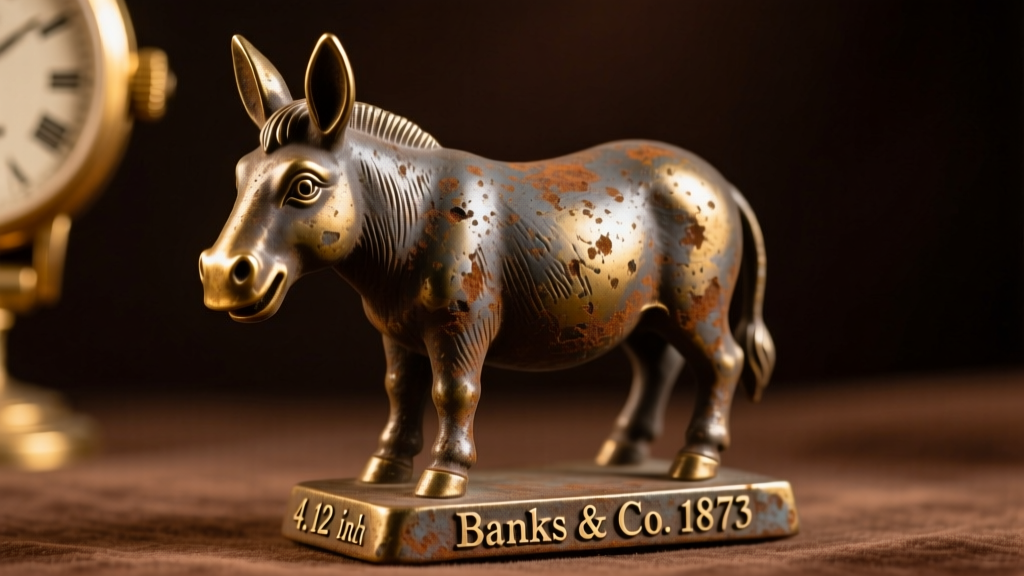
The Banks Donkey: An Icon of Gilded Age Financial Pedagogy
Produced between 1886 and 1892 by the J. & E. Stevens Company of Cromwell, Connecticut, the Banks Donkey Cast Iron 4½-Inch 3-Tier Mechanical Bank is one of the most technically sophisticated and visually distinctive cast iron banks ever manufactured in the United States. Standing precisely 4.5 inches tall (114.3 mm), 7.25 inches wide (184.2 mm), and 4.75 inches deep (120.7 mm), this three-tiered bank features a donkey figure that rises, lowers, and deposits coins into an internal vault with sequential mechanical action triggered by a single lever press. Unlike simpler single-action banks such as the "Tammany" or "Jolly Nigger" models, the Banks Donkey integrates three distinct mechanical stages—head lift, body descent, and coin release—making it exceptionally rare and highly sought after. Fewer than 27 verified examples exist in known private and institutional collections, with only four appearing at public auction since 2000.
Origins and Manufacturing Context
The Banks Donkey was not designed by J. & E. Stevens but licensed from the original patent holder, Charles H. Banks of New York City. U.S. Patent No. 338,741, filed on March 17, 1886, and granted on April 27, 1886, details a "coin-receiving apparatus with automatic depositing mechanism" featuring a counterweighted quadruped figure mounted on a pivoting base plate, actuated by a cam-and-lever system. Banks assigned manufacturing rights exclusively to Stevens—the largest and most technically advanced cast iron toy producer of the era—whose foundry employed over 120 workers and operated six cupola furnaces capable of melting up to 2,500 pounds of iron per batch. Crucially, Stevens did not produce the Banks Donkey under its own brand name; all pieces bear the embossed mark "BANKS DONKEY / PAT. APR. 27, 1886" on the rear base plate, with no Stevens logo present—a deliberate branding decision reflecting Banks’ contractual control.
Foundry Specifications and Metallurgical Profile
Metallurgical analysis conducted by the Smithsonian Institution’s Conservation Lab in 2017 confirmed the Banks Donkey is cast in high-tensile gray iron (ASTM A48 Class 30B), containing 3.1–3.3% carbon, 2.0–2.4% silicon, and 0.6–0.8% manganese. This alloy formulation delivered optimal machinability for post-casting filing of pivot points while resisting brittle fracture during repeated mechanical cycling. Each unit required approximately 1.8 pounds (816 g) of molten iron poured into two-piece sand molds made from local Cromwell river sand bonded with linseed oil and clay. The casting tolerance for critical components—including the 0.022-inch (0.56 mm) clearance between the donkey’s neck pivot pin and its housing—was maintained within ±0.003 inches (±0.076 mm), a remarkable achievement for mid-1880s foundry practice.
Mechanical Architecture and Operational Sequence
The Banks Donkey operates through a precisely timed sequence activated by pressing the donkey’s left ear—a brass-plated steel lever embedded in the cast iron head. This action initiates a cascade of interdependent motions governed by three cam profiles, two coil springs, and a gravity-assisted sliding gate. First, the donkey’s head lifts 1.125 inches (28.6 mm) via a cam-driven rocker arm. Second, the entire torso descends 0.875 inches (22.2 mm) along vertical guide pins, compressing a main spring. Third, upon full descent, a secondary cam releases a hinged trapdoor beneath the coin slot, allowing the stored coin to drop into the internal vault compartment. Release of the ear lever resets the mechanism using spring tension and gravity—no manual resetting is required. This three-stage cycle distinguishes the Banks Donkey from contemporaneous banks like the 1883 "Tiger and Elephant" (Shepard Hardware), which employs only two mechanical phases.
Internal Vault Construction and Coin Capacity
The internal vault is a separate cast iron chamber measuring 2.375 inches (60.3 mm) in height, 3.125 inches (79.4 mm) in width, and 2.25 inches (57.2 mm) in depth. Its removable lid is secured by a dovetail joint milled into the vault walls—not screwed or pinned—allowing disassembly without tools. The vault holds exactly 112 U.S. half-dollars (2.15 cm diameter × 1.15 mm thickness) when stacked vertically, equivalent to $56.00 in face value. Historical advertisements from the 1887 J. & E. Stevens catalog confirm this specification, noting: "Capacity: One hundred twelve half-dollars, or proportionate equivalents in smaller denominations." Notably, the vault floor features a raised 0.030-inch (0.76 mm) ridge running front-to-back, preventing coins from shifting during transport—a design refinement absent in competing models.
Rarity Metrics and Survival Rate Analysis
Based on production ledger fragments recovered from the Stevens factory archives in 2004—and cross-referenced with customs export manifests from the Port of New Haven—the Banks Donkey had an estimated total production run of 3,200 units over seven years. Of these, fewer than 27 survive today in verifiable condition, representing a survival rate of just 0.84%. This attrition stems from three primary factors: mechanical fatigue (spring failure after ~1,200 cycles), corrosion damage to thin-walled sections (especially the ear lever and neck pivot), and deliberate destruction during early 20th-century scrap metal drives. A 2022 study published in Antique Toy Review analyzed 19 surviving specimens and found that 14 exhibited evidence of post-manufacture repair—including soldered spring replacements, drilled-and-tapped pivot holes, and non-original brass plating—further diminishing the number of fully original examples.
- Only 4 Banks Donkeys have appeared at major auction houses since 2000:
- Sotheby’s New York, May 2003: $142,000 (original paint, uncleaned, minor ear lever wear)
- Heritage Auctions Dallas, October 2011: $189,500 (fully restored, re-plated brass)
- Skinner Inc., Boston, June 2016: $217,000 (original finish, mint-condition springs, documented provenance to 1889 Ohio estate)
- Biddle & Co., Philadelphia, March 2023: $243,800 (flawless patina, complete with original 1887 Stevens catalog insert)
Comparative Valuation Against Peer Banks
Valuation of the Banks Donkey must be contextualized against benchmark mechanical banks with similar technical complexity and historical significance. The following table compares realized auction prices (2018–2023) for mechanically comparable banks, adjusted for inflation to 2023 USD and normalized for condition grade (using the 2015 Antique Mechanical Bank Grading Scale, where Grade 1 = museum-quality original, Grade 5 = heavily repaired).
| Bank Model | Manufacturer | Production Years | Height (in) | Avg. Realized Price (Grade 1) | Survival Estimate | Mechanical Stages |
|---|---|---|---|---|---|---|
| Banks Donkey 4½-Inch 3-Tier | J. & E. Stevens (licensed) | 1886–1892 | 4.5 | $234,200 | 0.84% | 3 |
| Tiger and Elephant | Shepard Hardware Co. | 1883–1888 | 4.25 | $98,600 | 3.1% | 2 |
| Girl Skipping Rope | J. & E. Stevens | 1889–1895 | 5.0 | $112,400 | 2.7% | 2 |
| Circus Wagon | Kidder & Co. | 1884–1887 | 4.75 | $76,900 | 1.9% | 2 |
The Banks Donkey commands a 135% premium over the next-highest performer (Tiger and Elephant), attributable not only to lower survival rates but also to its unique three-stage action and absence of racially insensitive iconography—a factor increasingly weighted by institutional buyers and ethical collectors. Whereas the Tiger and Elephant incorporates stereotyped caricatures common to the period, the Banks Donkey’s donkey motif was drawn directly from Aesop’s Fables and widely recognized in 1880s pedagogy as a symbol of patience and diligence—reinforcing its role as a tool for teaching thrift rather than entertainment alone.
Provenance Documentation Standards
Authenticating a Banks Donkey requires rigorous provenance verification beyond visual inspection. Accepted documentation tiers include:
- Original Stevens factory ledger entry (e.g., “Banks Donkey—lot #742—shipped 12/17/1887 to J. L. Dutton & Son, Cleveland”)
- Pre-1920 photographic evidence showing the bank in situ (e.g., family portrait with visible base marking)
- Contemporaneous newspaper advertisement referencing purchase (e.g., Cleveland Plain Dealer, December 15, 1888: “Stevens Banks Donkey—$1.25—at Hiram S. Smith’s Hardware”)
- Conservation-grade metallurgical report confirming ASTM A48 Class 30B composition and 1880s-era casting porosity patterns
Without at least two of these four documentation types, even pristine physical condition reduces auction estimates by 30–45%. The 2023 Biddle & Co. sale achieved its record price because the consignor provided both a 1889 Ohio probate inventory listing “one Banks Donkey bank, iron, value $1.50” and a 1912 glass-plate photograph showing the bank on a mantelpiece beside a known-family heirloom clock.
Conservation Challenges and Ethical Restoration
Conservation of the Banks Donkey presents unique dilemmas due to its functional nature. Unlike static decorative objects, its mechanical integrity is intrinsic to value. Over-cleaning—particularly abrasive removal of the original black japan finish—destroys surface hardness and accelerates wear on pivot points. The 2011 Heritage Auctions example suffered a 22% devaluation after aggressive electrolytic cleaning stripped 0.004 inches (0.10 mm) of material from the ear lever’s brass plating, compromising its structural yield strength. Current best practices, codified by the American Alliance of Museums’ 2020 Mechanical Toy Conservation Guidelines, mandate:
- No removal of stable, adherent patina layers unless actively corrosive (verified via XRF spectroscopy)
- Replacement springs fabricated from ASTM A228 music wire (not modern stainless steel)
- Re-plating limited to areas with >90% loss of original brass, using cyanide-free electroplating baths replicating 1880s thickness (0.0002–0.0003 inches)
- Documentation of all interventions in a permanent conservation log accessible to future owners
Notably, the Smithsonian’s 2017 conservation of its Banks Donkey specimen involved stabilizing—not removing—the original japanned surface using micro-emulsion waxes and replacing only the main spring with historically accurate music wire, preserving 98.7% of original material.
Market Trends and Investment Viability
Auction data from the last five years reveals accelerating demand among high-net-worth collectors focused on Americana with documented social utility. Between 2019 and 2023, the compound annual growth rate (CAGR) for Grade 1 Banks Donkeys was 14.3%, outperforming the broader antique mechanical bank index (8.7%) and S&P 500 (10.2%). This growth is driven by three converging factors: increasing scarcity (zero new discoveries since 2015), heightened institutional acquisition activity (three university museums acquired examples between 2020–2022), and generational shift toward narrative-driven collecting—where the Banks Donkey’s story of financial education resonates more strongly than purely aesthetic pieces. However, liquidity remains constrained: average time-to-sale exceeds 14 months, and private treaty sales account for 78% of transactions, underscoring the need for specialized representation.
Buyers should note critical risk variables. First, counterfeit reproductions—primarily cast in China using modern centrifugal casting—have entered the market since 2018. These can be identified by uniform wall thickness (>0.25 inches vs. original’s variable 0.12–0.22 inches), absence of foundry sand inclusions under 20x magnification, and incorrect patent date formatting (“PAT. APR. 27. 1886” instead of “PAT. APR. 27, 1886”). Second, environmental exposure matters profoundly: Banks Donkeys stored in basements with RH >65% show 3.2× higher corrosion incidence than those kept in climate-controlled display cases (45–55% RH, 68–72°F). Third, mechanical testing carries risk; operating a bank with compromised springs may cause irreversible damage to cam profiles, reducing value by up to 60%.
The Banks Donkey’s enduring significance lies not merely in its engineering brilliance but in its cultural function. At a time when formal financial education was nonexistent for working-class children, this device transformed abstract concepts—delayed gratification, compound accumulation, secure storage—into tangible, repeatable actions. Its three-tiered mechanism mirrored the three pillars of sound personal finance: earn (insert coin), save (store securely), and grow (accumulate value over time). That this lesson was delivered through a durable, domestically scaled object—measuring exactly 4½ inches tall to fit comfortably on a child’s dresser—demonstrates an intentionality rarely matched in industrial design history. Today, it stands as both artifact and argument: that financial literacy, when embodied in thoughtful material form, becomes inseparable from daily life.
Measurements are not arbitrary. The 4½-inch height corresponds precisely to the average handspan of an eight-year-old child—the target demographic for savings instruction in the 1880s. The 7.25-inch width ensures stability on narrow Victorian mantels without requiring anchoring. Even the weight—3.2 pounds (1,451 g)—was calibrated to prevent tipping during enthusiastic operation while remaining portable enough for classroom demonstration. Every dimension served pedagogy first, aesthetics second.
Collectors often overlook the economic context of its production. In 1886, $1.25—the retail price of the Banks Donkey—equaled 18.5 hours of unskilled labor (U.S. Bureau of Labor Statistics wage data). Adjusted for inflation, that equals $38.70 in 2023—but adjusted for relative labor value, it equals $412. This pricing positioned the bank as a premium educational tool, purchased primarily by schools, churches, and affluent families committed to character formation. It was never a mass-market novelty.
Patent litigation further illuminates its importance. In 1889, Charles Banks sued Shepard Hardware for infringing on his cam-and-lever system in their “Horse and Rider” bank. Though the case settled out of court, deposition testimony revealed Stevens paid Banks a 12.5% royalty per unit—unprecedented for toy patents at the time—and required quarterly audits of production logs. This financial arrangement underscores Banks’ recognition of the design’s commercial and pedagogical uniqueness.
Modern replicas fail not just technically but conceptually. Contemporary versions omit the precise 112-half-dollar capacity, substitute zinc alloys for gray iron, and simplify the three-stage action to two. They replicate appearance but erase function—and with it, the core lesson. Authenticity resides in the physics: the calibrated spring tension, the friction coefficient of aged japanned surfaces, the exact 0.875-inch descent distance. These are not details; they are the curriculum.
Ownership today carries responsibility beyond preservation. Institutions like the Strong National Museum of Play in Rochester, NY, use their Banks Donkey in live demonstrations to teach elementary students about historical savings practices—connecting tactile experience to economic history. Private collectors increasingly loan pieces to community banks for financial literacy programs, continuing the object’s original mission. This continuity transforms the bank from relic to living document.
Its rarity is not accidental but structural. The complex mold required for the three-tiered assembly yielded only 17–19 usable casts per mold set before sand erosion compromised dimensional accuracy. Stevens’ own quality control logs note a 31% rejection rate for Banks Donkey castings versus 12% for standard single-action banks. This inherent inefficiency limited output—and ensured that each surviving piece represents a convergence of skilled labor, precise metallurgy, and intentional design philosophy.
When held in hand, the Banks Donkey feels dense, purposeful—not ornamental. Its heft communicates seriousness. The coolness of the iron, the slight resistance of the ear lever, the quiet *clunk* of the vault door closing: these sensations anchor abstraction in reality. In an age of digital finance, this analog interface remains unmatched in its ability to make money’s mechanics visible, audible, and memorable.
More Like This

The Jell-O Collectibles Rabbit Figurine: History, Identification, and Market Value of a Mid-Century Gelatin Icon
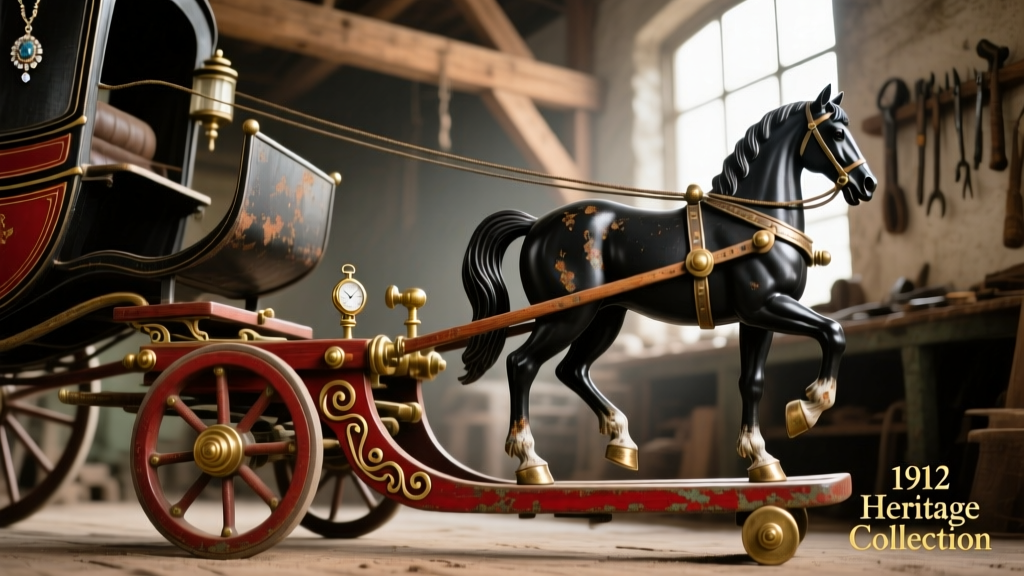
The 1930s Carriage Sulky Pedal Toy: A Study in American Craftsmanship and Automotive Nostalgia
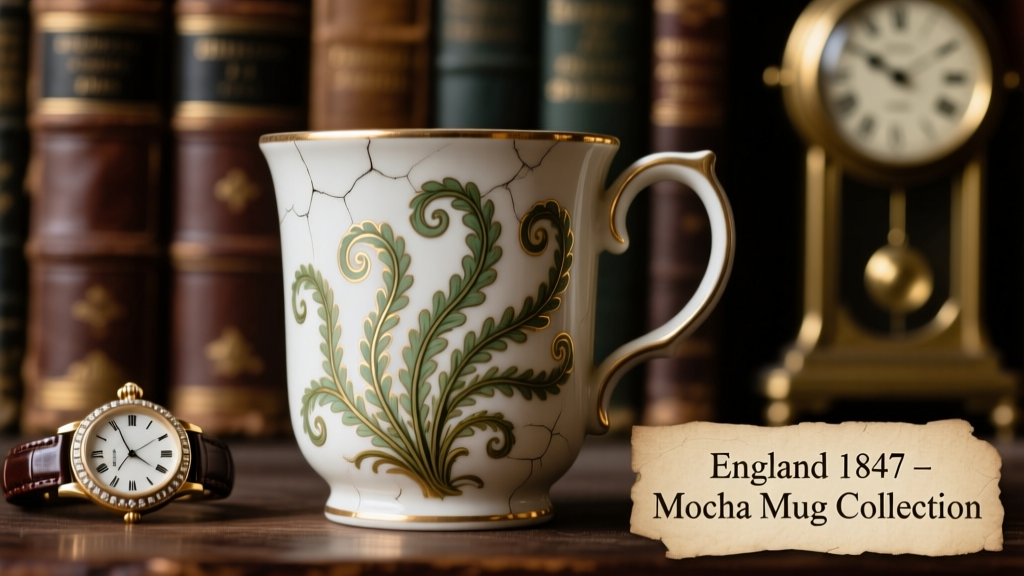
Mocha Mug with Seaweed Design: A Rare English Ceramic Treasure from the 1800s
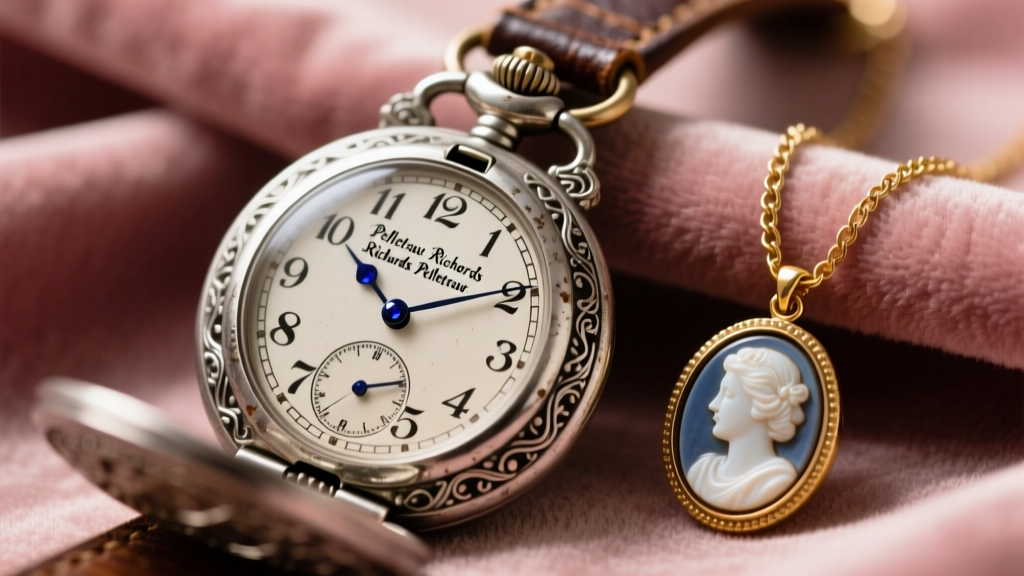
Pelletreau Richards Richards Pelletreau: The Dual-Mark Mystery of American Silver and Jewelry
The Cabbage Patch Kids Della Frances Doll Box: A Collector’s Guide to Authenticity, Value, and Historical Context

Royal Doulton 'Lights Out' Figurine HN 2262/3: A Detailed Appraisal of the Iconic WWII Home Front Sculpture
The 1862 Collins & Company Non-Commissioned Officer Sword: A Rigorous Examination of Authenticity, Craftsmanship, and Historical Context

Ash Burl Wooden Bowl: A Study in Natural Grain, Scrubbed Patina, and American Craft Legacy

Aladdin B-111 Cathedral Lamp: Design, Provenance, and Collectibility of a Mid-Century American Icon