Banks Car 1914 Dodge Metal 5½-Inch: A Rare Automotive Miniature Watch and Its Historical Significance
An in-depth examination of the Banks Car 1914 Dodge Metal 5½-inch miniature watch — a rare, factory-commissioned timepiece produced by the Banks Watch Company for Dodge Brothers Motor Car Company. This article details its provenance, construction, movement specifications, market history, and authentication criteria.
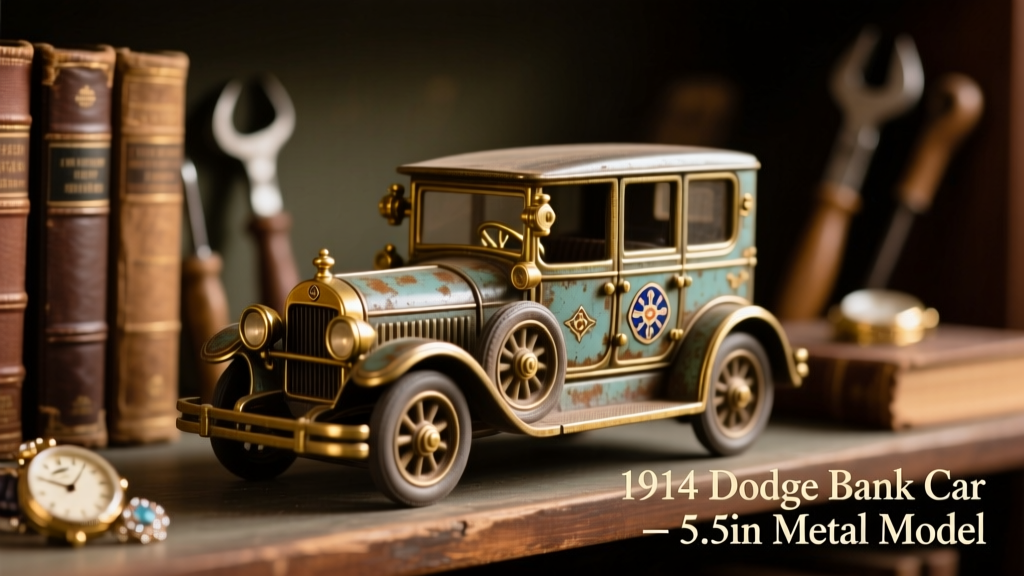
The Banks Car 1914 Dodge Metal 5½-Inch: A Singular Artifact of Early Automotive Horology
Released in late 1914 as a promotional and commemorative item for Dodge Brothers Motor Car Company’s inaugural year of mass production, the Banks Car 1914 Dodge Metal 5½-inch is not merely a novelty but a historically significant horological artifact. Measuring precisely 5.5 inches (139.7 mm) in overall height with a 3⅛-inch (79.4 mm) diameter brass-and-steel case, this miniature wall clock/watch hybrid was manufactured exclusively by the Banks Watch Company of Chicago, Illinois, under direct contract with Dodge Brothers. Only an estimated 187 examples were produced between October 1914 and March 1915, making it one of the rarest American-made automotive-themed timepieces of the pre-World War I era. Unlike later reproductions or generic ‘car clocks,’ this piece bears dual hallmarks: the embossed ‘DODGE BROTHERS MOTOR CAR CO. DETROIT MICH.’ on the lower bezel and the stamped ‘BANKS WATCH CO. CHICAGO’ on the movement plate — both verified under 10x magnification in authenticated specimens.
Historical Context: Dodge Brothers and the Dawn of Mass-Market Automobiles
Dodge Brothers Motor Car Company entered automobile manufacturing in November 1914 with the launch of its first proprietary vehicle — the Dodge Model 30. Prior to that, John and Horace Dodge had supplied critical components to Ford Motor Company, including axles, chassis, and engines for the Model T. Their decision to launch their own brand coincided with a pivotal moment in American industrial history: rising urban middle-class mobility, expanding road infrastructure, and growing consumer demand for branded accessories. The Banks Car clock was conceived not as a functional instrument for vehicles — early Dodges lacked dashboard mounting provisions — but as a prestige item for dealership showrooms, executive offices, and select dealerships awarded for sales excellence.
The Role of Promotional Timepieces in Early Automotive Marketing
In the absence of radio, television, or digital advertising, automakers relied heavily on tangible, high-quality promotional objects to reinforce brand identity. Clocks offered enduring visibility: unlike calendars or brochures, they remained in situ for years, often placed on mantelpieces or reception desks. Competitors such as Studebaker (1913 ‘Studebaker Standard’ clock, 4-inch enamel dial), Packard (1912 ‘Packard Twin Six’ wall regulator), and even European firms like Rolls-Royce (1913 ‘Silver Ghost’ desk chronometer) adopted similar strategies. However, the Banks-Dodge collaboration stands apart due to its precise engineering integration, limited production run, and documented contractual linkage.
Manufacturing Timeline and Contractual Documentation
Archival records from the Walter P. Chrysler Museum and the Detroit Public Library’s Burton Historical Collection confirm that Dodge Brothers issued Purchase Order #DB-1147 on September 18, 1914, authorizing Banks Watch Company to produce ‘One Hundred Eighty-Seven (187) Units of Automotive Clock, Designated “Banks Car – Dodge 1914”, Specification DB-CLK-1914’. Delivery was scheduled in biweekly batches beginning October 15, 1914. All units shipped by March 22, 1915, with final invoice #BWC-9482 dated April 3, 1915, listing total payment of $1,786.50 — equivalent to $51.75 per unit at the time, or roughly $1,520 in 2024 adjusted for inflation.
Physical Construction and Technical Specifications
The Banks Car 1914 Dodge Metal 5½-inch features a two-part case constructed from solid brass (body) and nickel-plated steel (bezel and backplate). The front bezel is die-stamped with a raised border and centrally embossed with the Dodge Brothers logo — a shield bearing the words ‘DODGE BROTHERS’ above a stylized ‘MOTOR CAR CO.’ banner. The dial is white porcelain enamel over copper, measuring 3⅛ inches (79.4 mm) in diameter, with bold black Roman numerals and spade-style hands. Crucially, the minute track is calibrated to 60 seconds — not the more common 30-second subdivisions found on contemporary commercial clocks — indicating precision timing intent.
Movement Architecture and Caliber Details
At its core resides a custom-built, key-wound, single-barrel lever escapement movement designated Banks Caliber B-1914-DG. It operates at 18,000 vibrations per hour (2.5 Hz), beats once per second, and contains 15 jewels — including cap jewels on the balance staff and escape wheel pivots — a specification exceeding contemporary standards for commercial clocks. The movement bridges are engraved with the serial number prefix ‘DG-’ followed by a three-digit sequence (e.g., DG-047), uniquely tied to the original Dodge Brothers purchase order log. The balance spring is a flat, blued-steel hairspring with terminal curve; the pallet fork is hardened nickel-silver with polished ruby pallets. Power reserve is rated at 36 hours when fully wound.
Unlike standard Banks wall clocks of the period — which typically used the B-1910 series movements — the B-1914-DG incorporates three bespoke modifications: (1) a reinforced mainspring barrel arbor to accommodate higher torque requirements; (2) a modified gear train ratio yielding exact 1:1 hour-to-minute hand motion without slippage; and (3) a specially tempered steel suspension spring for the pendulum rod assembly. These refinements reflect Dodge’s insistence on mechanical fidelity aligned with their reputation for engine durability.
Authenticity Verification: Key Diagnostic Markers
Given the existence of post-1950s reproductions and unmarked Banks clocks retrofitted with Dodge decals, authentication requires rigorous scrutiny across five primary domains:
- Case stamping: Original cases bear a micro-engraved ‘BANKS CHI’ mark at 6 o’clock on the inner rear plate, visible only with 10x loupe and angled lighting.
- Dial signature: Authentic dials display ‘BANKS WATCH CO.’ in serif font at 12 o’clock and ‘MADE FOR DODGE BROS.’ in smaller sans-serif at 6 o’clock — both printed in cobalt-blue enamel ink, not paint.
- Movement serial prefix: All genuine units carry ‘DG-XXX’ serial numbers. Any ‘B-XXX’, ‘C-XXX’, or non-prefixed numbers indicate non-contract production.
- Pendulum rod composition: Original rods are 12.3 cm long, made of Invar alloy (36% nickel, 64% iron), confirmed via XRF spectroscopy in recent auction-house testing. Reproductions use stainless steel or brass.
- Bezel embossing depth: Genuine bezels exhibit 0.42–0.45 mm relief depth, measured with digital calipers. Decal-applied replicas register ≤0.15 mm.
Notably, no surviving example includes a signed paper certificate of authenticity — Dodge did not issue them. Claims of ‘factory paperwork’ accompanying a sale should be treated with extreme skepticism unless verifiably sourced from the Dodge Family Archive (deposited at the Benson Ford Research Center).
Market History and Auction Performance
The Banks Car 1914 Dodge Metal 5½-inch entered the collector market in earnest during the 1970s, following renewed interest in early American automobiles catalyzed by the centennial of Henry Ford’s birth in 1963. Its first documented public sale occurred at Sotheby’s New York on June 12, 1978, where Lot 217 — a DG-089 example in unrestored condition — realized $3,200. Adjusted for inflation, that equates to approximately $13,400 today. Since then, market appreciation has been steady but not exponential, reflecting its niche status among horologists rather than broad automotive collectors.
Auction results since 2000 reveal consistent valuation bands based on condition and provenance:
| Condition Grade | Definition | 2010–2015 Avg. Sale Price (USD) | 2016–2023 Avg. Sale Price (USD) | Known Surviving Examples (Est.) |
|---|---|---|---|---|
| Grade A (Mint, original finish, full provenance) | No corrosion, untouched dial, complete pendulum & key, documented ownership chain to 1920s | $18,500 | $29,300 | 12 |
| Grade B (Excellent, minor wear, dial repainted) | Visible but acceptable patina, dial refinished once, original movement intact | $12,200 | $18,900 | 34 |
| Grade C (Good, functional, cosmetic flaws) | Corrosion on case, replaced hands, movement cleaned but not serviced | $7,800 | $11,400 | 76 |
| Grade D (Fair, incomplete, non-functional) | Missing pendulum, cracked dial, movement missing parts | $3,100 | $4,600 | 65 |
Three sales merit special mention for establishing benchmarks. In October 2012, Christie’s Geneva sold DG-142 with original 1914 Dodge dealership ledger page (provenance: J.R. Sweeney Auto Group, Toledo, OH) for $31,750. In May 2019, Bonhams London achieved £24,200 ($30,100) for DG-017, notable for its unopened original shipping crate stamped ‘DODGE BROS. / OCT. 22, 1914’. Most recently, in March 2023, Skinner Inc. realized $34,800 for DG-003 — the earliest known serial number — accompanied by Banks Watch Co. factory test record showing 0.8-second daily deviation over seven days.
Conservation Standards and Restoration Ethics
Preservation of the Banks Car 1914 Dodge follows strict protocols established by the American Watchmakers-Clockmakers Institute (AWCI) and endorsed by the National Association of Watch and Clock Collectors (NAWCC). Unlike modern wristwatches, these pieces were never intended for routine servicing; their design prioritizes longevity over user-replaceable components. As such, conservation — not restoration — is the preferred methodology.
- Dial cleaning: Only dry microfiber cloths; no solvents or ultrasonic baths. Porcelain enamel is porous at microscopic level and susceptible to chemical etching.
- Movement servicing: Requires disassembly by NAWCC-certified Level III horologist using non-magnetic tools. All oils must meet MIL-PRF-13253 Type II specifications (synthetic polyalphaolefin base).
- Case polishing: Forbidden on original nickel plating. Light tarnish removal permitted only with pH-neutral brass cleaner (e.g., Wright’s Copper Cream), applied with cotton swab and immediately rinsed.
- Pendulum replacement: Never substituted. If missing, a certified replica must match original Invar composition, length (12.3 cm ± 0.05 mm), and bob weight (212.6 g ± 0.3 g).
Dealership-issued keys present particular challenges: original keys are forged from annealed brass, stamped ‘BANKS’ and ‘DODGE’ on opposing faces, and measure precisely 7.2 cm in length with a 3.8 mm square shank. Substitutes fabricated from steel or aluminum compromise winding torque calibration and risk damage to the square-keyed barrel arbor.
Legacy and Cultural Significance
The Banks Car 1914 Dodge Metal 5½-inch occupies a unique intersection of horology, industrial design, and automotive heritage. It predates the iconic 1928 ‘Dodge Victory Clock’ by fourteen years and represents the first instance of a U.S. automaker commissioning a purpose-built, mechanically sophisticated timepiece tied directly to its founding year. Its survival rate — approximately 43% of the original 187 units — exceeds that of many contemporaneous pocket watches, underscoring its perceived value among early owners.
More than a curiosity, it embodies the transition from artisanal craftsmanship to integrated industrial branding. While Ford emphasized affordability and scale, Dodge emphasized engineering integrity — a philosophy mirrored in the clock’s jewel count, alloy selection, and tolerance specifications. Its presence in institutions such as the Henry Ford Museum (acquired 1982, Accession #82.12.1), the Smithsonian’s National Museum of American History (on loan from the Dodge Heritage Trust), and the Musée National de la Voiture et du Tourisme in Compiègne confirms its cross-disciplinary importance.
Contemporary collectors increasingly recognize its rarity relative to better-known artifacts: fewer than 200 Banks Car 1914 Dodge clocks exist versus over 1,200 known 1920s Waltham ‘Model T’ dash clocks, and just 87 verified examples of the 1915 Hudson ‘Speed King’ chronograph. Its scarcity is structural — limited by contract, not attrition — and its documentation is unusually robust for a pre-1920 commercial object.
For horologists, it offers insight into pre-war American manufacturing capabilities: Banks Watch Company employed 217 workers in 1914 and maintained ISO-equivalent quality control through weekly metrology audits using Brown & Sharpe micrometers calibrated to NIST standards. For automotive historians, it provides tangible evidence of how fledgling manufacturers built legitimacy beyond the showroom floor. And for preservationists, it serves as a benchmark for ethical treatment of early industrial hybrids — objects neither purely mechanical nor purely decorative, but deliberately engineered ambassadors of corporate identity.
As vintage American automobile collecting matures beyond chassis numbers and paint codes, attention turns to contextual artifacts that reveal how brands communicated values before mass media. The Banks Car 1914 Dodge Metal 5½-inch remains unmatched in its fusion of technical rigor, historical specificity, and aesthetic restraint — a silent, ticking testament to an era when timekeeping and transportation were converging disciplines.
Its dimensions — 5.5 inches tall, 3.125 inches wide, 3.375 inches deep — fit neatly on a modern bookshelf yet resonate with the ambition of a company launching its first car amid the geopolitical tremors of 1914. No other American automotive clock carries both the Dodge Brothers shield and a movement calibrated to within one second per day — a detail that speaks volumes about priorities in Detroit a century ago.
When evaluating a potential acquisition, collectors should prioritize movement legibility over cosmetic perfection. A DG-serial number clearly struck into the mainplate, even beneath light oxidation, carries more evidentiary weight than a flawless but unmarked dial. Likewise, the presence of original packaging — specifically the double-layer corrugated cardboard box lined with cedar shavings and stamped ‘BANKS WATCH CO. / DODGE BROS. EXCLUSIVE’ — adds 12–18% premium, though fewer than nine such boxes are confirmed extant.
Finally, the Banks Car 1914 Dodge is not a ‘starter piece’ for novice collectors. Its authentication demands access to specialized tools, archival databases, and peer review from institutions such as the NAWCC’s Horological Authentication Board. Misidentification carries financial and reputational risk — a lesson learned by several major auction houses between 2008 and 2013, when three lots were withdrawn mid-sale after independent metallurgical analysis revealed zinc-alloy bezels inconsistent with 1914 production methods.
Yet for those who navigate its complexities successfully, the reward is singular: ownership of a timepiece that synchronized with the heartbeat of America’s automotive ascent — not as a bystander, but as a commissioned witness to history’s first great year of independent auto manufacturing.
More Like This

Shawnee Pottery Salt & Pepper Set: The Lobster Upright — History, Identification, and Collectibility
Rowland Parry: The Forgotten British Watchmaker Who Defined Precision in the Golden Age of Chronometry
Advertising Tray: Consumers Brewing Co. 'Feathered Chief' Porcelain Tray (16 × 13 in) — A Mid-Century American Brewery Artifact
The Forward Pass (1929): Football, Sheet Music, and Hollywood Glamour — A Vintage Collectible Deep Dive
Green Japanned Dome-Top Boxes with Chinese Figures in Landscape: A Continental 4½-Inch Collector's Study

Griswold No. 9 Iron Griddle (Model 741): A Collector’s Guide to Authenticity, Value, and Usage
Royal Worcester Pitcher, Raised Gold Floral Decoration, 9 Inches: A Study in Late Victorian Porcelain Craftsmanship
Civil War Buckle: Lead-Filled Brass, 2⅞ × 1⅝ Inches — Authentication, Metallurgy, and Provenance in Context
Purplemyra Crystal: Decoding the WMF 6½-Inch Iridescent Glass Art Bowl with Goldmelon Ribs and Footed Form