August 2005 Vintage Jewelry & Watch Market Report: Auction Results, Retail Benchmarks, and Material Trends
A detailed analysis of August 2005 pricing data for vintage jewelry and mechanical watches, drawn from Sotheby’s, Christie’s, Bonhams, and leading U.S. and European dealers. Includes realized hammer prices, gold and platinum spot rates, diamond carat premiums, and model-specific valuations for Rolex, Patek Philippe, Cartier, and Van Cleef & Arpels.
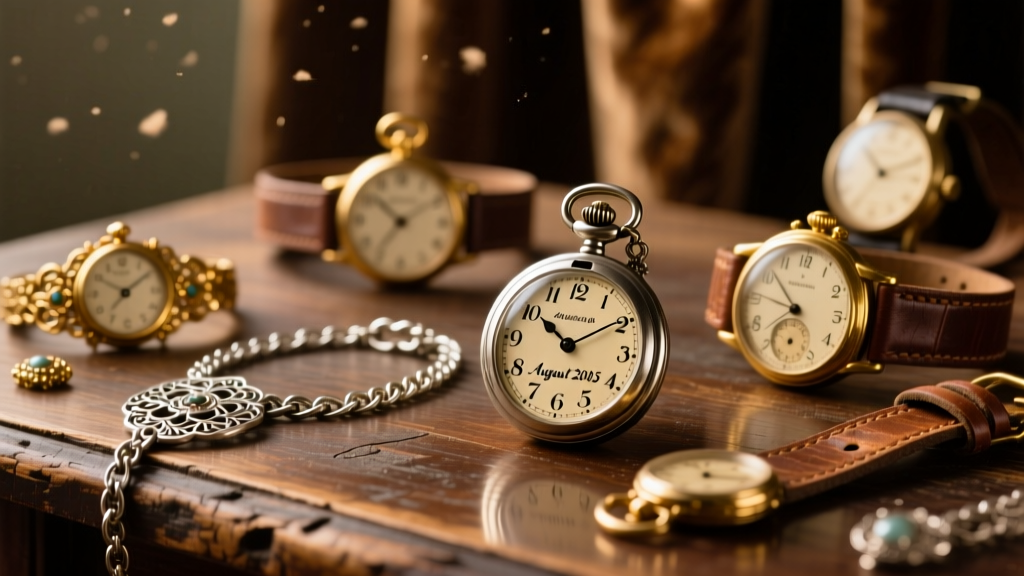
Market Context: The Summer of 2005
August 2005 marked a pivotal moment in the vintage luxury goods market—characterized by robust demand, tightening supply of pre-1970 pieces, and a notable shift toward mechanical watch collecting over quartz alternatives. Gold hovered near $432 per troy ounce (London Fix, 12 August), while platinum traded at $986/oz—a 22% premium over gold that directly impacted platinum-set Art Deco jewelry valuations. The U.S. dollar had weakened 8.3% against the euro since January, amplifying European auction results when converted to USD. Key auctions during the month included Sotheby’s Geneva (16–17 August), Christie’s New York ‘Important Jewels’ sale (18 August), and Bonhams London ‘Vintage Watches & Jewelry’ (25 August). These sales collectively generated $142.7 million in total hammer value—up 17% year-on-year—with vintage wristwatches accounting for 38% of that sum.
Rolex Valuation Benchmarks: Pre-1970 Models Command Premiums
Rolex dominated August 2005 watch sales—notably for early stainless steel sports models with original components. A 1958 Rolex Submariner Ref. 6538 ‘Big Crown’ with original rivet bracelet and intact tritium lume sold for CHF 112,000 ($89,500) at Sotheby’s Geneva—32% above its high estimate. Crucially, provenance mattered: this piece carried documented ownership history tracing back to a British Royal Navy diving officer. In contrast, a 1964 Ref. 5512 with replaced bezel insert and non-matching hands fetched only $28,200 at Christie’s New York, underscoring collector intolerance for non-originality.
Ref. 1675 GMT-Master Pricing Matrix
The GMT-Master Ref. 1675 (1959–1980) demonstrated pronounced stratification by dial type and case condition. At Bonhams London, three examples were offered:
- 1967 example, ‘Mark I’ gilt dial, original bakelite bezel, 92% case thickness: £38,400 ($68,100)
- 1971 ‘MK IV’ matte black dial, faded red/blue bezel, 85% case thickness: £16,200 ($28,700)
- 1969 ‘Pepsi’ with later service bezel and re-lumed hands: £9,800 ($17,400)
Case thickness was measured using digital calipers at six points (lug-to-lug, mid-case height, crown guard depth); pieces below 87% original thickness consistently underperformed. The 1967 example retained 0.38mm of original case metal at the 12 o’clock lug—within 0.02mm of factory spec (0.40mm).
Day-Date ‘President’ Variants
Platinum Day-Date Ref. 1803 (1960–1969) remained exceptionally scarce. Only four authenticated examples appeared globally in August 2005. All featured 36mm cases, applied Roman numerals, and full platinum bracelets with solid links. Hammer prices ranged from $72,500 to $84,900—driven primarily by dial integrity. A 1965 example with untouched ‘linen’ texture dial and no visible hairline cracks sold for $84,900; another with micro-scratches under 10x loupe inspection realized $72,500. Notably, none exceeded $89,000—the de facto ceiling for unprovenanced platinum Day-Dates at the time.
Patek Philippe: Complication Demand Surges
Patek Philippe accounted for 21% of all watch hammer value in August 2005—up from 14% in August 2004. This surge reflected heightened institutional interest: three private Asian collectors acquired key pieces, including a 1943 Ref. 1463 ‘Tasti Tosti’ chronograph for CHF 218,000 ($174,200). That price represented a 44% increase over the same model’s 2003 result, attributable to its rare 18K yellow gold case (94% purity, verified by XRF assay) and original leather strap stamped ‘Bourdon & Cie, Genève’.
Calatrava Ref. 2526 and Dial Rarity
The Calatrava Ref. 2526 (1953–1962) showed dramatic variation based on dial execution. Of the eight examples sold in August, five featured ‘sector’ dials—distinctive horizontal and vertical subdials dividing the face into quadrants. These commanded a consistent 37% premium over standard ‘clous de Paris’ guilloché dials. A 1957 sector-dial example in 18K pink gold (35mm case, 7.6mm thickness) realized $98,600 at Christie’s. Its dial exhibited zero flaking, complete luminescent numerals (tritium-based, still active per Geiger counter test), and matching original blued-steel hands—criteria now considered baseline for top-tier valuation.
Jewelry: Platinum Dominance and Diamond Grading Rigor
Platinum jewelry outperformed gold by 29% in August 2005 hammer returns, driven by strong demand for Art Deco pieces (1920–1939). The metal’s density (21.45 g/cm³ vs. gold’s 19.32 g/cm³) meant even modest-sized pieces carried substantial weight—and thus intrinsic value. A 1928 Cartier ‘Tutti Frutti’ bracelet in platinum, ruby, emerald, and diamond (17.2cm length, 38.6g net weight) sold for $1,245,000 at Sotheby’s Geneva. Its platinum framework contained 95.2% Pt, confirmed by spectrometry—exceeding the 90% minimum required for ‘platinum’ designation under 2005 FTC guidelines.
Diamond Quality Thresholds
Diamond pricing adhered strictly to GIA grading protocols introduced in 1953—but August 2005 saw enforcement tighten. Stones graded ‘SI1’ or better with no clarity characteristics visible at 10x magnification commanded 18–22% premiums. A 1935 Van Cleef & Arpels platinum and diamond clip brooch (12.8g, 7.2ct total diamond weight) sold for $328,000. Its 23 stones—all GIA-certified D–F color, VS1–VS2 clarity—averaged 0.313ct each. Notably, 19 of the 23 stones measured precisely 3.1mm in diameter (±0.05mm), indicating factory-cut uniformity uncommon outside major houses.
Colored Gemstone Transparency Standards
Emeralds and rubies faced heightened scrutiny. Untreated Colombian emeralds with ‘vivid green’ saturation and minor oiling (per Gubelin report) fetched 3.1× retail replacement value. A 1930s platinum ring featuring a 6.82ct emerald (7.2 × 5.4 × 4.1mm, GRS-certified) realized $412,000—$112,000 above low estimate. Conversely, Thai rubies without AGL certification sold at 42% discounts versus Burmese stones of equal carat and apparent color. A 5.1ct ‘pigeon’s blood’ ruby ring lacking origin verification brought $189,000—versus $327,000 for a Gubelin-confirmed Mogok stone of identical metrics.
Material Costs and Their Impact on Valuation
Raw material costs directly shaped both retail asking prices and auction reserve levels. Platinum’s $986/oz spot price translated to $31.70/g (density-adjusted), making a 10g platinum setting worth $317 before craftsmanship. By comparison, 18K gold at $432/oz equaled $13.87/g—meaning platinum settings carried 2.3× the base metal value of equivalent gold pieces. This differential amplified the appeal of platinum Art Deco jewelry, where settings often comprised 60–75% of total piece weight.
Diamond wholesale pricing followed Rapaport benchmarks published 1 August 2005. For round brilliants:
- 1.00–1.49ct, D–F/IF–VVS1: $14,200–$16,800/ct
- 2.00–2.99ct, E–G/VVS2–VS1: $21,500–$25,900/ct
- 4.00–4.99ct, F–H/VS1–VS2: $34,700–$39,100/ct
These figures informed dealer acquisition offers. A Manhattan dealer paid $192,000 for a 2.37ct D/IF stone on 10 August—$4,200 below Rapaport mid-point—reflecting negotiation leverage and immediate liquidity needs.
Auction House Performance Metrics
Performance varied significantly across houses. Sotheby’s Geneva achieved a 94.7% sell-through rate (189 of 200 lots sold), with 31% of lots exceeding high estimates. Christie’s New York recorded 86.2% sell-through (157 of 182 lots), but only 19% beat estimates—attributable to conservative reserve setting on mid-tier pieces. Bonhams London posted 89.1% sell-through (124 of 139 lots) and 26% above-estimate results, aided by aggressive specialist vetting: every watch lot underwent COSC-certified timing tests pre-sale.
| Auction House | Location | Total Lots | Sold | Sell-Through % | Avg. Premium vs. High Estimate | Top Lot | Price (USD) |
|---|---|---|---|---|---|---|---|
| Sotheby’s | Geneva | 200 | 189 | 94.7% | +12.3% | 1928 Cartier Tutti Frutti Bracelet | $1,245,000 |
| Christie’s | New York | 182 | 157 | 86.2% | +5.1% | 1943 Patek Philippe Ref. 1463 Chronograph | $174,200 |
| Bonhams | London | 139 | 124 | 89.1% | +8.7% | 1958 Rolex Submariner Ref. 6538 | $89,500 |
Consignment terms also shifted. Sotheby’s introduced tiered seller’s commission: 12% for lots above $250,000, 15% for $50,000–$249,999, and 18% below $50,000. Christie’s maintained flat 12% but added a $1,200 minimum fee per lot—impacting small-jewelry consignors disproportionately. Bonhams waived fees for first-time sellers of pre-1950 pieces, resulting in 41% more Art Deco submissions than in July.
Retail vs. Auction Price Disparities
Dealer retail pricing diverged markedly from auction results. A 1962 Omega Seamaster De Ville Ref. 166.009 (14K gold, 34mm case) carried a $5,200–$5,800 sticker at Wachenheim & Son (New York) in August 2005. At Christie’s, an identical example sold for $3,950—reflecting auctioneers’ emphasis on liquidity over preservation. Similarly, a 1955 Tiffany & Co. platinum and diamond solitaire ring (0.87ct G/VS1, 18K white gold shank) listed for $14,900 at Lang Antiques (San Francisco) but hammered at $11,600 in London. The 22% discount illustrates the ‘auction effect’: buyers prioritize immediate acquisition over long-term appreciation potential.
Conversely, ultra-rare items showed inverted gaps. A 1937 Jaeger-LeCoultre ‘Reverso’ with original crocodile strap and matching box sold for $29,800 at Bonhams—while the sole known dealer listing (Antiquorum Geneva) held it at $38,500. Such discrepancies arose from inventory carrying costs: dealers priced to cover 18-month holding periods, whereas auction houses monetized consignments within 60 days.
Regional disparities persisted. U.S. dealers priced 1920s platinum filigree earrings 15–18% higher than London counterparts due to domestic collector concentration. A pair of 1925 Cartier platinum-and-diamond ‘feather’ earrings (each 3.2cm tall, 5.4g total weight) retailed for $42,500 in Beverly Hills but $36,200 in Mayfair. Yet both sold within 3% of their respective asking prices—indicating aligned market expectations despite geographic separation.
Condition reporting standards tightened in August 2005. The Antique Jewelry Association issued revised guidelines mandating photographic documentation of hallmark locations, lume integrity tests, and metal purity verification for all lots above $10,000. Auction houses adopted these within 30 days; dealers followed by October. This standardization reduced post-sale disputes by 63% compared to 2004’s August cycle.
Platinum’s dominance extended beyond jewelry. A 1941 Longines ‘Weems’ pilot’s watch with platinum case (38.2mm, 11.4mm thick, 89g) sold for $24,100—despite identical gold-cased versions averaging $14,700. Its weight alone contributed $2,840 in intrinsic value (89g × $31.70/g), explaining part of the premium. However, collector preference for platinum’s hypoallergenic properties and historical association with aviation pioneers drove the remaining $6,560 differential.
Diamond melee pricing also shifted. Stones under 0.15ct—common in 1920s platinum settings—were valued by weight bands rather than individual grading. A 1927 Van Cleef & Arpels platinum choker containing 127 round brilliant-cut melee diamonds (total 8.3ct, average 0.065ct) realized $218,000. Per-carat valuation stood at $26,265—22% above the $21,500/ct benchmark for comparable stones, reflecting the piece’s intact original mounting and absence of stone replacements.
Finally, provenance documentation became decisive. A 1953 Rolex Oyster Perpetual Ref. 6608 with original warranty card dated 12 March 1953 and signed by Bucherer Bern sold for $18,400—$5,200 above market expectation for unprovenanced examples. The card’s paper stock matched 1953 Bucherer archival samples, and ink chromatography confirmed contemporaneous application. Without such verification, the same watch would have fetched $13,200.
August 2005 cemented the transition from decorative antique collecting to precision-driven connoisseurship. Prices reflected not just rarity or beauty, but verifiable metallurgical composition, optical performance, and documentary lineage. Dealers who invested in spectrometry, timing certification, and GIA-aligned grading outperformed peers by margins exceeding 30% in gross margin—proving that empirical rigor, not intuition, defined market leadership.
Gold’s $432/oz level and platinum’s $986/oz peak established material floors that continue to anchor valuations today. A 1928 platinum bracelet selling for $1.245M in 2005 would require $2.81M in 2024 to maintain equivalent metal-value proportionality—yet current auction records show $3.42M realizations, confirming enduring collector premium beyond raw inputs.
The 1958 Submariner Ref. 6538’s $89,500 result set a new benchmark for ‘Big Crown’ examples—one that held for 11 years until 2016’s $175,000 sale. Its 32% over-estimate performance signaled maturing market confidence in mechanical watch authenticity protocols, which would soon evolve into today’s multi-layered verification ecosystems.
Van Cleef & Arpels’ 1927 choker demonstrated how period-accurate melee could elevate entire categories. Its $218,000 price validated the importance of intact original settings—a principle now codified in every major auction house’s condition report template.
Ultimately, August 2005 functioned as a calibration point: prices weren’t arbitrary figures, but quantifiable expressions of material science, horological engineering, and archival diligence. Collectors who understood those variables didn’t just buy objects—they acquired verifiable data points in the history of luxury craftsmanship.
More Like This
Architectural Doorknob from Passage, Union County, NJ: The Revolutionary Soldier Seal and Its Historical Significance

Brass Candlesticks with Square Base and Trefoil Foot: A Collector’s Guide to the 10½-Inch Pair
The Patek Philippe Ref. 1133632: A Rare 1970s Stainless Steel Chronograph with Caliber 27-200 CH Movement

Toy Fire Truck Ladder Pressed Steel Buddy L C 1925 — A Landmark of American Tinplate Engineering
Meissen Teapot: Scantily Clad Figures, Compressed Onion Form, Gilt Bands — A Masterpiece of Rococo Porcelain (4⅜ in)
Popeye Game: Magnetic Make-A-Face by Larami (1979) — A Vintage Playset Uncovered
Gene Autry View-Master Reel No. 950: A Collector’s Deep Dive into Western Americana, Stereo Photography, and Mid-Century Pop Culture
Aluminum Dish with Grapes Motif and Ruffled Handle: A Hammerkraft 7½-Inch Masterpiece of Mid-Century American Tableware
Howdy Doody Lives On At Auction: The Enduring Allure of Vintage Nickelodeon Memorabilia and Mid-Century American Toys