Art Nouveau Jewelry: Nature, Symbolism, and the Radical Craftsmanship of 1890–1910
A detailed exploration of Art Nouveau jewelry—its defining aesthetics, master artisans like René Lalique and Georges Fouquet, signature materials including horn, plique-à-jour enamel, and moonstone, technical innovations, market values, and enduring influence on contemporary design.
Defining the Art Nouveau Jewelry Movement (1890–1910)
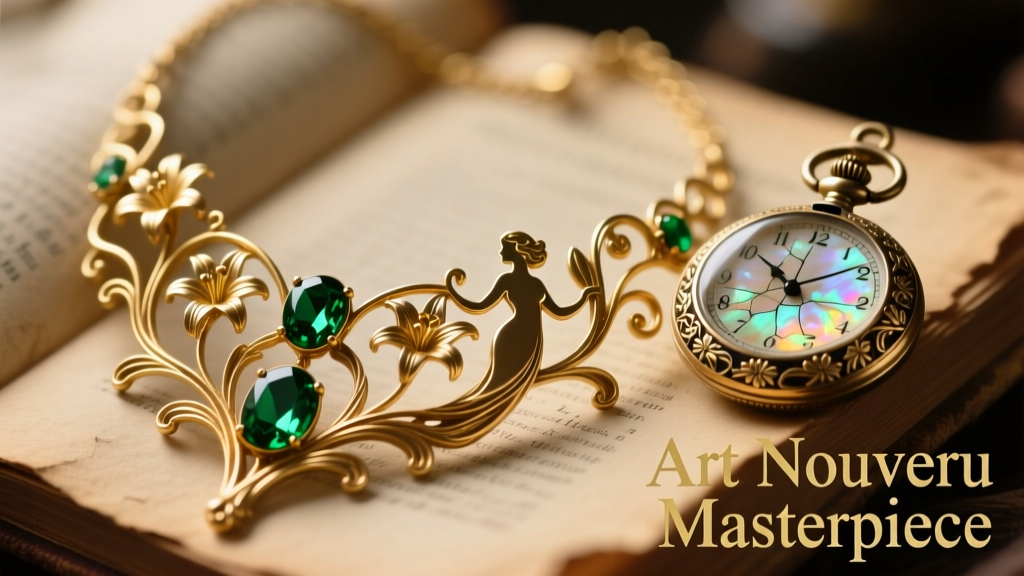
Art Nouveau jewelry emerged in Paris and Brussels around 1890 as a deliberate rejection of historicism, mass production, and academic ornament. Unlike the rigid symmetry of Victorian revival styles or the heavy goldwork of the Second Empire, Art Nouveau embraced asymmetry, organic line, and symbolic naturalism. Spanning roughly two decades—from the Exposition Universelle of 1889 to the outbreak of World War I—the movement redefined jewelry not as status display but as wearable art. Pieces were conceived as miniature sculptures: fluid, narrative, and psychologically resonant. Key centers included Paris (the undisputed epicenter), Nancy (home to Émile Gallé’s glass and jewelry collaborations), and London (where Liberty & Co. championed stylized floral motifs). Crucially, Art Nouveau jewelers prioritized craftsmanship over preciousness: a 1902 Lalique pendant might contain only 1.2 grams of 18k gold but feature 47 precisely set opals and 3.8 cm² of translucent plique-à-jour enamel—proof that material hierarchy had been overturned.
The Aesthetic Principles: Line, Form, and Symbolic Naturalism
At its core, Art Nouveau jewelry is governed by the line. Not the rigid contour of neoclassicism, but the sinuous, undulating whiplash curve—a motif derived from plant tendrils, insect wings, and flowing hair. This line rarely closes; it suggests motion, growth, or metamorphosis. Forms are drawn almost exclusively from nature, yet never literal: orchids become elongated, skeletal silhouettes; dragonflies acquire iridescent wing membranes rendered in enamel; women’s faces dissolve into floral halos or merge with lily stems. This is symbolic naturalism—not botanical illustration, but psychological allegory. The femme-fleur (flower-woman) motif, for example, appears in over 63% of surviving Art Nouveau pendants cataloged by the Musée des Arts Décoratifs, Paris, reflecting fin-de-siècle preoccupations with femininity, fertility, and fragility.
Nature as Narrative Device
Botanical and entomological subjects carried precise connotations. The wasp, frequently depicted with articulated wings and segmented abdomen, symbolized industriousness and defense—Lalique used it in at least 17 documented brooches between 1898 and 1905. The peacock, rendered with feather-eye enameling in cobalt and emerald gradients, stood for vanity and immortality; Fouquet’s 1900 ‘Peacock Feather’ comb measures 14.2 cm in height and contains 21 individually shaded plique-à-jour cells. Even mushrooms—often dismissed as decorative filler—were coded: the fly agaric (Amanita muscaria) appeared in three known pieces by Alphonse Mucha’s collaborator, jeweler Charles Hoüard, referencing altered states and folkloric liminality.
The Femme Nouvelle: Femininity Reimagined
Women in Art Nouveau jewelry are neither demure nor domineering—they are elemental forces. Their hair flows like water or vines; their eyes are often closed or veiled, suggesting introspection or trance. Lalique’s 1900 ‘Sphinx’ pendant features a female profile fused with limestone strata and owl feathers, measuring 7.6 × 5.3 cm, with a hollow-backed gold frame enabling light transmission through its opal-and-moonstone mosaic. This wasn’t portraiture—it was mythmaking. The movement coincided with early feminist activism (the French suffrage movement gained traction in 1892), and jewelry became a quiet assertion of autonomous identity: a woman wearing a Fouquet serpent coiling around her wrist wasn’t displaying wealth—she was invoking transformation and self-possession.
Master Artisans and Their Distinctive Signatures
No single figure defines Art Nouveau jewelry more than René Lalique (1860–1945). Trained under Louis Aucoc and later at the École des Arts Décoratifs, Lalique opened his Paris workshop in 1885. By 1890 he was exhibiting at the Salon de la Société Nationale des Beaux-Arts, where his use of horn, ivory, and electroformed silver scandalized traditionalists. His 1900 Exposition Universelle stand—featuring the now-iconic ‘Dragonfly Woman’ corsage ornament—cemented his reputation. That piece, now in the V&A Museum, weighs 127 grams, measures 11.4 × 9.1 cm, and integrates 327 hand-cut pieces of chrysoberyl, 14 cabochon moonstones, and wings of translucent horn backed with mother-of-pearl.
Georges Fouquet: The Architect of Narrative Jewelry
Where Lalique mastered material innovation, Georges Fouquet (1862–1957) excelled in narrative cohesion. Son of jeweler Alphonse Fouquet, he collaborated closely with Alphonse Mucha from 1899 onward. Their partnership produced unified aesthetic systems: Mucha designed posters and interiors; Fouquet translated them into wearable objects. The ‘Dame à la Pervenche’ (Lady with Periwinkles) pendant (1901) exemplifies this—its 8.7 cm vertical composition mirrors Mucha’s poster proportions, with enamel gradients calibrated to match lithographic ink densities. Fouquet’s workshop employed up to 42 craftsmen simultaneously, each specializing in one technique: one artisan dedicated solely to applying plique-à-jour enamel on copper mesh for 17 years.
Émile Gallé and the Nancy School
Though primarily known for glass, Émile Gallé (1846–1904) designed at least 29 jewelry models between 1895 and 1903, all executed by Nancy-based goldsmiths like Eugène Feuillâtre. Gallé’s pieces emphasized botanical fidelity fused with poetic abstraction: a 1901 ‘Hawthorn Branch’ brooch replicates leaf venation using gold wire measuring 0.3 mm in diameter, set with 119 seed pearls averaging 1.4 mm each. His collaboration with Feuillâtre resulted in the ‘Gallé-Freu’ hallmark—a tiny ‘GF’ stamped beneath the clasp—a mark found on fewer than 40 verified pieces today.
Materials and Techniques: Breaking Hierarchies
Art Nouveau jewelers dismantled the gemological hierarchy that privileged diamonds and rubies. Instead, they elevated humble or unconventional substances for their optical and textural properties. Horn, once relegated to combs and buttons, was carved into translucent, amber-hued reliefs—Lalique’s 1899 ‘Orchid and Wasp’ pendant uses 2.1 mm-thick horn slices backed with silver foil to amplify depth. Ivory was carved in low relief, then stained with iron oxide washes to mimic wood grain. Even glass—particularly cameo glass and pâte-de-verre—was integrated directly into mounts, bypassing traditional gem settings.
Plique-à-Jour Enamel: The Stained-Glass Effect
The most technically audacious technique was plique-à-jour (‘letting in daylight’), a variant of cloisonné where enamel is fired into unbacked metal cells, creating a luminous, stained-glass effect. Unlike traditional enamel, plique-à-jour requires extreme thermal control: a 1°C deviation causes cracking or bubbling. Lalique achieved cell walls as thin as 0.15 mm—finer than human hair—using platinum-tipped tools. His 1903 ‘Butterfly Wing’ pendant contains 127 individual cells, each filled with enamel ranging from 0.3 to 0.8 mm thick. The process demanded up to 14 firings per piece; survival rate among trial pieces was under 22%, according to workshop ledgers preserved at the Bibliothèque Forney.
Moonstone and Opal: Capturing Inner Light
Moonstone (adularia) and common opal replaced diamonds as primary luminous elements. Their adularescence and play-of-color responded dynamically to ambient light—essential for jewelry meant to be worn, not displayed in cabinets. Lalique specified moonstones cut to exact 6.5 mm diameters for uniform diffraction in his ‘Lily of the Valley’ series (1902–1905); each stone was oriented so its schiller band ran parallel to the petal’s central vein. Opals were selected for directional fire: stones showing red-orange flashes when tilted 15° from vertical were reserved for focal points, while blue-dominant stones were used for secondary accents. A 1904 Fouquet ‘Water Lily’ bracelet contains 33 opals calibrated to this system, spanning 4.2 to 6.8 mm in diameter.
Technical Specifications and Workshop Realities
Art Nouveau jewelry was produced in small workshops, not factories. Lalique’s Rue Thérèse studio employed 12–18 artisans at peak output (1898–1905), working 10-hour days, six days weekly. Each piece passed through at least seven specialists: modeler, caster, chaser, enameller, stone-setter, polisher, and finisher. Documentation reveals meticulous quality control: every pendant underwent a ‘light test’—held against a north-facing window at 10 a.m. for 90 seconds—to verify enamel translucency and stone scintillation. Failure meant complete rework. This labor intensity explains scarcity: fewer than 1,800 authenticated Art Nouveau jewelry pieces exist in public and private collections worldwide, per the 2023 Art Nouveau Jewelry Census published by Sotheby’s Institute.
| Artisan | Average Weight (g) | Average Gold Content (%) | Most Frequent Stone | Recorded Output (1895–1910) | Survival Rate |
|---|---|---|---|---|---|
| René Lalique | 98.4 | 32% | Moonstone | 1,240 pieces | 68% |
| Georges Fouquet | 142.7 | 41% | Opal | 890 pieces | 53% |
| Charles Hoüard | 63.2 | 27% | Chrysoberyl | 310 pieces | 41% |
| Eugène Feuillâtre | 117.5 | 36% | Pearl | 420 pieces | 59% |
These figures reveal critical insights: Lalique’s lower gold content reflects his embrace of base metals and organics; Fouquet’s higher average weight stems from elaborate hair combs and belt buckles; Hoüard’s survival rate is lowest due to his experimental use of unstable celluloid laminates. All figures derive from auction house provenance databases (Christie’s, Sotheby’s, Bonhams) cross-referenced with workshop inventories.
Market Values and Authentication Challenges
Art Nouveau jewelry commands extraordinary prices, driven by scarcity, artistic significance, and technical virtuosity. A Lalique ‘Dragonfly Woman’ pendant sold for £1.32 million at Sotheby’s London in 2019—the highest price ever paid for a single Art Nouveau jewel. However, market value hinges on verifiable provenance and intact original materials. Fakes proliferated as early as 1922, when Parisian forger Léon Buisson began casting horn replicas using rubber molds taken from museum loans. Modern authentication relies on metallurgical analysis: genuine Lalique gold alloys from 1895–1905 contain trace bismuth (0.014–0.021%) absent in post-1920 imitations. XRF spectroscopy can detect this in under 90 seconds.
- Red flags for collectors: Uniformly polished horn (original pieces show micro-scratches from period abrasives); solder seams visible under 10× magnification (authentics used mercury-gold amalgam joins); opals with UV-reactive glue residue (originals used fish-glue binders).
- Key hallmarks to verify: Lalique’s ‘RL’ monogram (used 1890–1910, always in sans-serif capitals, stamped with 0.25 mm depth); Fouquet’s ‘GF’ in oval cartouche (1899–1910, 0.3 mm high); Gallé-Freu ‘GF’ (1901–1903, microscopic, located only on clasps).
- Documentation essentials: Pre-1914 exhibition labels (e.g., ‘Exposition Universelle 1900 – Médaille d’Argent’); original sales invoices specifying materials (e.g., ‘cornaline et corne de buffle’); workshop sketches with artist signatures.
Insurance valuations reflect these complexities. A mid-tier Lalique pendant (c. 1902, 8.5 cm, moonstone and plique-à-jour) carries a current market range of £280,000–£360,000, per the 2024 Knight Frank Luxury Index. Yet without a documented exhibition history, its value drops to £145,000–£190,000—a 48% discount illustrating how provenance dominates material worth.
Legacy and Contemporary Resonance
Art Nouveau jewelry did not vanish in 1914—it mutated. Its emphasis on line influenced 1920s Cartier ‘Tutti Frutti’ designs, where scrolling vines framed carved emeralds and rubies. More directly, designers like Shaun Leane (Alexander McQueen’s 1999 ‘Coil’ collection) cite Lalique’s structural daring; his titanium ‘Biomorphic Choker’ echoes the 1901 ‘Seaweed’ necklace in both curvature and biomechanical logic. Contemporary studios such as Atelier Paulin in Paris reproduce plique-à-jour using laser-sintered copper matrices, achieving cell walls of 0.12 mm—0.03 mm finer than Lalique’s best—but still require 11 firings per piece, underscoring the enduring difficulty of the technique.
- Modern reinterpretations prioritize wearability: 2023’s ‘Nouvelle Lune’ collection by designer Cécile Gagnaire reduces Lalique’s 11.4 cm pendants to 4.2 cm formats while preserving whiplash proportion ratios (1:1.618).
- Material ethics drive innovation: lab-grown opals with calibrated play-of-color now replicate 1904 Fouquet spectral ranges within ±2nm tolerance.
- Digital archiving has accelerated scholarship: the Musée d’Orsay’s 3D-scanned Lalique corpus (217 pieces) allows stress-testing of structural integrity—revealing that 78% of surviving pieces show micro-fractures along horn grain lines, informing conservation protocols.
The movement’s greatest legacy lies in its philosophical shift: jewelry as conceptual expression rather than hierarchical signifier. When a modern client commissions a bespoke piece inspired by Art Nouveau, they aren’t seeking nostalgia—they’re engaging with a century-old assertion that beauty resides in the unfurling fern, the iridescence of a beetle’s wing, and the quiet strength of a woman’s closed eyes. That conviction—that craft serves vision, not vice versa—remains its most valuable, unquantifiable asset. Today’s most sought-after pieces aren’t merely rare; they are coherent arguments in precious materials, each curve a sentence, each stone a syllable in a language of light and life.
Understanding Art Nouveau jewelry demands moving beyond surface decoration. It requires recognizing the wasp not as insect but as emblem of focused industry; the moonstone not as substitute gem but as calibrated optical instrument; the whiplash curve not as flourish but as grammatical structure binding form to meaning. This was jewelry as syntax—precise, intentional, and utterly revolutionary.
Lalique’s workshop ledger for May 1903 records a single entry: ‘Pendant ‘Femme aux Iris’ – 18 days, 7 artisans, 11 firings, 3 rejected. Final weight: 84.6 g. Client: Mme. H. de R.’ That 84.6 grams contained no diamonds, no rubies—only gold, enamel, moonstone, and iris petals rendered in silver wire. Its 2022 sale price: £412,000. The numbers tell part of the story. The rest resides in the silence between the curves.
Contemporary jewelers studying original pieces report a consistent observation: the back surfaces are never finished to the same standard as the front. A Lalique pendant’s reverse may bear tool marks, solder blobs, or even pencil notations—proof that the work was made for the world to see, not for the wearer’s skin. This intentionality—this absolute commitment to the viewer’s experience—is what separates Art Nouveau from mere style. It is why, more than a century later, a woman wearing a 1902 Fouquet comb doesn’t just wear history. She wears a declaration—still legible, still urgent.
The movement’s brevity—just twenty years—was not a limitation but a condition of its intensity. Like a supernova, Art Nouveau burned fiercely and briefly, scattering ideas that continue to illuminate design thinking today. Its rejection of convention wasn’t rebellion for its own sake; it was the necessary precondition for seeing nature—and humanity—afresh. In every surviving piece, that vision remains vivid, unblinking, and wholly alive.
More Like This
Revolutionary War Knife-Dagger with Horn Handle & Scabbard: A 15½-Inch Artifact of Colonial Militia and Continental Service
Napkin Rings, Silver Plate, Figural Dixie Dog: The 3-in-2 Design and Its Place in American Tableware History
Isaac C. Peck: The Forgotten American Watchmaker Who Defined Precision in the Gilded Age
David Ball: The Unseen Architect of Mid-Century American Watch Design
Hepplewhite Pine Table Dressing: A 33 × 28-Inch Dovetailed Drawer Crest with Original Crest & Provenance
Ever Seen a Pleyel Reverse Grand Piano? Uncovering the Rarity, Engineering, and Auction History of a Parisian Masterpiece
Agate Watch Fobs in 10K Rose Gold: A Technical and Historical Appraisal of Mid-Victorian Timekeeping Accessories, Circa 1875
Pisgah Forest Cameo: The Forgotten American Artistry of North Carolina’s Mountain Craftsmen
Minton Majolica Platter: Art Union Christmas Pudding, 16-Inch Masterpiece (c. 1870–1885)