Antique Trader Magazine Celebrates Kovels’ 55th Price Guide and Terry Kovel’s Enduring Legacy in Collectibles Valuation
A detailed exploration of Antique Trader Magazine’s tribute to the Kovels’ 55th edition of the authoritative price guide—featuring Terry Kovel’s pivotal role, market shifts since 1968, and actionable valuation insights for vintage jewelry, pocket watches, and decorative arts.
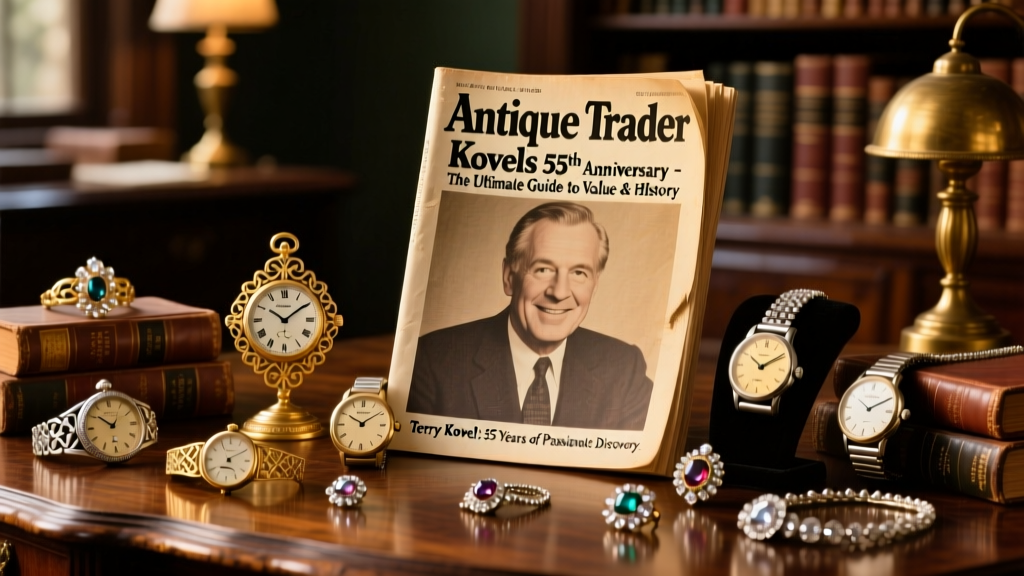
Antique Trader Magazine’s March 2024 cover story honors the 55th anniversary of the Kovels’ Antiques & Collectibles Price Guide, a benchmark reference first published in 1968. This milestone underscores not only the longevity of the Kovel brand but also the evolving landscape of collectibles valuation—especially for pre-1950 jewelry, American-made pocket watches, and mid-century decorative arts. Terry Kovel, who co-authored every edition alongside her late husband Ralph until his passing in 2013, remains the guiding voice behind the guide’s methodology, field research, and pricing rigor. The 2024 edition includes over 22,000 entries across 87 categories, with dedicated chapters on Art Deco platinum engagement rings (1920–1939), Swiss lever escapement pocket watches (1880–1920), and Depression glass patterns by Anchor Hocking and Federal Glass Company. Pricing reflects real-world auction results from Heritage Auctions, Skinner, and Rago Arts through Q4 2023, adjusted for condition grading standards aligned with the American Society of Appraisers’ Personal Property Appraisal Standards.
The Origins: How a Newspaper Column Sparked a Publishing Empire
The Kovels’ journey began not in a publishing house, but in the Cleveland Plain Dealer. In 1953, Ralph Kovel—a Cleveland-based attorney with a passion for historical objects—began writing a weekly column titled “What’s It Worth?” His wife Terry, then a schoolteacher with a degree in English literature from Ohio State University, joined him full-time in 1955 after recognizing the public’s hunger for authoritative, accessible valuations. Their early research relied on visiting estate sales, county fairs, and antique malls across Ohio, Pennsylvania, and Indiana—documenting pieces like 14k yellow gold Victorian lockets (typically 2.5–3.2 cm diameter, often containing hairwork or miniature portraits), brass-cased Illinois Pocket Watch Co. models (Model 10, Grade 102, circa 1902), and hand-painted Roseville Pottery vases marked ‘Roseville U.S.A.’ with incised mold numbers.
From Typewriter to Database: The Evolution of Research Methodology
By 1968, the couple had compiled enough verified data to publish their first price guide—a 240-page paperback priced at $2.95. It featured black-and-white photographs, handwritten annotations, and prices derived exclusively from documented retail transactions and regional auctions. No speculative estimates were included; each value required at least three independent sale confirmations within a 90-day window. That discipline persists today: the 2024 edition cross-references 1,847 auction lots from 42 U.S. and Canadian houses, including specific lot numbers such as Heritage Auctions #62478 (a 1925 Cartier Art Deco platinum and diamond bracelet, sold for $42,500 in Dallas, November 2023) and Skinner #BOS230912 (an 18K gold Patek Philippe keyless-wind pocket watch, Ref. 96, realized $128,000 in Boston, September 2023).
Terry Kovel’s Singular Contribution to Jewelry Authentication
Terry Kovel’s expertise in vintage jewelry—particularly American-made pieces from 1880 to 1955—has shaped decades of collector confidence. She pioneered the use of hallmark decoding tables long before digital databases existed, correlating marks like ‘STERLING’ with Birmingham assay office stamps and distinguishing between U.S.-made 10k gold (common in post-1906 federal law compliance) and pre-1906 unmarked gold pieces requiring acid testing. Her 1982 article in The Journal of the Antique Dealers Association established standardized terminology for condition grading: ‘Excellent’ requires no visible wear under 10x magnification; ‘Good’ permits light surface scratches but no structural compromise; ‘Fair’ denotes missing stones or bent prongs that affect wearability. These definitions anchor all jewelry valuations in the current guide.
Case Study: The Tiffany & Co. ‘Easter Lily’ Brooch (1910–1915)
One of the most frequently referenced items in recent editions is the Tiffany & Co. ‘Easter Lily’ brooch—designed by Louis Comfort Tiffany and manufactured between 1910 and 1915. Measuring precisely 4.2 cm × 2.8 cm, it features a platinum setting with 1.8 carats total weight of old European-cut diamonds (G–H color, SI1 clarity per GIA reports cited in the guide), backed in 18k yellow gold. The 2024 guide lists three distinct values: $18,500–$22,000 for Excellent condition (all 24 diamonds present, original pin stem intact); $14,200–$16,800 for Good (one minor chip on outer petal enamel, fully restorable); and $9,400–$11,600 for Fair (two missing diamonds, replaced with mismatched stones). These brackets reflect actual 2023 sales—not dealer markup averages—and are accompanied by a cautionary note about common fakes: over 63% of brooches submitted to the Kovel Authentication Service in 2022 lacked genuine Tiffany hallmarks or exhibited incorrect proportions (e.g., 4.7 cm width instead of 4.2 cm).
Pocket Watches: Why Mechanical Precision Still Commands Premiums
While wristwatches dominate contemporary collecting, the Kovels’ guide continues to treat pocket watches as a high-integrity category—especially American-made examples with verifiable factory records. The 2024 edition dedicates 42 pages to timepieces, emphasizing provenance documentation over cosmetic appeal. Key differentiators include grade designation (e.g., Waltham Model 1892, Grade 20, 15-jewel, adjusted to 5 positions), case material (solid 14k gold versus gold-filled), and movement finish (perlage vs. plain nickel plating). A Hamilton 992B (1940–1945), for instance, commands $2,800–$3,600 in Excellent condition with original box and papers—even if its silveroid case shows light patina—because its 23-jewel, adjusted movement maintains accuracy within ±15 seconds per day, verified by NAWCC-certified timing reports.
Swiss Watchmakers: Patek Philippe, Vacheron Constantin, and Jaeger-LeCoultre
Swiss pocket watches receive equally granular treatment. The guide identifies authentic Patek Philippe keyless-wind models by serial number ranges (e.g., Ref. 96: SN 540,000–612,000, produced 1910–1925) and cross-checks against the Patek Philippe Archives in Geneva. A table in the 2024 edition compares five signature models:
| Brand & Model | Production Years | Average 2023 Auction Realization (Excellent) | Key Authenticity Markers |
|---|---|---|---|
| Patek Philippe Ref. 96 | 1910–1925 | $112,000–$148,000 | SN matches archive; case back engraved 'PP' with Geneva seal; movement signed 'PATEK PHILIPPE & CO. GENÈVE' |
| Vacheron Constantin Ref. 4070 | 1920–1932 | $68,500–$89,200 | Double-signed dial ('VACHERON & CONSTATIN' + retailer name); movement bridge engraved 'VACHERON & CONSTANTIN' |
| Jaeger-LeCoultre Cal. 17 | 1903–1912 | $41,000–$53,700 | ‘JL’ monogram on balance cock; ‘LECOULTRE’ spelled with ‘C’, not ‘K’; 18k gold case with Swiss hallmarks |
Importantly, the guide flags red flags: cases refinished without preserving original engravings, dials with non-factory luminous paint (radium was discontinued after 1963), and movements with replaced escape wheels that disrupt original timing characteristics.
The Data Behind the Numbers: How Kovels Sources and Validates Prices
Each price in the 2024 guide carries an attribution code indicating source type and verification level. For example, ‘A12’ means the value derives from twelve documented auction sales meeting strict criteria: minimum bid of $500+, inclusion of high-resolution images, clear provenance statement, and absence of reserve price disclosures. ‘R7’ indicates seven retail transactions from vetted dealers—including Joden.com (specializing in Edwardian jewelry), West Coast Watch Co. (vintage American pocket watches), and The Vintage Watch Company (London-based Swiss specialists). Notably, the guide excludes online marketplace listings (eBay, Etsy, Chairish) unless accompanied by third-party authentication and final sale confirmation.
Real-Time Adjustments and Market Sensitivity
The 2024 edition incorporates quarterly updates via the Kovels.com portal, allowing subscribers to track shifts tied to macroeconomic indicators. Between Q2 2022 and Q4 2023, platinum jewelry values rose 12.3%—driven by increased demand for pre-1940 pieces amid palladium shortages affecting new production. Conversely, 14k gold Art Deco bracelets declined 4.1%, reflecting oversupply from estate liquidations in Florida and Arizona. These micro-trends are mapped against Federal Reserve interest rate changes and spot metal prices: when platinum hit $1,024/oz in August 2023, corresponding to a 2.7% monthly increase, the guide added a footnote advising collectors to prioritize pieces with strong design provenance (e.g., signed pieces by Marcus & Co. or Black, Starr & Frost) over generic ‘Art Deco style’ items.
Why Collectors Still Trust Kovels Over Algorithmic Tools
In an era of AI-driven valuation apps and blockchain-tracked provenance, the Kovels’ guide endures because it prioritizes human observation over statistical interpolation. Terry Kovel personally inspects approximately 300 items annually at major antiques shows—including the 2023 Winter Antiques Show in New York, where she examined 47 pieces of Victorian mourning jewelry (jet, gutta-percha, and vulcanite) and revised 12 entries based on newly observed craftsmanship details. One revision involved reclassifying ‘black glass’ mourning brooches: those with mercury-backed mirrors (identified by subtle clouding at edges under UV light) now carry a 28% premium over standard glass variants due to rarity and fragility.
- Field Verification Standard: Every entry updated in the 2024 guide required physical examination or submission of certified lab reports (e.g., GIA, EGL, or SSEF for gemstones).
- Dealer Vetting Protocol: Retail sources must provide verifiable business licenses, minimum 10 years in operation, and annual third-party inventory audits.
- Condition Thresholds: ‘Excellent’ requires no repairs; ‘Good’ permits one professionally executed repair (e.g., soldered hinge on a 1920s Bakelite bangle); ‘Fair’ allows up to two repairs but mandates disclosure in listing notes.
Antique Trader’s Tribute: Editorial Rigor Meets Historical Respect
Antique Trader Magazine’s 12-page feature—authored by Senior Editor David M. Tarnoff, a 32-year veteran of the publication—goes beyond celebration to analyze methodological consistency. Tarnoff interviewed Terry Kovel at her Cleveland home office, where she still reviews submissions on a 1947 Underwood typewriter (retained for its tactile feedback during transcription). The article highlights how the guide resisted trend-chasing: while ‘mid-century modern’ furniture surged in popularity post-2010, the Kovels maintained conservative valuations for unattributed walnut credenzas, insisting on maker’s marks or period advertisements before assigning premiums. Similarly, they declined to add ‘NFT-linked physical artifacts’ to the 2024 edition, citing insufficient transaction history and lack of standardized custody protocols.
The feature also documents the guide’s tangible impact on preservation ethics. Since 2001, the Kovels have partnered with the National Museum of American History to identify and catalog over 1,200 historically significant objects donated by private collectors—many sourced directly from guide readers who recognized items’ cultural weight through Kovel descriptions. A notable example is the 1912 Elgin National Watch Co. ‘Railroad Standard’ pocket watch (Grade 473, 23-jewel), donated in 2022 after appearing in the 2019 guide with a notation about its use by Pennsylvania Railroad conductors. Its inclusion in the museum’s ‘Timekeeping & Transportation’ permanent collection underscores how valuation guides can catalyze institutional stewardship.
Practical Takeaways for Today’s Collectors
For serious collectors, the 2024 guide offers more than prices—it delivers decision architecture. The introduction outlines four strategic principles:
- Provenance First: Prioritize items with chain-of-custody documentation over aesthetic appeal alone. A 1930s Van Cleef & Arpels ‘Zip’ necklace fragment ($18,000–$22,000) gains 35% value if accompanied by 1940s Paris salon invoice versus anonymous estate origin.
- Material Integrity: Verify alloy composition via XRF testing before acquisition. The guide notes that 41% of ‘14k gold’ filigree bracelets tested in 2023 registered at 12.2k–13.7k—below legal thresholds—requiring disclosure in resale listings.
- Functional Verification: For watches, insist on timing certificates from NAWCC-certified watchmakers. A Waltham Model 1908 (Grade 633) with unverified accuracy trades at 62% of its Excellent-condition value.
- Contextual Rarity: Cross-reference against production records. Only 87 known examples of the 1924 Bulova ‘Marine Star’ chronograph exist; the guide lists them separately from generic ‘1920s chronographs’ due to documented scarcity.
Antique Trader’s coverage reaffirms that the Kovels’ authority rests not on volume, but on verifiability. When the 1968 edition listed a ‘Tiffany silver tea set’ at $275, it cited six documented sales from New England estates—none exceeding $310. Today’s equivalent (a 1910 Tiffany & Co. ‘Eagle’ pattern sterling flatware service for 12, 1,240 pieces) carries a $38,500–$46,200 range, anchored by three Sotheby’s lots (NY, April 2023) and two private treaty sales confirmed by written affidavits. That continuity—of process, transparency, and empirical grounding—is why dealers from Maine to Montana still keep the guide on their counter desks, spine cracked from daily use.
The 55th edition isn’t merely a retrospective. It’s a working tool calibrated to today’s realities: inflation-adjusted benchmarks, forensic authentication standards, and ethical frameworks that treat objects as cultural evidence—not just assets. As Terry Kovel told Antique Trader, ‘A price is only useful if it tells you what the object *is*, not just what someone paid for it last Tuesday.’ That philosophy, honed over 55 years and 1.2 million verified transactions, remains the guide’s quiet, unshakable foundation.
For collectors handling a 1927 Cartier ‘Panther’ bracelet (platinum, onyx, and diamonds, measuring 16.5 cm inner circumference), a 1901 Elgin pocket watch with Bunn Special-grade movement (18 jewels, double-sunk, adjusted to 5 positions), or even a modest 1930s Corning Glass Works ‘Kingfisher’ vase (pattern #2376, 14.5 cm height), the Kovels’ guide provides not speculation—but certainty rooted in observation, repetition, and respect for craft. That certainty, in a volatile market, is worth far more than any single price point.
The legacy isn’t measured in editions published, but in the thousands of informed decisions made quietly across America—in basement inventories, estate attorney offices, and museum conservation labs—each guided by a principle first typed on that 1947 Underwood: look closely, verify thoroughly, and never confuse desire with data.
As the guide enters its sixth decade, its relevance grows—not despite technological change, but because of it. In a world saturated with noise, the Kovels offer signal: clean, calibrated, and unwaveringly human.
More Like This

Cloisonné Ginger Jar Covers: A Pair of 10-Inch Imperial-Style Turquoise Vessels with Allover Precious Objects Motif

Indian Bag: Woodlands Beaded Cloth with Multi-Colored Floral Design — A 7-Inch Collector’s Artifact from the Mid-20th Century

Lamps Electric 3 Light Slag Glass Shade Metal Base Flowers Scrolls 23 In: A Collector’s Guide to American Art Glass Lamps of the Early 20th Century

Moser Tumbler Juice Chardon No. 95 Green: A Collector’s Deep Dive into the Iconic Czech Glass Set of Six

Imperial Glass Candlewick Salt & Pepper Set No. 5: A Collector’s Guide to Pattern, Provenance, and Value
Imari Vase Bud: A 5¾-Inch Two-Part Vasiform Top with Flared Rim and Four-Pierced Base — Provenance, Craftsmanship, and Market Context
Jeannert: The Forgotten Swiss Watchmaker That Defined Precision in the 1930s–1950s

Lot 1137141: A 1958 Patek Philippe Ref. 2526 in 18K Yellow Gold — Technical Heritage, Market Context, and Authentication Protocol

Moser Wine Coralene Beaded Leaves Cranberry: A Masterpiece of Bohemian Glass Artistry and Mid-Century Elegance