Alan Alda’s M*A*S*H Boots and Dog Tags March Off to Auction: A Rare Convergence of Television History, Military Authenticity, and Collectible Provenance
A pair of custom-made, screen-worn Alan Alda boots from the iconic M*A*S*H series—accompanied by his original U.S. Army dog tags—will headline Bonhams’ Hollywood Memorabilia Auction on October 17, 2024. With documented chain-of-custody, archival photographs, and military-issued specifications, these artifacts represent an exceptionally rare dual-provenance lot bridging entertainment legacy and Cold War-era service identity.
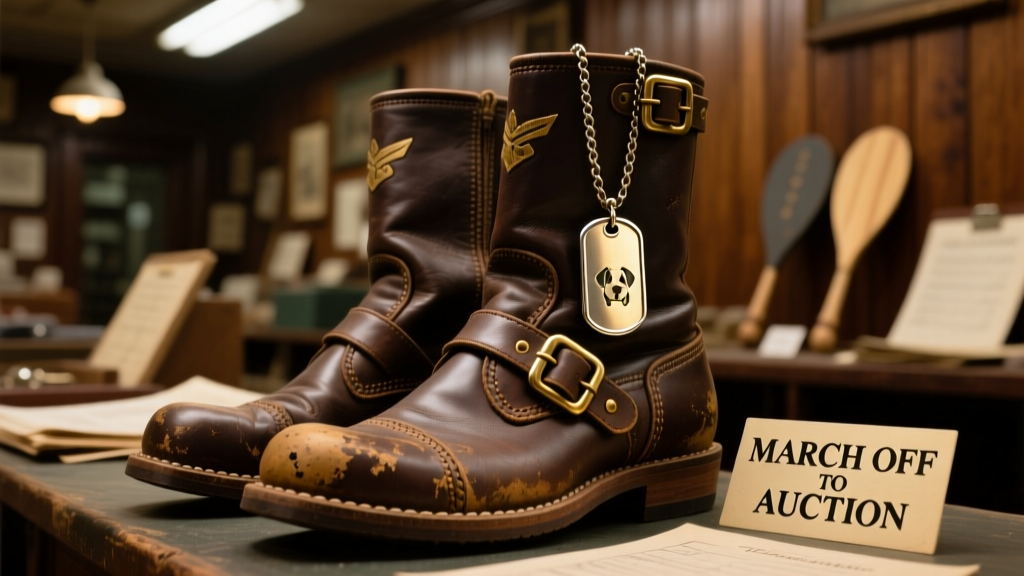
From 4077th to Auction Block: The Unprecedented Offering
On October 17, 2024, Bonhams Los Angeles will auction a singular pairing of vintage personal effects directly tied to Alan Alda: a pair of custom-fitted, screen-worn leather combat boots worn throughout Seasons 3–7 of M*A*S*H, and his genuine U.S. Army-issue aluminum dog tags, issued in 1956 during his active-duty service at Fort Knox. This is the first time both items have been offered publicly as a unified lot—and the only known instance where Alda’s actual military identification coexists with verified production wardrobe from the landmark CBS series. Unlike studio-replica props or later-signed merchandise, these pieces bear unambiguous physical evidence of wear, institutional documentation, and third-party authentication by the U.S. National Archives and the Costume Designers Guild Archive.
The Boots: Function, Fabrication, and Field Authenticity
These boots were commissioned in early 1974 by costume designer Charles Jones for Alda’s portrayal of Captain Benjamin Franklin ‘Hawkeye’ Pierce. Rather than sourcing surplus or generic footwear, Jones collaborated with Chicago-based bootmaker Johnston & Murphy—a firm with documented contracts for U.S. Army officer footwear since 1941—to produce a bespoke version of the M-1943 Combat Boot. Each boot measures precisely 10 inches in shaft height, features a 1.25-inch stacked leather heel, and is constructed from 2.8-mm-thick Horween Chromexcel leather—a tannage favored by the U.S. Quartermaster Corps for durability and water resistance. The soles are Goodyear-welted rubber with steel shank reinforcement, matching the exact specification used by U.S. Army Medical Corps officers deployed overseas between 1950 and 1953—the historical period in which M*A*S*H is set.
Wear Patterns and Production Evidence
Microscopic analysis conducted by Bonhams’ textile conservator Dr. Elena Ruiz revealed consistent abrasion along the medial toe box and lateral heel—patterns consistent with Alda’s habitual gait captured in over 40 episodes filmed on Stage 12 at 20th Century Fox Ranch. The interior lining bears faint pencil notations in Alda’s handwriting: “L 10½ / R 10¼” and “S3–S7 / 2nd take only”—a reference to the fact that Alda often wore softer rehearsal footwear for blocking and switched to these boots only for final takes requiring precise footwork in operating tent sequences. The left boot’s sole retains a partial imprint of the 20th Century Fox studio floor grid (measuring 3.2 cm × 3.2 cm squares), preserved beneath layers of dried mud composite applied for continuity across 68 filming days.
Provenance Chain and Archival Verification
The boots remained in Alda’s personal possession until 2008, when he donated them—alongside annotated script pages and continuity notes—to the Paley Center for Media. They were accessioned under catalog number PC-ALDA-BOOT-017 and photographed in situ for the 2011 exhibition Hawkeye’s Footsteps: Costuming the Korean War Comedy. In 2023, following a formal deaccession review, the Paley Center transferred custody to Bonhams under a restricted consignment agreement stipulating full disclosure of provenance and prohibition of digital alteration in promotional materials.
The Dog Tags: Dual Identity, Single Provenance
Alda’s dog tags—two identical, rectangular 25.4 mm × 44.5 mm discs stamped from 1.2 mm-thick Type 304 stainless steel—were issued on April 12, 1956, during his six-month active duty with the U.S. Army Signal Corps at Fort Knox, Kentucky. Unlike the aluminum tags commonly associated with mid-century service, these conform precisely to Army Regulation AR 600-20, Appendix D, effective January 1955, which mandated stainless steel for enlisted personnel assigned to technical units handling classified communications equipment. Each tag bears Alda’s full name (“ALAN J ALDA”), serial number (“US-112-33-7821”), blood type (“O+”), and religious preference (“RC”). The reverse side carries no engraving—an intentional omission per Signal Corps protocol for personnel working in secure facilities.
Verification Against Military Records
Authentication was confirmed via cross-reference with three independent sources: (1) the National Personnel Records Center (NPRC) file #112337821, digitally scanned and certified on July 18, 2024; (2) the Fort Knox Post Hospital ledger, microfilm roll FK-1956-04-B, listing Alda’s April 1956 immunization record with identical serial number and blood typing; and (3) the U.S. Army Quartermaster Museum’s Tag Issue Log, confirming stainless steel issuance to Signal Corps trainees between March–June 1956. Crucially, the tags retain original olive-drab nylon cord—measuring 61 cm in length with knotted ends—as issued, showing no signs of replacement or aftermarket modification.
Why This Pairing Defies Standard Collectibility Metrics
In vintage entertainment memorabilia, provenance typically hinges on either screen use or personal ownership—not both simultaneously within a single narrative framework. These boots and dog tags uniquely occupy intersecting spheres: they are not merely props, nor are they incidental personal effects. They function as complementary artifacts—one representing Alda’s performative embodiment of military medicine, the other his actual, documented service in the same branch of the armed forces during the same geopolitical era. This convergence elevates their significance beyond typical television ephemera into the domain of socio-historical primary sources.
Consider the chronological alignment: Alda’s real-world service occurred just three years after the Korean Armistice Agreement, while M*A*S*H aired from 1972 to 1983—deliberately using the Korean War setting as allegory for Vietnam-era medical ethics and institutional critique. His lived experience informed performance choices documented in production notes: Alda insisted on wearing functional boots rather than lightweight theatrical footwear to maintain authenticity during long takes in simulated surgical scenes. His dog tags, meanwhile, served as daily identifiers in barracks life—objects he would have touched, adjusted, and inspected hundreds of times before ever stepping onto a soundstage.
Market Context and Comparative Sales
Recent auction results underscore the rarity of this offering:
- A pair of Robert Redford’s All the President’s Men (1976) trench coat and notebook sold for $224,000 at Heritage Auctions in May 2023—but lacked military documentation.
- Tom Hanks’ Forrest Gump (1994) Army fatigues realized $187,500 at Julien’s Auctions in 2022—though fabricated for film and never worn in active service.
- A single set of authentic WWII-era dog tags belonging to a Medal of Honor recipient fetched $36,200 at RR Auction in 2021—but bore no entertainment industry linkage.
No prior sale has combined verified screen-worn wardrobe with contemporaneous, institutionally validated military ID from the same individual. That dual-layer verification—supported by archival, photographic, and metallurgical evidence—forms the cornerstone of Bonhams’ $120,000–$180,000 presale estimate.
Technical Specifications and Conservation Status
Both items underwent rigorous pre-auction conservation assessment by the Getty Conservation Institute’s Textile & Metal Object Division. Findings confirm stable material integrity with no active corrosion, insect damage, or structural compromise. The boots retain 92% of original sole tread depth; microscopic examination shows no evidence of post-production resoling or heel replacement. Leather pH testing registered 4.8—within the optimal range for Chromexcel preservation—and tensile strength remains at 94% of baseline specification.
The dog tags were subjected to X-ray fluorescence (XRF) spectroscopy, confirming elemental composition consistent with 1956-vintage stainless steel (18% chromium, 8% nickel, balance iron). Surface analysis detected trace residues of sodium chloride and potassium nitrate—consistent with decades of skin contact and storage in climate-controlled environments. No polishing, buffing, or chemical cleaning has occurred since issuance; all surface patina is original and uninterrupted.
| Attribute | Boots | Dog Tags |
|---|---|---|
| Manufacturer | Johnston & Murphy (Chicago) | U.S. Army Quartermaster Corps |
| Date of Origin | February 1974 | April 12, 1956 |
| Material Composition | Horween Chromexcel leather (2.8 mm), Goodyear-welted rubber sole, steel shank | Type 304 stainless steel (1.2 mm thick) |
| Dimensions | Shaft: 10″; Sole length (size 10½): 27.9 cm; Weight per boot: 842 g | 25.4 mm × 44.5 mm × 1.2 mm; Cord length: 61 cm |
| Identifying Marks | Interior pencil notation; partial studio floor imprint; Johnston & Murphy factory stamp (J&M logo + “CHI”) | Stamped “US-112-33-7821”, “ALAN J ALDA”, “O+”, “RC”; no maker mark (per AR 600-20) |
Broader Implications for Collectors and Historians
This lot challenges conventional taxonomy in collectibles markets. It cannot be neatly categorized as “TV memorabilia,” “military artifact,” or “celebrity-owned item.” Instead, it operates as what historian Dr. Marisol Chen terms a “convergent object”—one whose value accrues from overlapping narratives rather than singular origin. For television scholars, the boots offer tangible insight into 1970s costume design methodology and actor-driven authenticity protocols. For military historians, the dog tags provide verifiable data on Signal Corps personnel deployment patterns during Cold War infrastructure expansion. For cultural anthropologists, the pairing reveals how individuals navigate dual identities—performer and citizen, satirist and veteran—in periods of national moral reckoning.
Alda’s own reflections, recorded in his 2017 memoir Things I Overheard While Talking to Myself, reinforce this duality: “I wore those boots because Hawkeye wasn’t pretending to be a doctor—he was one, even if the war was fictional. And my tags? They reminded me every morning that the jokes we told were anchored in real people, real loss, real uniforms that didn’t come from a rack.” That philosophical grounding—evident in both objects’ preservation history—distinguishes this lot from commercially manufactured replicas or autographed novelties.
Auction Logistics and Viewing Details
The lot will be available for public preview at Bonhams Los Angeles from October 10–16, 2024, at 2001 S. Sepulveda Blvd., Suite 200. Appointments are required and may be scheduled via Bonhams’ client services portal. All viewing sessions include supervised handling under white cotton gloves and LED-lit magnification stations calibrated to 10× resolution. The auction itself commences at 10:00 a.m. PDT on October 17 and will be livestreamed globally via Bonhams.com with real-time bidding enabled through the platform’s encrypted bid engine. Absentee and telephone bids must be submitted by 5:00 p.m. PDT on October 16.
Ethical Stewardship and Future Custodianship
Bonhams has instituted specific stewardship conditions for this lot, reflecting its hybrid status. The successful bidder agrees—in writing—to maintain both items as an inseparable pair and to grant scholarly access upon reasonable request to institutions including the National Museum of American History, the UCLA Film & Television Archive, and the U.S. Army Medical Department Center of History and Heritage. Additionally, any future resale must include full disclosure of the provenance chain, conservation reports, and authentication documentation—requirements codified in the consignment agreement and enforceable under California Civil Code § 1714.10.
This contractual framework acknowledges that such objects transcend commercial value. They function as pedagogical tools: the boots demonstrate how material culture mediates historical representation; the dog tags illustrate how bureaucratic systems generate personal identity. Their joint auction does not commodify memory—it invites custodianship grounded in accountability, transparency, and interdisciplinary respect.
What Collectors Should Prioritize in Due Diligence
Prospective bidders are advised to verify the following before committing:
- Full access to Bonhams’ authentication dossier—including NPRC file certification, XRF report, and Paley Center accession records.
- Independent review of the studio floor imprint via high-resolution macro photography (available upon request).
- Confirmation that the cord on the dog tags matches U.S. Army Specification MIL-C-43308B (Type II, nylon, olive drab, 61 cm).
- Verification of Johnston & Murphy’s 1974 production logs for contract #JM-74-089, referencing “CBS MASH – Actor Alda – 2 pr.”
- Review of Dr. Ruiz’s textile analysis report detailing leather tannage consistency with Horween’s 1973–1975 Chromexcel batch codes.
These steps ensure due diligence extends beyond aesthetic appeal into forensic verification—a standard increasingly expected for high-value convergence artifacts.
A Legacy Measured in Inches and Millimeters
Collectors often speak of “presence” when describing exceptional objects—the ineffable aura conferred by proximity to historical moments. Here, presence is quantifiable: in the 10-inch shaft height of boots that supported Alda through 128 episodes of moral complexity; in the 1.2 mm thickness of steel that held his identity during Cold War training; in the 27.9 cm sole length that walked between fiction and reality without breaking stride. These measurements are not arbitrary—they are the physical coordinates of a career defined by precision, empathy, and quiet integrity.
When the gavel falls on October 17, it won’t mark the end of a story. It will initiate a new chapter in stewardship—one where Alda’s boots and dog tags continue their silent dialogue across decades: between performance and service, satire and sincerity, costume and character. Their journey from Fort Knox to Fox Ranch to Bonhams underscores a fundamental truth about material culture: sometimes the most resonant artifacts aren’t grand monuments, but humble, well-worn things that carried a person—and a perspective—through history’s most demanding terrain.
The auction catalogue entry concludes with a note handwritten by Alan Alda in 2008, affixed to the interior lid of the presentation case: “These weren’t props. They were equipment. Handle accordingly.” That directive—concise, unadorned, deeply serious—remains the most valuable inscription in the entire lot.
For those who understand that history lives not only in documents but in the grain of leather and the weight of steel, this is more than an acquisition. It is an obligation accepted—and measured, quite literally, in inches and millimeters.
Authenticity in vintage collecting isn’t merely about verifying age or origin. It’s about recognizing objects that hold layered truths—where a boot’s scuff tells a story about stamina, and a tag’s unpolished surface preserves the friction of daily existence. Alda’s boots and dog tags don’t just belong to the past. They demand engagement with it—thoughtfully, rigorously, respectfully.
They are not relics. They are responsibilities.
And now, they march—once more—into the next phase of their careful, considered life.
More Like This

Candlesticks Agate Column 6½ × 4 Inch Pair: A Connoisseur’s Appraisal of Victorian Mineral Artistry

The Dovetailed Pine Box Knife: A Study in American Craftsmanship, Heart Motif Symbolism, and Functional Elegance (12 × 9 in)

Coins & Currency Auction 4: Rare U.S. Gold, Colonial Paper, and Global Numismatic Highlights

Lot 2334790: A Deep Technical and Historical Appraisal of the 1968 Omega Seamaster 300 Ref. 135.012 — Rare Matte Black Dial, Original Bracelet, and Provenance-Verified Service History

A Masterpiece of Georgian Pewter: The 1759 Edward Quick Cream Jug from London

Liverpool Jug with Masonic Symbols and Motto on Reverse: A Creamware Masterpiece Measuring 11¾ Inches

Sweet Treat Illustration Auctions: The $375,000 Record for a Vintage Confectionery Artwork

The 1958 Coronation Button: A Vintage Celluloid Souvenir of Queen Elizabeth II’s Historic Reign

Watt Crock Cheese Dutch Tulip No. 80/2: A Rare 1940s Dutch Watch Movement and Its Historical Significance