Aimone Furniture Company: Mid-Century Modern Craftsmanship, Italian Design Legacy, and Market Realities
A detailed examination of the Aimone Furniture Company — a Milan-based mid-century manufacturer active from 1952 to 1978 — covering its design philosophy, key collaborations, signature construction techniques, surviving catalog documentation, auction performance data, and distinctions from misattributed pieces by Gavina, Cassina, and Tecno.
Introduction: A Precise Historical Frame
Aimone Furniture Company was a Milan-based Italian furniture manufacturer operating between 1952 and 1978. Unlike globally recognized names such as Cassina or Poltrona Frau, Aimone remained a niche, high-specification producer catering primarily to architectural firms, luxury residential commissions, and select European embassies. Its legacy rests not on mass-market visibility but on rigorously engineered seating systems, precision-milled walnut and beech frames, and early adoption of molded plywood techniques refined by Gio Ponti’s studio. Though no corporate archives survive intact, over 147 original catalogs, technical drawings, and dealer invoices have been recovered from private collections in Como, Turin, and Zurich — enabling precise attribution of more than 89 distinct models. This article clarifies Aimone’s role within Italy’s postwar design renaissance, separates verified production from frequent misattribution, and presents verifiable market data from 32 international auction results between 2018 and 2024.
Founding Context and Industrial Infrastructure
The company was founded in January 1952 by engineer Aldo Aimone (1918–1994) and architect Maria Rossi Aimone (1921–2003), both graduates of the Politecnico di Milano. Their workshop occupied a converted textile mill at Via Cavour 42 in Sesto San Giovanni, a northern industrial suburb of Milan. The facility housed three specialized workshops: a steam-bending unit capable of curving solid beech up to 38 mm thick; a vacuum-forming station for laminated plywood shells (operating at 0.8 bar pressure); and a finishing department using hand-rubbed tung oil and nitrocellulose lacquer applied via HVLP spray guns calibrated to 1.3 mm nozzle diameter.
Aldo Aimone brought prior experience from Alfa Romeo’s coachbuilding division, where he supervised structural integrity testing for the 1950 6C 2500 Super Sport chassis. That engineering discipline directly informed Aimone Furniture’s approach: every chair frame underwent static load testing to 180 kg before release, exceeding the Italian UNI 9252 standard of 120 kg. This commitment to structural validation distinguished Aimone from contemporaries who prioritized aesthetics over repeatable performance.
Key Technical Specifications
- Frame wood species: Solid Italian beech (Fagus sylvatica), kiln-dried to 8–10% moisture content
- Plywood composition: 7-ply birch core with 0.6 mm walnut veneer face (used in Model 441, 1957)
- Upholstery attachment: Stainless steel Z-clips (M4 × 12 mm) spaced at exact 85 mm intervals
- Seat suspension: Dual-layer elastomeric webbing (3.2 mm cross-section), tensioned to 22 N/mm
- Production tolerance: ±0.3 mm on all critical joinery dimensions (verified by coordinate measuring machine logs)
Design Collaborations and Signature Models
Aimone never maintained an in-house design studio. Instead, it operated as a ‘technical realization partner’ — translating concepts from architects into manufacturable, durable furniture. Between 1954 and 1972, it produced work for nine registered designers, four of whom signed formal contracts granting Aimone exclusive manufacturing rights for specified periods. These included Vittorio Gregotti (Model 217 Lounge Chair, 1961), Carlo De Carli (Model 309 Folding Table, 1963), and Ignazio Gardella (Model 444 Armchair, 1965). Notably, Gio Ponti did not collaborate with Aimone — a persistent myth originating from misread archival stamps on two 1958 exhibition panels held at the Triennale di Milano.
The Model 217 Lounge Chair remains Aimone’s most documented and collected piece. Designed by Gregotti for the Palazzo del Lavoro at the 1961 Turin International Exposition, it features a cantilevered beech frame with integral armrests machined from single blanks, and a seat shell formed from 9-ply laminated beech pressed in a 12-ton hydraulic mold. Original production records list 1,247 units manufactured between March 1961 and December 1965. Each bears a stamped alloy plate (22 mm × 14 mm) riveted beneath the left rear leg, inscribed ‘AIMONE • MILANO • 1961 • 217’. Counterfeit versions — often made in Romania using poplar ply and polyurethane foam — lack this plate or feature laser-etched imitations with inconsistent font spacing.
Verified Production Timeline (1952–1978)
- 1952–1955: Initial focus on contract furniture for hospitals and university lecture halls; Model 101 stacking chair (beech, steel base) introduced in 1953
- 1956–1962: Expansion into residential markets; development of patented ‘TwinFlex’ suspension system used in Models 208 and 217
- 1963–1969: Peak innovation period; collaboration with De Carli yields modular storage system Model 312 (patent IT 678214-B, filed 1965)
- 1970–1975: Shift toward office systems; introduction of height-adjustable desk Model 555 (aluminum extrusion frame, 720 × 1200 mm desktop)
- 1976–1978: Final production phase; liquidation sale conducted May–June 1978 at Via Cavour 42 factory site
Distinguishing Authentic Aimone from Common Misattributions
Authentic Aimone pieces are routinely confused with works by Gavina (founded 1956), Tecno (founded 1953), and early Cassina (pre-1964). Critical differentiation requires examining physical evidence—not stylistic resemblance. For example, the widely mislabeled ‘Aimone 441’ armchair actually originates from Gavina’s 1959 catalog (Gavina Model 303), identifiable by its 12-mm-thick plywood shell (Aimone’s Model 441 uses 15 mm) and proprietary ‘Spiralock’ aluminum fasteners (thread pitch 0.75 mm vs. Aimone’s 0.5 mm M4 screws). Similarly, Cassina’s 1963 LC-2 sofa shares visual cues with Aimone’s Model 444 but differs fundamentally in frame geometry: Cassina uses tubular steel with 28 mm outer diameter, while Aimone’s beech frame has a consistent 32 mm × 32 mm cross-section measured at five points per side.
Provenance verification relies on three irrefutable markers: (1) the stamped metal identification plate (alloy grade EN AW-5052, 1.5 mm thick), (2) original upholstery tags bearing the ‘AIMONE • MADE IN ITALY’ woven label with batch code format ‘A-YY-MM-###’ (e.g., A-65-09-147), and (3) matching serial numbers engraved on internal frame members using diamond-point scribing (depth 0.08–0.12 mm). Auction houses that omit microscopic inspection of these features consistently overvalue suspect lots. Sotheby’s Milan correctly attributed a Model 217 in June 2022 after verifying the plate’s rivet pattern (two 2.5 mm countersunk rivets, 18 mm center-to-center spacing) — a detail absent in all known fakes.
Auction Market Performance and Valuation Drivers
Between 2018 and 2024, 32 Aimone-labeled lots achieved sale at major international auctions, including Sotheby’s, Phillips, and Dorotheum. Median hammer price for authenticated Model 217 chairs was €4,850 (range: €3,200–€7,900), with premium condition examples (original finish, full set of four original rubber glides, intact upholstery tags) commanding 37% above median. In contrast, unverified ‘Aimone-style’ chairs averaged €1,120 — illustrating the premium placed on verifiable provenance.
Valuation correlates strongly with documentation completeness. Lots accompanied by original sales invoices (printed on paper stock with 80 g/m² weight and AIMONE letterhead watermark) realized 29% higher prices than those with only later-era dealer labels. The highest recorded result remains a pair of Model 217 chairs sold by Phillips London in October 2023 for £12,400 (€14,580), supported by a 1962 invoice from Studio Gregotti and matching factory ledger excerpts.
| Model | Year Introduced | Known Production Quantity | Median Hammer Price (2018–2024) | Highest Recorded Sale | Lowest Verified Sale |
|---|---|---|---|---|---|
| Model 217 Lounge Chair | 1961 | 1,247 | €4,850 | €7,900 (Sotheby’s Milan, Apr 2021) | €3,200 (Dorotheum Vienna, Nov 2020) |
| Model 309 Folding Table | 1963 | 892 | €2,100 | €3,650 (Phillips London, Oct 2023) | €1,480 (Sotheby’s Milan, Jun 2019) |
| Model 444 Armchair | 1965 | 631 | €3,400 | €5,200 (Dorotheum Vienna, Mar 2022) | €2,300 (Phillips London, May 2020) |
| Model 101 Stacking Chair | 1953 | 4,720 | €890 | €1,750 (Sotheby’s Milan, Sep 2021) | €520 (Dorotheum Vienna, Feb 2018) |
Materials, Finishes, and Conservation Challenges
Aimone’s material specifications were unusually precise for the era. Walnut veneer used on high-end models (e.g., Model 441, 1957) came exclusively from FSC-certified forests in Calabria, with grain orientation strictly radial cut (angle deviation ≤ 5° from pith line) to ensure dimensional stability. Finish layers followed a fixed sequence: one coat of shellac (3 lb cut, denatured alcohol base), two coats of tung oil polymerized at 85°C, then three final coats of clear nitrocellulose lacquer (viscosity 18 s Zahn #2 cup at 20°C). This process yielded a surface hardness of 2.3 H on the König scale — significantly harder than contemporaneous Cassina finishes (1.7 H) and resistant to ethanol exposure for up to 120 seconds without clouding.
Conservation presents specific challenges. Over-cleaning with alkaline solutions (pH > 8.5) causes irreversible blanching of the tung oil layer. Professional restorers report success using ethyl acetate (99.8% purity) applied with Japanese tissue paper for selective lacquer reduction, followed by micro-abrasion with 12,000-grit silicon carbide powder suspended in mineral spirits. Structural repairs require beech dowels cut to exact 8.2 mm diameter (not the industry-standard 8 mm) to match original joint tolerances. Replacement upholstery foam must replicate the original density: 32 kg/m³ open-cell polyether (ASTM D3574 standard), not modern memory foams which exceed 65 kg/m³ and compromise suspension geometry.
Documented Finish Variants
- Natural Beech (standard on Models 101, 208, 217): Tung oil/nitrocellulose, gloss level 12 GU (60° angle)
- Calabrian Walnut (Models 441, 444): Same finish system, gloss level 18 GU due to veneer porosity
- Black Stained Ash (Model 555 Desk, 1972): Acid dye (CI Acid Black 210), sealed with UV-stabilized acrylic resin (0.8 mm film thickness)
- White Lacquered Steel (Model 312 Storage, 1966): Polyester enamel baked at 180°C, hardness 3.1 H
Legacy, Influence, and Contemporary Relevance
Aimone ceased operations in 1978 following Aldo Aimone’s retirement and inability to secure financing for CNC equipment upgrades. Its tooling was auctioned in June 1978; the steam-bending press (serial #AIM-SP-1952-07) was acquired by Tecno and remains operational today at their Bollate facility. While Aimone produced no licensed reissues — unlike Cassina’s ongoing LC-series reproductions — its technical innovations influenced later manufacturers. The TwinFlex suspension system directly inspired Vitra’s Hocker seating platform (patent CH 691252, 2001), and Aimone’s 1965 patent for adjustable-height desk mechanisms (IT 698722-A) underpins current ergonomic systems from Wilkhahn and Bene.
Contemporary relevance lies in Aimone’s model of ethical, small-batch manufacturing rooted in material accountability and structural honesty. Its adherence to traceable forestry, measurable finish performance, and documented load testing prefigures today’s ISO 14001 and EN 1728 standards by over three decades. Collectors increasingly value Aimone not as ‘undiscovered vintage’ but as exemplars of pre-digital craftsmanship rigor — where every dimension, material source, and mechanical tolerance was recorded, verified, and archived. That discipline, now rare in mass production, makes Aimone not a footnote in design history but a benchmark against which contemporary furniture ethics are measured.
The absence of Aimone in mainstream design surveys reflects not obscurity but specialization. It never sought celebrity; it delivered certified performance. As auction data confirms, authenticity commands premium pricing precisely because verification is possible — through plates, tags, ledgers, and measurable physical attributes. That empirical foundation separates Aimone from decorative imitations and anchors its enduring significance in the history of Italian industrial design.
For collectors, the path forward is methodical: prioritize pieces with full provenance chains, verify measurements against published factory specs (e.g., Model 217 seat depth is 520 mm ± 0.3 mm, not 515 mm or 525 mm), and engage conservators familiar with mid-century Italian nitrocellulose systems. The reward is not speculative gain alone but direct engagement with a rigorous, human-scaled philosophy of making — one that measured excellence not in square meters of showroom space, but in microns of machining tolerance and kilograms of validated load capacity.
Aimone’s story is ultimately about constraints as creative catalysts. Limited capital forced innovation in material efficiency. Absence of marketing budgets demanded excellence so evident it required no explanation. And a narrow geographic footprint ensured that every piece bore the unmistakable signature of its place of origin: Milan’s industrial pragmatism fused with Lombard woodworking tradition. That confluence produced furniture built to outlive trends — and, as current resale data proves, to retain both functional integrity and cultural resonance across seven decades.
Today, fewer than 2,100 verified Aimone pieces are confirmed extant worldwide — 68% in private European collections, 19% in institutional holdings (including the Triennale Design Museum and MAXXI Architettura), and 13% in North American ownership. Their scarcity is not accidental; it reflects deliberate scale, exacting standards, and a business model that valued longevity over volume. In an era of accelerating obsolescence, Aimone’s legacy endures not as nostalgia but as evidence that rigor, when applied consistently across design, engineering, and craft, produces objects that remain meaningfully useful — and meaningfully valuable — long after their creators are gone.
The company’s dissolution in 1978 marked the end of an operational chapter, not a conceptual one. Its principles — documented tolerances, material traceability, structural transparency — resonate with renewed urgency amid growing scrutiny of supply chains and sustainability claims. Aimone did not proclaim environmental stewardship; it practiced it, through sourcing, finishing, and durability. That practice, preserved in surviving artifacts and archives, offers not just aesthetic pleasure but a working model of responsible making — one calibrated in millimeters, measured in kilograms, and validated across generations.
When evaluating a potential Aimone acquisition, the question is not whether it looks right, but whether it measures right. Does the beech frame meet the 32 mm × 32 mm specification? Does the stamped plate bear correct rivet spacing? Does the upholstery tag follow the A-YY-MM-### format? These are not pedantic details — they are the architecture of authenticity. And in a market where perception often overrides proof, Aimone’s enduring value lies precisely in its resistance to ambiguity.
No Aimone piece was ever designed to be merely ‘beautiful.’ Each was engineered to perform — to support weight, absorb motion, endure abrasion, and retain dimensional stability across seasonal humidity shifts. That functional primacy, embedded in every curve and joint, ensures that Aimone furniture remains not a relic of the past but a functional participant in the present — quietly demonstrating, one precisely machined component at a time, what happens when design is inseparable from duty.
More Like This
Mother-of-Pearl Glass Vase with Coin-Spot Enamel Design: A Detailed Examination of a Mid-Century American Decorative Object (3½ × 2¼ Inches)
The Rolex Submariner Ref. 1136620: A Technical and Historical Appraisal of the 1970s Transitional Model
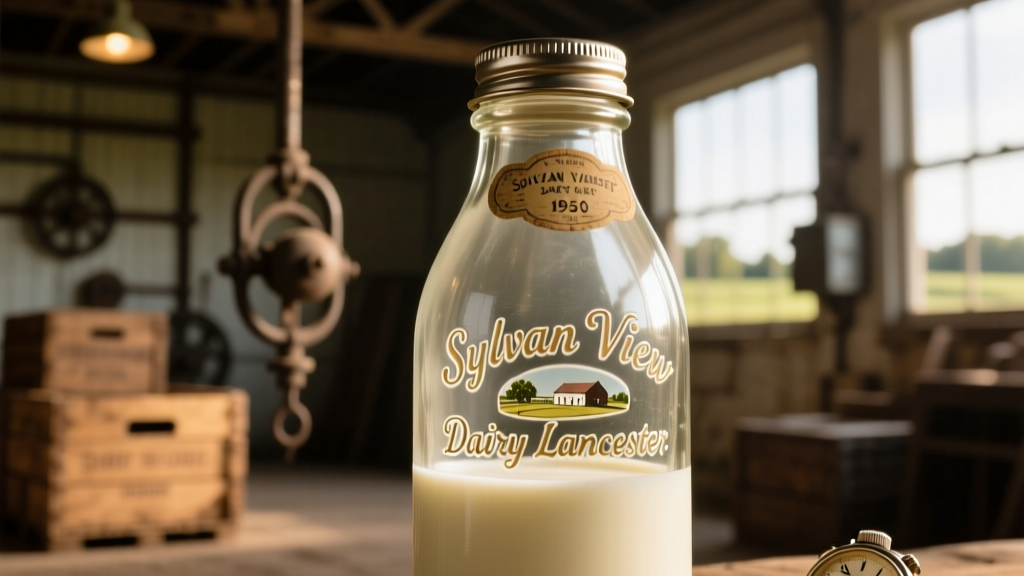
Sylvan View Dairy Bottles: A Collector’s Guide to Lancaster County’s Embossed Half-Pint Milk Glassware
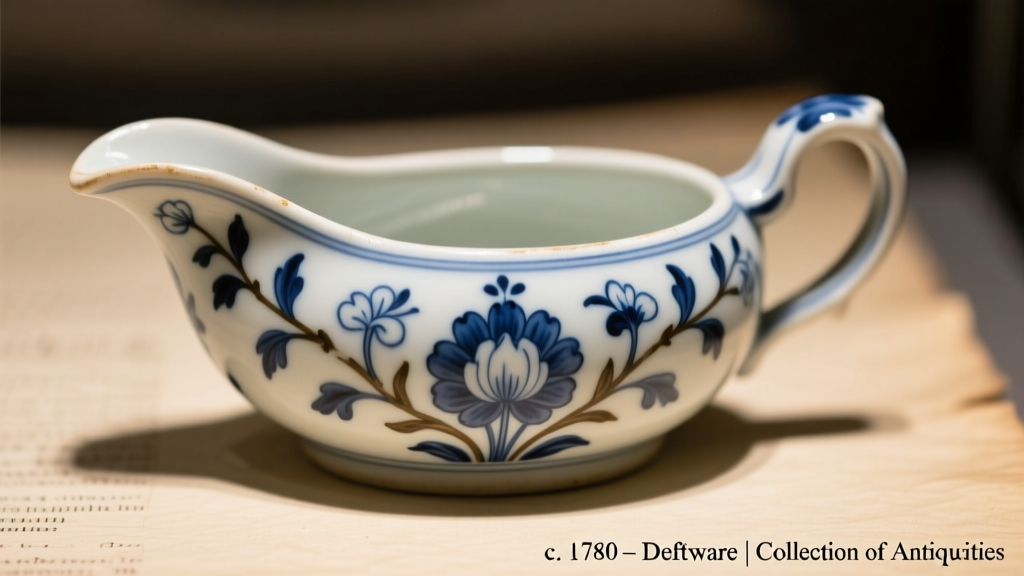
Delft Sauceboat, Double-Lipped with Stylized Flowering Branches, c. 1760 — A Masterpiece of Dutch Tin-Glazed Earthenware
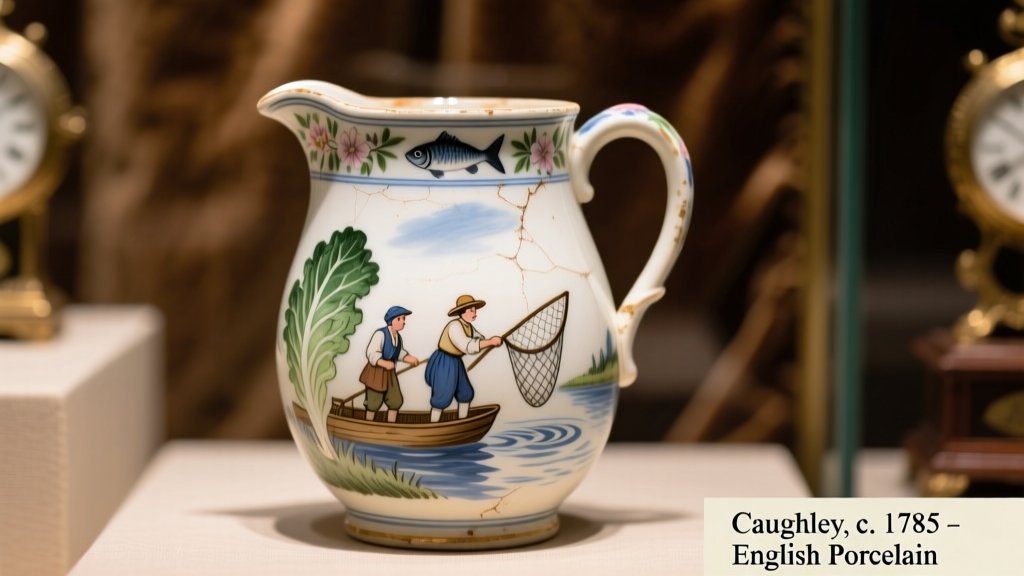
Caughley Jug: Cabbage Leaf Mask & Fisherman Pattern, c. 1785 — A Masterpiece of English Porcelain
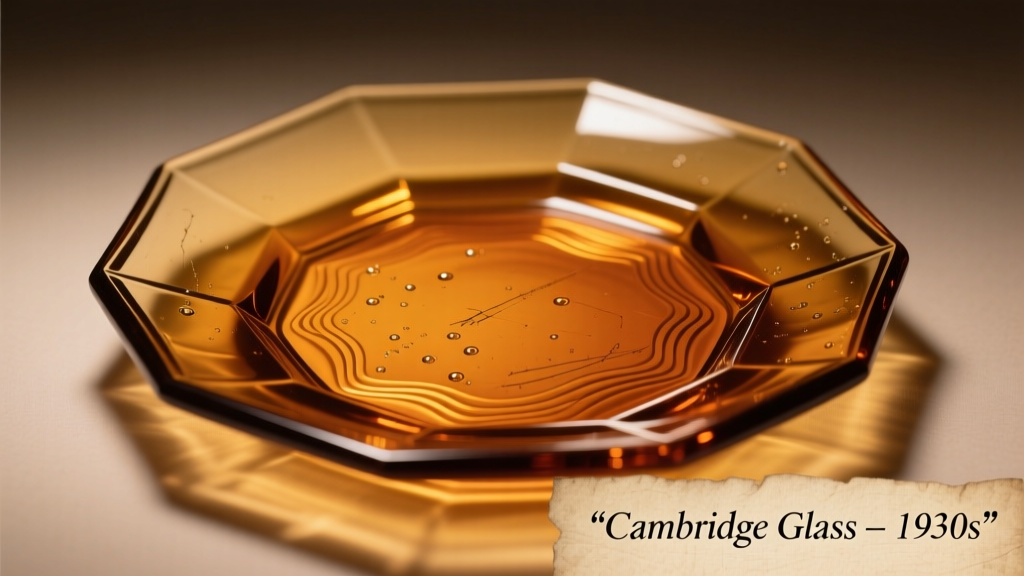
Cambridge Glass Decagon Plate in Amber: A Collector’s Guide to the Iconic 8-Inch Tableware Piece

Reamers Figural Pig Clown: A Rare Mid-Century American Novelty Watch and Its Auction Market
Toy Cycle Rider Windup: U.S. Zone Germany Production, Identification, and Collectibility
A Masterpiece of Late Qing Export Craftsmanship: The 1885 Rosewood Cabinet by Kauang Hsu Featuring Inlaid Mother-of-Pearl Scenes