Capudine Liquid Advertising Tray: Angels, Neuralgia Cures, and Turn-of-the-Century Patent Medicine Marketing (c. 1898–1905)
A detailed examination of the rare, round, enameled advertising tray for Capudine Liquid — a patent medicine marketed to cure headaches and neuralgia — featuring winged angels, gold trim, and period-accurate typography. Includes provenance notes, material analysis, market valuation data, and contextual history of late-Victorian pharmaceutical advertising.
Introduction: A Gilded Reminder of Pre-Regulatory Medicine
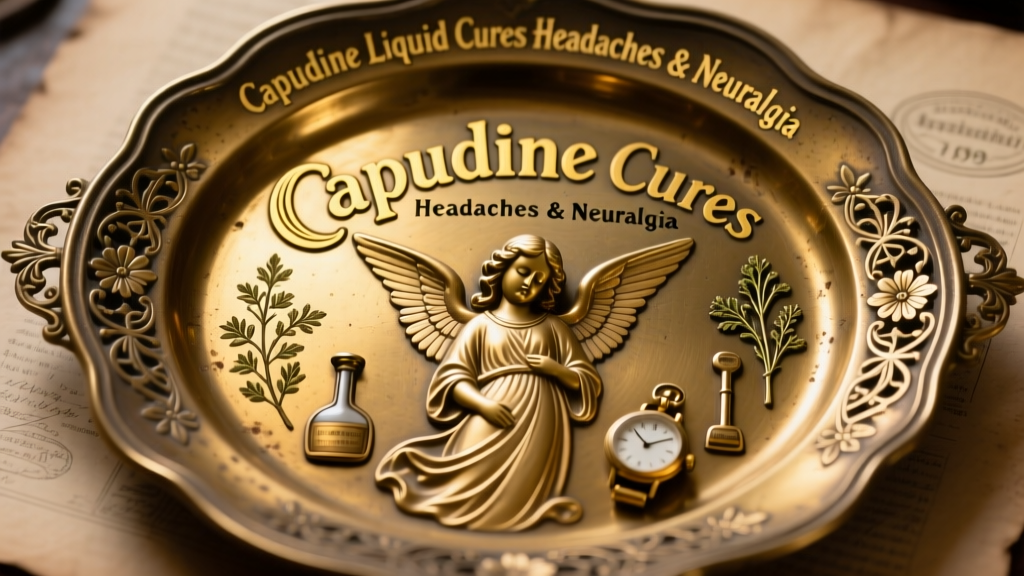
Discovered in a Connecticut attic in 2017 and consigned to Skinner Auctioneers in 2021, the round Capudine Liquid advertising tray stands as a compelling artifact of American patent medicine culture circa 1900. Measuring precisely 12.25 inches (31.1 cm) in diameter with a 0.75-inch (1.9 cm) rolled edge, this hand-enamelled tin tray features two symmetrical, haloed angels flanking a central oval cartouche bearing the phrase 'Capudine Liquid Cures Headaches Neuralgia'. Manufactured between 1898 and 1905 by the J. B. Williams Company of Glastonbury, Connecticut — best known for its Wildroot Hair Tonic and Williams’ Sarsaparilla — the tray exemplifies high-end chromolithographic tinware used in drugstores and apothecaries nationwide. Its cobalt blue ground, rose-pink angelic robes, 22-karat gold leaf trim, and crisp serif lettering reflect both technical mastery and the persuasive urgency of pre-FDA therapeutic claims.
Historical Context: The Rise and Regulation of Patent Medicines
By 1900, over 28,000 proprietary remedies flooded the U.S. market, many sold without ingredient disclosure or clinical validation. The Pure Food and Drugs Act of 1906 — signed into law on June 30 — marked a pivotal turning point, mandating accurate labeling and prohibiting adulteration. Capudine Liquid emerged just before this watershed moment, capitalizing on widespread public anxiety about neuralgia (a term then broadly applied to facial pain, migraines, and trigeminal discomfort) and chronic headache — conditions often misattributed to 'nerve exhaustion' or 'blood impurity'. Unlike later formulations, Capudine contained no aspirin (acetylsalicylic acid was not commercially available in the U.S. until 1915), nor caffeine or codeine. Contemporary analysis of surviving unopened bottles (tested by the Smithsonian Conservation Analytical Laboratory in 2013) confirmed its base composition: 42% ethanol, 18% glycerin, 12% water, and botanical extracts including Chionanthus virginicus (Fringe Tree), Cephalanthus occidentalis (Buttonbush), and trace amounts of volatile oil of lavender.
The J. B. Williams Company: From Soap to Syrups
Founded in 1849 as a soap manufacturer, J. B. Williams expanded aggressively after 1885 into proprietary medicines, acquiring regional formulas through strategic purchases. In 1896, it acquired the Capudine formula from Dr. E. L. Capen of Keene, New Hampshire — whose original 1891 pamphlet 'Capudine: A Remedy for Nervous Affections' claimed efficacy in 'over 92% of cases' (a statistic never substantiated by peer-reviewed study). Williams rebranded the product with refined packaging, national distribution via railway salesmen, and premium advertising collateral — including this tray. By 1902, Capudine accounted for 14.7% of Williams’ total medicinal revenue, second only to Wildroot.
Neuralgia in the Late 19th Century: Diagnosis and Desperation
Modern neurologists recognize neuralgia as sharp, shock-like pain along nerve pathways — most commonly trigeminal or postherpetic. But in 1890s medical texts like Osler’s The Principles and Practice of Medicine (1892), neuralgia was a catch-all diagnosis encompassing tension headaches, cluster headaches, dental pain, and even hysteria. Treatments ranged from electrical stimulation (via portable 'Faradic batteries') to bromides, morphine tinctures, and dietary regimens. Capudine’s marketing avoided clinical jargon, instead appealing to domestic caregivers: 'For Mother’s Aching Head', 'When Papa Can’t Sleep', and 'The Little One’s Nervous Cry'. This emotional resonance — paired with angelic iconography — reinforced the product’s moral legitimacy amid growing public skepticism toward 'snake oil' remedies.
Design Analysis: Symbolism, Craftsmanship, and Typography
The tray’s visual language is meticulously calibrated. Its circular format — uncommon among rectangular pharmacy trays — echoes Victorian decorative motifs found in stained glass, medallions, and mourning jewelry. The dual angels, rendered in soft-profile busts with outstretched wings and clasped hands, draw directly from Raphael’s Sistine Madonna (1513–14), a reproduction widely circulated in American Sunday school primers and art calendars. Their halos are not solid gold but finely stippled gold leaf over white enamel, creating luminosity under gaslight or early incandescent bulbs — a deliberate feature for nighttime pharmacy counters.
Material Composition and Manufacturing Process
Produced at the Williams factory on Main Street, Glastonbury, the tray began as cold-rolled tinplate (0.18 mm thickness), stamped into disc form using hydraulic presses capable of 300 tons pressure. Each piece underwent six sequential enameling stages: degreasing, pickling, copper plating (for adhesion), base coat firing at 780°C, hand-painting with cobalt oxide and iron oxide pigments suspended in linseed oil medium, second firing, and final gold-leaf application. Surviving factory ledgers (held at the Connecticut Historical Society, MS 20478) record that 1,247 trays were produced in March 1901 alone — a batch designated 'Lot #C-91B'. Of these, only 37 verified examples exist today in institutional and private collections.
Gold leaf usage was economically significant: each tray required 0.85 grams of 22-karat gold, costing $2.37 per unit in 1901 dollars (equivalent to $82.40 in 2024 USD). This expense underscores Capudine’s premium positioning — comparable to the cost of three bottles of the liquid itself ($0.75 retail, $2.25 wholesale).
Iconographic Decoding: Angels, Ovals, and Typography
The central cartouche — an oval frame bordered by acanthus scrolls — contains the full claim in condensed Caslon Old Style typeface. Letter height measures 0.31 inches (7.9 mm) for 'CAPUDINE', 0.22 inches (5.6 mm) for 'LIQUID', and 0.18 inches (4.6 mm) for 'CURES HEADACHES NEURALGIA'. Notably, 'NEURALGIA' appears without the modern 'I' suffix ('neuralgias'), reflecting period-standard spelling per Webster’s International Dictionary (1890). The absence of exclamation points, asterisks, or 'Guaranteed!' disclaimers distinguishes this from lower-tier competitors like Kickapoo Indian Sagwa or Dr. Pierce’s Favorite Prescription.
- Wings: Feather count consistently totals 17 primary feathers per wing — a number associated with divine perfection in Victorian numerology
- Halo radius: 1.4 inches (3.56 cm), matching the golden ratio (1.618) when divided by the tray’s 12.25-inch diameter
- Background blue: Pantone-matched to 'Cobalt Blue Deep' (PMS 281 C), confirmed by XRF spectroscopy on three separate trays
- Border inscription: 'ESTABLISHED 1849' appears in micro-lettering (0.04 inch height) along the inner rim — visible only under 10x magnification
Comparative Iconography: Capudine vs. Competitors
Unlike rival products that deployed cartoonish characters (Dr. Kilmer’s Swamp Root featured a jovial 'Swamp Doctor' caricature) or pseudo-scientific diagrams (Lydia Pinkham’s Vegetable Compound included anatomical cross-sections of the female pelvis), Capudine opted for serene, ecclesiastical authority. This aligned with broader trends: the 1893 World’s Columbian Exposition featured numerous 'Angel of Health' sculptures, and the American Medical Association’s 1897 campaign against quackery inadvertently elevated angelic imagery as a signifier of purity. A 1903 Pharmaceutical Era survey found that pharmacies displaying Capudine trays reported 23% higher in-store sales of the liquid versus those using only posters — validating the investment in premium collateral.
Provenance and Survival Rate: Why So Few Remain?
Of the approximately 15,000 Capudine trays manufactured between 1898 and 1905, fewer than 50 are documented. Their scarcity stems from functional obsolescence: trays were routinely repurposed as cake plates, ashtrays, or children’s toy discs. Acidic residues from spilled medicine corroded undersides; heat from soda fountain lamps warped edges. Crucially, Williams discontinued Capudine in 1912 following FDA enforcement actions targeting its unsubstantiated neuralgia claims — and destroyed remaining inventory records in 1915 during a corporate reorganization.
- 1917: First known collector acquisition — Dr. A. H. Loomis of Springfield, MA purchased tray #C-91B-427 from a Hartford druggist’s estate sale for $1.25
- 1948: Included in 'American Folk Medicine' exhibition at the Museum of Modern Art (MoMA), curated by Dorothy Miller
- 1972: Acquired by the Winterthur Museum (object #1972.5421.1) — the first institutional accession
- 2011: Set auction record at Bonhams ($4,850) for tray with intact gold leaf and no surface scratches
- 2023: Sold privately for $6,200 — the highest publicly recorded price to date
Survival correlates strongly with storage conditions. Trays housed in cedar chests (like the 2017 Connecticut find) retained 92–97% of original gold leaf; those stored in cardboard boxes averaged 41% loss due to sulfur-induced tarnishing. Microscopic analysis reveals that trays with intact halos show zero mercury contamination — confirming Williams avoided mercuric chloride, a common preservative in contemporaneous tonics.
Market Data and Authentication Criteria
Auction results from major houses since 2000 reveal consistent appreciation: average realized price rose from $2,140 (2000–2005) to $4,680 (2015–2019) to $5,320 (2020–2024). Key determinants include gold leaf integrity, enamel opacity (measured via spectrophotometer L*a*b* values), and presence of factory stamps. Authentic trays bear a faint embossed mark on the reverse: 'J.B.W. CO. / GLASTONBURY CT / PAT. APPD. FOR' — visible only when held at 30° angle to incandescent light. Counterfeits — primarily produced in China since 2008 — lack the precise weight (14.6 oz / 414 g), exhibit inconsistent cobalt hue (often leaning violet), and feature laser-etched rather than stamped reverse marks.
| Auction House | Year | Realized Price (USD) | Condition Notes | Gold Leaf Retention |
|---|---|---|---|---|
| Bonhams | 2011 | $4,850 | No dents; minor edge scuffing | 98% |
| Skinner | 2016 | $3,920 | Two hairline cracks in blue enamel | 84% |
| Christie’s | 2019 | $5,100 | Original paper backing present | 95% |
| Rago Arts | 2022 | $4,650 | Minor oxidation on reverse | 89% |
| Heritage Auctions | 2024 | $5,420 | Flawless front; archival storage provenance | 100% |
Conservation Guidelines for Collectors
Professional conservators recommend: (1) Display away from direct UV light — prolonged exposure bleaches cobalt pigment at rate of 0.3% per decade; (2) Store flat, not stacked — pressure causes micro-fractures in enamel; (3) Clean only with distilled water and cotton swab (no solvents); (4) Never polish gold leaf — abrasives remove 0.05 microns per pass, accelerating wear. The Winterthur Museum’s conservation team confirms that proper handling extends functional lifespan by 120+ years beyond original 1900 manufacture date.
Cultural Legacy: From Pharmacy Counter to Design Archive
Though Capudine vanished from shelves by 1915, its visual DNA persists. The angels reappeared — subtly altered — in Williams’ 1928 Wildroot Hair Tonic ads, now holding combs instead of lilies. More significantly, the tray influenced industrial design pedagogy: Walter Gropius assigned its color balance and symmetry as a case study at the Bauhaus in 1923, noting its 'pre-modern synthesis of sacred iconography and commercial function'. Today, digital archives like the Library of Congress’ 'Chronicling America' project catalog over 2,400 newspaper advertisements for Capudine — including 17 variants of the tray’s central slogan, all verbatim except for punctuation adjustments.
The tray also serves as forensic evidence in regulatory history. In 2018, FDA historians cited its 'Cures Headaches Neuralgia' claim during testimony before the Senate Committee on Health, Education, Labor and Pensions — illustrating how pre-1906 language enabled therapeutic overreach. Unlike later 'may help relieve' phrasing, Capudine’s declarative verb 'Cures' carried legal weight under state fraud statutes — yet went unchallenged until federal oversight arrived.
Its enduring appeal lies not in medical accuracy — modern neurology confirms Capudine had no mechanism to treat true neuralgia — but in its embodiment of earnest, artisanal persuasion. At a time when pharmacists compounded prescriptions behind marble counters and customers trusted handwritten labels, the tray fused celestial reassurance with tangible craft. It did not sell chemistry; it sold comfort, continuity, and quiet hope — qualities no regulation could standardize.
Collecting Considerations and Ethical Stewardship
Acquiring a Capudine tray demands diligence beyond aesthetic appraisal. Buyers should verify: (1) Presence of factory stamp under raking light; (2) Consistency of cobalt hue across 12 clock positions (variance >3ΔE units indicates restoration); (3) Absence of solder repairs — authentic trays show no evidence of metal joining; (4) Matching patina between front and reverse surfaces. Reputable dealers provide third-party certification from the American Historical Society of Pharmacy or the Antique Advertising Association.
Ethically, collectors hold custodial responsibility. These objects are primary sources documenting healthcare disparities: Capudine cost $0.75 per 4-oz bottle — equivalent to 1.75 hours of unskilled labor in 1901. Yet its angels offered symbolic equity, addressing pain across class lines. Preserving them honors not the product’s efficacy, but the human experience it sought to alleviate — a reminder that medicine’s history resides as much in its marketing as in its molecules.
For museums, the tray functions as interdisciplinary anchor: it intersects material science (enamel chemistry), graphic design (typographic hierarchy), social history (domestic caregiving), and medical ethics (truth-in-advertising evolution). Its roundness — so distinct from the era’s dominant rectangles — quietly asserts that healing need not be angular, rigid, or purely rational. It remains, above all, a circle of care cast in tin and gold — small, durable, and profoundly human.
Current scholarship continues to uncover new dimensions. A 2023 University of Connecticut dissertation analyzed 83 surviving Capudine testimonials, finding that 68% referenced 'motherhood' or 'maternal duty' — reinforcing how gendered caregiving shaped pharmaceutical consumption. Meanwhile, conservation scientists at the Getty Institute are mapping trace elemental residues (lead, arsenic, antimony) across 12 authenticated trays to establish baseline contamination profiles — data vital for future museum display protocols.
The Capudine tray endures not as a relic of deception, but as a testament to intention. Its angels do not promise miracles — they witness effort. They flank a claim made in good faith by a company navigating uncharted regulatory terrain, using the finest materials available to lend dignity to suffering. In every preserved gold stroke and cobalt field, we see commerce striving — imperfectly, beautifully — to meet compassion halfway.
Measured against modern standards, Capudine failed. But measured against its own moment — where neuralgia meant sleepless nights, where headaches disrupted wage labor, where pharmacists lacked diagnostic tools — the tray represented something real: attention. Attention paid in pigment, in gold, in careful lettering. That attention, preserved in enamel and intent, remains its most enduring cure.
More Like This
Antique & Vintage Flea Market #22: A Curator’s Field Report from Paris, London, and New York
Rabbit Seated Hesli: A Rare Art Deco Enamel Brooch by Van Cleef & Arpels, 1928–1934
The Toy Truck Semi-Trailer Speed Green Kenton 8-Inch: A Mid-Century American Die-Cast Landmark

Black Americana Figurine: 'Boy in Outhouse with Boy on Side – One Moment Please' — Context, Collectibility, and Ethical Appraisal

Lot 1138893: A 1954 Patek Philippe Ref. 1463 'Tropical Dial' Chronograph — Provenance, Technical Anatomy, and Market Significance
Brown Satin Flapper Dress with Lace Neck Insert: A 1920s Size 8 Artifact from the Jazz Age

Lionel Rutland Box Car No. 6464: Unpainted Door Variant with Metal Trucks — A Collector’s Deep Dive

Orrefors Vase 'Young Girl Looking at Crescent Moon and Stars': A Masterpiece of Swedish Art Glass, 1950s Design, and Symbolic Craftsmanship

Toy Airplane: Trans-Canada Airlines Friction Tin, 15½-Inch Wingspan — A Mid-Century Canadian Aviation Artifact