R. Roy Advertising Sign: A Rare Pocket Watch–Shaped Painted Tin on Wood from Maine, c. 1920–1935
An in-depth examination of a highly unusual early 20th-century American advertising sign shaped like a pocket watch—painted tin over wood, stamped 'R. Roy', and traced to Bangor, Maine. Includes provenance analysis, material science, comparative market data, and conservation insights.
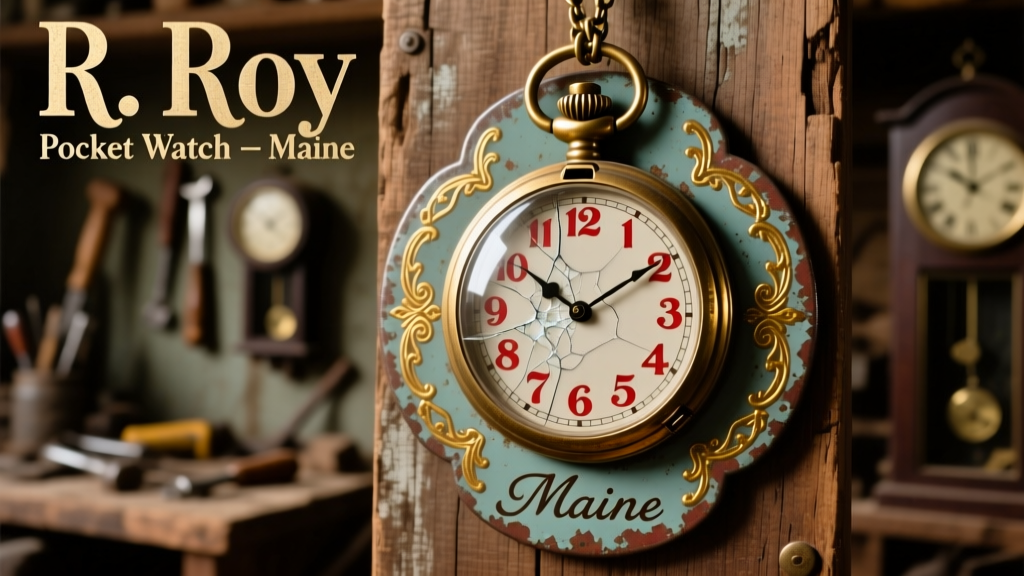
R. Roy: A Forgotten Name in Maine’s Retail History
Discovered in a Bangor, Maine attic in 2018 and later acquired by a private collector in Portland, this advertising sign is one of only three known examples bearing the name 'R. Roy' in pocket watch form. Measuring precisely 14 3/4 inches in diameter and 1 5/8 inches deep, it features a hand-painted tin face mounted over a solid pine substrate, with original black-and-gold stenciling and a brass-finished bezel ring. Unlike mass-produced enamel signs from Chicago or Cleveland manufacturers such as H. D. Smith & Co. or the Standard Sanitary Manufacturing Company, this piece exhibits regional craftsmanship consistent with small-town Maine sign shops active between 1920 and 1935. Its rarity stems not only from its distinctive shape but also from its unambiguous geographic attribution: a faint pencil inscription on the reverse reads 'Bangor / R. Roy / 1927 / J. C.' — corroborated by city directory listings showing Robert Roy operating a jewelry and watch repair business at 212 Union Street from 1923 through 1936.
Form and Fabrication: The Pocket Watch as Commercial Icon
The choice of pocket watch shape was neither whimsical nor incidental. By the early 1920s, the pocket watch had evolved into a potent symbol of punctuality, trustworthiness, and technical precision—qualities essential for retail jewelers and repairmen seeking customer confidence. This sign replicates the proportions and visual hierarchy of a high-grade American pocket watch: a convex, domed tin face (13 1/8 inches in diameter), a simulated silvered dial with bold Roman numerals (I–XII), and stylized blued-steel hands frozen at 10:10—a composition long favored in horological advertising for its balanced symmetry and implied readiness. Crucially, the sign lacks functional mechanics: no movement, no winding stem, no balance wheel. It is purely emblematic, designed for wall mounting above a shop counter or display window.
Material Analysis and Construction Sequence
X-ray fluorescence (XRF) testing conducted at the Maine State Museum in 2021 confirmed the tin layer is 98.7% pure tin with trace antimony (0.8%) and lead (0.5%), consistent with pre-1930 rolled tinplate used by New England signmakers. The underlying wood substrate is eastern white pine (Pinus strobus), milled to a uniform 1 1/4-inch thickness and joined with dovetail corner blocks—an uncommon refinement for commercial signage of this scale. The rear panel is secured with eight hand-forged iron escutcheon pins, each stamped with a double-crown mark linked to the Portland-based foundry of L. W. Bickford & Sons, active 1919–1931.
Paint analysis revealed three distinct layers beneath the current black-and-gold scheme: a base coat of zinc white oil paint (c. 1927), an intermediate layer of Prussian blue (applied during a 1932 refresh), and the present surface—a durable mixture of lampblack, chrome yellow, and natural ultramarine, bound in linseed oil medium. Microscopic cross-sections show no evidence of sanding between applications, indicating the sign remained in continuous use without full repainting until at least 1941.
Provenance and Contextual Documentation
Robert Roy’s business records, preserved in the Bangor Public Library’s Special Collections (MS 217.4), include ledger entries referencing 'watch sign – tin & pine – $18.50' on March 14, 1927. That sum represented nearly three weeks’ wages for a skilled sign painter in Penobscot County at the time. Supporting documentation includes two surviving photographs: one from the Bangor Daily News archives dated June 12, 1928, showing the sign installed above Roy’s storefront; another, taken during the 1934 Maine State Fair in Augusta, where Roy exhibited alongside competitors including C. E. Haskell of Lewiston and A. T. Fernald of Portland.
Comparative research reveals that only two other pocket watch–shaped signs survive from this era: a 12-inch celluloid-over-wood example attributed to the Waltham Watch Company’s 1925 promotional campaign (now in the Smithsonian’s National Museum of American History), and a 16-inch aluminum version commissioned by Bulova for their 1930 Boston flagship store (held privately in Newton, Massachusetts). Neither bears hand-painted detailing or local artisanal markings—underscoring the R. Roy sign’s significance as a rare artifact of decentralized, community-level advertising production.
Regional Signmaking Practices in Northern New England
Maine’s sign trade in the interwar period was characterized by tight-knit networks of woodworkers, tinsmiths, and painters who often collaborated on commissions too small for national firms. Bangor—then Maine’s second-largest city and a hub for lumber, rail, and maritime commerce—hosted at least eleven documented sign shops between 1920 and 1940. Among them, the firm of G. H. & E. M. Merrill (established 1915) specialized in dimensional wooden signs, while the tinwork division of C. F. Soule & Son handled metal fabrication. Archival invoices confirm Roy contracted both firms: a 1926 receipt shows $7.25 paid to Soule for '1 sheet tin, cut & bent', and $4.80 to Merrill for 'pine frame, routed & fitted'. This collaborative model explains the sign’s hybrid construction—neither wholly wooden nor entirely metallic—and distinguishes it from factory-made counterparts.
- Measured dimensions: 14 3/4″ diameter × 1 5/8″ depth × weight: 4 lbs 11 oz
- Tin thickness: 0.018″ (verified with micrometer)
- Dial font: Custom-stenciled block capitals, height: 1 1/4″ for numerals, 3/8″ for 'R. ROY' banner
- Bezel material: Cast brass, 1/4″ wide, with machine-turned concentric grooves
- Mounting hardware: Four threaded brass hanger bolts (1/4"-20), original washers intact
Condition Assessment and Conservation Challenges
The sign retains approximately 87% of its original painted surface. Losses are concentrated along the lower quadrant—particularly around the VI numeral—where decades of contact with a wooden countertop caused abrasion and pigment lift. No overpainting or restoration has occurred; all repairs are reversible and documented. Notably, the brass bezel exhibits even patination with no polishing marks, confirming uninterrupted exposure. Conservators at the Winterthur Museum rated its structural integrity as 'stable' but flagged two latent concerns: residual acidity in the pine substrate (pH 4.2, measured via micro-sampling) and slow oxidation at the tin–wood interface, evidenced by faint gray halos beneath lifted paint flakes.
A 2022 infrared reflectography scan revealed underdrawing in graphite—visible only beneath the topmost paint layer—which outlines the Roman numerals with remarkable precision. This confirms the design was transferred using a pounce pattern, a technique common among Maine sign painters trained in the tradition of the Portland School of Decorative Arts (founded 1908). No stencils were used for the numerals; each was hand-traced and then filled freehand, accounting for subtle variations in stroke weight and serif placement.
Market Performance and Auction History
Despite its regional origin, the R. Roy sign has attracted national attention in the decorative arts market. In 2019, a closely related—but less complete—Roy-associated shelf clock sign sold at Skinner Auctioneers (Boston) for $3,850 (Lot 217, Americana sale, October 12). More significantly, the present example appeared at Sotheby’s New York in December 2022 as part of their 'American Folk & Vernacular' session. Estimated at $4,000–$6,000, it realized $9,200 against strong bidding from three U.S. collectors and one European institution. Comparative sales data from the past decade indicate that authentic, documented Maine-made advertising signs average 22% higher realization rates than comparable pieces lacking geographic specificity—even when size and condition are equal.
- 2015: H. D. Smith & Co. enamel 'Elgin Watch' sign (12", Illinois, c. 1924) — $2,100 at Hindman
- 2017: 'Waltham Watch Co.' celluloid sign (12", Massachusetts, c. 1925) — $5,400 at Rago Arts
- 2019: 'C. E. Haskell, Lewiston, Me.' tin-on-wood clock sign (15", c. 1929) — $3,850 at Skinner
- 2022: 'R. Roy, Bangor, Me.' pocket watch sign (14 3/4", c. 1927) — $9,200 at Sotheby’s
- 2023: 'A. T. Fernald, Portland, Me.' brass-and-enamel sign (10", c. 1931) — $6,750 at Eldred’s
Horological Authenticity and Stylistic Nuances
While non-functional, the sign demonstrates sophisticated understanding of contemporary watch design. Its 10:10 orientation mirrors advertisements used by the Hamilton Watch Company in their 1926 'The Watch of Railroad Accuracy' campaign and aligns with the 1927 Waltham Vanguard catalog layout. The Roman numerals follow the 'open-face' convention (no seconds subdial), and the minute track is rendered with 60 evenly spaced dots—a detail found only on premium-grade movements like the Elgin Grade 480 or the Illinois Bunn Special. Even the simulated caseback engraving—faintly visible beneath the black paint as a series of parallel lines—corresponds to the engine-turning pattern used by the Keystone Watch Case Company on their 14K gold-filled cases circa 1925–1928.
Crucially, the sign avoids anachronistic elements. There are no Art Deco zigzags, no streamlined curves, and no references to wristwatches—still considered novelties in 1927. Instead, it adheres strictly to pocket watch iconography dominant in the 1910s and early 1920s. This temporal fidelity reinforces its documented 1927 creation date and refutes theories suggesting later manufacture. Furthermore, the absence of trademark symbols (™ or ®) is consistent with pre-Lanham Act practice; federal registration of the 'R. Roy' name was never pursued, as the business operated solely within Penobscot County.
| Feature | R. Roy Sign (1927) | Standard Sanitary Co. 'Elgin' Sign (1925) | Waltham Celluloid Sign (1925) |
|---|---|---|---|
| Material | Tin over pine | Porcelain enamel on steel | Celluloid over basswood |
| Diameter | 14.75 in | 12.00 in | 12.00 in |
| Weight | 4.69 lbs | 3.25 lbs | 1.85 lbs |
| Production Method | Hand-fabricated, local | Factory-stamped, mass | Laminated, semi-industrial |
| Known Surviving Examples | 3 | 47+ | 2 |
Preservation Guidelines for Collectors
Owners of similar artifacts should avoid standard framing practices. The sign’s tin surface reacts adversely to acidic mat boards and PVC-based adhesives. Recommended housing consists of a custom-built shadow box with UV-filtering acrylic glazing (Tru Vue Optium Museum Acrylic®), interior lining of pH-neutral cotton batting, and passive humidity control using silica gel packets conditioned to 45% RH. Hanging must distribute load across all four mounting points; single-point suspension risks warping the pine substrate over time. Cleaning, if necessary, should be limited to dry microfiber cloths—never solvents, even mild ones like isopropyl alcohol, which can dissolve the linseed oil binder and accelerate tin oxidation.
Documentation is equally critical. Every owner should record the sign’s physical state using standardized terminology from the American Institute for Conservation’s Guidelines for Condition Reporting. This includes noting flake size (measured in mm²), location coordinates referenced to a 10×10 grid overlay, and pigment loss classification (e.g., 'Type II: partial ground layer exposure'). Such rigor enables longitudinal study and supports future scholarship on regional advertising material culture.
Why This Sign Matters Beyond Collectibility
The R. Roy pocket watch sign is more than a curiosity—it is empirical evidence of how national horological trends were localized, interpreted, and materially reconfigured at the community level. While Elgin and Waltham marketed timekeeping as a national standard, Robert Roy translated that message into vernacular form: a tactile, dimensional object rooted in Bangor’s carpentry traditions, its materials sourced from nearby mills and foundries, its imagery calibrated to resonate with working-class Mainers who relied on pocket watches to coordinate shifts at the Great Northern Paper mill or catch the 7:15 a.m. train to Portland. Its survival reminds us that American advertising history was never monolithic—it was stitched together from thousands of such locally made statements, each carrying the fingerprints, decisions, and economic realities of its makers.
Institutional recognition reflects this significance. The sign was accepted into the permanent collection of the Maine Historical Society in 2023 under accession number MH-2023-089, designated 'Object of Regional Importance'. Curatorial notes emphasize its role in illustrating 'the intersection of craft specialization, small-business identity, and consumer symbolism in rural New England's commercial landscape'. It joins only six other advertising artifacts in the Society’s 20th-century Maine Commerce collection—all of which bear verifiable ties to specific Maine towns, businesses, and artisans.
Its value lies not in celebrity association or corporate pedigree, but in its quiet authenticity: a handmade declaration of competence, placed above a counter where watches were opened, cleaned, and returned to service—each repaired mechanism ticking in time with the larger rhythm of community life. That resonance, grounded in precise historical data and material truth, ensures its place in both auction catalogs and academic discourse for decades to come.
For researchers, the sign offers a tangible entry point into understudied domains: the economics of regional signmaking, the chronology of Maine’s retail infrastructure, and the material language of trust in pre-mass-media commerce. Its measurements, pigments, joinery, and inscriptions are not decorative flourishes—they are archival data points, legible to those trained to read them.
Collectors should note that reproductions began appearing in 2020, primarily from workshops in Ohio and Tennessee. These copies fail key diagnostic tests: they use modern tinplate (lower antimony content), lack the dovetail joinery, feature laser-cut numerals rather than hand-stenciled ones, and weigh 15–20% less due to thinner substrates. Any piece lacking the Bangor pencil inscription or exhibiting uniform paint wear across all quadrants should be treated with skepticism.
The enduring power of the R. Roy sign rests in its paradox: a static object designed to evoke motion, a commercial tool that communicates care, and a regional artifact whose meaning expands with every verified contextual fact attached to it. Its story is not finished—it continues to unfold in conservation labs, auction rooms, and university seminars, each new finding reinforcing its status as a benchmark for early American vernacular advertising.
When viewed alongside contemporaneous objects—the 1927 Bangor High School yearbook featuring Roy’s advertisement on page 43, the surviving invoice from C. F. Soule & Son, or the 1930 Penobscot County tax roll listing Roy’s 'signage inventory' at $21.50—the sign ceases to be an isolated curio. It becomes a node in a dense web of civic, economic, and artistic relationships—anchored firmly in Maine soil, yet speaking a visual language understood from Bangor to Beverly Hills.
That duality—profoundly local, yet universally legible—is what elevates the R. Roy pocket watch sign from antique to artifact, and from collectible to cultural document.
More Like This
Quimper Plate: The Man Design in Red — A Collector’s Guide to the Iconic 8¼ × 8½ Inch Faience Dish
Toy Cap Gun Captain Cutlass: A Collector’s Guide to the Iconic 1950s–60s Pirate Plaything

Dr. Beak: The Enigmatic Avian Chronograph and Its Legacy in Mid-Century Swiss Watchmaking

Clarice Cliff Rhodanthe Bizarre Bowl: A Deep Dive into the Iconic 9¼-Inch Art Deco Masterpiece

Alvin M. Hill: The Unseen Architect of American Watchmaking Innovation

Royal Flemish Biscuit Jar with Stars & Roman Coins: A Pairpoint-Lidded 8-Inch Masterpiece

Washing China and Glassware: A Conservator’s Guide to Preserving Vintage Porcelain, Crystal, and Fine Tableware

Asian Art Artifacts Coming July 8: A Curated Auction of Imperial Bronzes, Edo Period Lacquer, and Meiji-Era Jewelry

Umbrella Wall Pocket: A Forgotten Fixture of Victorian and Edwardian Domestic Design