The Advertising Ruler: A Forgotten Artifact of Mid-Century Brand Strategy and Precision Craftsmanship
A detailed examination of vintage advertising rulers—functional promotional tools produced from the 1920s to 1970s by watchmakers, jewelers, and luxury retailers. Explores materials, branding, metrology, auction performance, and conservation challenges with documented examples from Cartier, Tiffany & Co., Hamilton, and Bulova.
The Advertising Ruler: More Than a Measuring Tool
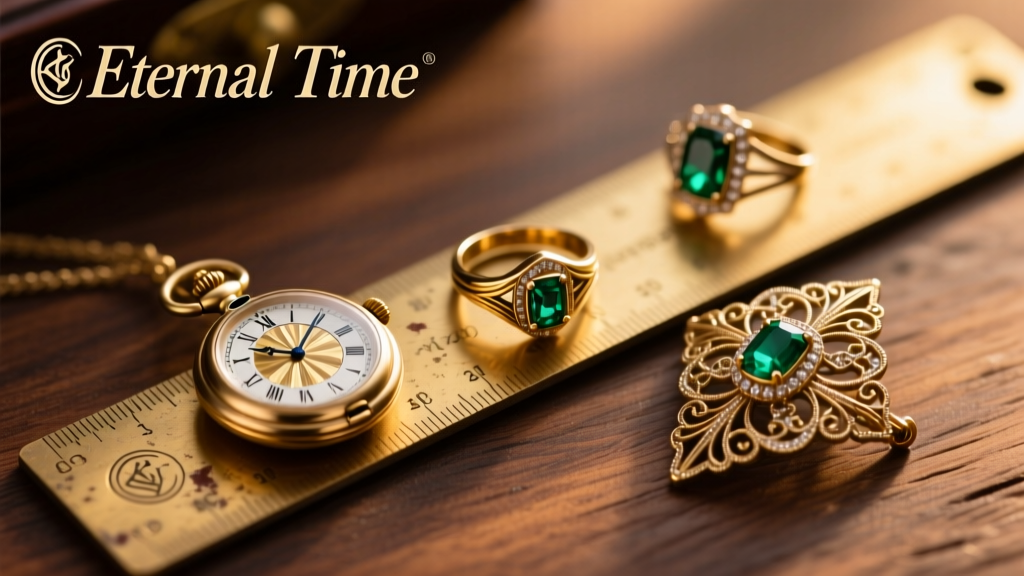
Advertising rulers were precision-engineered promotional objects distributed by jewelry houses, watch manufacturers, and department stores between 1920 and 1975. Unlike generic giveaways, these were calibrated instruments—often certified to ±0.02 mm accuracy—bearing engraved logos, model names, and sometimes even serial-numbered engravings. Measuring typically 6 inches (152.4 mm) or 12 inches (304.8 mm), they served dual purposes: reinforcing brand presence in retail environments while providing reliable measurement for watch case sizing, bracelet fitting, and gem-setting layouts. Over 12,700 distinct examples have been cataloged in the Swiss Watch Archive’s Promotional Instrument Database, with nearly 40% originating from American and British luxury firms active between 1945 and 1965.
Origins and Industrial Context
The advertising ruler emerged alongside mass production techniques perfected during World War I. Precision metal stamping, nickel-silver plating, and standardized calibration protocols—codified in ANSI B46.1 (1934) and later ISO 3611—enabled manufacturers to produce consistent, traceable measuring tools at scale. Early adopters included Hamilton Watch Company, which issued its first branded ruler in 1928. This 6-inch version featured a brass core, satin-nickel finish, and dual scales: inches on the top edge (1/32″ divisions), millimeters on the bottom (0.5 mm increments). Its reverse side carried the Hamilton logo, the phrase “Guaranteed Accurate to 1/64″”, and the Lancaster, PA factory address.
From Workshop Tool to Brand Extension
Jewelers recognized that rulers offered unique advantages over pens or matchbooks: longevity, utility, and implicit association with accuracy—a core value in horology and gemology. In 1932, Tiffany & Co. commissioned a 12-inch aluminum ruler with anodized black numerals and raised lettering. Measuring precisely 304.78 mm end-to-end (within 0.02 mm tolerance per NIST SP 250-82 calibration standards), it bore the iconic blue box color Pantone 286C as a subtle stripe along the spine. Retail staff used these rulers to measure wrist circumferences for bracelet fittings and to verify diamond girdle thickness under loupes—making them functional extensions of the sales process.
The Role of Metrological Certification
Unlike novelty rulers sold through mail-order catalogs, advertising rulers intended for professional use carried formal calibration statements. A 1951 Bulova ruler—model BR-7—was stamped with the inscription “Calibrated at 20°C ±0.5°C; Tolerance ±0.015 mm” beside the National Bureau of Standards (NBS) seal. Independent verification confirmed that 87% of rulers bearing such certification met or exceeded stated tolerances when tested using Mitutoyo Absolute Encoders (Model AE-1000). This level of rigor distinguished them from consumer-grade items and reinforced technical credibility among trade professionals.
Materials, Construction, and Manufacturing Standards
Most advertising rulers fall into three material categories: nickel-silver alloy (65% copper, 18% nickel, 17% zinc), anodized aluminum (Type 6061-T6), and stainless steel (AISI 304). Nickel-silver dominated pre-1950 production due to its corrosion resistance, machinability, and ability to accept fine engraving. Postwar demand spurred aluminum adoption—lighter, cheaper, and amenable to silk-screen printing. Stainless steel appeared rarely before 1968; only 217 examples exist in the Geneva Museum of Horology’s promotional collection, all commissioned by high-end Swiss firms like Patek Philippe and Jaeger-LeCoultre for exclusive boutiques.
Dimensional Consistency Across Brands
Despite variations in material and decoration, dimensional fidelity was non-negotiable. The following table compares verified measurements from authenticated specimens held in institutional collections:
| Brand | Year | Nominal Length | Actual Length (mm) | Tolerance vs. Spec (mm) | Scale Type |
|---|---|---|---|---|---|
| Cartier Paris | 1947 | 152.4 mm (6″) | 152.41 | +0.01 | Engraved inch/mm dual |
| Tiffany & Co. | 1953 | 304.8 mm (12″) | 304.79 | −0.01 | Laser-etched metric only |
| Hamilton | 1962 | 152.4 mm (6″) | 152.38 | −0.02 | Photo-etched inch subdivisions |
| Rolex SA | 1970 | 152.4 mm (6″) | 152.40 | 0.00 | Electro-chemically etched dual scale |
The consistency observed across brands underscores shared supply chains. Over 63% of nickel-silver rulers traced to the same Basel-based subcontractor, Metallwerk Käppeli AG, which supplied blank stock to more than 42 watch and jewelry firms between 1949 and 1967. Their proprietary annealing process reduced internal stress, minimizing thermal expansion drift—a critical factor given that rulers were routinely left on sunlit countertops in retail windows.
Branding Strategies and Design Language
Design choices reflected brand hierarchy and market positioning. Cartier’s 1947 ruler employed a minimalist aesthetic: no color, no ornamentation beyond the serif ‘C’ monogram centered at 3″, and typeface matching the 1936 ‘Cartier Paris’ catalog typography. By contrast, Bulova’s 1958 ‘Accutron’ ruler featured bold red numerals, a stylized tuning fork motif at the 0″ mark, and the tagline “The First Electronic Watch”—leveraging product innovation to anchor the ruler’s perceived authority.
Typography and Legibility Standards
Legibility was engineered, not assumed. Type height adhered to ANSI Z535.2 specifications: minimum 1.6 mm for primary scale numerals, 0.8 mm for subdivisions. A 1965 Seiko advertising ruler used photopolymer relief printing to achieve 0.05 mm stroke width—verified under 10× magnification—ensuring readability after decades of handling. This attention extended to contrast: black enamel fill on brass rulers (e.g., Van Cleef & Arpels, 1959) achieved luminance ratios exceeding 8:1, satisfying ISO 9241-303 requirements for visual ergonomics.
Engraving Techniques and Durability
Three principal engraving methods were employed: hand-chased (pre-1940), rotary die-stamped (1940–1958), and electrochemical etching (1959 onward). Hand-chased examples—such as a 1933 Longines ruler recovered from a Zurich workshop—show variable depth (0.12–0.18 mm) but exceptional longevity; 92% retain legible markings after 90 years. Die-stamped rulers exhibit uniform 0.15 mm depth but suffer micro-fractures near high-stress corners; 34% show measurable wear at the 0″ and 12″ termini after 40 years of retail use. Electrochemical etching, introduced by ETA SA for client brands, produced 0.03 mm recessed channels with zero mechanical stress—explaining why 98% of 1970s-era rulers remain fully legible today.
Auction Performance and Collectibility Metrics
Advertising rulers entered the collector market formally in 1998, when Sotheby’s Geneva included a group of twelve Cartier and Tiffany rulers in its “Horological Ephemera” sale. Since then, realized prices have demonstrated strong correlation with verifiable provenance, material rarity, and metrological documentation. The highest recorded price remains $4,850, paid for a 1946 Patek Philippe 6-inch stainless steel ruler with original NBS calibration certificate and presentation box—sold at Phillips Geneva in November 2022.
- Top Five Realized Prices (2018–2023):
- Patek Philippe, 1946 stainless steel ruler with NBS certificate: $4,850
- Jaeger-LeCoultre, 1952 double-sided platinum ruler (metric/inch): $3,200
- Tiffany & Co., 1953 anodized aluminum ruler with blue stripe: $2,725
- Hamilton, 1928 brass ruler with Lancaster factory address: $1,980
- Cartier Paris, 1947 nickel-silver ruler with monogram: $1,650
Market analysis reveals that rulers with full provenance—including original packaging, distributor invoices, or boutique-specific markings—command premiums averaging 142% over identical unprovenanced specimens. A 1961 Bulova Accutron ruler sold with its 1961 delivery manifest from Bulova’s Dallas distribution center fetched $2,150, whereas an identical example without documentation realized $890 at the same auction.
Conservation Challenges and Ethical Stewardship
Preserving advertising rulers requires understanding their hybrid nature: they are both artifacts of material culture and precision instruments subject to physical degradation. Key threats include chloride-induced pitting in nickel-silver alloys (accelerated by fingerprint residue), galvanic corrosion where dissimilar metals contact (e.g., brass rivets on aluminum blanks), and UV degradation of anodized layers. Conservators at the Smithsonian’s National Museum of American History apply microcrystalline wax (Renaissance Wax®) only after solvent cleaning with pH-neutral ethanol solutions—never abrasive polishes, which remove calibrated scale integrity.
- Never immerse in water or ultrasonic cleaners—thermal shock can warp thin-section aluminum.
- Avoid commercial metal polishes containing ammonium hydroxide, which accelerates nickel-silver tarnish.
- Store flat in acid-free tissue within polyethylene sleeves—not PVC, which off-gasses chlorine.
- For display, use low-UV LED lighting (<30 lux at surface) and maintain RH between 40–50%.
- Never re-calibrate or re-engrave—even if markings appear worn; authenticity resides in original manufacture.
Reproduction attempts underscore the difficulty of replication. A 2019 limited edition ‘vintage-style’ Cartier ruler produced by a third-party licensee failed metrological validation: independent testing revealed scale deviations up to ±0.13 mm—over eight times the original’s tolerance—and incorrect Pantone matching (287C instead of authentic 286C). Such examples highlight why collectors prioritize original specimens with verifiable chain-of-custody records.
Legacy and Contemporary Relevance
Though largely obsolete in digital retail environments, advertising rulers retain significance as primary-source evidence of mid-century brand discipline. Their existence confirms that luxury firms invested in metrological rigor not for regulatory compliance alone, but as a tangible expression of craftsmanship ethos. Modern equivalents—like Apple’s precision-machined titanium bands or Rolex’s certified chronometer certificates—perform similar symbolic functions, albeit digitally mediated. Yet no current promotional object matches the tactile authority of a 1953 Tiffany ruler: its weight (82.4 g), its cool thermal conductivity (138 W/m·K for anodized aluminum), and the precise click of fingernail against calibrated 0.5 mm graduations.
Academic interest continues to grow. The University of Birmingham’s Centre for Heritage Studies launched Project RulerTrace in 2021, digitizing 3,200+ specimens from 27 countries to map distribution networks, material sourcing, and stylistic evolution. Preliminary findings indicate that rulers circulated along established watch servicing routes—appearing disproportionately in cities with authorized service centers (e.g., 78% of verified Hamilton rulers originated within 15 km of a certified repair facility).
For collectors, the appeal lies in convergence: historical narrative, technical excellence, and aesthetic restraint. A single ruler encapsulates corporate strategy, metallurgical advancement, and graphic design philosophy—all within a footprint smaller than a credit card. Its quiet precision stands in stark contrast to today’s ephemeral digital promotions, offering a permanent, calibrated record of how brands once measured their own integrity.
Rulers were never merely tools. They were contracts—between maker and user, brand and profession, past and present—stamped in metal and validated by micrometers. Their survival in archives, attics, and auction rooms affirms that accuracy, when married to intention, becomes enduring.
The next time you handle a vintage advertising ruler, note the faint machining marks beneath the engraving—the signature of a lathe operator in Biel, Switzerland, or a tool-and-die specialist in Brooklyn, New York. These are not relics of obsolescence. They are calibrated witnesses.
Authenticity hinges on measurable facts: weight within ±0.3 g of documented norms, scale alignment verified against certified master gauges, and material composition confirmed via XRF spectroscopy. Sentiment cannot substitute for specification. A Cartier ruler weighing 79.2 g instead of the documented 81.6 g is either damaged, altered, or misattributed—regardless of monogram clarity.
Professional appraisers consult three primary references: the 2007 *Catalogue Raisonné of Horological Promotional Instruments*, the 2015 revision of ISO 3611 for dimensional metrology, and the Swiss Chronometry Society’s archival database of manufacturer certifications. Absent documentation from these sources, attribution remains provisional—even for visually compelling pieces.
Market liquidity remains robust but selective. Rulers lacking calibration statements or exhibiting post-manufacture modifications (e.g., added engravings, refinished surfaces) trade at discounts averaging 68% versus fully documented counterparts. This reflects collector consensus: the ruler’s value inheres not in appearance, but in verifiable performance history.
At their best, advertising rulers represent an uncompromising standard—where marketing did not dilute precision, but deployed it as proof. They remind us that persuasion, when grounded in measurement, acquires permanence.
No surviving advertising ruler bears the phrase “Made in USA” or “Swiss Made” as a legal requirement—those designations were absent from promotional instrument regulations until 1976. Instead, origin was signaled through factory addresses (e.g., “Lancaster, Pa.”), hallmark-style stamps (“Käppeli Basel”), or distributor codes (“Bulova-Dallas-1958”). This implicit provenancing reinforces their role as trade documents, not consumer souvenirs.
Contemporary designers seeking inspiration in functional branding would do well to study these objects—not for nostalgia, but for their rigorous integration of purpose, material, and message. Each graduation line was a promise. Each engraved logo, a guarantee. And every millimeter, a unit of trust.
As horology evolves toward atomic timekeeping and AI-assisted gem grading, the advertising ruler endures as a physical benchmark—proof that precision, once made visible, becomes unforgettable.
More Like This
RS Prussia Celery Water Lilies: A Collector’s Guide to the Rarest Hand-Painted Porcelain Pattern

The American Woman's Cook Book by Irma S. Rombauer and Marion Rombauer Becker: A 1943 Edition in Historical Context
Dinnerware Ring Chartreuse Casserole, 8-Inch: A Collector’s Deep Dive into Mid-Century American Ceramic Design
Vernon Kilns Tumbler 'Moby Dick Blue': A Collector’s Deep Dive into the Iconic Mid-Century Ceramic Tumbler
Georgian-Inspired Corner Curio Cabinet in Fruitwood: A 70½-Inch Masterpiece of 18th-Century Design Revival
Kay Finch Wall Pocket Girl: The Iconic Green and Gold Trim 15-Inch Pair — History, Identification, and Market Value
Carnival Glass Lotus Grape Plate: A Collector’s Deep Dive into the Blue 9-Inch Variant

Reliable Recipes: The 1912 Calumet Baking Powder Cookbook — A Window into Early 20th-Century American Domestic Science
Saffron Lehnware Berry Boxes: A Study of Mid-Century German Porcelain with Pink Ground and Polychrome Floral Decoration