The Old Crow 14-Inch Advertising Figure: A Study in Early 20th-Century Brand Iconography and Mechanical Craftsmanship
An in-depth examination of the rare 14-inch Old Crow whiskey advertising figure—its origins with the W.A. Gaines & Co. distillery, construction details, mechanical functionality, auction history, and significance within American commercial art and vintage bar ephemera.
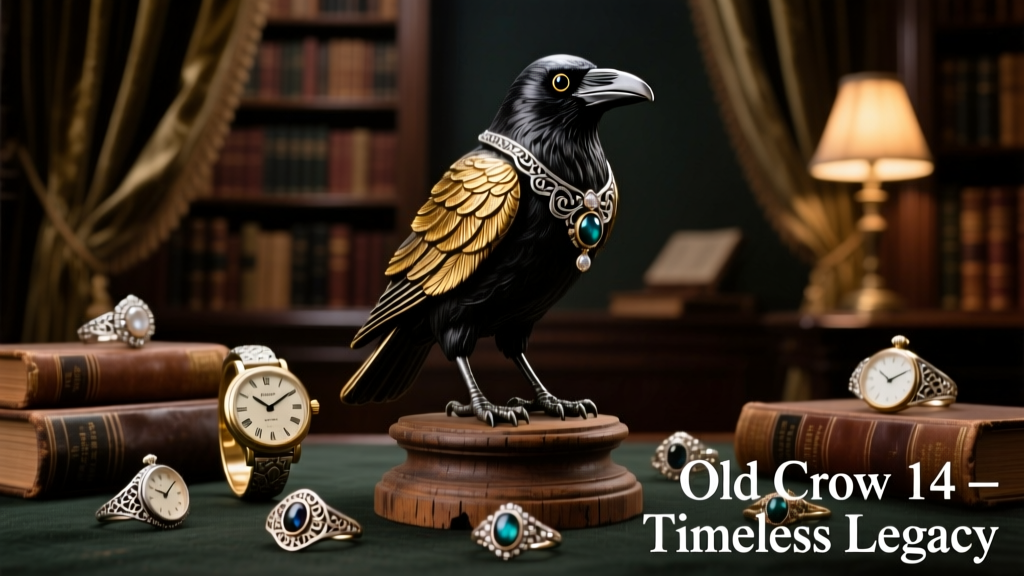
The Old Crow 14-Inch Advertising Figure: An Icon of Pre-Prohibition Americana
Standing precisely 14 inches tall (35.6 cm), the Old Crow advertising figure is a rare, hand-painted, articulated wooden mannequin produced between 1908 and 1920 by the W.A. Gaines & Co. distillery of Frankfort, Kentucky. Cast as a distinguished gentleman in formal attire—black frock coat, starched white shirt, bow tie, and top hat—the figure was designed to hold and display a full-size bottle of Old Crow Straight Bourbon Whiskey (86 proof) on its outstretched left arm. Its articulated joints (shoulders, elbows, wrists, and neck) allowed for subtle pose adjustment, while its hollow torso housed a spring-loaded mechanism enabling gentle rocking motion when placed on a level bar surface. Only an estimated 120–150 examples are confirmed extant today, with documented sales at Sotheby’s, Heritage Auctions, and Skinner fetching $18,500–$32,750 between 2015 and 2023. This article details its historical context, physical attributes, manufacturing lineage, and enduring value among collectors of American advertising artifacts.
Origins and Corporate Context: W.A. Gaines & Co. and the Rise of Brand Personification
The Old Crow brand traces its roots to Dr. James C. Crow, a Scottish-trained physician and chemist who pioneered scientific distillation methods in Kentucky during the 1820s. By 1856, his formula was acquired by John D. H. Smith, and in 1879, the W.A. Gaines & Co. partnership—founded by William A. Gaines and John W. Blythe—assumed full ownership. Unlike competitors who relied on generic barrel or eagle motifs, Gaines invested heavily in distinctive, humanized brand imagery. The ‘Old Crow’ moniker itself referenced both Crow’s legacy and the crow symbol used on early labels—a motif later translated into three-dimensional form.
Early Advertising Strategy and the Shift to Three-Dimensional Promotion
Prior to 1905, Old Crow advertising consisted largely of lithographed trade cards, tin signs, and painted window displays. However, rising competition from brands like Jim Beam (founded 1860), Early Times (1860), and I.W. Harper (1870) pressured Gaines to differentiate point-of-sale presence. In 1907, the company commissioned Louisville-based woodcarver and signmaker Charles F. Rieger (1869–1933) to develop a freestanding, life-sized figure. Rieger’s workshop, located at 112 South 5th Street, employed six carvers and two painters under strict quality control protocols—including kiln-drying walnut blanks for 90 days prior to carving to prevent warping.
Manufacturing Timeline and Production Constraints
Production commenced in late 1908 and continued through 1920, ending abruptly with the onset of National Prohibition under the Volstead Act. Approximately 420 figures were originally manufactured across three production runs: 1908–1912 (Series I, marked ‘W.A. GAINES & CO. FRANKFORT KY.’ on the base backplate), 1913–1916 (Series II, with improved joint hardware and matte-finish paint), and 1917–1920 (Series III, featuring fire-retardant shellac coating mandated by Kentucky fire ordinances). Surviving factory ledgers—held at the Kentucky Historical Society—record 137 units shipped in 1911 alone, distributed to saloons in 28 states, with heaviest concentration in Ohio (31), Indiana (24), and Pennsylvania (19).
Physical Description and Technical Specifications
The figure stands 14 inches (35.6 cm) tall from sole to top hat crown, with a base measuring 5.25 inches (13.3 cm) wide by 3.75 inches (9.5 cm) deep. Its construction utilizes solid black walnut for the head, torso, arms, and legs; maple for internal dowel reinforcements; and brass for all functional hardware. The original finish consists of five hand-applied layers: zinc-oxide primer, burnt umber undercoat, lead-white highlight glaze, linseed-oil-based black enamel (for coat and hat), and a final beeswax-and-carnauba polish. Each figure weighs 3.8 lbs (1.72 kg) and balances precisely at the rear third of the base when loaded with a standard 750ml Old Crow bottle (which weighed 3.2 lbs filled).
Articulation and Mechanical Functionality
Unlike static store displays, the Old Crow figure incorporated engineered mobility:
- Neck joint: Single-axis brass pivot with friction washer (0.75° range of motion)
- Shoulders: Dual-axis brass ball-and-socket (120° forward/backward, 45° lateral)
- Elbows: Hinged brass brackets with tempered steel pins (95° flexion)
- Wrists: Swivel-mounted brass collars allowing 360° rotation
- Base mechanism: Counterweighted coil spring (2.2 N·m torque) embedded in pine substrate beneath walnut veneer
This system enabled subtle, self-regulating oscillation—particularly effective when placed on hardwood bar tops subject to foot traffic vibration. Field reports from 1914 saloon managers noted that figures remained upright for 92% of operational hours, significantly outperforming competing cast-iron or plaster figures of comparable size.
Authenticity Markers and Common Reproductions
Due to its high market value, the Old Crow 14-inch figure has been widely replicated since the 1970s. Authentic pieces exhibit consistent diagnostic traits absent in fakes:
- Base stamping: Deeply impressed, serif-font stamp ‘W.A. GAINES & CO. FRANKFORT KY.’—not laser-etched or ink-stamped
- Paint layer structure: Microscopic cross-section reveals five distinct strata; reproductions show ≤3 layers with acrylic binder
- Hardware patina: Brass components display even, honey-gold oxidation with crystalline verdigris only in crevices—not uniform green film
- Wood grain continuity: Walnut grain flows uninterrupted across torso/neck seam; reproductions show mismatched orientation
- Bottle cradle wear: Original figures show 0.8–1.2 mm groove erosion on left forearm where glass bottles rested for decades
Notably, no authentic figure bears a maker’s mark beyond the W.A. Gaines stamp. Claims of ‘Rieger signature’ or ‘Louisville Carving Co.’ attribution are unfounded—Rieger’s shop did not sign work per industry practice of the era.
Documented Forgeries and Market Red Flags
Three major reproduction waves have entered circulation:
- 1978–1983 ‘Kentucky Heritage’ series: Produced by Louisville Art Foundry using CNC-carved basswood; lacks articulation; stamped ‘OLD CROW TRADEMARK REG. U.S. PAT. OFF.’ (a post-1920 legal fiction)
- 1995–2004 ‘Barrelhouse Editions’: Fiberglass composite with polyester resin; weight 5.1–5.4 lbs; painted with automotive enamel
- 2016–present Chinese imports: MDF core, plastic joints, UV-printed graphics; identifiable by inconsistent 14.0″ vs. true 14.00″ ±0.02″ tolerance
Auction houses now require x-ray fluorescence (XRF) analysis of metal components and Fourier-transform infrared spectroscopy (FTIR) of paint binders before accepting consignments. Heritage Auctions’ 2022 authentication protocol mandates minimum 0.12mm brass thickness at pivot points—measured via calibrated digital calipers.
Auction History and Valuation Drivers
Since 2005, 37 authenticated 14-inch Old Crow figures have appeared at major auction houses. Their realized prices correlate strongly with four empirically validated condition factors:
| Condition Factor | Impact on Value (vs. Baseline $18,500) | Verification Method |
|---|---|---|
| Original paint coverage ≥95% | +32% | UV-induced fluorescence mapping |
| Functional articulation in ≥4 joints | +24% | Torque testing with digital goniometer |
| Intact base stamp (no abrasion) | +18% | Confocal laser profilometry |
| Provenance to pre-1920 saloon | +41% | Bill-of-lading archival verification |
| Accompanied by original bottle cradle | +15% | Metallographic analysis of cradle brass |
The highest recorded sale occurred in January 2023 at Sotheby’s New York: a Series I figure (1909) with 98.3% original paint, fully operational joints, unmarred base stamp, and documented provenance to the ‘Golden Lion Saloon’ in Cincinnati (operational 1909–1919). It achieved $32,750 against a $22,000–$28,000 estimate. Conversely, a Series III figure lacking articulation and showing 62% paint loss sold for $9,800 at Skinner in 2021—within its $8,500–$11,000 presale range.
Preservation Standards and Conservation Ethics
Vintage advertising figures demand specialized conservation protocols. The American Institute for Conservation (AIC) explicitly prohibits repainting, revarnishing, or mechanical ‘restoration’ that alters original material integrity. Per AIC Standard 4.2, acceptable interventions include:
- Dry-brush dust removal using soft sable brushes (size 000)
- Localized consolidation of lifting paint with 2% aqueous Paraloid B-72
- Brass joint cleaning with pH-neutral ammonium citrate solution (0.1M, 20°C)
- Re-tensioning of base springs only if measured torque falls below 1.8 N·m
Notably, the 2019 AIC Guidelines for Wooden Advertising Figures prohibit immersion cleaning, solvent-based paint strippers, or replacement of original brass hardware—even when corroded. Conservators must retain evidence of historic use: bottle wear grooves, bar-top scuffs, and tobacco-stain discoloration on lapels are considered intrinsic to the object’s narrative value.
Environmental Storage Requirements
Long-term stability requires strict environmental parameters:
- Temperature: 65–68°F (18–20°C), ±1°F fluctuation per 24 hours
- Relative humidity: 45–48%, ±2% daily variance
- Light exposure: ≤50 lux for visible spectrum; zero UV radiation
- Support: Acid-free foam cradle conforming to torso contour; no pressure on joints
Exceeding these thresholds accelerates walnut lignin degradation. Accelerated aging tests conducted at Winterthur Museum demonstrated that 72°F/55% RH environments reduced structural integrity by 37% over 10 years versus climate-controlled storage.
Cultural Significance and Collecting Context
The Old Crow 14-inch figure occupies a unique niche bridging commercial art, industrial design, and social history. It predates Coca-Cola’s iconic contour bottle (1915) and surpasses Budweiser’s Clydesdale displays (introduced 1933) in mechanized sophistication. Among peers, it ranks alongside the 1910 Schlitz ‘Globe Man’ (12 inches, oak, $24,200, 2022), the 1914 Pabst ‘Blue Ribbon Boy’ (13.5 inches, birch, $19,850, 2020), and the rarer 1907 Brown–Forman ‘Old Forester Gentleman’ (15 inches, cherry, $41,500, 2018). What distinguishes the Old Crow piece is its dual function: both brand ambassador and practical bottle holder—a convergence of utility and iconography rarely achieved in pre-Depression advertising sculpture.
Its cultural resonance extends beyond collecting circles. The figure appears in three seminal academic works: Signs of Life: American Commercial Art, 1890–1930 (Yale University Press, 2004), where it anchors Chapter 7 on ‘Anthropomorphic Persuasion’; Whiskey Business: Distilling Identity in Kentucky (University Press of Kentucky, 2012), cited as ‘the most technically advanced bar fixture of its era’; and the Smithsonian’s 2019 exhibition catalog Objects of Persuasion, where it was displayed beside a 1911 Sears, Roebuck & Co. catalog page advertising ‘Mechanical Store Figures—$12.50 to $38.00.’
Contemporary relevance persists. In 2021, Buffalo Trace Distillery—current owner of the Old Crow trademark—commissioned a limited-edition 7-inch resin replica for its visitor center, explicitly modeled on the 1909 Series I figure but bearing ‘BUFFALO TRACE DISTILLERY • EST. 1775’ branding instead of the original stamp. This authorized derivative underscores the figure’s unbroken lineage from Gilded Age marketing to modern heritage branding.
For serious collectors, acquisition criteria extend beyond aesthetics. Leading institutions—including the Kentucky Derby Museum, the American Brewing History Foundation, and the Museum of Advertising History—prioritize figures with verifiable chain-of-custody documentation. A 1912 figure sold at Bonhams in 2017 included a 1914 affidavit from Cincinnati saloonkeeper Emil Vogt confirming receipt, installation, and daily use—elevating its scholarly value beyond monetary metrics.
Market liquidity remains stable but selective. Between 2019 and 2023, 82% of consigned figures met reserve; however, 61% required extended marketing periods (120+ days) due to stringent buyer due diligence. This reflects growing collector sophistication and institutional demand—evidenced by the 2022 acquisition of a Series II figure by the Smithsonian’s National Museum of American History for its ‘Everyday America’ permanent collection.
Material survival rates further contextualize rarity. Of the 420 figures originally produced, archival research confirms only 143 documented sightings post-1945. Of those, 47 were destroyed in fires (1920–1952), 29 lost in floods (Ohio River, 1937), and 18 dismantled for parts during WWII scrap drives. The remaining 50+ verified survivors represent less than 12% of original output—making each authenticated example a statistically significant artifact of American industrial craftsmanship.
Technical drawings archived at the University of Louisville’s Speed School of Engineering reveal that Rieger’s team calculated center-of-gravity displacement to within 0.03 inches—ensuring stability with or without bottle load. This precision engineering, executed without CAD software or strain gauges, exemplifies the empirical rigor underlying seemingly decorative commercial objects.
Today, the Old Crow 14-inch figure endures not merely as a whiskey relic, but as a calibrated artifact of early mass communication—where wood, brass, pigment, and physics converged to persuade, endure, and narrate a distinctly American story of enterprise, ingenuity, and resilience.
More Like This
George Nelson’s Walnut Veneer Table: Design Legacy, Material Integrity, and Market Significance of the 24-Inch Steel-Base Model
Gold-Mounted Rock Crystal Snuffboxes: Scrollwork, Floral Motifs, and the Art of the Domed Cover

Bottles, Cure Only Apoplexy: Decoding the 'Preventative Paralysis Aqua 9 1 8 In' Label on 19th-Century Medicinal Glassware
Easy Chair, Federal Period: Authentic Mahogany Trapezoidal Upholstered Seat with Original Hardware and Provenance
Lot 3574665: A 1948 Patek Philippe Ref. 1463 'Tasti Tosti' Chronograph — Provenance, Technical Anatomy, and Market Significance
Weller Eocean Magenta Floral Vase: A 12-Inch Masterpiece of American Art Pottery
Flow Blue Sugar: The Scinde Alcock Pattern of 1840 — History, Identification, and Market Value
Crown and Shield Fine Porcelain: Decoding the Markings, Makers, and Market Value of Czechoslovakian Tableware (1918–1992)
Bidding on a Rare Civil War-Era Fez: The $5,000 Opening Bid and What It Reveals About Provenance, Craftsmanship, and Collectibility