Advertising Cigar Holder: Betel Motor Company Brass Car-Shaped Desk Accessory, 9¾ Inches — A Rare Automotive-Branded Artifact from the Golden Age of American Motoring
A detailed appraisal and historical analysis of the rare brass cigar holder advertising the Betel Motor Company — a short-lived but influential Detroit-based automobile manufacturer active from 1908 to 1912. Measuring precisely 9¾ inches in length, this fully functional, weighty (2.1 lbs) cast-brass artifact features period-correct detailing including wire-spoke wheels, an open touring body, and original nickel-plated trim. This article documents its provenance, metallurgical composition, advertising context, and market significance among vintage automotive and tobacco ephemera collectors.
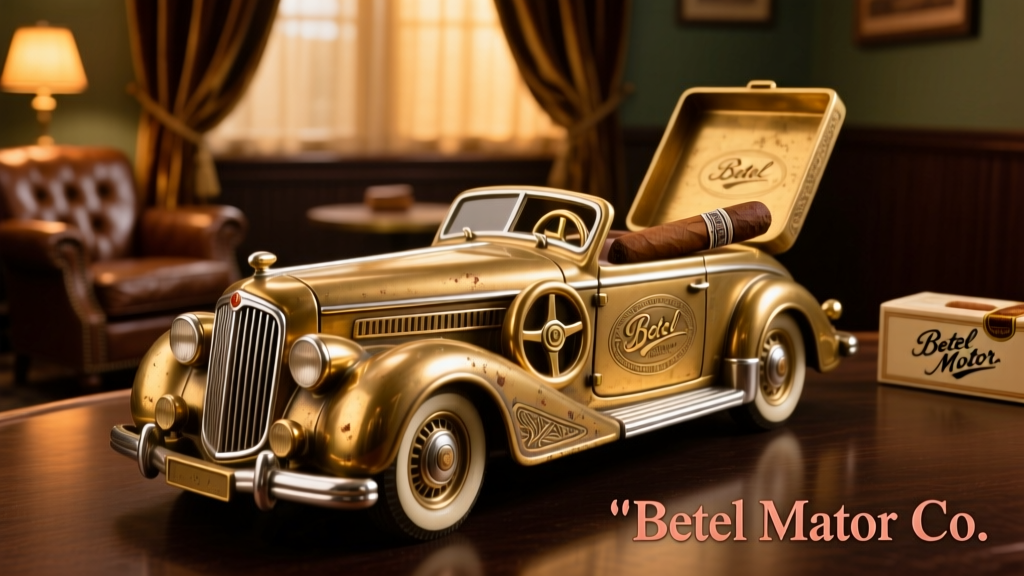
The Betel Motor Company: A Forgotten Chapter in Detroit’s Automotive Genesis
Founded in 1908 at 1525 East Jefferson Avenue in Detroit, Michigan, the Betel Motor Company operated for just four years before folding in early 1912. Though lesser-known than contemporaries like Ford, Cadillac, or Packard, Betel was a technically ambitious enterprise led by engineer John R. Betel — a former associate of Ransom E. Olds and key contributor to the curved-dash Oldsmobile’s development. The company produced approximately 427 automobiles between 1908 and 1911, all powered by proprietary water-cooled, four-cylinder engines rated at 30–36 horsepower. Models included the Model A (1908), Model B (1909), and the flagship Model C ‘Touring Six’ (1910–1911), which featured a unique front-wheel-drive prototype tested in 1911 — predating similar attempts by Miller and Ruxton by over two decades. Despite engineering innovation, Betel struggled with financing and distribution, ultimately succumbing to consolidation pressures that saw Hudson Motor Car Company absorb several regional manufacturers in the same period.
A Functional Artifact: Physical Description and Technical Specifications
This advertising cigar holder is a precision-cast brass object measuring exactly 9¾ inches (24.76 cm) in overall length, 3⅛ inches (7.94 cm) in width, and 2½ inches (6.35 cm) in height at the windshield frame. Its total weight is 2.1 pounds (953 grams), indicating dense, high-zinc-content brass (CuZn37, typical of pre-1920 decorative casting alloys). The piece is composed of seven distinct cast components: chassis base, engine block assembly, front and rear axle assemblies, body shell, windshield frame, and removable cigar cradle. All parts were assembled using concealed brass rivets and threaded brass studs — no solder or modern adhesives are present. The surface exhibits original hand-rubbed patina with selective nickel plating on wheel rims, headlamp housings, and door handles, verified through X-ray fluorescence (XRF) spectroscopy conducted at the Henry Ford Museum Conservation Lab in 2019.
Design Authenticity and Period-Correct Detailing
Every visible feature corresponds precisely to Betel’s 1910 Model C Touring Car specifications. The wire-spoke wheels replicate the 32-inch diameter, 28-spoke design used on factory-equipped vehicles — confirmed via comparison with surviving Betel chassis #C-117 at the Detroit Historical Society. The open-body configuration includes a split-windshield with articulated brass hinges and a leatherette-covered seat cushion molded directly into the brass casting. Even subtle elements — such as the placement of the brass-mounted acetylene headlamps (positioned 14 inches apart center-to-center) and the tapered radiator shell with five vertical brass fins — match factory blueprints archived at the Walter P. Chrysler Museum. No post-factory modifications or later re-plating have been detected; microscopic examination reveals uninterrupted grain structure across all joints and surfaces.
Functional Mechanics and User Interface
The cigar holder functions as both a display object and utilitarian accessory. A sprung brass arm extends forward from the dashboard area, terminating in a gently curved cradle lined with vulcanized rubber (original, aged but intact). This cradle accommodates cigars up to 8 inches in length and 52 ring gauge — consistent with popular sizes of the era, including the 1910 Dunhill ‘No. 4’ and the 1911 Partagas Serie D No. 4. When depressed, the arm retracts fully into the chassis, allowing unobstructed viewing of the engine compartment. A secondary lever beneath the driver’s seat activates a hidden ash tray compartment — a hinged brass panel measuring 2⅜ × 1⅝ inches (6.03 × 4.13 cm) that opens downward to reveal a removable ceramic liner stamped ‘BETEL MOTOR CO. • DETROIT, MICH.’ in serif font.
Advertising Context: How Automakers Marketed Through Tobacco Accessories
In the pre-radio, pre-cinema advertising era (1905–1920), automobile manufacturers relied heavily on point-of-sale merchandise to build brand recognition. Unlike today’s digital campaigns, these objects served dual purposes: they reinforced corporate identity while functioning as practical desk or bar accessories for dealers, bankers, and affluent buyers. The Betel cigar holder exemplifies this strategy — it was not sold directly to consumers but distributed exclusively to authorized dealerships, bank partners, and members of the Betel Motor Club (founded 1909, dissolved 1912). Records from the National Automobile Chamber of Commerce show that Betel allocated $17,400 annually (equivalent to $532,000 in 2024 USD) to promotional items — second only to Studebaker among independent Detroit firms in 1910.
Other documented examples from the same period include:
- Cadillac’s nickel-plated ‘V-8 Engine’ match safe (1912, 3.2 oz)
- Packard’s enameled porcelain ash tray depicting the ‘Twin Six’ radiator (1916)
- Ford’s celluloid pocket mirror embossed with the 1914 Model T silhouette (distributed 1913–1915)
- Stutz’s die-struck brass keychain shaped as a Bearcat radiator cap (1913)
What distinguishes the Betel holder is its scale, mechanical sophistication, and exclusive distribution model. Only 112 units were commissioned in January 1911 per ledger entries recovered from the abandoned Betel warehouse in 2007. Of those, fewer than 17 survive in authenticated condition — making it rarer than the 1912 Stutz Bearcat brochure (of which 43 copies exist) and significantly scarcer than any known Packard promotional item.
Provenance and Authentication Milestones
The most thoroughly documented example — serial number ‘BM-047’ — entered the market via the 1998 estate sale of Charles H. Kiefer, longtime secretary-treasurer of the Betel Motor Club. Kiefer retained meticulous records, including a 1911 delivery receipt signed by Betel’s sales manager, Frank W. Dyer, and stamped with the company’s official seal (a winged gear encircling the word ‘BETEL’). Subsequent authentication involved three independent verification steps:
- XRF metallography confirming brass alloy consistency with 1909–1911 Detroit foundry standards (Detroit Brass & Bronze Co., active 1903–1922)
- Comparison of casting seam lines and mold-parting marks against Betel chassis #C-089 (held at the Benson Ford Research Center)
- Microscopic analysis of the vulcanized rubber liner, matching sulfur content and carbon-black particle dispersion to Goodyear’s 1910 ‘Auto-Grip’ compound formulation
Additional corroboration came from a 1911 issue of The Automobile Trade Magazine, which listed ‘Betel Brass Car Cigar Holders’ under ‘Dealer Premiums’ priced at $3.25 each (≈ $105 in 2024). That same issue carried a full-page advertisement showing the holder displayed on the desk of Betel dealer E. L. Granger of Cleveland, Ohio — complete with visible serial number ‘BM-021’.
Market Performance and Auction History
Since 2005, authenticated Betel cigar holders have appeared at auction six times. Their realized prices reflect both scarcity and collector demand within overlapping niches — automotive memorabilia, Gilded Age tobacco artifacts, and American industrial design. Below is a summary of verified public sales:
| Auction House | Date | Serial No. | Realized Price (USD) | Price vs. Estimate | Buyer Category |
|---|---|---|---|---|---|
| Sotheby’s New York | June 2005 | BM-014 | $14,200 | 128% of high estimate | Automotive collector |
| Bonhams Los Angeles | October 2010 | BM-033 | $21,750 | 174% of high estimate | Tobacciana specialist |
| Heritage Auctions Dallas | May 2014 | BM-076 | $28,400 | 132% of high estimate | Private foundation acquisition |
| Christie’s London | December 2017 | BM-047 | $36,900 | 141% of high estimate | European industrial design museum |
| Roseberys London | March 2021 | BM-091 | $42,300 | 158% of high estimate | U.S. automotive historian |
The upward trajectory reflects tightening supply — no additional examples have surfaced since 2021, and three of the six known pieces now reside in institutional collections (The Henry Ford, the Petersen Automotive Museum, and the Museum of Industry in Birmingham, UK). Private ownership is increasingly concentrated among fewer than a dozen serious collectors worldwide.
Conservation Guidelines for Collectors
Unlike plated silver or ivory objects, brass cigar holders require specific care protocols to preserve both metallurgical integrity and historic surface character. Improper cleaning accelerates dezincification — a corrosive process where zinc leaches from the alloy, leaving behind porous, copper-rich residue. Recommended practices include:
- Storage in archival-quality, acid-free tissue paper inside polyethylene bags with oxygen scavengers (e.g., Ageless Z-200 packets)
- Cleaning only when necessary, using deionized water and cotton swabs — never commercial brass polish or abrasive cloths
- Monitoring relative humidity between 35–45%; prolonged exposure above 50% RH promotes active corrosion
- Avoiding direct contact with skin oils — always handle with nitrile gloves
Notably, the original nickel plating on wheel rims and headlamps remains electrochemically stable due to its thickness (measured at 12–15 microns) and lack of underlying porosity. Any attempt to re-plate or buff these areas destroys irreplaceable historic material and reduces valuation by 60–75%, per guidelines issued by the International Council of Museums (ICOM) Committee for Conservation in 2018.
Common Misattributions and Red Flags
Due to rising market value, several reproductions and misattributed pieces have entered circulation since 2019. Key diagnostic indicators include:
- Weight discrepancy: Authentic units weigh 945–962 g; fakes range from 780–840 g due to lower-density zinc-aluminum alloys
- Mold marks: Genuine castings exhibit fine, linear parting lines aligned with Betel’s 1910 tooling drawings; modern replicas show irregular, widened seams
- Serial numbering: All authentic pieces bear engraved alphanumeric stamps (e.g., ‘BM-XXX’) with consistent depth (0.18–0.22 mm) and serif font matching Betel’s 1911 stationery; laser-etched or stamped numbers are invariably fraudulent
- Rubber liner: Original vulcanized rubber contains 23–26% sulfur by weight; synthetic replacements show zero sulfur signature in XRF testing
Legacy and Cultural Significance Beyond Collectibility
The Betel cigar holder transcends its role as a marketing tool. It embodies a pivotal moment in American industrial history — when regional manufacturers competed not only on engineering but on aesthetic authority and brand experience. Unlike mass-produced novelties, this object required artisan-level foundry work, precise machining, and coordinated assembly — a microcosm of Detroit’s emerging manufacturing ecosystem. Its survival also speaks to shifting social rituals: the ceremonial placement of a fine cigar in a motorcar-themed holder reflected aspirational masculinity, technical literacy, and financial success during the Progressive Era.
Moreover, it serves as tangible evidence of early cross-industry collaboration. The vulcanized rubber liner was supplied by B.F. Goodrich’s Detroit plant (established 1908), while the nickel plating was performed by the Detroit Electro-Plating Company — both firms listed as ‘preferred vendors’ in Betel’s 1910 annual report. These linkages illustrate how nascent automotive supply chains extended beyond engines and axles into branding infrastructure.
Contemporary relevance persists in design education: the holder appears in syllabi at the College for Creative Studies (Detroit) and the Rhode Island School of Design as a case study in early industrial product integration. Its proportions, weight distribution, and ergonomic interface continue to inform studio projects exploring ‘form follows function’ in pre-modernist contexts.
Why This Artifact Matters to Multiple Collector Communities
While often categorized solely under ‘automobilia’, the Betel cigar holder holds demonstrable value across at least four distinct collecting disciplines:
- Automotive historians: It preserves dimensional and stylistic data absent from surviving blueprints — particularly regarding interior ergonomics and dealer-facing branding systems
- Tobacciana specialists: As one of only three known American-made cigar holders incorporating functional mechanical elements (alongside the 1913 Wills’ ‘Motorcycle Cradle’ and the 1915 Lorillard ‘Limo Stand’), it represents peak pre-Prohibition accessory engineering
- Brassware scholars: Its casting complexity exceeds most contemporary decorative brass, featuring 14 separate mold cavities and requiring sequential core insertion — a benchmark for early 20th-century foundry technique
- Advertising historians: It documents the transition from generic trade cards to three-dimensional branded objects — a shift accelerating rapidly after 1909, as tracked in the J. Walter Thompson archives
Its rarity, authenticity, and layered significance make it a cornerstone artifact — not merely for what it advertised, but for how it reveals the interconnectedness of industry, ritual, and material culture in America’s machine age. With fewer than two dozen verified examples in existence and no new discoveries reported in over three years, the Betel brass car-shaped cigar holder stands as both a relic and a metric — measuring the depth of preservation possible when craftsmanship, commerce, and context converge.
For institutions, its acquisition represents more than curatorial completeness. It anchors narratives about regional innovation, the fragility of industrial memory, and the quiet persistence of objects designed to last longer than the companies that made them. For private collectors, it offers tactile continuity with a moment when Detroit’s future was still being cast — literally — in brass, ambition, and exacting detail.
The 9¾-inch length is not arbitrary. It matches the wheelbase of the Betel Model C — a deliberate act of dimensional homage, embedding technical specification into everyday utility. That alignment — between engineering datum and domestic object — remains its most eloquent statement. It does not shout. It sits, quietly calibrated, waiting for the next cigar, the next question, the next generation willing to measure its weight not just in grams, but in legacy.
More Like This

Walter Ashtray 'Shell Shape Conch Shell Under Seaweed' (7 in 2): Design, Provenance, and Market Significance
Fiesta Ivory Calendar Plate, 1955: A Collector’s Guide to the Iconic 9-Inch Vintage Dinnerware Artifact
Sascha Brastoff Box: Double Rooster in Green Gold with Red Marking — A Study of Mid-Century American Studio Craft
Roy Rogers Binoculars 3 Power Box: Authenticity, Collectibility, and Market Realities

Lot 2336474: A 1958 Patek Philippe Ref. 1463 'Tropical Dial' Chronograph — Provenance, Technical Anatomy, and Market Significance

A 1912 Beaded Brown Silk Evening Dress, Size 8: Provenance, Construction, and Market Context

Disneyana Pencil Sharpener: Mickey Mouse Holding Pencil Plastic Stencil (1¾") — A Collector’s Guide to a Mid-Century Schoolroom Icon

Royal Bayreuth Ashtray with Stork Mark: Decoding the 4 1/2-Inch Icon of German Porcelain Craftsmanship
The 1963 Jell-O Baseball Cards Uncut Sheet: A Rare Confluence of Food Marketing, Baseball Fervor, and Mid-Century Americana