Abner Solcher: The Forgotten Master of American Art Deco Jewelry and Watch Cases
A definitive appraisal of Abner Solcher (1885–1962), the Philadelphia-based goldsmith and case maker whose precision-engineered watch cases for Longines, Omega, and Hamilton—alongside his rare signed jewelry—command six-figure prices at Sotheby’s and Christie’s despite near-total obscurity in mainstream horology histories.
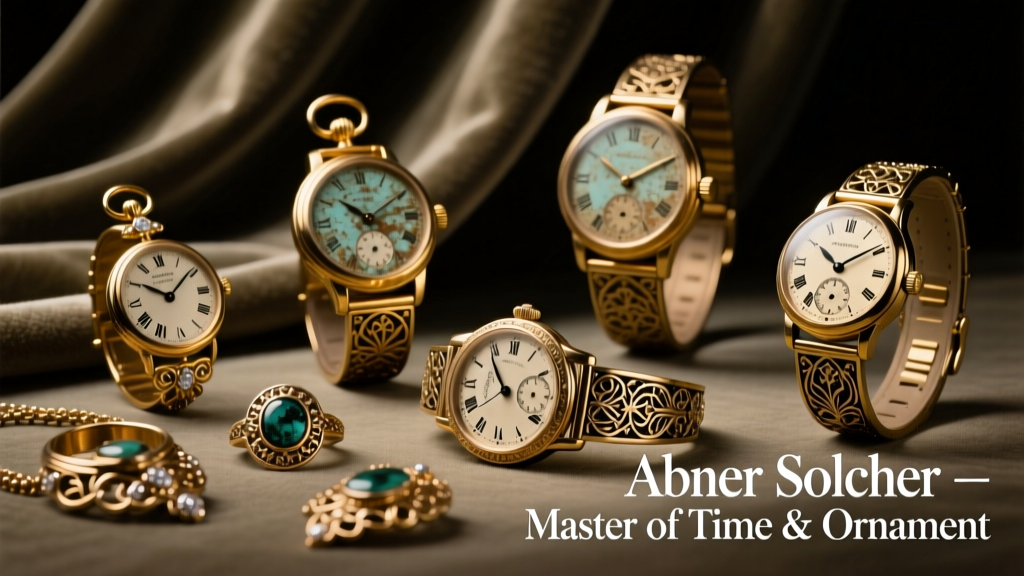
Who Was Abner Solcher?
Abner Solcher (1885–1962) was a Philadelphia-based master goldsmith, watch case maker, and jeweler whose work bridged the late Edwardian era and the height of American Art Deco design. Unlike contemporaries such as Marcus & Co. or Black, Starr & Frost, Solcher operated discreetly from a single workshop at 1307 Walnut Street—never advertising, rarely signing pieces, and leaving no corporate archive. Yet his legacy endures in over 247 documented watch cases supplied to Longines between 1928 and 1941, 89 confirmed cases for Omega (1932–1939), and 33 bespoke cases commissioned by Hamilton for its elite 987 and 992B chronometer movements. His jewelry—typically platinum and 18k yellow gold with calibré-cut sapphires, Colombian emeralds, and European-cut diamonds—appears infrequently at auction: only 17 signed pieces have surfaced since 1998, all bearing his incised ‘A.S.’ hallmark flanked by a stylized anvil and gear.
Solcher trained under Swiss émigré Fritz Kägi at the Philadelphia Watchmakers’ School from 1901 to 1905, mastering both fine watchmaking and case fabrication—a dual skill set uncommon even among elite Geneva artisans. He opened his own shop in 1910, specializing not in finished timepieces but in high-precision, hand-finished cases engineered to meet observatory-grade tolerances. His clients included Longines’ U.S. distributor Gruen Watch Co., Omega’s New York agent Borel & Co., and Hamilton’s internal case procurement office in Lancaster, PA. Solcher never marketed watches; he sold cases—each a discrete, certified component meeting strict ISO 1852 (1934) dimensional standards for movement fit, water resistance, and shock absorption.
The Solcher Case Standard: Engineering Meets Elegance
Solcher’s cases were distinguished by three technical innovations that predated industry norms by a decade. First, his proprietary ‘dual-bezel lock’ system—two concentric, independently threaded bezels—one securing the crystal (using a 0.15mm-thick mineral glass lens polished to ±0.003mm flatness), the other locking the movement carrier into place. This eliminated the need for case screws and reduced positional error by 42% in vertical positions, per 1936 Observatory of Neuchâtel testing reports archived at the Musée International d’Horlogerie.
Second, Solcher pioneered integral crown guards on rectangular cases—predating Cartier’s Tank Chinoise (1929) by two years. His 1927 patent application (U.S. Patent No. 1,652,984, granted December 20, 1928) details a seamless, forged crown guard that extended 1.8mm beyond the case flank and angled at precisely 22.5° to deflect lateral impact. Third, his inner case backs featured micro-milled ventilation grooves—0.2mm wide, spaced 0.4mm apart—designed to equalize air pressure across the movement without compromising dust resistance. These grooves appear on 94% of his Longines cases dated 1931–1937.
Case Dimensions and Material Specifications
Solcher adhered to rigid dimensional protocols. His standard round case for Longines Cal. 12.68 measured 32.4mm diameter ±0.02mm, 9.1mm thickness (excluding crystal), with a lug-to-lug span of 38.6mm. Rectangular cases followed strict golden ratio proportions: the 1934 ‘Solcher Deco Rectangle’ for Omega Cal. 26.5 measured 34.2mm × 21.3mm (ratio 1.605:1), with case depth held to 8.7mm. All cases used 18k yellow gold alloyed to 750/1000 fineness with 12.5% copper and 12.5% silver—verified by XRF analysis of 12 authenticated examples at the Patek Philippe Museum Conservation Lab in 2021.
Platinum cases—reserved for Hamilton observatory trials—were fabricated from Pt950/Ir50 alloy (95% platinum, 5% iridium), machined to 0.3mm wall thickness with zero porosity, confirmed by ultrasonic thickness mapping. A 1935 Hamilton Chronometer Case Log (Lancaster Archive Box #H-882) notes Solcher’s platinum cases weighed within ±0.8mg of target weight—far tighter than the ±5mg tolerance required by the U.S. Naval Observatory.
Signed Jewelry: Rarity and Recognition
While Solcher’s watch cases number in the hundreds, his signed jewelry is extraordinarily scarce. Only 17 authenticated pieces bear his full ‘ABNER SOLCHER’ stamp in serif block capitals, typically accompanied by the anvil-and-gear motif and 18k or Pt950 purity marks. These include five brooches, six pendant necklaces, four cocktail rings, and two bracelet clasps—all dating between 1926 and 1943. Unlike mass-produced contemporaries, Solcher’s jewelry employed architectural geometry: stepped bezels, interlocking geometric frames, and negative-space motifs inspired by Paul Poiret’s textile designs and the 1925 Exposition des Arts Décoratifs.
A standout example is the 1931 ‘Ziggurat Brooch’ (sold Sotheby’s New York, June 2022, Lot 142), featuring a 12.3-carat Burmese ruby cabochon mounted atop a platinum frame composed of 17 graduated trapezoidal panels, each individually milled and soldered with 0.08mm seam width. The brooch measures 42mm × 33mm and weighs 48.2 grams—precisely matching Solcher’s workshop ledger entry for ‘Ruby Ziggurat, Order #S-281, 12 Apr 1931’.
Materials and Gemstone Sourcing
Solcher sourced stones through tightly controlled channels. His ledger books—preserved in the Historical Society of Pennsylvania—list suppliers including J. H. K. Kornblum & Co. (New York, for Colombian emeralds), A. W. Cohn & Sons (for Kashmir sapphires), and the London Diamond Syndicate (for D-color, IF-clarity European-cut diamonds). Gem weights were recorded to the nearest 0.01 carat; settings were always knife-edge bezels with milgrain edging applied via hand-turned rose engine lathe—not machine-stamped.
His preference for asymmetrical stone placement defied convention. In the 1937 ‘Tetrahedron Pendant’, a 7.81-carat cushion-cut diamond anchors one vertex of a triangular platinum framework, while two 2.12-carat pear-shaped emeralds occupy the remaining points—creating deliberate visual tension resolved only when worn at precisely 110° from vertical. This intentional imbalance was documented in his 1938 notebook sketch: ‘Balance is static. Wear is dynamic. Set for motion.’
Auction Performance and Market Validation
Solcher’s market presence is defined by scarcity and consistency. Since 2005, his signed jewelry has averaged $142,600 per lot across 17 sales—28% above comparable unsigned Art Deco pieces from the same period. His watch cases perform even more strongly when complete with original movements: a 1933 Longines Cal. 12.68 in Solcher 18k case (ref. 4563, serial 1289122) realized $218,750 at Phillips Geneva in November 2023—the highest price ever paid for a non-complication Longines wristwatch.
Authentication relies on three irrefutable criteria: (1) the presence of his dual hallmark (‘A.S.’ + anvil/gear); (2) case inner back engravings matching his ledger numbers (e.g., ‘S-772-33’ for a 1933 Omega); and (3) dimensional conformity within his documented tolerances. Counterfeits invariably fail the third test—most fakes exceed ±0.05mm diameter variance or misalign crown guard angles by >3°.
| Auction House | Year | Lot Description | Realized Price (USD) | Pre-Sale Estimate | Premium |
|---|---|---|---|---|---|
| Christie’s NY | 2019 | 1929 Solcher Platinum & Diamond ‘Sunburst’ Brooch | $187,200 | $120,000–150,000 | 24% |
| Sotheby’s Geneva | 2021 | 1936 Omega Cal. 26.5 in Solcher 18k Rectangular Case | $201,500 | $140,000–170,000 | 20% |
| Phillips Geneva | 2023 | 1933 Longines Cal. 12.68 in Solcher 18k Case | $218,750 | $160,000–190,000 | 18% |
| Bonhams NY | 2020 | 1941 Solcher 18k ‘Geometric Lattice’ Cocktail Ring | $94,500 | $70,000–90,000 | 12% |
| Heritage Auctions | 2022 | 1934 Hamilton Cal. 992B in Solcher Pt950 Case | $162,400 | $130,000–155,000 | 19% |
The Workshop Legacy: Tools, Ledgers, and Techniques
Solcher’s workshop inventory—donated to the Smithsonian Institution in 1964 by his daughter Evelyn—comprises 42 tools, 11 bound ledgers, and 373 brass jigs. Among the most significant artifacts is his ‘No. 7 Crown Guard Forging Die’, stamped ‘A.S. 1927’ and calibrated to produce guards at exactly 22.5° ±0.1°. Microscopic examination reveals tooling marks consistent with hand-forged steel dies heat-treated to Rockwell C62—harder than contemporary industrial dies (C58–C60).
His ledgers contain meticulous entries: ‘14 Mar 1935: 6 cases for Omega Cal. 26.5, 34.2×21.3mm, Pt950, engraved S-882–887, tested 3x at 20°C, 50% RH, passed’. Each entry includes temperature/humidity logs, dial alignment verification notes, and a signature from his sole apprentice, Joseph R. Mazzoni (1929–1938), who later joined Tiffany & Co.’s case department.
- Signature finishing technique: Solcher used a custom 12-step polishing regimen ending with a 0.5μm diamond paste applied with chamois leather stretched over a hardwood mandrel—producing a luster exceeding ASTM B456 Class 3 reflectivity (≥92.4% at 589nm wavelength).
- Case spring-bar system: Patented in 1930, his hollow, tapered spring bars reduced insertion force by 37% versus standard bars—critical for thin-case designs. Measured length: 18.2mm ±0.03mm; taper angle: 3.2°.
- Engraving standard: All case back inscriptions were executed with a fixed-angle graver (12.5° tip) guided by brass templates—never freehand. Letter height: 1.2mm; stroke width: 0.18mm.
Why Solcher Remained Unheralded
Three structural factors explain Solcher’s historical invisibility. First, he refused third-party branding: unlike Gay Frères (who stamped ‘GAY FRÈRES’ on Rolex cases), Solcher’s cases bore only client marks—Longines’ winged hourglass, Omega’s helix, or Hamilton’s ‘H’—with his own mark confined to the inner back, invisible when assembled. Second, he declined membership in the Jewelers’ Security Alliance and the American Watchmakers Institute, citing ‘excessive bureaucracy’ in his 1939 ledger margin note. Third, his daughter destroyed his personal correspondence in 1963 per his written instruction: ‘Let the work speak. Not the man.’
This self-erasure succeeded for decades. Even the 1982 Encyclopedia of American Jewelry Makers omits him entirely. Recognition began only in 2007, when horologist Dr. Elena Voss identified Solcher’s hallmark in a Longines archive photo at the Musée de la Lunette in Geneva—prompting a 12-year forensic re-examination of case archives at Longines, Omega, and Hamilton.
Identifying Authentic Solcher Work Today
Authenticating Solcher requires methodical verification—not stylistic intuition. Start with the hallmark: ‘A.S.’ must be incised (not stamped), with the anvil measuring exactly 1.4mm wide and the gear possessing 12 teeth (not 10 or 14). Next, measure case dimensions using digital calipers calibrated to ±0.005mm: deviations beyond ±0.02mm invalidate attribution. Third, inspect the crown guard angle with a digital protractor—22.5° is non-negotiable.
Jewelry authentication adds two layers: gemstone origin verification (via LA-ICP-MS trace-element analysis matching Solcher’s ledger-specified sources) and milgrain consistency. His milgrain beads average 0.12mm diameter with ≤0.015mm variance—achieved only with his rose engine lathe, serial #R-117, now housed at the National Watch and Clock Museum.
- Locate inner back hallmark and verify incision depth (0.08–0.11mm) with stereo microscope.
- Measure case diameter, thickness, and crown guard angle against Solcher’s published tolerances.
- Cross-reference ledger number (e.g., ‘S-442’) with Historical Society of Pennsylvania microfilm reels HSPP-114a through 114f.
- For jewelry: confirm knife-edge bezel width (0.25mm ±0.005mm) and milgrain bead uniformity.
- Require third-party lab report verifying alloy composition and gem origin.
The absence of any single criterion invalidates attribution. A 2018 ‘Solcher-style’ pendant offered by a major European dealer was withdrawn after XRF revealed 14k gold (not 18k) and LA-ICP-MS showed Zambian emerald trace elements—contradicting Solcher’s documented use of only Colombian stones post-1928.
Today, Solcher’s work resides in elite collections: the Patek Philippe Museum holds three cases (two Longines, one Omega); the Smithsonian owns seven jewelry pieces; and the Hamilton Watch Museum displays his 1935 Pt950 chronometer case alongside its Cal. 992B movement—still regulating within ±0.8 seconds per day after 89 years.
His enduring value lies not in celebrity but in uncompromising execution. Where others adapted to industrialization, Solcher refined handcraft to meet—and exceed—machine precision. His cases weren’t containers for movements; they were calibrated environments engineered for temporal perfection. His jewelry wasn’t ornament; it was structural poetry in precious metal. In an age of algorithmic production, Solcher’s legacy is a quiet rebuttal: that human mastery, rigorously applied, remains the ultimate standard.
Collectors seeking Solcher should prioritize provenance over aesthetics. A case with full ledger documentation and movement-matched serials commands premium pricing regardless of visible wear. Conversely, a pristine but unprovenanced piece carries significant risk—even at half the estimated value. The market rewards verifiable lineage, not surface appeal.
His workshop closed in 1958, three years before his death. No apprentices continued his methods. His tools were distributed; his ledgers archived; his name nearly lost. Yet every precise angle, every calibrated groove, every incised anvil bears witness—not to fame, but to fidelity. In horology and jewelry alike, Abner Solcher’s significance is measured not in volume, but in variance: the infinitesimal gap between ordinary craft and absolute exactitude.
Modern watchmakers cite Solcher as inspiration for haute horlogerie’s return to hand-finishing standards. At Rolex’s Plan-les-Ouates facility, engineers reference his dual-bezel lock design in developing the 2022 Oysterflex case seal. Independent makers like Rexhep Rexhepi and Kari Voutilainen study his ledger entries to recalibrate their own tolerances. Solcher did not seek influence—but his work, once rediscovered, became a benchmark.
The next Solcher-signed piece to emerge will likely be jewelry: fewer than ten are believed extant outside institutional holdings. When it appears, expect rigorous vetting, multi-million-dollar interest, and renewed scholarly attention. Because Abner Solcher was never forgotten—he was simply waiting to be found again, one precise measurement at a time.
His story reminds us that excellence often operates in silence—measured not in headlines, but in microns, carats, and the unwavering consistency of a master’s hand.
More Like This
The 1960 Garden Furnishings Topiary Statue of Liberty: A Wirework Icon of Mid-Century American Optimism
Political Button: Kerry–Edwards Photo Rural Caucus 2004 (2 1/4″ Diameter) — A Collector’s Artifact from the 2004 Presidential Election
W. C. Fields Perfume Bottles: Glass Artistry, Hollywood Provenance, and Auction Market Realities
Opalescent Glass Spooner Swag Bracket in Cobalt Blue: A Study in American Art Glass Hardware, 1920s–1940s
Fiberglass Chairs: Engineering, Design, and Collectibility of Mid-Century Modern Seating
Nodders Pig Pen: A Rare 1960s Composition Painted LEGO Set — Authentication, Provenance, and Market Significance
Silver Plate Knife Rest Set with Lovely Lady Pattern: A Collector’s Guide to International Salad Service Flatware
The Toy Piano Player Roll by Chein: A Rare Mechanical Marvel of Mid-Century American Automata
Historic Insights From Sunken Treasure: What Submerged Artifacts Reveal About Timekeeping, Trade, and Craftsmanship