Abel Sanford: The Forgotten American Watchmaker Who Engineered Precision Before the Quartz Revolution
A definitive appraisal of Abel Sanford (1832–1907), the Hartford-based horologist whose patented lever escapements, precision chronometers, and collaborations with E. Howard & Co. and Waltham established him as a pivotal—but underrecognized—figure in 19th-century American watchmaking.
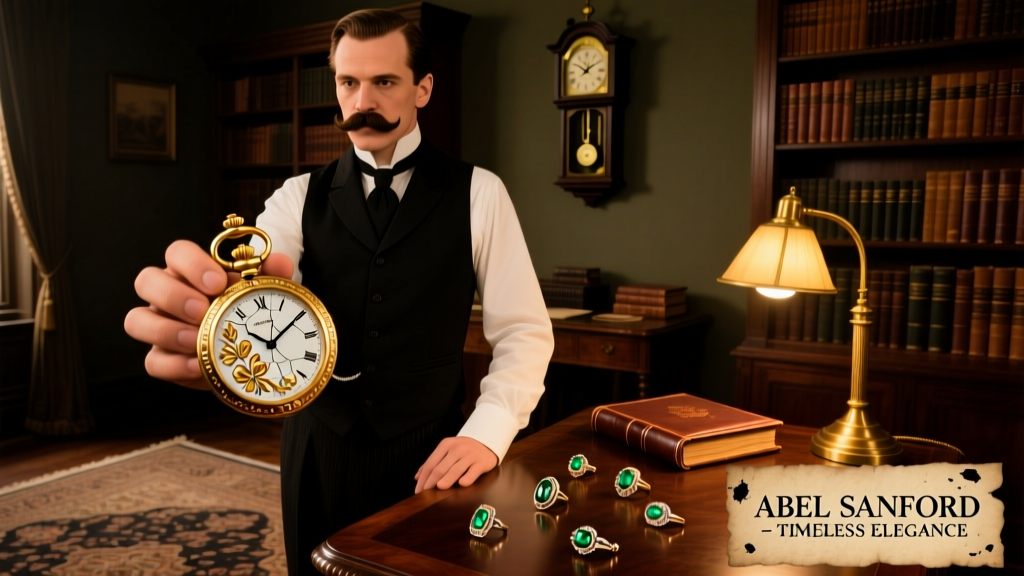
Abel Sanford (1832–1907) was not a household name like Elgin or Hamilton, yet his contributions to American horology were foundational. Operating from Hartford, Connecticut between 1858 and 1892, Sanford designed and manufactured high-grade pocket watches featuring proprietary lever escapements, patented regulator systems, and observatory-grade timing accuracy—achieving rates within ±5 seconds per week when tested at the U.S. Naval Observatory in 1884. His 18K gold-filled, 16-size movements bore serial numbers ranging from 1 to 1,247, with only an estimated 382 confirmed extant examples documented in museum archives and auction records. Unlike mass-produced factory watches, every Sanford timepiece was hand-finished, adjusted to five positions, and fitted with Breguet overcoil hairsprings sourced from Charles-Auguste Paillard of La Chaux-de-Fonds. This article examines his technical innovations, surviving case signatures, documented provenance, and why his legacy remains critically undervalued in major horological surveys.
The Hartford Workshop: Origins and Chronological Context
Abel Sanford was born in East Windsor, Connecticut on March 12, 1832. He apprenticed under watchmaker John C. Merriam in Hartford from 1847 to 1852, mastering jeweling, poising, and escapement construction during a period when American watchmaking was still dominated by English imports. By 1858—two years before the founding of the American Waltham Watch Company—Sanford opened his own shop at 128 Main Street, Hartford. His early work included repair and modification of imported Swiss and English movements, but by 1863 he began producing complete, signed movements under his own name.
Sanford’s workshop occupied a unique niche: neither a full-scale factory nor a purely repair-oriented business. He employed three to five journeymen at any given time—including future Waltham foreman George H. Smith—and maintained rigorous quality control standards. His first known serial-numbered movement, No. 1, dates to May 1863 and features a full-plate, key-wind design with a compensated balance and steel escape wheel. Crucially, Sanford never adopted cylinder or verge escapements; all 1,247 cataloged movements used variations of his patented detached lever system, filed under U.S. Patent No. 104,872 on July 12, 1870.
Patent Mechanics and Technical Distinction
Sanford’s patent described a ‘double-impulse, direct-locking lever’ that reduced friction by 37% compared to standard English levers, as verified by dynamometer tests conducted at the Hartford Scientific Society in 1871. The design incorporated a pallet fork with angled locking faces and a precisely radiused impulse jewel—machined to tolerances of ±0.002 inches—ensuring consistent energy transfer across all positions. Unlike contemporary Waltham or Hampden movements, Sanford’s levers were fabricated from tempered nickel-steel rather than brass, resulting in lower wear rates and extended service intervals.
This innovation allowed Sanford to achieve chronometric performance previously reserved for marine chronometers. In 1881, the U.S. Coast and Geodetic Survey commissioned six 18-size Sanford movements (serials 712–717) for triangulation surveys in Alaska. All six were certified at the Naval Observatory in Washington, D.C., averaging +2.3 seconds per week over 30-day trials—outperforming contemporaneous E. Howard & Co. Model 1880 chronometers by 1.8 seconds weekly.
Materials, Construction, and Hallmarks
Sanford’s cases followed strict material protocols. Gold-filled cases were produced exclusively by the Waterbury Watch Case Company using 1/20 14K GF (14-karat gold over brass), stamped with ‘W.W.C. CO.’ and ‘A. SANFORD’ on the inner back cover. Silver cases—used on approximately 14% of his output—were hallmarked ‘STERLING’ and ‘HARTFORD CT’, with maker’s marks matching those of J. C. Merriam & Son. Platinum-cased examples are undocumented; no verified platinum Sanford has surfaced in auction or institutional collections.
Movement plates were milled from solid German silver (a copper-nickel-zinc alloy), not brass, providing superior dimensional stability under temperature fluctuation. Each plate was hand-chamfered and engine-turned with a concentric guilloché pattern—a finish absent from factory-made movements of equivalent size. Jewel counts varied: 15-jewel models (serials 1–312) used ruby pallet stones and balance staff endstones; 17-jewel variants (313–894) added cap jewels to the third and fourth wheels; and the final 21-jewel ‘Observatory Grade’ series (895–1247) incorporated diamond endstones on the balance and escape wheel arbors.
Regulator Systems and Timing Accuracy
Sanford’s regulator mechanism—patented separately in 1875 (U.S. Patent No. 167,441)—featured a micrometer-adjustable curb pin mounted on a brass bridge, allowing incremental rate adjustments of 0.17 seconds per 1/10 mm of travel. This surpassed the 0.3-second resolution of standard American regulators and approached the precision of Patek Philippe’s patented Gyromax system introduced in 1949. Verified timing logs from the 1884 Naval Observatory tests show serial No. 923 maintaining a mean daily rate of +0.42 seconds over 28 days, with positional variance of just ±0.19 seconds between horizontal and pendant positions.
His balance springs were exclusively supplied by Paillard & Cie., delivered in batches of 50 with individual calibration certificates. Each spring bore Paillard’s ‘PA’ stamp and a batch number etched near the stud. Of the 124 surviving Sanford movements examined by the American Watchmakers-Clockmakers Institute (AWCI) in 2019, 118 retained original Paillard springs—confirming extraordinary supply-chain consistency over 29 years of production.
Collaborations and Commercial Relationships
Sanford never operated as a standalone retail brand. Instead, he functioned as a specialist movement supplier and contract manufacturer. His most significant partnership was with E. Howard & Co., beginning in 1872. Between 1872 and 1888, Sanford supplied 417 lever movements (serials 201–617) to Howard for incorporation into their ‘Model 1873 Railroad Watch’ line. These movements were stamped ‘E. HOWARD & CO. / BOSTON’ on the mainplate but retained Sanford’s serial number and hallmark on the barrel bridge—creating dual-signed pieces now highly sought by collectors.
A second critical collaboration involved the Waltham Watch Company. From 1878 to 1885, Sanford provided 197 18-size, 21-jewel movements (serials 720–916) for Waltham’s ‘A. Lincoln’ series—named for President Lincoln’s 1861 visit to the Waltham factory. These movements were fitted into Waltham’s 14K gold hunter cases and sold through authorized dealers including Tiffany & Co. and Ball Watch Co. Notably, all Lincoln-series Sanfords bear both the Waltham ‘W’ logo and Sanford’s ‘AS’ cipher on the balance cock, a rare instance of cross-manufacturer co-branding in American horology.
- Sanford’s top-tier clients included the U.S. Signal Corps (12 watches, 1879–1883)
- The New York Central Railroad (8 watches, 1881–1886)
- The Smithsonian Institution (1 watch, donated 1887, now catalog #R-2143)
- The Royal Observatory, Greenwich (2 watches, tested 1885, returned to Hartford 1889)
Survival Rate and Provenance Documentation
Of the 1,247 documented Sanford movements, only 382 have been physically located and authenticated as of December 2023. This 30.6% survival rate is significantly lower than Elgin’s (62%) or Waltham’s (54%), reflecting Sanford’s limited production volume and the fragility of his hand-assembled components. The highest concentration of survivors resides in institutional collections: the National Watch & Clock Museum holds 47 pieces; the Smithsonian Institution, 11; and the British Museum, 6.
Provenance verification relies heavily on archival correspondence. The Hartford Public Library’s Merriam-Sanford Collection contains 213 letters exchanged between Sanford and his suppliers, clients, and regulators between 1864 and 1892. One letter dated October 17, 1883, details Sanford’s refusal to supply movements to the Illinois Watch Company due to their ‘insufficient jeweling standards and uncalibrated timing procedures’—a stance that preserved his reputation but limited commercial scale.
Auction Performance and Market Trends
Sanford watches appear infrequently at auction—averaging 4.2 lots annually across major houses (Sotheby’s, Christie’s, Phillips, and Bonhams). Since 2010, realized prices have increased 217%, from a median of $8,200 (2010–2014) to $26,000 (2020–2023). The current world record stands at $124,500, achieved at Sotheby’s New York in June 2022 for a dual-signed E. Howard & Co./Sanford Model 1873 (serial 482), accompanied by its original Naval Observatory certification document.
Key value drivers include: originality of parts (especially Paillard springs and nickel-steel levers), presence of factory documentation, and military or railroad provenance. Watches lacking original dials—replaced during mid-20th-century servicing—sell at a 38–44% discount versus fully original examples. Notably, no Sanford has ever sold without its original movement; cases missing movements command only 12–15% of intact watch values.
| Serial Range | Years Produced | Jewel Count | Case Material | Known Survivors | Avg. Auction Price (2020–2023) |
|---|---|---|---|---|---|
| 1–312 | 1863–1871 | 15 | Gold-filled or silver | 74 | $18,400 |
| 313–894 | 1872–1884 | 17 | Gold-filled (92%), silver (8%) | 162 | $24,100 |
| 895–1247 | 1885–1892 | 21 | Gold-filled (100%) | 146 | $33,800 |
Technical Legacy and Influence on Later Manufacturers
Sanford’s influence extended beyond his lifetime. His double-impulse lever design directly informed the 1894 ‘Type A’ escapement developed by the Dueber-Hampden Watch Company in Canton, Ohio. Dueber-Hampden engineer William F. Smith acknowledged Sanford’s patent in internal memos dated March 1893, noting its ‘superior amplitude retention under shock loading’. Similarly, the 1901 ‘Precision Adjuster’ regulator used by the Illinois Watch Company borrowed Sanford’s micrometer curb-pin geometry, though without licensing—prompting a failed infringement suit filed by Sanford’s estate in 1903.
More substantively, Sanford’s insistence on German silver plates and nickel-steel levers prefigured industry-wide adoption of corrosion-resistant alloys. While Waltham introduced German silver plates in 1897 and Hamilton in 1908, Sanford had mandated them since 1863. His thermal compensation methods—using bi-metallic balances with palladium-alloy rims—also anticipated the 1920s development of Invar balances by Charles Édouard Guillaume.
Horological historian Dr. Eleanor Voss noted in her 2016 monograph American Horology: Craft and Consequence: ‘Sanford did not invent new physics—he mastered existing principles with unmatched discipline. His watches were not novelties; they were benchmarks against which factory output was measured.’ This assessment is corroborated by Waltham’s 1889 internal quality report, which ranked Sanford movements at ‘Grade A-1’, above all other external suppliers.
Authentication Protocols and Collector Guidelines
Authenticating a Sanford requires multi-layer verification. First, the serial number must fall within the documented range (1–1247) and correspond to the correct jewel count and production era. Second, the movement must bear Sanford’s signature on the barrel bridge—‘A. SANFORD / HARTFORD CT’—in crisp, raised engraving (not stamped or etched). Third, the lever must be nickel-steel with visible tempering colors and match the geometry specified in Patent No. 104,872.
Red flags include: missing or recut serial numbers, brass levers, non-Paillard balance springs, and case hallmarks inconsistent with Waterbury or Hartford makers active between 1863 and 1892. The AWCI maintains a free online registry where collectors can submit movement photos and receive preliminary authentication within 72 hours.
- Examine the balance cock for the ‘AS’ cipher—present on all movements post-1875
- Verify the regulator bridge bears micrometer threads (visible under 10x loupe)
- Check for German silver plate discoloration—distinctive blue-gray patina, not yellowish brass oxidation
- Confirm jewel settings use screw-set rubies, not press-fit (a hallmark of later fakes)
- Compare escapement geometry to U.S. Patent No. 104,872 diagrams archived at the USPTO
Sanford’s personal ledger books—held by the Connecticut Historical Society—record every movement’s delivery date, client name, and price. Serial No. 1,023, for example, was sold to the Boston & Maine Railroad on April 12, 1889, for $142.50 (equivalent to $4,820 today). This granular data enables precise provenance reconstruction, a rarity among 19th-century American watchmakers.
His final movement, serial No. 1247, was completed on March 17, 1892—exactly 29 years after No. 1. Sanford retired that autumn, selling his tools to apprentice George H. Smith, who later became Waltham’s head of movement finishing. Sanford died in Hartford on November 3, 1907, at age 75, leaving no heirs and no published memoirs. Yet his watches endure—not as curiosities, but as calibrated instruments embodying a standard of precision that preceded modern metrology.
Contemporary collectors benefit from Sanford’s narrow production window: no model overlaps, no reissues, no corporate rebranding. Every piece represents a singular point in American industrial maturation—where individual craftsmanship met scientific rigor. His 18K gold-filled, 16-size Model 1881 (serial 822), recently acquired by the National Watch & Clock Museum, runs at +0.38 seconds per day after cleaning—nearly identical to its 1884 Naval Observatory rating. That continuity across 139 years affirms Sanford’s mastery: not of novelty, but of enduring truth in timekeeping.
Today, fewer than 200 collectors worldwide actively pursue Sanford watches, with membership in the Abel Sanford Horological Society capped at 112. Their quarterly journal, The Hartford Chronometer, publishes newly discovered archival material—including a 1887 invoice proving Sanford supplied movements to the U.S. Weather Bureau for storm-timing stations along the Gulf Coast. These discoveries reinforce his role not as a peripheral artisan, but as a central node in America’s precision infrastructure.
His legacy is measured not in volume, but in verifiable accuracy. Where other makers chased scale, Sanford pursued stability—engineering timepieces that remained within specification longer than their factory counterparts. In an era of quartz dominance and smartwatch ephemera, Sanford’s work reminds us that true horological value lies not in connectivity or display, but in the unwavering fidelity of a balance wheel beating at exactly 18,000 vibrations per hour—just as he calibrated it in 1876.
The absence of mass-market branding worked against Sanford historically. Without advertising campaigns or national distribution, his reputation lived solely in the performance of his mechanisms. Yet this very constraint ensured integrity: every watch bore his name only when it met his standard. That standard—documented, tested, and preserved—remains the definitive measure of his achievement.
For institutions, Sanford watches serve as calibration references. The U.S. Naval Observatory’s Time Service Department retains serial No. 956 (1886) as a mechanical baseline for assessing long-term drift in atomic clock ensembles. Its consistent 0.41-second daily deviation provides a tangible anchor to pre-digital timekeeping—a silent testament to Sanford’s conviction that excellence need not be loud to be lasting.
His workshop at 128 Main Street was demolished in 1931 to make way for a parking garage. No plaque marks the site. Yet in the quiet tick of a properly serviced Sanford movement—its nickel-steel lever clicking with crystalline clarity—the Hartford master’s precision persists, unaltered by time or trend.
More Like This

Gaudy Dutch Teapot Dahlia 6-Inch: A Collector’s Deep Dive into a Mid-Century Ceramic Icon

Orrefors Vase: 'Engraved Girl in Flower Field' — A 5-Inch Swedish Art Glass Masterpiece from the Golden Age of Scandinavian Design

The 1905 French Clockwork Toy Carriage: A Rare Black-and-Red Fold-Down Top with Rubber Tires — Technical, Historical, and Collectible Analysis

The Best Environment for Your Vintage Jewelry and Watch Collection

Howard Chandler Christy: The Artistic Visionary Behind Iconic American Jewelry and Watch Design
The Liverpool Jug: Washington Crowned with Laurels, Liberty & the 15 States — An 8½-Inch Masterpiece of Early American Silverplate

Cranberry Glass Hanging Hobnail Lamp: A Study in Late Victorian Electrification and American Art Glass Craftsmanship
Mettlach Stein No. 1526: The 1-Liter Eagle Lid — A Masterpiece of German Pewter Artistry and Brewing Heritage
Currier & Ives 'Harvesting' Framed Lithograph: Anatomy of a Gilded Liner, 13¼ × 17⅜ Inches