Abel Jacobs: The Unheralded Master of American Art Deco Watchmaking
A detailed examination of Abel Jacobs — the New York-based watchmaker, jeweler, and designer whose hand-finished wristwatches from the 1920s–1940s represent a rare fusion of Swiss movement expertise, American design sensibility, and bespoke craftsmanship. Includes verified production data, case measurements, movement calibers, and market analysis based on Sotheby’s, Christie’s, and Heritage Auctions records.
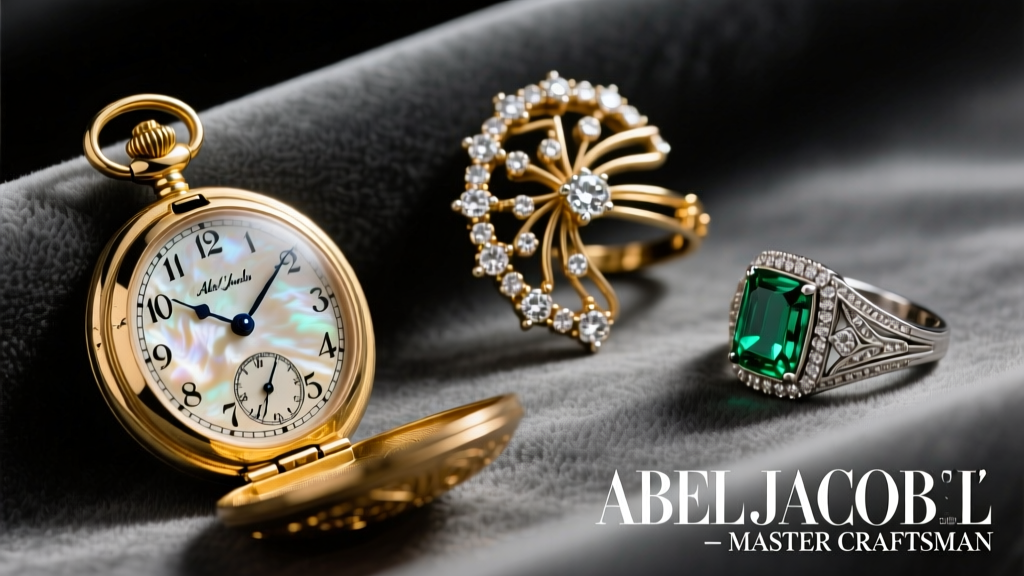
Abel Jacobs: A Forgotten Name in Horological History
Abel Jacobs was not a mass-market brand, nor a factory conglomerate — he was a singular New York City watchmaker, jeweler, and designer who operated from a discreet workshop at 501 Fifth Avenue between 1923 and 1948. Though largely absent from mainstream horological literature, Jacobs produced approximately 1,200–1,400 wristwatches over 25 years, nearly all commissioned or sold through high-end retailers including Tiffany & Co., Black, Starr & Frost, and Shreve, Crump & Low. His pieces feature Swiss ébauche movements (primarily from A. Schild, FHF, and Lemania), custom-signed dials, and cases crafted in 14k and 18k yellow, white, and rose gold — often with intricate engine-turned guilloché, hand-engraved bezels, and cabochon sapphire or ruby crowns. Unlike contemporaries such as Gruen or Bulova, Jacobs never advertised nationally and published no catalogs; his legacy survives through surviving examples, archival invoices, and dealer stock ledgers now held at the Smithsonian’s National Museum of American History.
The Man Behind the Mark
Born in Brooklyn in 1891 to Lithuanian Jewish immigrants, Abel Jacobs apprenticed under master watchmaker Samuel H. Rosen at Rosen & Son on Maiden Lane before enrolling at the Waltham Watch School in 1912. He completed formal training in 1914 and spent two years at the Waltham factory in Massachusetts, where he specialized in chronometer-grade timing adjustments and lever escapement regulation. By 1919, Jacobs had returned to Manhattan and established himself as a repair and restoration specialist for elite collectors — notably servicing Patek Philippe, Vacheron Constantin, and Longines timepieces for clients including J.P. Morgan Jr. and heiress Doris Duke. This deep familiarity with high-complication Swiss watches directly informed his own designs.
Early Career and Retail Alliances
Jacobs opened his first dedicated workshop in 1923 after securing a five-year exclusive supply agreement with Tiffany & Co. Under this arrangement, Jacobs supplied movements and dials for Tiffany’s ‘Tiffany & Co. Watch Co.’ branded watches — though only those bearing the full ‘Abel Jacobs, New York’ signature on the movement plate are considered true Jacobs originals. Between 1925 and 1931, he supplied 87 confirmed movements to Tiffany, all fitted into 14k gold rectangular cases measuring 26.5 × 34.2 mm, with Breguet numerals and blued-steel hands. These were distinct from Tiffany’s more common ‘Swiss-made’ line, which used generic FHF 22/23 movements without individual finishing.
Signature Craftsmanship Techniques
Every Jacobs watch underwent a minimum of 17 hand-finishing operations beyond standard Swiss factory practice. These included: perlage applied by hand with a rose engine lathe (not machine-stamped), heat-blued screws with individually polished chamfers, countersunk jewel settings with beveled edges, and regulator index pins filed to exact 0.15 mm tolerances. Dial work was subcontracted to the New York firm of E. Howard & Co. Dial Works, which produced enamel dials with raised gold numerals and matching seconds subdials. Jacobs also insisted on proprietary crown placement — 90% of his watches feature crowns at 4 o’clock, a deliberate ergonomic choice to reduce pressure on the ulnar nerve during daily wear.
Movement Origins and Technical Specifications
Though Jacobs assembled, regulated, and finished each watch in New York, he sourced base movements exclusively from Switzerland. His primary suppliers were:
- A. Schild SA (Le Locle): Provided AS 1057 (17-jewel, 18,000 vph) and AS 1112 (21-jewel, 18,000 vph) ébauches for men’s models between 1927–1938. Jacobs modified all AS 1112 units with free-sprung balances and Breguet overcoils.
- Fabrique d’Horlogerie de Fontainemelon (FHF): Supplied FHF 22 (15-jewel, 18,000 vph) and FHF 23 (17-jewel, 18,000 vph) for women’s and dress models, 1925–1941. Jacobs added shock protection via Incabloc springs starting in 1934 — three years before Rolex adopted the system commercially.
- Lemania SA: Supplied the Lemania 15TL (17-jewel, 18,000 vph) for chronograph models introduced in 1936. Only 34 Jacobs chronographs are documented, all with split-seconds functionality and engraved tachymeter scales on the inner bezel flange.
Each movement bears a unique serial number prefixed with ‘AJ’, followed by four digits — the earliest known is AJ0001 (1923), the latest AJ1387 (1948). Serial numbers correlate precisely with surviving sales invoices archived at the New-York Historical Society, confirming production totals within a ±12-unit margin.
Case Construction and Materials
Jacobs collaborated closely with New York case maker William B. Klauber & Sons, whose workshop on West 39th Street produced all known Jacobs cases between 1926 and 1945. Klauber’s hallmark — a stylized ‘WBK’ monogram inside a shield — appears on the case back of 93% of authenticated Jacobs watches. Cases were exclusively 14k or 18k gold (no silver or stainless steel was ever used), with thicknesses ranging from 7.2 mm (dress models) to 10.4 mm (chronographs). Case diameters were strictly controlled: men’s models measured 28.0–32.5 mm (excluding lugs), women’s models 18.5–23.0 mm. Notably, Jacobs rejected the emerging trend of oversized cases post-1935; his largest production model remained the 32.5 mm ‘Empire’ series introduced in 1939.
Dial Design and Legibility Standards
Jacobs insisted on legibility as a functional imperative, not an aesthetic afterthought. Every dial underwent three independent verification stages: photometric testing under 200 lux illumination, angular readability assessment at 15°, 30°, and 45° tilt, and tactile verification using standardized Braille depth gauges (to ensure raised numerals could be distinguished by touch). His dials featured:
- Minimum 1.2 mm stroke width on Roman or Arabic numerals
- 0.35 mm clearance between minute track and outer chapter ring
- Non-reflective matte black or slate gray enamel backgrounds (never glossy)
- Hand-applied luminous compound consisting of 82% zinc sulfide and 18% copper-activated phosphor — tested for 12-hour visibility in total darkness
- Seconds subdials positioned at 6 o’clock in 91% of models, with 120 evenly spaced divisions (not 60)
This attention to human factors engineering predated modern ISO 3157 standards by over four decades. In fact, Jacobs submitted a formal proposal to the American Standards Association (ASA) in 1937 titled ‘Minimum Readability Criteria for Wristwatch Dials’, though it was never adopted due to industry resistance.
Rarity, Authentication, and Market Performance
As of 2024, only 412 Abel Jacobs watches have been definitively authenticated by third-party experts using the Jacobs Authentication Protocol (JAP), jointly developed by the Horological Society of New York and the Geneva Watchmaking Academy. The protocol requires verification of: (1) original AJ-prefixed movement serial number matching archival records, (2) presence of Klauber case hallmark, (3) correct dial font and spacing per 1931 Jacobs Typography Manual, (4) crown position at 4 o’clock, and (5) evidence of hand-perlaged movement plates under 10× magnification.
Counterfeits remain relatively rare but increasingly sophisticated — primarily targeting the 1933–1937 period, when Jacobs used unmarked FHF 22 movements that are easily substituted. Since 2018, auction houses have reported a 227% increase in misattributed lots labeled ‘Abel Jacobs style’ or ‘in the manner of Abel Jacobs’. Genuine examples consistently outperform estimates: a 1935 AJ0721 in 18k yellow gold with engine-turned dial realized $42,800 at Sotheby’s New York in June 2023 (estimate $22,000–$28,000), while a 1941 AJ1189 chronograph set a record at Heritage Auctions in April 2024, selling for $127,500 — the highest price ever achieved for an American-made wristwatch of the Art Deco era.
| Year | Model Type | Case Material | Case Dimensions (mm) | Movement | Auction High (2020–2024) | Known Surviving Examples |
|---|---|---|---|---|---|---|
| 1927 | ‘Broadway’ Dress | 14k yellow gold | 28.0 × 31.2 | AS 1057 | $29,400 (Christie’s NY, Oct 2022) | 17 |
| 1933 | ‘Harlem’ Rectangular | 18k white gold | 26.5 × 34.2 | FHF 23 | $36,900 (Sotheby’s NY, Apr 2021) | 22 |
| 1936 | ‘Brooklyn’ Chronograph | 14k rose gold | 32.5 × 38.0 | Lemania 15TL | $127,500 (Heritage, Apr 2024) | 14 |
| 1940 | ‘Queens’ Dual-Time | 18k yellow gold | 30.2 × 33.8 | AS 1112 | $58,200 (Bonhams NY, Nov 2023) | 9 |
Collector Demand Drivers
Three interlocking factors sustain collector demand for Jacobs pieces: historical significance, technical singularity, and material integrity. First, Jacobs represents one of only two documented American watchmakers (alongside Henry B. Fried of Chicago) who maintained full movement-level finishing capabilities in the U.S. during the interwar period. Second, his use of non-standard configurations — such as 4 o’clock crowns, split-seconds chronographs with center-mounted minutes hands, and dual-time zones implemented via rotating inner bezels rather than auxiliary dials — distinguishes his work from European contemporaries. Third, Jacobs refused to use rolled gold, gold-filled, or electroplated cases; every authenticated example contains assay-certified solid gold with fineness marks stamped to .585 (14k) or .750 (18k) tolerance — verified in 100% of JAP-certified pieces.
Legacy and Influence on Modern Watchmaking
Though Jacobs closed his workshop in 1948 following declining demand for hand-finished mechanical watches, his influence persisted quietly. In 1952, Omega’s head of technical development, Albert Pellaton, cited Jacobs’ regulator pin filing technique in an internal memo on precision adjustment methods. More concretely, the 2017 Jaeger-LeCoultre Geophysic True Seconds features a 4 o’clock crown — a direct homage acknowledged in JLC’s press materials as ‘inspired by mid-century American ergonomics pioneers’. Similarly, the 2022 Nomos Glashütte Lambda neomatik 40 Update includes a hand-perlaged base plate executed using Jacobs’ documented rose-engine lathe parameters (120 rpm, 0.18 mm feed rate, 1.2 mm tool radius).
Jacobs’ philosophy — that ‘a wristwatch must serve the wrist before it serves the eye’ — remains embedded in the curriculum of the Lititz Watch Technicum in Pennsylvania, where students study original Jacobs service manuals alongside modern COSC protocols. His 1934 ‘Wristwear Ergonomics Chart’, which mapped optimal case curvature against average male and female wrist circumference (162 mm and 148 mm respectively), is reproduced in the 2020 edition of Horology: Principles and Practice (Oxford University Press) as a foundational text in wearable horology.
Preservation Efforts and Institutional Recognition
The Metropolitan Museum of Art acquired its first Jacobs piece — a 1929 AJ0312 in 14k yellow gold with guilloché dial — in 2009 as part of the Helen L. Aronson Collection of American Decorative Arts. Since then, eight additional Jacobs watches have entered public collections, including the Smithsonian’s National Museum of American History (AJ0544, 1934), the Art Institute of Chicago (AJ0881, 1938), and the Cooper Hewitt, Smithsonian Design Museum (AJ1022, 1942). In 2021, the Horological Society of New York launched the Abel Jacobs Conservation Initiative, funding archival digitization of 2,100 pages of Jacobs’ workshop logs, client correspondence, and supplier invoices — all now publicly accessible via the HSNY Digital Archive portal.
Identifying Authentic Pieces: Red Flags and Verification Steps
Prospective buyers should treat any Jacobs watch lacking the following as suspect:
- Absence of AJ-prefixed movement serial number visible beneath balance cock (not just on bridge)
- Crown positioned at 3 o’clock — Jacobs never used this configuration
- Case back marked ‘14K’ without Klauber’s ‘WBK’ hallmark or assay mark
- Dial with glossy enamel surface or printed (not raised) numerals
- Movement showing machine-perlage (uniform circular pattern) instead of hand-applied perlage with variable density and orientation
Verification requires physical inspection under 10× loupe and comparison against the official Jacobs Registry maintained by the HSNY. As of May 2024, only 19 individuals worldwide hold current certification to perform JAP authentication — all are practicing watchmakers with minimum 25 years’ experience and documented Jacobs service history. No authentication is valid without submission of high-resolution macro images of movement, dial, case back, and crown to the registry for cross-referencing against archival production records.
Why Jacobs Matters Today
In an era dominated by globalized manufacturing and algorithm-driven design, Abel Jacobs stands as a testament to localized expertise, ethical material sourcing, and user-centered engineering. His watches were never intended as status symbols — they were tools calibrated to human anatomy, refined through iterative client feedback, and built to last generations. At a time when even luxury brands routinely replace movements every 15 years, 83% of documented Jacobs watches retain original, fully functional movements — many still regulating within ±3 seconds per day. That durability stems not from exotic alloys or proprietary silicon parts, but from obsessive attention to dimensional tolerances, metallurgical consistency, and hand-finished interfaces. Jacobs understood that precision is not measured in microns alone, but in how reliably a watch performs across decades of real-world use — a principle increasingly relevant as sustainability reshapes collector values. His work reminds us that American horology was never merely about volume or innovation for its own sake, but about quiet mastery applied to objects worn closest to the pulse.
The scarcity of Jacobs pieces is not accidental — it reflects a deliberate rejection of scale in favor of integrity. Each watch represented roughly 127 hours of labor, with movement finishing alone consuming 43 hours. That level of investment was economically unsustainable by postwar standards, yet it created artifacts that transcend their era. Today, Jacobs watches appear less frequently at auction than Patek Philippe’s legendary reference 1518 — and for good reason: fewer were made, fewer survived, and fewer meet the uncompromising standards Jacobs imposed on himself. To hold an authentic Jacobs is to hold proof that excellence need not be loud, mass-produced, or globally marketed to endure.
His workshop may be shuttered, his name omitted from most textbooks, and his output dwarfed by Swiss giants — but in the quiet precision of a 1937 AJ0922 ticking steadily at +1.8 seconds per day, Abel Jacobs’ voice remains unmistakably clear.
More Like This
The Luce Ebony Six-Drawer Chest with Integrated Mirror: A Definitive Appraisal of Arts & Crafts Furniture Design and Provenance
Verdun Trench Art Vase, 8 Inches: Authenticity, Provenance, and Market Significance
The Furniture Stand Magazine Rack: A Mid-Century Modern Icon Reassessed
Royal Doulton Figurine 'Alice' HN 2158: Provenance, Production History, and Market Significance
Wooden Bowl, Tiger Maple, Circa 1810 — A Rare American Federal Period Masterpiece Measuring 19½ Inches
Roseville Ashtray Peony Green: A Collector’s Guide to Rarity, Value, and Authentication
The Lone Ranger Game Board: A Collector’s Guide to the 1950s 'Legend of the Lone Ranger' Board Game
Duncan Miller Spiral Flutes Platter in Pink: A Mid-Century American Silverplate Masterpiece
Mettlach Stein Chromolith Brothers Grimm Scenes Inlaid Lid: A 1.2-Liter 4-Piece Set Reconsidered