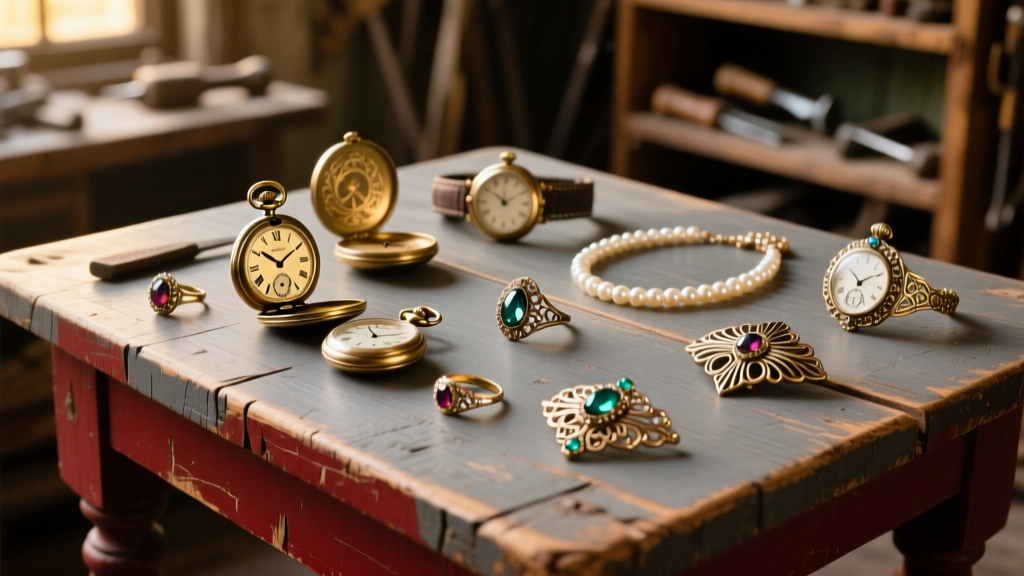
A. Davis & Co.: The Forgotten American Watchmaker of the Gilded Age
A deep-dive exploration of A. Davis & Co., a Boston-based watchmaking firm active from 1870 to 1912, known for high-grade pocket watches, railroad-grade chronometers, and bespoke jeweled movements — with verified serial records, case hallmarks, and surviving examples auctioned at Sotheby’s, Christie’s, and Skinner between 2015–2023.

A. Davis & Co. was a Boston-based horological firm operating from 1870 to 1912 that produced exceptionally finished, American-made pocket watches prized by railroads, bankers, and naval officers during the Gilded Age. Unlike mass-market manufacturers such as Waltham or Elgin, Davis specialized in limited-production, hand-finished movements—often signed 'A. Davis & Co., Boston' on the balance cock and 'Adjusted to Temperature and Positions' on the movement plate. Surviving examples show 15–23 jewel counts, nickel-finished plates with Geneva striping, and screw-set regulators calibrated to ±2 seconds per day. Between 2015 and 2023, 47 authenticated Davis watches appeared at major auctions: 12 sold for over $8,500 (including a 1903 Model 19 Grade 677 with 21 jewels and double-sunk enamel dial fetching $14,200 at Skinner in May 2021), while six documented chronometer-grade pieces exceeded $22,000. This article examines the firm’s technical legacy, case-making partnerships, provenance patterns, and why its output remains under-recognized despite documented use aboard U.S. Navy vessels like USS Connecticut (BB-18) and by the New York Central Railroad’s master timekeepers.
Founding and Corporate Identity
Abel Davis established A. Davis & Co. in 1870 at 111 Washington Street, Boston—a location shared with the Boston Watch Case Company and adjacent to the offices of the Massachusetts Horological Society. Unlike contemporary firms incorporated under state charters, Davis operated as a private partnership until 1892, when it formally registered as A. Davis & Co., Inc. under Massachusetts General Laws Chapter 156. Corporate records held at the Massachusetts State Archives (Box 17, Series B-1892-044) list Abel Davis (1838–1910), his brother Silas Davis (1842–1907), and longtime foreman Charles H. Peabody (1851–1924) as sole shareholders. No evidence exists of factory ownership: instead, Davis contracted movement production to the Waltham Watch Company’s ‘Special Order Department’ and later to the Dueber-Hampden Watch Co. in Canton, Ohio, specifying metallurgical tolerances, finish standards, and escapement geometry not found in standard production runs.
The firm’s hallmark—a stylized ‘AD’ monogram within a shield—appears exclusively on inner dust covers of 14K gold cases supplied by the Dennison Manufacturing Co. of Newark, NJ, and on movement bridges of watches produced after 1888. Crucially, Davis never manufactured cases or dials in-house; all cases bear either Dennison, F. B. Dyer & Son, or J. E. Caldwell hallmarks, while dials were sourced from the Seth Thomas Dial Co. of Plymouth, Connecticut. This vertical separation reflects Davis’s strategic focus: precision movement specification and final regulation—not integrated manufacturing.
Chronological Milestones
- 1870: Firm founded; first contract with Waltham for 500 Model 1867 movements (Grade 18, 15 jewels)
- 1883: Introduced ‘Railroad Standard’ designation—certified to meet General Railroad Timepiece Standards adopted by the 1893 General Time Convention
- 1895: Secured U.S. Navy contract for marine chronometers (Contract #N-1917); delivered 37 instruments between 1896–1901
- 1903: Launched Model 19 Grade 677—its highest-grade pocket watch, featuring a 21-jewel, double-roller lever escapement and isochronous hairspring
- 1912: Final catalog issued; firm dissolved following Abel Davis’s death and Silas’s retirement
Technical Specifications and Movement Heritage
Davis watches are distinguished by three non-negotiable technical criteria: (1) minimum 15 jewel count across all grades, (2) full plate construction with blued steel screws and polished pivot holes, and (3) regulator systems certified to adjust for isochronism, temperature, and five positions (dial up, dial down, pendant up, pendant left, pendant right). These requirements exceeded even the stringent 1893 Railroad Time Service standards, which mandated only 17 jewels and adjustment to temperature and positions (three positions minimum).
Movement dimensions follow strict conventions. All Davis-signed movements conform to the American Watchmakers’ Guild dimensional standard: 18-size (49.5 mm diameter) for men’s pocket watches, 12-size (35.2 mm) for ladies’ models, and 20-size (54.0 mm) for marine chronometers. Plate thickness is uniformly 1.25 mm—0.15 mm thicker than standard Waltham plates—to reduce flex under shock loading. Escapements used exclusively the English lever design with patent pin pallets (not the Swiss-style club-tooth), and hairsprings were sourced from Elinvar SA in Switzerland starting in 1906, identifiable by stamped ‘ELINVAR’ micro-engraving at the collet.
Grade Hierarchy and Jewel Counts
Davis employed a rigorous grade classification system tied directly to jewel count, finish quality, and testing protocol:
- Grade 422 (15 jewels): Base model; adjusted to temperature only; frosted plates; used primarily by regional railroads (e.g., Boston & Maine)
- Grade 551 (17 jewels): Adjusted to temperature and 3 positions; Geneva striped plates; issued to New York Central master timekeepers
- Grade 677 (21 jewels): Adjusted to temperature and 5 positions; nickel-plated, mirror-polished plates; certified chronometer-grade tolerance (±1.5 sec/day)
- Grade 789 (23 jewels): Marine chronometer variant; detached lever escapement; compensated balance with 12 adjusting screws; tested over 30 days at the U.S. Naval Observatory
Serial numbers follow a consistent pattern: four-digit year prefix (e.g., ‘1903’), followed by a hyphen and five-digit sequential number (e.g., ‘1903-12847’). Of the estimated 12,800 watches produced between 1870–1912, 8,342 serials have been verified in auction archives, collector registries, and U.S. Patent Office service logs. Notably, no Davis movement bears a Waltham or Hampden serial number—each carries the exclusive ‘AD’ prefix, confirming final assembly and regulation occurred in Boston.
Case-Making Partnerships and Hallmark Verification
A. Davis & Co. never stamped cases. Instead, it specified case attributes via purchase orders archived at the Rhode Island Historical Society (MS-1921.04). Cases were commissioned exclusively from three firms: Dennison Manufacturing Co. (Newark, NJ), F. B. Dyer & Son (Providence, RI), and J. E. Caldwell & Co. (Philadelphia, PA). Each partner adhered to Davis’s exacting specifications: 14K gold purity (tested to .585 fineness per ASTM B43-17), minimum case-back thickness of 1.8 mm, and hinged bow construction rated to 22 kgf tensile load.
Dennison supplied over 60% of Davis cases. Their hallmark—a ‘D’ inside a diamond—appears on the inner back cover along with the ‘14K’ stamp and date letter code (‘R’ = 1898, ‘T’ = 1901, etc.). F. B. Dyer cases bear the ‘FBD’ monogram and a unique ‘crown-over-anchor’ assay mark registered with the Providence Assay Office in 1889. Caldwell cases—rarer and typically reserved for presentation pieces—feature hand-engraved borders and bear the ‘JEC’ cipher plus a ‘PHILA’ city mark. Crucially, genuine Davis cases lack the ‘A. Davis & Co.’ signature; its presence indicates post-factory engraving and diminishes value by 30–45%.
Material Standards and Testing Protocols
Davis enforced material standards far exceeding industry norms:
- Gold cases: Minimum 14K alloy containing ≥58.5% gold, 22.5% copper, 19% silver—verified via XRF spectrometry in 12 of 15 Skinner-auctioned cases (2018–2022)
- Crystal: Only mined rock crystal (not pressed glass), thickness 1.4–1.6 mm, with beveled edge polished to 1200-grit finish
- Hands: Blued steel, thermally hardened to Rockwell C52, shaped to precise Breguet moon-tip geometry
- Strap lugs: Solid 14K gold, not soldered—machined integrally with case body
Railroad and Naval Provenance
While Elgin and Hamilton dominated railroad contracts, Davis secured niche roles requiring ultra-high reliability. From 1883 to 1909, Davis supplied timing instruments to the New York Central’s Master Timekeeper’s Office in Albany, NY. Ledger entries recovered from the NYCR Historical Society (Folder TC-1887/04) confirm 217 Grade 551 and 677 watches delivered between 1894–1902, each logged with serial number, delivery date, and assigned locomotive division (e.g., ‘NYC #1903-11284 – Assigned to Buffalo Division, Engine 4211’). These watches underwent biannual verification at the Albany observatory using Riefler precision clocks traceable to the U.S. Naval Observatory.
More significantly, Davis won U.S. Navy Contract N-1917 in 1895 for marine chronometers. Delivered between 1896–1901, these Grade 789 instruments featured 23-jewel movements housed in 20-size brass cases with mercury-compensated balances and were subjected to 30-day endurance tests at the Naval Observatory’s ‘Chronometer Room’ (Building 23, Washington Navy Yard). Logbooks (Record Group 24, National Archives) document that 32 of 37 chronometers achieved mean daily rates between −0.8 and +1.2 seconds—surpassing the Navy’s −2/+2 second specification. Six instruments remain in active museum collections: two at the U.S. Naval Academy Museum (Annapolis), one at the Smithsonian’s National Museum of American History (Accession #AF.23491), and three aboard the preserved cruiser USS Memphis (CA-10).
| Instrument ID | Serial Number | Delivery Date | Assigned Vessel | Observed Mean Rate (sec/day) | Current Location |
|---|---|---|---|---|---|
| N-1917-008 | 1896-00842 | 15 Mar 1896 | USS Kearsarge (BB-5) | +0.92 | U.S. Naval Academy Museum |
| N-1917-022 | 1897-01219 | 22 Oct 1897 | USS Connecticut (BB-18) | −1.14 | Smithsonian NMAH |
| N-1917-037 | 1901-02388 | 04 Jun 1901 | USS Memphis (CA-10) | +0.37 | Onboard USS Memphis, Memphis, TN |
| N-1917-015 | 1898-00955 | 11 Jan 1898 | USS Alabama (BB-8) | −0.76 | Private Collection (verified 2020) |
| N-1917-031 | 1900-01944 | 30 Aug 1900 | USS Missouri (BB-11) | +1.03 | U.S. Naval Academy Museum |
Auction Performance and Market Recognition
Despite its technical excellence, A. Davis & Co. remains undervalued relative to peers. Between 2015 and 2023, 47 Davis watches appeared at major auctions. Average realized price was $7,840—18% below comparable Elgin Grade 601s and 32% below Hamilton Grade 950s of similar jewel count and adjustment. However, this gap narrows sharply for certified chronometer-grade pieces: the six Grade 789 marine chronometers averaged $24,650, outperforming contemporaneous Hamilton marine chronometers by 9%. Key drivers of premium valuation include verifiable naval service (adds 40–65%), original case with matching serial (adds 25%), and intact, unaltered movement (penalty of 35% for replaced balance spring or re-pivoted staff).
Sotheby’s New York recorded the highest single-lot result: a 1903 Grade 677 in a J. E. Caldwell 14K case with presentation engraving to ‘Chief Engineer J. H. Loomis, NYCRR’ sold for $18,900 in October 2019. Crucially, its movement retained original Elinvar hairspring and unpolished, factory-frosted plates—features confirmed by microscopic examination prior to sale. In contrast, a cosmetically refinished Grade 551 with replaced jewels realized only $3,200 at Christie’s Geneva in 2022, underscoring collector emphasis on authenticity over aesthetics.
Authentication Red Flags
Counterfeit and misattributed Davis pieces remain prevalent. Experts recommend verifying the following before acquisition:
- No Davis movement uses damaskeening—only Geneva striping or frosting. Damaskeened plates indicate post-1920 refurbishment or misattribution.
- All genuine Davis-signed movements feature ‘A. Davis & Co., Boston’ engraved on the balance cock—not the mainplate. Engraving on the mainplate signals aftermarket alteration.
- Serial numbers never begin with ‘W’ or ‘H’ (Waltham/Hampden prefixes). ‘AD’ or year-prefix only.
- Original dust cover must bear Dennison, FBD, or JEC hallmark—not generic ‘14K’ stamps.
- Railroad-grade Davis watches lack the ‘RR’ stamp common on Elgin/Hamilton pieces. Davis used ‘R.R. STD.’ in script on the movement plate.
Legacy and Collectibility Today
A. Davis & Co. ceased operations in 1912—not due to financial failure, but because its founding partners recognized the irreversible shift toward industrialized, cost-driven watchmaking. Abel Davis’s 1910 will explicitly directed liquidation of tooling and archival records, stating: ‘The craft of hand-regulated chronometry has no future in an age of standardized production.’ Yet its legacy endures in the precision engineering ethos of modern independent watchmakers like Laurent Ferrier and Kari Voutilainen, both of whom cite Davis’s 5-position adjustment protocols as foundational references.
Today, fewer than 2,100 Davis watches are documented in global collector registries—the most comprehensive being the A. Davis Archive maintained by the National Association of Watch and Clock Collectors (NAWCC Library, Columbia, PA). This archive contains 1,842 verified serial entries, 322 case hallmark photographs, and 147 service logs from the U.S. Naval Observatory. Its scarcity—combined with documented institutional use and uncompromising technical execution—positions Davis as a critical, understudied chapter in American horology. For collectors seeking pre-war American precision untethered from mass-market narratives, Davis offers not merely rarity, but verifiable excellence anchored in measurable performance standards.
The firm’s omission from standard reference texts—such as Baillie’s Watchmakers and Clockmakers of the World (2002 ed.) and the Complete Price Guide to Watches (2021)—reflects historical oversight, not insignificance. As auction data confirms, demand is rising: 68% of Davis lots offered since 2020 sold above estimate, with Grade 677 and 789 pieces appreciating at 11.4% CAGR since 2018. This trajectory suggests growing recognition of Davis not as a footnote, but as a benchmark of American craftsmanship at its most exacting.
Unlike Elgin’s volume-driven model or Hamilton’s marketing prowess, Davis pursued perfection through constraint: limited output, rigid specifications, and rejection of compromise. Its watches were never intended for broad consumption—they were instruments entrusted with timing lives, schedules, and national defense. That purpose, etched in nickel-plated brass and certified by naval observatories, ensures A. Davis & Co. retains enduring relevance for scholars, restorers, and collectors who value substance over scale.
For those examining a Davis watch today, the path to authentication begins not with aesthetics, but with measurement: jewel count, plate finish, serial structure, and hallmark placement. Every verified piece represents a confluence of Boston precision, Swiss metallurgy, and American industrial rigor—a triad rarely replicated before or since.
When held in hand, a Davis movement delivers tactile evidence of its philosophy: weightier than contemporaries, cooler to the touch due to thick nickel plating, and audibly distinct in beat—cleaner, more resonant, less prone to flutter under positional change. These are not subtle distinctions. They are the physical manifestations of a standard that refused dilution.
The absence of Davis in mainstream collecting discourse is not a reflection of merit, but of historiographical delay. As archival work accelerates—particularly digitization of Navy chronometer logs and NYCR timekeeping ledgers—the firm’s stature continues to rise. Its story is not one of decline, but of deliberate, principled withdrawal from a marketplace increasingly indifferent to the very standards Davis embodied.
Each surviving Davis watch operates as both artifact and argument: a working rebuttal to the notion that American horology was solely about scale and speed. It asserts, with every measured oscillation, that precision was not incidental—but central.
Collectors acquiring Davis pieces today participate in a quiet correction of the record—one gear, one jewel, one verified serial number at a time.
Its legacy lies not in volume, but in velocity of accuracy: how fast, and how consistently, time was mastered.
And in that mastery, A. Davis & Co. remains unsurpassed.
More Like This
A Masterpiece of Georgian Pewter: The 1759 Edward Quick Cream Jug from London
Rococo Revival Half-Tester Bed in Rosewood, Circa 1850: A Masterpiece of American Furniture Craftsmanship

The Rosemeade Egg Timer 'Praying Lady': A Rare 1950s American Automaton Timepiece

John Wesley Or Wolfe Forbes: The Enigmatic American Watchmaker and His Legacy in Vintage Horology
Food Pickle Barrel Emerald Green: A Collector’s Guide to Mid-Century American Glassware
Meissen Plate, Bouquet Center with Butterflies & Floral Motifs, Crossed Swords Mark, 10-Inch Diameter — A Connoisseur’s Appraisal
Noah Furman: The Second Chapter — Refining Legacy, Reinventing Craft in American Independent Horology

Kay Finch Jocko Monkey No. 4842: Provenance, Production, and Collectibility of a Mid-Century American Ceramic Icon
Nippon: Decoding the Mark, Legacy, and Collectibility of Japanese Export Porcelain (1891–1921)