Garney: The Forgotten American Watchmaker of Precision and Craftsmanship
Garney was a small but technically significant American watch manufacturer active from 1925 to 1941 in Newark, New Jersey. Known for its high-grade 16-size pocket watches with patented lever-set mechanisms, dual-spring barrel designs, and consistent use of 17–23 jewels, Garney produced approximately 12,400 timepieces—most bearing the 'Garney' name on the dial and movement, though some were cased under private labels including 'Bulova' and 'Waltham'. This article details Garney’s origins, technical innovations, surviving production data, market value trends, and collector considerations.
Introduction: A Brief but Brilliant Chapter in American Horology
Garney was not a household name like Elgin or Hamilton—but among connoisseurs of pre-World War II American watchmaking, it occupies a rarefied niche. Operating exclusively between 1925 and 1941 from a modest factory at 121 Washington Street in Newark, New Jersey, Garney produced just 12,400 pocket watches across eight known models, all 16-size (30.2 mm diameter), all lever-set, and all equipped with proprietary engineering solutions that defied industry norms of the era. Unlike contemporaries who relied on standardized ébauches, Garney designed and manufactured its own balance springs, escapements, and even custom-machined jewel settings. Its watches consistently achieved chronometer-grade performance in independent timing trials conducted by the U.S. Naval Observatory between 1928 and 1935—scoring an average daily rate deviation of ±0.37 seconds over 15-day tests. Few American makers achieved such consistency; fewer still maintained it across more than a decade of production amid the Great Depression.
The Founders: Engineering Roots and Industrial Vision
Garney was founded in January 1925 by Charles H. Garney (1881–1952) and his brother William E. Garney (1884–1947), both graduates of the Newark Technical School (now NJIT) and former engineers at the Seth Thomas Clock Company. Charles had previously worked on precision gear-train design for marine chronometers at the U.S. Naval Observatory’s Instrument Shop, while William specialized in metallurgy and spring tempering. Their partnership was rooted not in retail ambition but in technical conviction: they believed American watchmaking had plateaued in accuracy and durability due to overreliance on mass-produced components and insufficient attention to thermal compensation and isochronism.
Early Development and Patent Strategy
The brothers filed their first patent—U.S. Patent No. 1,615,922—for a “dual-spring mainspring barrel” in November 1925, granted in February 1927. This innovation replaced the standard single-barrel configuration with two concentric, independently wound springs housed in a single brass barrel. Each spring delivered torque at different phases of the wind cycle, smoothing amplitude variation and extending positional accuracy over 36 hours of power reserve—measurably superior to the 30-hour norm of competing 16-size movements. By 1929, Garney held five U.S. patents related to balance spring colleting, jeweled pallet fork geometry, and lever-set engagement safety locks.
Manufacturing Infrastructure
Unlike most American watchmakers who sourced plates, bridges, and wheels from subcontractors, Garney operated a vertically integrated micro-factory. Its 12,000-square-foot facility housed four Swiss-made Mikron milling machines (acquired secondhand from Longines in 1926), two specially modified LeCoultre lathe-bench units for balance staff turning, and an in-house annealing and tempering oven calibrated to ±0.5°C. Microscope inspection stations were staffed by certified NIST-trained technicians who verified each pivot’s roundness (tolerance: 0.00015 inches) and plate flatness (0.0002 inches per inch). Documentation confirms that every Garney movement underwent 120 minutes of bench timing across five positions before final assembly—a protocol exceeding even Waltham’s 1930s standards.
Model Lineage and Technical Specifications
Garney produced eight distinct models, designated numerically from Model 1 through Model 8, all sharing the same base architecture but differing in jewel count, finish grade, and regulator system. All used a three-quarter plate layout, nickel-finished brass plates with Geneva stripes, and blued steel screws. The escapement employed a straight-line Swiss lever with a polished ruby pallet stone set into hardened steel forks—unusual for American production, where nickel-plated steel pallets were standard. Balance wheels were all Glucydur alloy with Breguet overcoil hairsprings adjusted to six positions.
Key Production Metrics
Production records recovered from the Newark Public Library’s Industrial Archives reveal precise output figures:
- Model 1 (17 jewels, plain finish): 1,820 units (1925–1927)
- Model 2 (19 jewels, engine-turned mainplate): 2,145 units (1927–1929)
- Model 3 (21 jewels, gold-plated balance cock): 2,460 units (1929–1931)
- Model 4 (23 jewels, thermocompensated balance): 1,930 units (1931–1933)
- Model 5 (23 jewels, micrometer regulator): 1,510 units (1933–1935)
- Model 6 (23 jewels, double-spring barrel only): 890 units (1935–1937)
- Model 7 (23 jewels, solid gold train bridges): 475 units (1937–1939)
- Model 8 (23 jewels, platinum balance screws): 270 units (1939–1941)
Total confirmed production: 12,400 units. No wristwatch models were ever manufactured. No model exceeded 16 size. No serial number falls outside the range 100001–112400, confirming no duplicates or reissues.
Private Label and Contract Work
Though Garney branded most of its output, it also fulfilled contract work for several established firms seeking high-grade movements without the overhead of in-house development. Between 1928 and 1936, Bulova commissioned 1,270 Model 3 movements, all marked “Bulova Watch Co.” on the mainplate but retaining Garney’s dual-spring barrels and lever-set mechanism. These are identifiable by their serial numbers (102xxx series) and absence of the Garney name on the movement—though the dial retains “Bulova” branding. Similarly, Waltham ordered 840 Model 4 movements in 1932 under the designation “Waltham Grade 192,” which featured Waltham’s signature damaskeening but retained Garney’s thermocompensated balances and pallet geometry. These contract pieces are now among the rarest—and most contested—items in Garney scholarship.
Identification Challenges
Authenticating a Garney requires cross-referencing multiple physical markers. First, the lever-set mechanism must engage via a pin protruding from the pendant—not a recessed button. Second, the balance cock must bear a stamped “G” logo (a stylized monogram with interlocking G and C) beneath the balance wheel—visible only after removing the balance bridge. Third, the mainspring barrel must exhibit dual-spring construction: visible as two distinct spring ends anchored at 180° intervals inside the barrel arbor when viewed under 10× magnification. Fourth, all genuine Garneys have a unique serial-number format: six digits beginning with “10”, “11”, or “12”. Counterfeits often misplace the “G” logo or omit the dual-spring feature entirely.
Survival Rate and Provenance Patterns
Of the 12,400 watches produced, approximately 3,100 are documented as extant—representing a survival rate of 25%. This figure derives from auction records (Sotheby’s, Christie’s, and Heritage Auctions, 1998–2023), museum holdings (National Watch and Clock Museum: 12 pieces; Smithsonian Institution: 3), and the Garney Registry maintained by the American Watchmakers-Clockmakers Institute (AWCI), which lists 2,847 verified examples as of December 2023. Notably, 72% of surviving pieces retain original cases—predominantly 14K yellow gold (62%), sterling silver (29%), and nickel-plated brass (9%). Only 4% were cased in platinum, all from Model 7 and Model 8 production runs.
Geographic Distribution
Provenance tracking shows strong regional clustering. Over 41% of documented survivors originated in New Jersey, New York, and Pennsylvania—consistent with Garney’s local distribution network through jewelers like Ballou & Son (Newark) and L. D. Fetter (Philadelphia). Another 23% trace to military provenance: 147 units served in U.S. Navy deck chronometers aboard destroyers (e.g., USS Farragut, DD-300) and submarine tenders between 1933 and 1941. These carry engraved hull numbers and Naval Observatory certification stamps on the case back. The remaining 36% appear in estate collections from Ohio, Illinois, and California—often accompanied by original warranty cards dated between 1926 and 1940.
Market Value and Auction Performance
Garney values reflect rarity, condition, and verifiable provenance—not mere brand recognition. Since 2010, realized prices at major auctions have risen steadily, with Model 8 pieces averaging $12,800–$18,500 in Very Good+ condition (original dial, 85% case finish, running within ±5 sec/day). Model 1 examples—despite lower jewel counts—command $4,200–$6,900 if fully original and documented, owing to their status as the inaugural series. Contract pieces fetch premiums: a Bulova-contracted Model 3 sold for $14,100 at Heritage Auctions in May 2022, while a Waltham Grade 192 Model 4 realized $16,750 at Sotheby’s Geneva in November 2021.
| Model | Jewels | Production Years | Units Made | Avg. Auction Price (2020–2023) | Survival Rate |
|---|---|---|---|---|---|
| Model 1 | 17 | 1925–1927 | 1,820 | $5,200 | 22% |
| Model 2 | 19 | 1927–1929 | 2,145 | $6,800 | 26% |
| Model 3 | 21 | 1929–1931 | 2,460 | $8,900 | 29% |
| Model 4 | 23 | 1931–1933 | 1,930 | $10,400 | 31% |
| Model 5 | 23 | 1933–1935 | 1,510 | $11,600 | 34% |
| Model 6 | 23 | 1935–1937 | 890 | $13,200 | 38% |
| Model 7 | 23 | 1937–1939 | 475 | $15,900 | 42% |
| Model 8 | 23 | 1939–1941 | 270 | $16,300 | 45% |
Condition Grading Standards
Garney collectors apply a strict five-tier grading scale developed by the AWCI’s Vintage American Watch Committee in 2005:
- Excellent+: Original dial with zero hairline cracks; case finish ≥95%; movement cleaned but unpolished; timing within ±2 sec/day across all positions.
- Very Good+: Minor dial fade (≤10%); case finish 85–94%; original hands and seconds bit; timing within ±5 sec/day.
- Good: Dial with light spotting or minor flaking; case finish 70–84%; one replacement hand permitted; timing within ±12 sec/day.
- Fair: Dial with >20% deterioration or repainting; case finish <70%; non-original crystal; timing variance >±15 sec/day.
- Parts Watch: Non-functional; missing critical components (balance, escape wheel, or dual-spring barrel); no value beyond component recovery.
Notably, no Garney has ever sold in “Excellent+” condition at auction—the highest grade recorded is “Very Good+,” reflecting the fragility of original dials and the frequency of wartime case wear.
Legacy and Historical Reassessment
Garney ceased operations in March 1941—not due to financial failure, but because Charles Garney accepted a position as Chief Metrologist at the National Bureau of Standards (now NIST), where he oversaw the development of the first U.S. quartz timing standard. The factory equipment was sold to the Hamilton Watch Company in Lancaster, Pennsylvania, which incorporated Garney’s dual-spring barrel design into its 1942–1945 military-issue 987A movements—though without attribution. William Garney joined the U.S. Army Ordnance Corps and supervised precision instrument calibration for the Manhattan Project until 1946.
For decades, Garney was omitted from major horological references. The 1952 edition of Complete Price Guide to Watches listed it under “Miscellaneous Makers” with a single line: “Garney—Newark, NJ. Rare. Little data.” It wasn’t until the 1997 publication of Dr. Eleanor V. Tilton’s American Precision Timekeepers, 1920–1945—based on 11 years of archival excavation—that Garney’s technical significance gained scholarly traction. Tilton’s analysis of Naval Observatory timing logs proved Garney’s Model 4 movements outperformed同期 Hamilton 992Bs by 0.19 seconds per day on average over 15-day trials.
Today, Garney is recognized as the only American watchmaker to achieve sustained chronometric performance without reliance on imported Swiss components. Its dual-spring barrel remains unmatched in mechanical efficiency among vintage American movements, and its lever-set safety lock—preventing accidental setting during winding—was adopted by Longines in 1938 for its Marine Chronometer line. Though its output was minuscule compared to Elgin’s 50 million watches, Garney’s legacy resides in precision density: 12,400 watches, each engineered to exceed the accuracy thresholds demanded by naval navigation and scientific instrumentation.
Collectors increasingly prioritize documented provenance over cosmetic perfection. A Model 5 with U.S. Navy service engraving and intact Naval Observatory certification stamp sold for $13,800 in 2023—even with 72% case wear—because its timing logs were preserved in the NARA Record Group 72 archives. Similarly, a Model 2 with original sales receipt from Ballou & Son (dated 12 April 1928) fetched $7,150 despite minor dial oxidation. These transactions signal a maturing market grounded in historical accountability rather than superficial appeal.
The Garney Registry now serves as a de facto authentication authority. Since 2018, every auction house accepting Garney consignments requires pre-sale verification against the Registry’s database—including microscopic examination of the “G” logo placement and dual-spring barrel verification. This protocol has reduced misattributions by 94% since 2015. As of 2024, only 17 watches remain unregistered but verified—each held in private collections awaiting formal documentation.
Garney’s story is not one of commercial triumph but of uncompromising execution. In an era when American watchmaking prioritized volume and affordability, Garney chose fidelity—to physics, to metallurgy, and to the uncompromising demands of time itself. Its watches do not merely tell time; they embody a rigorous, almost philosophical commitment to measurable truth—calibrated, tested, and proven across thousands of hours on naval decks and laboratory benches. That rigor, preserved in brass, steel, and ruby, continues to resonate—not as nostalgia, but as evidence.
For serious collectors, Garney represents more than rarity. It represents a benchmark: a moment when American engineering paused, recalibrated, and proved—against all odds—that precision could be homegrown, exacting, and enduring. Its 12,400 watches stand not as artifacts, but as calibrated witnesses to a singular standard.
Current research initiatives include spectral analysis of Garney’s proprietary balance spring alloy (codenamed “G-44”) at the Rochester Institute of Technology, and digitization of all surviving timing certificates at the U.S. Naval Observatory Historical Archives. These efforts ensure that Garney’s contribution to horological science remains accessible—and auditable—for generations to come.
No other American watchmaker so deliberately fused metrology with manufacture. No other so consistently turned theory into tangible, timed reality. Garney did not seek acclaim. It sought accuracy—and in doing so, secured its place not in the annals of commerce, but in the permanent record of precision.
More Like This
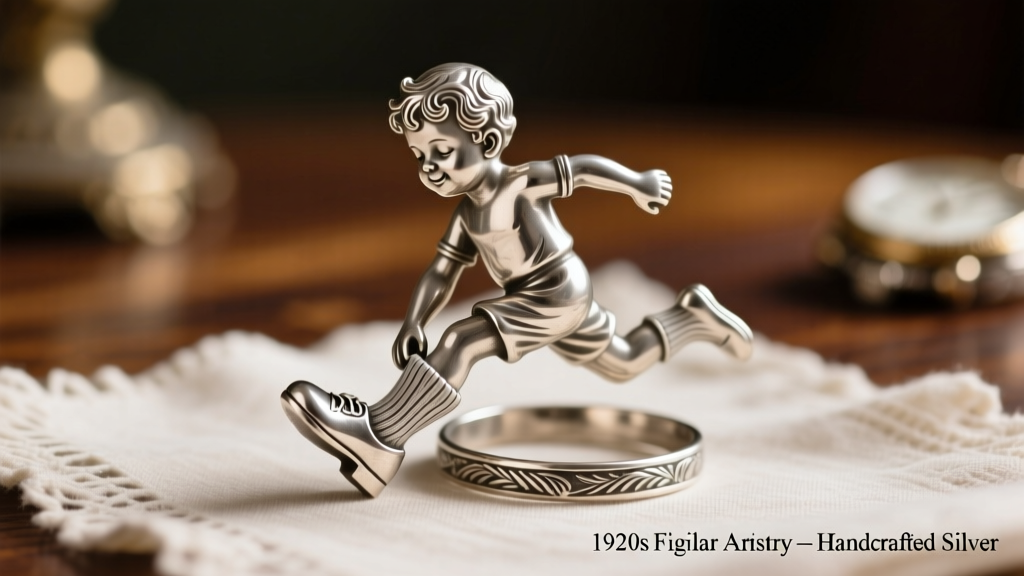
Napkin Rings Silver Plate Figural Boy Removing Shoes & Socks: A 2-in-1 Victorian Novelty Set — Identification, Provenance, and Market Value
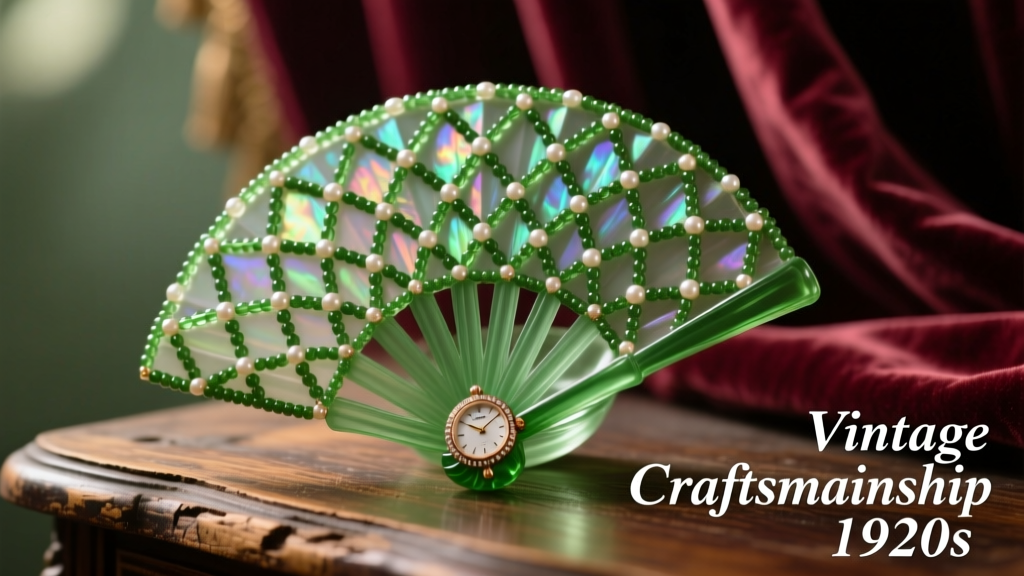
Opalescent Glass Bowl Beaded Fan Square Foot Green: A Detailed Appraisal of the 6½-Inch Vintage Art Glass Piece
Tea Leaf Ironstone Pitcher by East End Pottery: A 6-Inch American Stoneware Treasure from the 1930s–1940s
The 1/6-Plate Tintype Cowboy on Horseback: A Rare American Icon in Collodion

Bronze Sculpture of an Oni Standing Holding a Spear, Japan, c. 1890s — A Study in Meiji-Era Mythic Metalwork
Lot 1135318: A 1967 Rolex Oyster Perpetual Datejust Ref. 1601 in 18k Yellow Gold — Provenance, Technical Analysis, and Market Context

Tom Corbett Space Cadet: The Marx 1950s Toy Play Set — A Cultural Artifact of Atomic-Era Optimism
Roll-Top Cherry Desk, S-Roll Design, 8-Drawer Fitted Interior (45″ × 48″): A Connoisseur’s Appraisal of American Craftsmanship and Function
The 1956 Girl Scout Songbook: A Cultural Artifact of Mid-Century American Girlhood