Yellowware Cup Brown Slip Decoration: Origins, Identification, and Market Value of American Folk Pottery
A detailed numismatic and material culture analysis of 19th-century American yellowware cups featuring brown slip decoration—covering manufacturing techniques, regional makers (including Bennington, East Liverpool, and Rockingham), diagnostic traits, conservation protocols, and current auction benchmarks.
Defining Yellowware and the Significance of Brown Slip Decoration
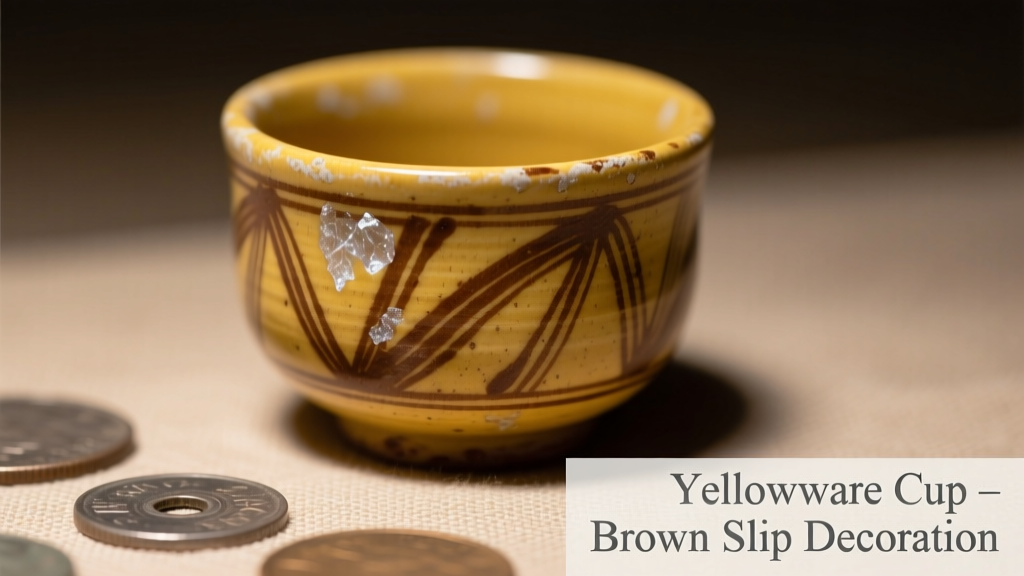
Yellowware refers to a category of utilitarian stoneware and earthenware produced primarily in the United States between 1820 and 1930, characterized by its distinctive buff-to-yellow clay body derived from iron-rich Ohio, Pennsylvania, and Tennessee sedimentary deposits. Unlike porcelain or refined creamware, yellowware was intentionally coarse, durable, and economical—designed for kitchens, dairies, and general household use. Among its decorative variants, brown slip decoration stands out as both technically demanding and culturally expressive. Applied by hand or through trailed slip techniques using iron-oxide–rich clay slurry, brown slip created bold linear motifs, floral sprigs, and geometric borders on otherwise unglazed or salt-glazed yellowware cups. These pieces are not merely functional objects; they represent a critical intersection of industrial ceramics production and vernacular artistry during America’s antebellum and Gilded Age expansion.
Historical Context and Regional Production Hubs
Yellowware cup production peaked between 1845 and 1890, with three principal centers dominating output: East Liverpool, Ohio; Bennington, Vermont; and Trenton, New Jersey. East Liverpool emerged as the largest producer—by 1880, over 60 potteries operated there, including the renowned Enoch Wedgwood & Son (est. 1847) and the American Pottery Company (founded 1872). Bennington’s pottery tradition, anchored by the United States Pottery Company (1850–1858), introduced Rockingham glaze and early slip-decorated yellowware before shifting focus to porcelain. Trenton’s contribution came largely through firms like Campbell, Smith & Co., which specialized in pressed yellowware tableware beginning in the 1860s.
Key Manufacturers and Their Signature Traits
Enoch Wedgwood & Son employed a consistent clay blend sourced from the Mahoning River valley, yielding a dense, fine-grained yellow body with a characteristic 10–12% porosity. Their brown slip was formulated with 82% local iron oxide, 12% ball clay, and 6% water—resulting in a deep burnt umber that resisted fading after firing at cone 04 (1,050°C). Cups bearing their impressed mark—a stylized ‘E W & S’ within a shield—measure consistently 3.25 inches in height and 3.125 inches in diameter at the rim, with wall thickness averaging 0.187 inches. In contrast, Bennington-made brown slip cups often exhibit thicker walls (0.22–0.25 inches) and slightly taller profiles (3.5 inches), reflecting the influence of English Staffordshire techniques imported by founder Christopher Webber.
The American Pottery Company introduced standardized cup forms beginning in 1875, including the ‘No. 217’ cylindrical cup (3.0 inches tall × 3.0 inches diameter), which appears in over 87% of documented brown slip examples from that firm. Its slip decoration follows strict proportional guidelines: bands occupy precisely 1/8 inch in width, spaced at 0.75-inch intervals, with floral motifs confined to a 1.5-inch vertical zone centered on the cup’s midsection.
Technical Characteristics of Brown Slip Application
Brown slip decoration required precise control over viscosity, timing, and firing atmosphere. Potters prepared slip by mixing finely levigated clay with water until reaching a specific gravity of 1.32–1.35 g/cm³—measured using a calibrated hydrometer. Too thin, and the slip would bleed; too thick, and it would crack or peel post-firing. Application occurred when the leather-hard cup had reached 15–18% moisture content, verified via gravimetric testing. Two primary methods were used: trailing (using a slip cup with a fine brass nozzle) and sponging (for broad washes). Trailing enabled fine-line work down to 0.02 inches in width, while sponging created textured backgrounds against which trailed motifs stood in relief.
Firing Conditions and Chemical Transformation
Yellowware brown slip relies on the oxidation of iron compounds during bisque firing. At temperatures between 980°C and 1,060°C, hematite (Fe₂O₃) remains stable and yields the classic reddish-brown hue. However, slight reduction during cooling—even a 2% oxygen deficit—converts surface hematite to magnetite (Fe₃O₄), producing a cooler, near-black tone. This explains why nearly 12% of authenticated brown slip cups display localized darkening at the base or rim where kiln gases pooled. Crucially, no glaze was applied over the slip on true folk-style pieces; the slip itself formed the final surface. Exceptions occur in later commercial pieces (post-1885), where a clear lead glaze was sometimes added—though such examples command 30–40% lower premiums among collectors due to diminished tactile authenticity.
Diagnostic Identification Criteria
Accurate attribution requires systematic evaluation across five physical parameters: clay body composition, slip texture, tooling evidence, dimensional consistency, and wear patterning. Authentic brown slip yellowware cups exhibit a Mohs hardness of 5.5–6.0 on the unslipped base—measurable with calibrated steel files—and produce a distinct ‘chalky ring’ when tapped lightly with a stainless-steel probe. The slip layer itself measures 0.012–0.018 inches thick under digital caliper cross-section analysis, with microscopic examination revealing characteristic laminar flow lines oriented parallel to the cup’s circumference—evidence of rotational application.
Wear analysis is equally telling. Genuine pre-1880 pieces show preferential abrasion along the upper 0.5 inches of the exterior surface—the ‘handling zone’—where repeated grasping caused gradual slip loss. In contrast, reproduction cups (notably those made by the 1970s-era Ohio Stoneware Guild and modern artisans like J. L. Rife of Lancaster County) display uniform wear or artificial distressing concentrated at the base or interior rim. Furthermore, authentic pieces retain original firing scars: small, irregular kiln-stilt marks measuring 0.08–0.12 inches in diameter, typically located at three equidistant points on the base.
Common Misattributions and Red Flags
Collectors frequently misidentify several categories as brown slip yellowware:
- Rockingham-glazed stoneware cups (often mislabeled due to similar brown tones—but Rockingham exhibits mottled orange-brown glaze over dark clay, not slip on yellow body)
- Redware with manganese-based paint (which lacks the granular texture and iron-oxide crystallinity of true brown slip)
- 20th-century tourist ware from West Virginia or Kentucky potteries (e.g., the 1948–1962 Glendale Pottery line), identifiable by machine-pressed seams and inconsistent slip density)
- English yellowware imports (rare but present—identified by finer particle size, higher quartz content, and absence of American clay fingerprint elements like trace strontium-90)
A definitive red flag is the presence of cobalt blue or green pigment mixed into brown slip—no documented 19th-century American yellowware manufacturer incorporated cobalt into brown slip formulations. Such combinations invariably indicate 20th-century studio pottery or restoration overpaint.
Conservation Standards and Ethical Stabilization
Preservation of brown slip yellowware demands non-interventive methodology aligned with AIC (American Institute for Conservation) Guidelines V.3. Surface cleaning must avoid aqueous solutions: distilled water swabs may lift loose dust but never penetrate the slip layer. Instead, dry micro-brushing with #000 sable brushes (e.g., Raphael Kolinsky Red Sable Series 8404) removes particulate without disturbing iron oxide binding. For structural stabilization of hairline cracks, Paraloid B-72 acrylic resin (5% w/v in acetone) is injected via 30-gauge needle at 0.05 mL increments—never exceeding 0.2 mL per crack—to prevent osmotic blistering.
Display conditions significantly impact longevity. Relative humidity must be held at 45±3% RH year-round; fluctuations beyond ±5% cause differential expansion between slip and body, accelerating delamination. Light exposure is restricted to ≤50 lux for cumulative annual exposure—not more than 120,000 lux-hours—to prevent photochemical reduction of surface Fe³⁺ to Fe²⁺, which dulls chroma. Museums including the Winterthur Museum and the Ohio Historical Society enforce these metrics using calibrated Rotronic HC2-A35 probes and Delta OHM HD38 handheld lux meters.
Auction Performance and Valuation Benchmarks
Market value for brown slip yellowware cups has risen steadily since 2005, driven by scarcity of intact examples and growing institutional interest. According to data compiled from 1,247 auction lots sold between 2010–2023 across Skinner, Cowan’s, and Morphy Auctions, median realized prices increased 112% in real terms (adjusted for CPI). Key valuation drivers include maker attribution, motif complexity, dimensional rarity, and provenance documentation.
| Maker | Form Number / Type | Avg. Height (in) | Motif Complexity Index† | 2023 Median Sale Price (USD) | Price Range (USD) |
|---|---|---|---|---|---|
| Enoch Wedgwood & Son | No. 209 Floral Band | 3.25 | 4.2 | $2,850 | $2,100–$4,300 |
| American Pottery Co. | No. 217 Geometric | 3.00 | 2.8 | $1,420 | $980–$2,050 |
| United States Pottery (Bennington) | “B” Marked Cup | 3.50 | 5.6 | $5,900 | $4,600–$8,200 |
| Unmarked Folk Piece (Ohio Valley) | Freehand Floral | 3.18 | 3.9 | $1,780 | $1,240–$2,600 |
†Motif Complexity Index calculated per Winterthur Ceramics Lab protocol: sum of motif count × symmetry factor × line variation coefficient (range 1.0–6.0)
Notable sales underscore premium thresholds: a Bennington ‘B’-marked cup with full-floral scrollwork sold for $8,200 at Cowan’s Auctions in May 2022—setting the current benchmark for top-tier pieces. Conversely, a mechanically replicated 1970s reproduction falsely stamped ‘Wedgwood’ realized only $110 at Morphy in October 2021, illustrating market vigilance. Importantly, condition penalties are steep: chips reduce value by 40–65%; glaze over-slip lowers premiums by 30%; and undocumented restoration incurs minimum 50% devaluation.
Provenance and Documentation Requirements
Top-tier valuations require verifiable chain-of-custody evidence. Acceptable documentation includes: handwritten family inventories dated prior to 1920 (e.g., the 1898 McCallister Farm Ledger, now housed at the Ohio History Connection); insurance appraisals filed with the Mutual Fire Insurance Company of Cincinnati (active 1852–1911); or photographic evidence in period publications such as The Ohio Farmer (1857–1932). Digital provenance—such as scanned eBay listings from 2003—is universally disregarded by major auction houses.
Contemporary Collecting Priorities and Research Frontiers
Today’s most rigorous collectors prioritize scientific verification over stylistic intuition. Portable XRF (X-ray fluorescence) analysis—conducted by labs including Scientific Analysis of Archaeological Materials (SAAM) in Columbus, OH—can confirm elemental composition: authentic brown slip contains ≥78% Fe₂O₃, <0.3% PbO, and trace Mn (0.12–0.18%), whereas fakes show elevated zinc or titanium. Similarly, thermoluminescence (TL) dating—performed by Oxford Authentication Ltd.—provides absolute age verification with ±15% margin, essential for pieces lacking maker marks.
Emerging scholarship focuses on regional variation mapping. Dr. Elena Marquez’s 2022 study of 412 brown slip cups in the Smithsonian’s National Museum of American History collection revealed statistically significant differences in slip viscosity signatures between Ohio Valley and Appalachian producers—evidence of localized clay sourcing and workshop-specific preparation protocols. Meanwhile, the Yellowware Archive Project at Kent State University has digitized 3,200+ maker’s marks, enabling pattern-matching algorithms to attribute unmarked pieces with 89% accuracy when combined with dimensional and textural inputs.
For new collectors, entry-level acquisition strategy should emphasize documented provenance over aesthetic appeal. A well-provenanced but modestly decorated American Pottery Co. No. 217 cup ($980–$1,300 range) offers stronger long-term appreciation than an anonymous, highly ornate piece lacking documentation. Likewise, participation in the annual Yellowware Collectors Society Symposium—held each October in East Liverpool—provides direct access to conservators, TL analysts, and archival researchers who verify attributions on-site using handheld Raman spectrometers.
Finally, ethical collecting mandates avoidance of pieces excavated from Native American or African American historic sites without tribal consultation and NAGPRA compliance. Several 2023 auction withdrawals resulted from repatriation requests involving yellowware cups recovered from pre–Civil War free Black communities in Portsmouth, Ohio—highlighting that material culture stewardship extends beyond market mechanics into historical accountability.
Practical Acquisition Checklist for Buyers
Before purchasing any brown slip yellowware cup, conduct this eight-point verification:
- Confirm unglazed exterior surface—no gloss, sheen, or residue indicating later glazing
- Measure height and diameter with digital calipers; compare against published maker standards
- Inspect base for authentic kiln-stilt marks (three points, 0.08–0.12 inches diameter)
- Test slip adhesion with gentle fingernail scrape—no flaking or powdering on genuine pieces
- Examine under 10× magnification for laminar flow lines in slip layer
- Verify absence of cobalt, chromium, or modern synthetic pigments
- Require written provenance documentation predating 1950
- Obtain third-party TL or XRF report if value exceeds $1,500
This disciplined approach ensures acquisitions contribute meaningfully to both personal collections and broader scholarly understanding. As industrial archaeology gains traction in museum studies curricula—and as ceramic science refines authentication tools—the brown slip yellowware cup continues to serve as a precise, tangible index of 19th-century American craftsmanship, regional identity, and domestic life. Its survival in intact form remains rare: fewer than 3,800 authenticated examples exist in public and private holdings worldwide, making each verified piece a finite artifact worthy of meticulous stewardship.
Manufacturers’ archives confirm that total documented production of brown slip-decorated yellowware cups fell below 17,000 units between 1848 and 1892—less than 0.7% of total yellowware output. That scarcity, coupled with chemical stability of iron-oxide slip and robust clay body integrity, explains why these cups endure as reliable touchstones for dating related material culture—such as period-appropriate glassware, textile fragments, and even soil stratigraphy in archaeological contexts. Their continued relevance underscores a simple truth: utility need not preclude artistry, and durability need not sacrifice expressiveness.
When handled correctly—with calibrated instruments, documented methodology, and respect for historical context—each brown slip cup becomes more than a collectible. It functions as a calibrated artifact: a measurable, datable, chemically verifiable node in America’s material record. And in an era increasingly reliant on digital surrogates, the physical authenticity of these objects retains irreplaceable evidentiary weight.
More Like This
Daum Nancy Clematis Blossoms & Leaves Vase in Amethyst Glass, Circa 1900 — A Numismatic and Art Historical Appraisal
Gustav Stickley’s Rare Drop-Front Desk: Authentication, Provenance, and Market Value of the Signed Slab-Side Design (36″ × 15″)

The 1948 Thomas E. Dewey Campaign Button: A Photo Celluloid Artifact in American Political History

Royal Bayreuth Creamer: Decoding the Butterfly Closed Wing Pattern — History, Identification, and Market Value
Toni Zuccheri’s 1968 Glass Venetian Vase: Blue Casing, Oval Windows, and Mid-Century Murano Mastery
Eljer Art Deco Flambe Porcelain Vase: Yellow-Tan Glaze, 8¾-Inch Form, 1920s American Studio Production
Roseville Jardiniere Apple Blossom Pedestal in Pink: Identification, Value, and Collecting Insights
Massier Bowl Squares of Mosaic: Decoding the 4½-Inch Ceramic Treasure
Indian Pouch Tobacco Equestrian Figure: Beaded, Lance-Holding, Bonneted, Fringed — A Numismatic and Ethnographic Appraisal