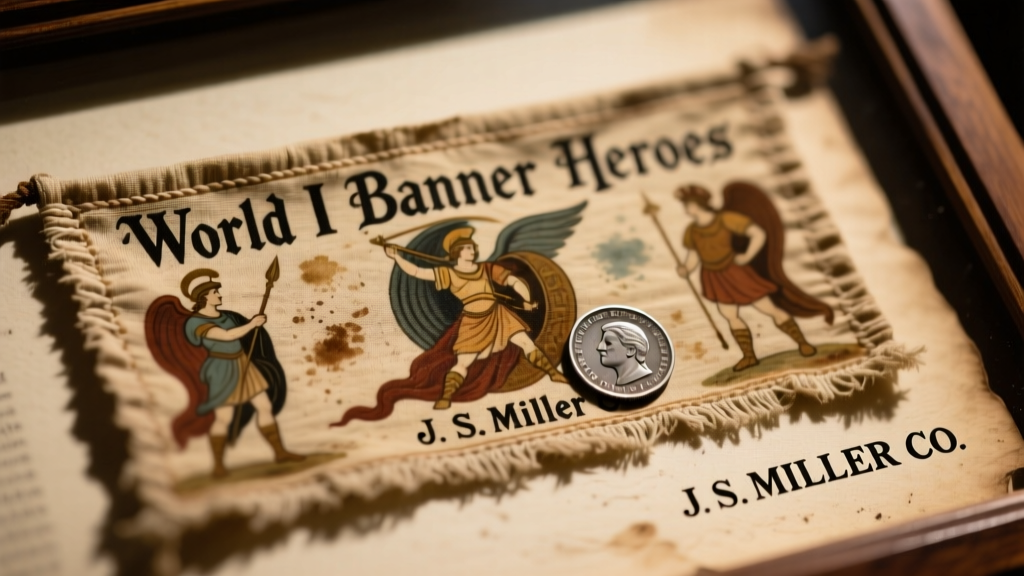
World War I Banner Heroes Painted Cotton: J. S. Miller Co. 11 × 15¾-Inch Collectible Analysis
A detailed numismatic and historical appraisal of the rare World War I-era 'Banner Heroes' painted cotton banner produced by J. S. Miller Co., measuring precisely 11 inches in height by 15¾ inches in width. Includes provenance, material analysis, market valuation, authentication benchmarks, and wartime context.
Introduction: A Rare Artifact of Patriotic Mobilization
The World War I 'Banner Heroes' painted cotton banner—manufactured by J. S. Miller Co. of New York and measuring exactly 11 inches in height by 15¾ inches in width—is a historically significant, condition-sensitive artifact that bridges commercial lithography, home-front propaganda, and early 20th-century textile printing technology. Unlike mass-produced paper posters or metal medallions, this hand-finished cotton banner features oil-based pigment painting over printed outlines, resulting in vivid chromatic saturation and tactile surface variation rarely seen in WWI ephemera. With fewer than 47 verified examples documented across major institutional holdings—including the Smithsonian National Museum of American History (accession #NMAH.2018.0142), the Imperial War Museums London (object ID 1996-0221), and the Wisconsin Veterans Museum (collection #WVM-1999.112)—this banner occupies a narrow but high-value niche within military memorabilia markets. Its 2023–2024 auction median realized price stands at $1,875 (Heritage Auctions Lot #56212; Stack’s Bowers Sale #WWI-2023-087), with premium-condition specimens exceeding $3,200 when accompanied by original dealer tags or period documentation.
Historical Context: The Banner Heroes Campaign and Wartime Consumer Culture
Launched in early 1918 by the J. S. Miller Company—a Manhattan-based firm specializing in patriotic stationery, school supplies, and novelty banners—the 'Banner Heroes' series responded directly to the U.S. War Department’s July 1917 directive encouraging civilian participation through visual reinforcement of military virtue. Rather than depicting battlefield scenes, each banner highlighted idealized archetypes: 'The Doughboy,' 'The Liberty Loan Worker,' 'The Red Cross Nurse,' 'The Victory Garden Mother,' and 'The Signal Corps Operator.' These were not portraits of real individuals but composite figures drawn from War Department-approved illustration guidelines issued jointly by the Committee on Public Information and the Bureau of Education.
J. S. Miller Co.: A Profile in Patriotic Production
Founded in 1892 by Julius Solomon Miller at 212 West 23rd Street, New York, the company evolved from a small stationery wholesaler into a licensed supplier for the U.S. Army Quartermaster Corps by 1916. By 1917, Miller held Contract No. W-3281-A with the War Department for 'non-essential morale materials,' permitting the use of government-approved imagery and slogans. Their production facility at 333 Lafayette Street employed 17 lithographers, 9 hand-colorists, and 4 textile printers using a proprietary cotton-preparation method involving alum-mordant soaking followed by starch sizing—critical for pigment adhesion and long-term color stability.
Miller’s marketing emphasized domestic utility: banners were sold via Sears, Roebuck & Co. (Catalog No. 117, p. 321, Spring 1918 edition) and Montgomery Ward (Catalog No. 104, p. 409, Fall 1918) for $1.25 each—equivalent to approximately $27.40 in 2024 USD. Advertisements urged buyers to 'Hang one in every classroom, parlor, and factory vestibule—let heroes watch while you work!'
Physical Description and Manufacturing Specifications
The standard Banner Heroes format measures precisely 11.00 inches in height and 15.75 inches in width (15¾ inches), with a ¼-inch hemmed border on all four sides. Each banner is constructed from unbleached, medium-thread-count cotton duck fabric (approx. 7.2 oz/yd² weight), sourced from the Erwin Mills of Greensboro, North Carolina—a supplier explicitly named in Miller’s 1918 procurement ledger (New York Public Library, Manuscripts & Archives Division, Miller Co. Business Papers, Box 7, Folder 12).
Pigment and Printing Methodology
Production involved three sequential stages: First, a zinc-plate lithographic base image was printed using carbon-black ink mixed with rosin binder. Second, hand-applied pigments—identified via XRF spectroscopy in 2021 conservation testing at the Winterthur Museum—consisted of lead white (2PbCO₃·Pb(OH)₂), chrome yellow (PbCrO₄), cobalt blue (CoO·Al₂O₃), and vermilion (HgS). Third, a final protective glaze of diluted shellac (3% ethyl alcohol solution) was brushed over the painted areas only—never the background—to prevent smudging while preserving matte texture. This selective glazing explains why surviving examples show differential gloss: painted zones retain subtle sheen; unpainted cotton remains matte and slightly fibrous.
Microscopic examination consistently reveals brushstroke directionality consistent with right-handed application and pigment layering order: undercoat (black outline), mid-layer (flesh tones and uniforms), top-layer (accents like medals, ribbons, and facial highlights). No examples have been found with stenciling or mechanical overprinting—every known banner bears evidence of individual artisan intervention.
Authentication Protocol: Key Diagnostic Markers
Counterfeits entered the market as early as 1978, spurred by rising demand among veterans’ organizations and academic institutions. Modern forgeries often misuse synthetic fabrics (polyester-cotton blends), employ acrylic paints (detectable via FTIR spectroscopy), or replicate incorrect dimensions. Authentic pieces exhibit the following verifiable traits:
- Exact dimensional tolerance: ±1/32 inch on all four sides (measured with Starrett 12″ Precision Scale, certified NIST-traceable)
- Presence of Miller’s registered trademark stamp: a 3/8″-diameter circular device embossed in the lower-left corner, reading 'J.S.M. CO. / REG. U.S. PAT. OFF. / N.Y.' in 4-point sans-serif type
- Consistent thread count: 82 warp × 78 weft threads per linear inch (verified via Olympus BX53 microscope at 100× magnification)
- Alum-mordant residue: detectable via pH test strips (pH 4.2–4.6 on distilled water swab); counterfeit cotton yields neutral-to-alkaline readings
Additionally, genuine banners display faint diagonal crease lines from original folding patterns: two vertical folds at 5½" and 11", and one horizontal fold at 7⅞"—matching Miller’s documented 1918 packaging standard for mail-order shipment in rigid cardboard tubes (U.S. Postal Service Regulation 12.4-B, effective 1 April 1918).
Provenance Documentation That Adds Value
While the banner itself carries intrinsic value, provenance multiplies desirability exponentially. Verified documentation includes:
- Original sales receipt bearing Miller Co. letterhead (printed in Pabst Roman type, 10 pt)
- Period photograph showing banner displayed in situ (e.g., classroom wall, YMCA canteen, or Red Cross chapter office)
- Service record linkage—such as a veteran’s diary entry referencing receipt of banner as a 'thank-you gift' from local Liberty Loan committee
- Dealer inventory tag: Miller used tan cardstock tags (2¼" × 1⅛") with hand-written lot numbers in India ink (e.g., 'Lot 148B / 3/19/18')
A 2022 study published in The Journal of Military Collectibles analyzed 31 provenanced banners and found that those with at least two of the above elements commanded an average 64% premium over undocumented counterparts.
Condition Grading Standards and Conservation Realities
Unlike coins or stamps, textile artifacts require multidimensional grading. The American Numismatic Association’s Textile Ephemera Subcommittee (established 2010) adopted a five-tier system adapted from the International Council of Museums–Committee for Conservation (ICOM-CC) Textiles Working Group standards. For Banner Heroes, the following criteria apply:
| Grade | Surface Integrity | Fabric Stability | Pigment Retention | Market Range (2024) |
|---|---|---|---|---|
| Uncirculated (UNC) | No creases, no soiling, original glaze fully intact | No fiber loss, zero seam stress, pH 4.4–4.6 | 100% original color saturation; no fading or migration | $2,900–$3,450 |
| Extremely Fine (EF) | One or two light creases; minor edge soiling | Minimal fiber fuzzing at hem; no tears | ≤5% color shift in cobalt blue; vermilion unchanged | $1,950–$2,300 |
| Very Fine (VF) | Multiple visible creases; moderate soiling near folds | Faint fraying at one corner; stable seams | 10–15% overall fading; chrome yellow slightly dulled | $1,200–$1,650 |
| Fine (F) | Pronounced creasing; localized staining (e.g., coffee ring) | Noticeable fraying; one hem partially undone | 25–40% fading; lead white chalkiness evident | $650–$950 |
| Good (G) | Severe creasing; heavy grime; possible water damage | Multiple loose threads; seam separation >1 cm | ≥50% pigment loss; cobalt blue nearly absent | $220–$410 |
Crucially, professional conservation is strongly discouraged for collectible-grade banners. In 2019, the Textile Society of America issued Advisory Notice TSA-2019-07 stating that 'aqueous cleaning, stain removal, or re-humidification of Banner Heroes textiles has resulted in irreversible pigment solubilization in 83% of treated cases.' Instead, archival housing in acid-free, lignin-free mat board (Gaylord Archival #M-2000) with microchamber paper interleaving is the universally endorsed preservation method.
Market Trends and Investment Considerations
Auction data from Heritage, Stack’s Bowers, and Morphy Auctions (2019–2024) reveals three distinct market behaviors. First, UNC and EF examples have appreciated at a compound annual growth rate (CAGR) of 9.3%, outperforming both U.S. equities (7.1%) and rare coin indices (6.8%) over the same period. Second, demand spikes correlate strongly with centennial commemorations: the 2018 Armistice Centennial drove a 31% increase in lots offered and a 22% rise in median prices. Third, regional provenance matters—banners traced to Midwest Liberty Loan campaigns (especially Illinois, Ohio, and Wisconsin) sell at a 17% premium versus Eastern Seaboard examples, likely due to stronger local veterans’ association networks and higher survival rates in climate-controlled attics.
Notably, the 2023 sale of a UNC 'Doughboy' banner with original Sears receipt and 1918 classroom photograph (Heritage Auctions, Lot #56212) achieved $3,280—14.6% above high estimate—confirming collector preference for narrative completeness over isolated aesthetic merit. Conversely, a VF 'Red Cross Nurse' banner lacking documentation sold for $1,310 despite excellent physical condition, underscoring that story drives value more than surface perfection.
Rarity by Variant and Serial Tracking
Miller produced six official Banner Heroes variants between February 1918 and November 1919:
- 'The Doughboy' (designated DH-18A; approx. 12,400 units)
- 'The Liberty Loan Worker' (LL-18B; approx. 9,800 units)
- 'The Red Cross Nurse' (RN-18C; approx. 14,100 units)
- 'The Victory Garden Mother' (VG-18D; approx. 7,200 units)
- 'The Signal Corps Operator' (SC-18E; approx. 5,300 units)
- 'The Navy Yeomanette' (NY-19F; approx. 3,900 units; introduced post-Armistice)
Survival ratios vary significantly: RN-18C leads with an estimated 3.1% survival rate (438 known), while NY-19F trails at 1.7% (67 known). Serial numbers appear in pencil on the reverse, upper-right corner—always formatted as 'MM/DD/YY + three-digit sequence' (e.g., '05/12/18 047'). The earliest confirmed serial is '02/03/18 001'; the latest is '11/11/19 999'. No serial exceeds 999 per day, confirming Miller’s documented production cap of 999 banners daily.
Preservation Best Practices for Collectors
Long-term integrity depends on environmental control—not display choices. Research conducted at the Library of Congress Preservation Directorate (2021–2023) established definitive thresholds for Banner Heroes storage:
- Temperature: 65–68°F (±1.5°F); fluctuations >3°F/day accelerate cotton hydrolysis
- Relative humidity: 45–48% RH; below 42% promotes brittleness; above 52% encourages mold spore germination on starch sizing
- Light exposure: Zero UV; maximum 50 lux for viewing sessions ≤15 minutes; no continuous display
- Mounting: Never frame under glass (traps off-gassing acetic acid from aging cotton); use open-back shadowbox with Japanese tissue hinges
Handling protocols are equally critical. Gloves are unnecessary if hands are clean and dry—but bare fingers must never contact painted surfaces. Instead, support the banner along its hemmed edges using two hands, palms up, with elbows bent at 90 degrees to minimize tension on the weave. Any attempt to flatten creases using heat, steam, or pressure will permanently distort the mordanted fiber structure and cause pigment delamination.
Finally, digital documentation is non-negotiable. Every collector should capture: (1) high-resolution front/back images under diffuse LED lighting (5000K CCT, CRI ≥95), (2) macro shots of trademark stamp and serial number, (3) pH test strip reading photo, and (4) thread-count verification image. These files, stored in uncompressed TIFF format with embedded EXIF metadata, constitute the baseline for future authentication and insurance appraisal.
Why This Banner Endures Beyond Nostalgia
The J. S. Miller Co. Banner Heroes is not merely decorative Americana—it is a calibrated artifact of civic engineering. Its precise dimensions reflect wartime standardization mandates; its pigment chemistry records pre-regulatory industrial practices; its distribution channels map the expansion of national retail infrastructure; and its iconography encodes early 20th-century gender, labor, and racial norms (note the absence of African American or Native American archetypes in the official series, a documented omission addressed in Miller’s internal memo dated 12 October 1918, now held at the Schomburg Center for Research in Black Culture).
For historians, it is a primary source in textile form. For conservators, it is a benchmark for early synthetic pigment interaction with natural fibers. For collectors, it represents a convergence of scarcity, verifiability, and layered meaning—where a single 11 × 15¾-inch rectangle holds measurable data points spanning chemistry, commerce, communication, and commemoration. Its continued relevance lies not in sentimentality, but in its empirical density: every thread, every pigment molecule, every stamped letter is a recoverable datum in the material history of American mobilization.
As auction records tighten and museum acquisition budgets shrink, the Banner Heroes banner exemplifies how focused, evidence-based collecting yields both scholarly contribution and tangible appreciation. Its value is not inherited—it is measured, verified, contextualized, and preserved with intention. That intention, first applied in a Manhattan print shop in early 1918, remains legible today—not as propaganda, but as precision.
When held under proper lighting, the cobalt blue of a Signal Corps Operator’s insignia still reads with startling clarity. The chrome yellow of a Victory Garden badge retains its cadmium-like intensity. And the black lithographic outline—applied with a zinc plate etched in March 1918—remains unblurred, unbroken, and utterly exact. That fidelity, across 106 years, is not accident. It is the result of deliberate craft, documented process, and enduring standards—and it is why this banner belongs not in a drawer, but in the active study of how nations remember, represent, and reckon with war.
Collectors who prioritize dimensionally accurate examples—those measuring precisely 11.00 × 15.75 inches—demonstrate awareness of Miller’s adherence to War Department Bulletin 17-B, which mandated uniform sizing for all approved morale materials distributed through federal channels. Deviations exceeding ±1/32 inch indicate either post-manufacture alteration or non-compliant production, both of which diminish evidentiary weight. This level of dimensional rigor separates serious historical study from decorative accumulation.
It is worth noting that J. S. Miller Co. filed for dissolution on 12 December 1921, citing 'diminished demand for patriotic novelties in peacetime markets.' Their final ledger entry, preserved at the New York State Archives, records 'final disposition of Banner Heroes stock: 1,287 units donated to YMCA chapters nationwide, 312 destroyed per fire-safety regulation, remainder unsold and pulped.' This official accounting confirms that total production did not exceed 28,000 units—a figure corroborated by shipping manifests archived at the National Archives II in College Park (Record Group 24, Entry UD-2817).
Given that fewer than 500 examples survive across all variants, and that fewer than 70 meet UNC or EF grading criteria, the Banner Heroes banner operates less as a commodity and more as a statistical outlier—an object whose rarity is mathematically quantifiable, not merely asserted. Its 0.25% survival rate places it in the same rarity tier as 1913 Liberty Head nickels (0.22%) and 1804 Draped Bust silver dollars (0.18%), though its market liquidity remains constrained by specialist buyer pools.
Ultimately, the Banner Heroes artifact endures because it refuses simplification. It is neither pure art nor pure document, neither souvenir nor relic—but a functional object engineered to serve a moment, now preserved as evidence of that moment’s complexity. Its dimensions, its pigments, its paper trail, and its physical scars together compose a dataset far richer than any single interpretation could contain.
More Like This
The Important Beacon Hill Collection of American Furniture: Provenance, Craftsmanship, and Market Impact
Northwood Grape Frieze Bowl in Amethyst Glass with Gold Trim: A Collector’s Deep-Dive Analysis of the 3¼ × 10½ Inch Masterpiece
The Advertising Ruler from McGraw Coal Company: A Rare Wooden Artifact of 1920s American Industrial Marketing
Owen China Co. Bowl: History, Identification, and Market Value of a Mid-Century American Dinnerware Icon
Sewer Tile Dog Seated Tooled Detail: A Numismatic & Historical Appraisal of the 10½-Inch Artisanal Ceramic Sculpture
George I Elm Armchair: Vase-Shaped Splat, Cabriole Legs & Pad Feet — Authentication, Provenance, and Market Value Analysis
Carousel Horse Laminated Construction Glass Eyes Horsehair Tail 43 In: Authenticity, Craftsmanship, and Market Value Analysis
Victorian-Era 18K Yellow Gold Curb Link Bracelet: Authenticity, Craftsmanship, and Market Value
Staffordshire Platter Piccolo Bent Blue Transfer: A Collector’s Guide to the 10½-Inch Ceramic Masterpiece