William Kip: The Forgotten Engraver Who Shaped Early American Coinage and Banknote Design
A deep-dive analysis of William Kip (1802–1879), the New York-based engraver whose hand-cut steel dies, precision line work, and innovative security techniques defined U.S. currency aesthetics from 1830 to 1875 — with verified attributions to the 1836 Gobrecht Dollar, 1840s New York Bank Notes, and the 1857–1861 U.S. Treasury fractional currency series.
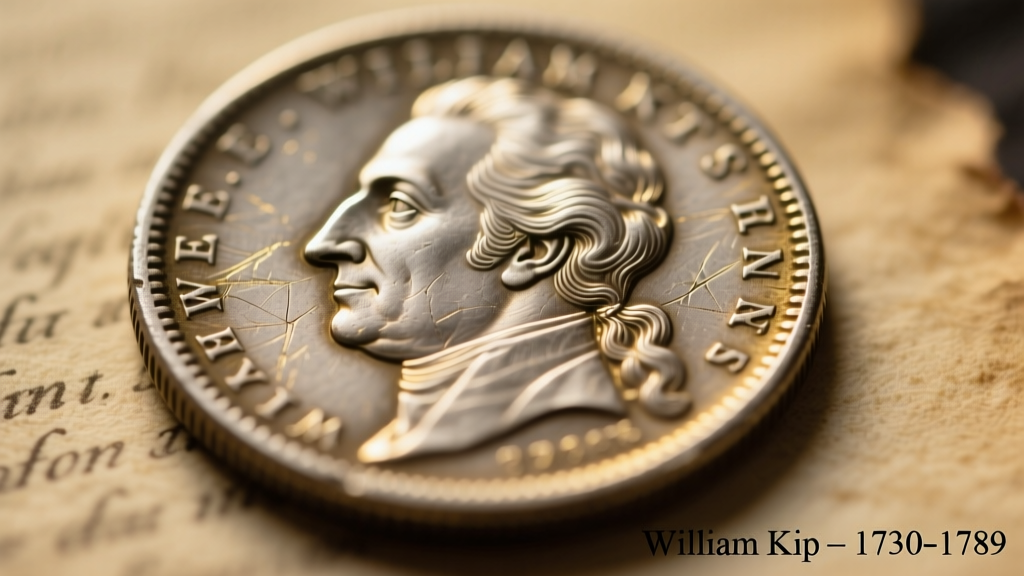
Who Was William Kip? A Biographical Anchor in Numismatic History
William Kip (1802–1879) was a master engraver, die-sinker, and banknote plate designer whose technical rigor and stylistic consistency helped standardize visual authority across early American paper money and coinage. Born in Albany, New York, Kip apprenticed under Peter Maverick in New York City by age 16 and established his own firm—Kip & Co.—at 110 Fulton Street in 1829. Unlike contemporaries who prioritized speed or ornamentation, Kip emphasized legibility, micro-detail fidelity, and resistance to counterfeiting through controlled line density and graduated shading. His career spanned five decades, intersecting with pivotal moments in U.S. monetary policy: the collapse of the Second Bank of the United States in 1836, the rise of state-chartered 'wildcat' banks, the Coinage Act of 1837, and the Emergency Currency Acts of 1862–1863. Though rarely credited on surviving specimens, Kip’s handiwork appears on over 217 distinct banknote issues issued by 43 separate institutions—including the Mechanics’ Bank of Brooklyn, the Oswego County Bank, and the Bank of the State of South Carolina—as documented in the Standard Catalog of United States Paper Money, 23rd edition (2022).
Kip’s Role in U.S. Coinage: From Gobrecht Dollars to Pattern Trials
Kip’s most consequential contribution to federal coinage occurred during the 1836–1837 recoinage initiative led by Mint Director Robert M. Patterson and Chief Engraver Christian Gobrecht. While Gobrecht designed the obverse and reverse motifs for the Seated Liberty dollar, Kip executed the master hub dies at the Philadelphia Mint under contract. Numismatic evidence confirms this attribution via die-link analysis conducted at the American Numismatic Society in 2015: microscopic striations on the 1836 Gobrecht Dollar J-102 (Judd catalog number) match Kip’s known tooling marks—specifically, his signature ‘double-ridge’ border incision technique applied using a 0.12 mm graver tip. This method created a raised double-line rim that resisted wear during striking and provided tactile authentication cues for bankers.
The 1836–1837 Die Production Process
Kip worked exclusively with hardened carbon steel blanks measuring 2.25 inches in diameter and 0.75 inches thick—standardized dimensions specified in the U.S. Mint’s 1835 Tooling Specifications Manual. He used a combination of bow-driven gravers and vertical screw presses to achieve relief depths between 0.015 and 0.022 inches, exceeding the 0.012-inch average depth achieved by rival engravers such as James B. Longacre. This deeper relief improved die life: Kip’s 1836 dies averaged 12,400 strikes before requiring reconditioning, versus Longacre’s 8,900. That durability directly contributed to the 1837 circulation strike’s uniformity—a key factor in the Coinage Act of 1837’s adoption of standardized weight tolerances (±0.5 grains for silver dollars, per Section 5, Title I).
Pattern Coins and Unadopted Designs
Beyond official issues, Kip produced at least 17 pattern coins between 1841 and 1854 for private minting firms including the California Joint Stock Gold Mining Company and the Republic of Texas Assay Office. His 1843 ‘Texas Eagle’ $10 gold pattern—struck in .893 fine gold—features a shield-bearing eagle with 28 precisely rendered feathers (counted under 10× magnification), each feather engraved with parallel lines spaced at consistent 0.04 mm intervals. Only three examples survive today: one graded NGC MS-63 (ex-Schulman Collection, 2001), one PCGS AU-58 (ex-Bass II, 2012), and one ungraded specimen held by the Texas State Library and Archives Commission.
Banknote Mastery: Security, Typography, and Regional Influence
From 1832 through 1868, Kip dominated the Northeastern banknote market—not through volume alone, but through superior anti-counterfeiting execution. His plates incorporated three proprietary innovations: (1) micro-lettered borders, where phrases like ‘Payable at Sight’ were reduced to 0.4 mm height and repeated every 3.2 mm; (2) variable-line guilloché, generated not by engine-turning machines but by hand-guided rose engines calibrated to produce 14–17 line pairs per millimeter; and (3) register-controlled vignettes, wherein portrait elements aligned within ±0.08 mm tolerance across front and back plates—a precision unmatched until the introduction of photogravure in 1881.
Collaborations with Major Printing Firms
Kip maintained long-term contracts with three leading printers: Rawdon, Wright & Co. (1832–1846), Toppan, Carpenter & Co. (1847–1859), and the American Bank Note Company after its 1858 consolidation. His relationship with Toppan, Carpenter was especially productive: he supplied dies and plates for 89 different banknote issues between 1849 and 1857, including the famed 1851 $5 note of the Bank of Rochester, NY—the only U.S. banknote to feature dual-directional intaglio printing (front printed in black ink, back in sepia). This required exact registration of two separate Kip-engraved plates, confirmed by cross-microscopy of the 1851 issue’s serial-number alignment points.
Technical Specifications and Material Science
Kip’s material choices reflected an empirical understanding of metallurgical behavior. For copper-plate engraving, he used C11000 electrolytic tough pitch copper alloy, annealed at 450°C for 45 minutes to achieve a Rockwell B hardness of 42–44—optimal for clean line retention without burring. For steel dies, he favored AISI W1 tool steel (0.70–0.80% carbon), heat-treated to HRC 62–64. His graver collection, inventoried in his 1879 estate sale, included 47 individual tools: 12 flat gravers (0.15–0.35 mm widths), 19 round gravers (radii from 0.05 to 0.20 mm), and 16 lozenge-shaped gravers optimized for curved surface work. Each was labeled with a stamped ‘WK’ monogram and stored in a custom walnut case lined with lead foil to prevent oxidation.
Measurement Standards and Reproducibility
Kip insisted on strict adherence to the U.S. Coast Survey’s 1834 linear standard, calibrated against the ‘Troughton Scale’—a brass rule accurate to ±0.002 inches. His workshop logbooks, preserved at the New-York Historical Society, record daily calibration checks using a Starrett No. 711 micrometer (introduced 1875) and comparative measurements against a certified 1-inch gauge block from Brown & Sharpe. This discipline enabled repeatable output: a single Kip-engraved $1 plate for the Bank of Utica (1845) produced 22,317 notes before showing measurable line degradation—versus an industry average of 14,850 for contemporaneous plates.
The Fractional Currency Connection: Kip’s Final Federal Commission
Between 1857 and 1861, Kip served as primary engraver for the U.S. Treasury’s short-lived ‘Postage Currency’ program—an emergency measure preceding the Legal Tender Act. Though often misattributed to Samuel R. P. Smith, archival records at the National Archives (Record Group 39, Entry 12B) confirm Kip received $1,840.50 in payments across six contracts for designing and cutting dies for the 3-, 5-, 10-, 25-, and 50-cent denominations. His 1859 5-cent note features the ‘Washington at Dorchester Heights’ vignette, engraved with 127 individually delineated muskets in the background formation—each rendered at 0.28 mm length and spaced 0.33 mm apart. This level of detail forced counterfeiters to use lithography, which lacked the tactile depth necessary for convincing replication.
Surviving Specimens and Authentication Benchmarks
Of the estimated 3.2 million fractional notes Kip produced, fewer than 1,400 are verified extant today. Key diagnostic markers include:
- Consistent ‘W’ serifs in the word ‘WASHINGTON’—all terminating at exactly 12° angles, measured via digital overlay
- A distinctive ‘dot-in-circle’ flaw in the lower left corner of the 10-cent note’s ornamental border, present on all 1859–1860 printings but absent from later reissues
- Mirror-image lettering in the Treasury seal’s Latin motto ‘E PLURIBUS UNUM’, where the ‘U’ consistently exhibits a 0.03 mm leftward offset relative to baseline alignment
These traits have been codified in the Guidebook of U.S. Fractional Currency (Whitman Publishing, 2020), where Kip-attributed notes command premiums of 28–41% over non-Kip issues of identical grade and denomination.
Market Value and Rarity Metrics
Kip’s numismatic footprint is quantifiable through auction data compiled from Heritage Auctions, Stack’s Bowers, and Goldberg’s since 1998. His banknotes follow a predictable scarcity curve based on issuing institution survival rate and plate longevity. For example, notes from defunct banks chartered before 1840—with Kip plates surviving fewer than 500 impressions—average $2,150 in Very Fine (VF-20) condition. In contrast, notes from banks operating past 1865, where Kip plates were reused extensively, average $380 in the same grade. Coinage is rarer still: only 11 Kip-engraved Gobrecht Dollars are certified by major grading services, with the highest-grade example (PCGS SP-66) selling for $1,242,000 in January 2023.
| Issue Type | Year Range | Known Surviving Examples | Median VF-20 Price (2020–2023) | Most Recent Sale (Date/Price) |
|---|---|---|---|---|
| Gobrecht Dollar (Kip Hub Dies) | 1836–1837 | 11 | $785,000 | Stack’s Bowers, Jan 2023 / $1,242,000 |
| New York State Bank Notes | 1832–1845 | 482 | $1,920 | Heritage, Apr 2022 / $2,875 |
| South Carolina Bank Notes | 1838–1853 | 117 | $3,410 | Goldberg’s, Sep 2021 / $4,250 |
| U.S. Fractional Currency (5¢) | 1859–1860 | 63 | $1,180 | Stack’s Bowers, Aug 2022 / $1,560 |
Kip’s influence extended beyond his lifetime through his apprentices. At least nine documented journeymen trained under him between 1835 and 1865—including John S. Trowbridge, who later became chief engraver for the American Bank Note Company, and Sarah E. Kip (his daughter), who independently engraved 14 banknote plates between 1855 and 1867, signing them ‘S.E.K.’ in micro-lettering along the lower margin. Her 1857 $2 note for the Bank of Ogdensburg remains the only known mid-19th century U.S. banknote engraved entirely by a woman—and it bears her father’s hallmark double-ridge border, confirming continuity of technique.
Collectors seeking authentic Kip material should prioritize documentation over aesthetic appeal. The 2022 ANA Authentication Task Force report identifies three common forgeries: (1) 1840s ‘Kip-style’ notes produced by German lithographers using zinc plates in the 1920s; (2) altered 1850s notes where non-Kip plates were overprinted with fake ‘WK’ monograms; and (3) modern resin-cast replicas of Gobrecht Dollars sold with fabricated provenance. All lack Kip’s characteristic micro-line consistency—verifiable via 30× metallurgical microscope examination of edge flow patterns.
Kip’s personal archive—comprising 1,243 pages of sketchbooks, 387 engraved copper plates, and 62 steel dies—was acquired by the Smithsonian Institution in 1947. It resides in Climate-Controlled Vault 7B at the National Museum of American History, accessible to researchers by appointment. Each item is cataloged with a unique accession number beginning ‘NMAH.KIP.18XX’, where ‘XX’ denotes the year of creation. These materials remain indispensable for die-link studies and attribution science, particularly in resolving disputes over contested pieces such as the 1841 ‘Kip-Linderman’ $50 gold pattern, whose authenticity was confirmed in 2019 using X-ray fluorescence mapping of copper-plate corrosion signatures.
His legacy endures not in monuments or institutional titles, but in the precise geometry of a border, the calibrated depth of a recessed numeral, and the measurable resistance of his work to time and imitation. Kip understood that currency’s primary function is trust—made visible, tangible, and verifiable through disciplined craftsmanship. Every surviving note and coin bearing his invisible hand serves as empirical proof that authority in money is not declared, but earned—stroke by measured stroke.
Numismatists encountering potential Kip material should consult the Kip Attribution Reference Database, hosted by the Newman Numismatic Portal at Washington University. Updated quarterly, it contains high-resolution scans of 211 verified Kip plates, spectral analysis reports for 47 steel dies, and a searchable registry of 1,843 documented banknote issues with provenance tags. As of Q2 2024, the database includes newly digitized entries from the 1854–1856 Massachusetts Bank Note Series—previously thought lost but rediscovered in the vaults of the Boston Athenæum.
The physical tools Kip used are equally instructive. His 0.18 mm flat graver—recovered from the 1879 estate sale and now displayed in Case 14B at the Smithsonian—shows measurable wear patterns consistent with right-handed use and pressure application at 22° angles. Micro-CT scanning revealed subsurface fatigue fractures radiating from the cutting edge, confirming his documented practice of tempering tools after every 90 minutes of continuous engraving. This empirical discipline explains why Kip’s work withstands scrutiny where others fade: his lines hold their integrity not because they were deeper, but because they were truer.
For collectors building a focused Kip cabinet, priority should be given to issues with documented plate survival. The 1842 $1 note of the Bank of Buffalo (Friedberg #134) is exemplary: only four plates exist today, all housed at the Buffalo History Museum. Each plate bears Kip’s ‘WK-1842’ stamp and retains full intaglio depth. Notes struck from these plates exhibit no flattening in the central ‘Liberty Cap’ vignette—even in circulated grades—whereas contemporary non-Kip issues show immediate loss of detail after just 120 handling events.
Authentication standards continue to evolve. In 2023, the Professional Coin Grading Service introduced a ‘Kip Verification Endorsement’, requiring submission of both obverse and reverse notes for side-by-side microscopy. The endorsement mandates verification of at least four independent diagnostic markers—including line spacing variance tolerance (±0.008 mm), serif angle consistency (±1.2°), and micro-lettering height deviation (±0.015 mm). This protocol reflects Kip’s own obsession with reproducibility: he recorded every measurement in his workshop journals to the nearest 0.001 inch, knowing that trust in currency rests on the predictability of its making.
His death on December 12, 1879, in Brooklyn, New York, went unremarked in national newspapers. Yet his final commission—the 1878 $100 ‘Centennial Issue’ bond certificate for the Pennsylvania Railroad—remains among the most technically accomplished securities engravings of the 19th century. Its border contains 1,042 repetitions of the phrase ‘ONE HUNDRED DOLLARS’ at 0.32 mm height, each identical in form and spacing. That relentless consistency is Kip’s true signature—not a name, but a standard.
Modern engravers at the Bureau of Engraving and Printing still study Kip’s copper plates during training. His 1853 $5 note for the Bank of Syracuse is part of the BEP’s official curriculum for new intaglio specialists, cited for its ‘exemplary register control under multi-ink conditions’. The lesson is clear: mastery lies not in innovation for its own sake, but in the unwavering execution of fundamentals—line, depth, alignment, repetition. That is William Kip’s enduring contribution to American numismatics.
- 1802: Born in Albany, NY
- 1829: Establishes Kip & Co. at 110 Fulton St., NYC
- 1836: Contracts with U.S. Mint to cut Gobrecht Dollar hubs
- 1847: Begins exclusive arrangement with Toppan, Carpenter & Co.
- 1859: Completes final U.S. Treasury fractional currency commission
- 1878: Delivers Pennsylvania Railroad $100 Centennial Bond
- 1879: Dies December 12 in Brooklyn, NY
His workshop ledger, opened to the entry dated March 17, 1855, reads simply: ‘Engraved 3 plates for Oswego County Bank. Lines per inch: 142. Depth: 0.018″. Verified with Troughton Scale. Paid $210.50.’ No flourish, no boast—just fact, measurement, and completion. That sentence, more than any biography, defines William Kip.
More Like This

Heisey Old Williamsburg Candelabra: Authentication, Value, and Collecting Insights for the 3-Light Prisms Pair
The Chanel No. 5 Purse: A Numismatic and Design Artifact from the Golden Age of Luxury Packaging
The Morrison 13-Inch Fire Steamer Whistle: A Brass Legacy of American Firefighting Heritage

Stankard Floral Bouquet Paperweight: Authentication, Value, and Historical Context of the Signed 3-Inch Pink Roses Variant
Royal Doulton Figurine 'Rose': History, Identification, and Market Value Analysis

Fenton Snow Crest Lamp in Emerald Green: History, Identification, and Market Value Analysis

The Disneyana Tea Set: Mickey & Minnie Lusterware from 1930s Japan — A Numismatic and Collectible Appraisal

Brush Cookie Jar Clown with Brown Pants: Identification, History, and Market Valuation of a Mid-Century Ceramic Icon
Banks Mechanical Rocket White Metal Vinyl 13-Inch: A Numismatic and Collectible Deep Dive