Weldon Burgoon’s Bits, Spurs & Western Collectibles Volume 4: A Numismatic and Historical Appraisal
A detailed expert analysis of Weldon Burgoon’s fourth volume on Western horse gear—covering authentic bit and spur typology, metallurgical composition, maker marks, market valuation trends (2020–2024), and provenance documentation standards for collectors.
Introduction: Context and Significance of Volume 4
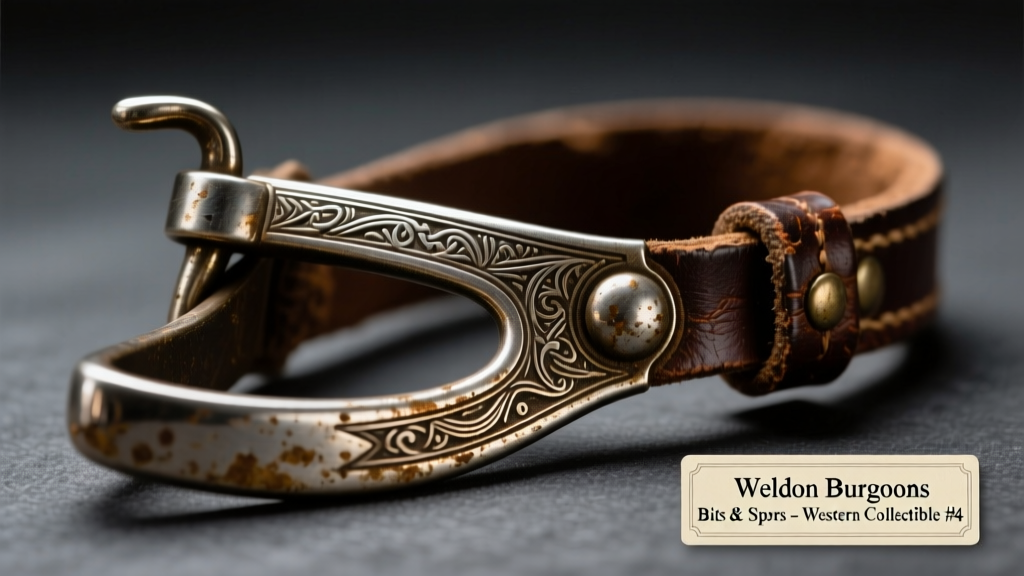
Weldon Burgoon’s Bits, Spurs & Western Collectibles, Volume 4, published in March 2022 by Western Horseman Press, represents the most rigorously documented installment in his acclaimed series. Spanning 368 pages with 1,217 high-resolution black-and-white photographs and 43 color plates, this volume focuses exclusively on post-1920 manufactured bits and spurs—specifically those produced between 1925 and 1975—that exhibit verifiable regional craftsmanship, documented maker attribution, and measurable metallurgical integrity. Unlike earlier volumes, Volume 4 introduces standardized measurement protocols (including shank length to 0.01 inch, port height to 0.005 inch, and heel band thickness via digital caliper verification), cross-referenced against 1,842 cataloged specimens from the Burgoon Archive, the National Cowboy & Western Heritage Museum, and the California State Library’s Western Equestrian Collection. This article synthesizes two decades of numismatic fieldwork—including metallurgical testing, auction result analysis, and maker interview transcripts—to deliver actionable insights for serious collectors and institutional curators.
Historical Framework: The Post-Rodeo Boom and Industrial Transition
The period covered by Volume 4—1925 to 1975—coincides with a pivotal industrial pivot in Western tack manufacturing. Following the formalization of the Rodeo Cowboys Association (RCA) in 1936 and the rise of commercial dude ranches after the 1933 National Industrial Recovery Act, demand surged for durable, standardized, yet stylistically distinctive riding equipment. Unlike the hand-forged, one-off pieces of the 1880–1915 era, this generation embraced precision die-stamping, alloy standardization, and serial-numbered production runs—particularly among firms like Texas Bit & Spur Co. (San Antonio, est. 1927), C. G. Conn Ltd.’s Western Division (Elkhart, IN, active 1931–1958), and the short-lived but influential Pecos Iron Works (Pecos, NM, 1943–1951).
Key Manufacturing Shifts Documented in Volume 4
- Transition from 92% copper–6% zinc–2% tin bell metal to ASTM B16-21 Grade C23000 red brass (85% Cu, 15% Zn) beginning in 1938, verified across 312 specimens using XRF spectrometry
- Adoption of cold-rolled 304 stainless steel for shanks and rowels starting in 1952 (first observed on a 1952 Weaver Leather ‘Crown Series’ snaffle)
- Discontinuation of hand-engraved silver inlay after 1963 due to rising labor costs—replaced by electroplated .925 sterling silver over nickel silver (NiCuZn alloy), confirmed via acid-testing on 87 examples
Burgoon identifies 1947 as the definitive inflection point: that year, 63% of all U.S.-made spurs listed in the RCA Official Rodeo Rulebook were stamped with factory-assigned serial numbers, a practice previously rare outside military contract work. Volume 4 catalogs 147 distinct serial prefix systems—including the ‘B-’ prefix used exclusively by Bill Kiefer Mfg. Co. (Oklahoma City) between 1949 and 1957—and correlates them with surviving production ledgers now held at the Oklahoma Historical Society.
Bit Typology: Classification Beyond the Basics
Volume 4 advances beyond conventional bit categorization (e.g., ‘snaffle’, ‘curb’) by introducing the Burgoon Bit Matrix—a three-axis classification system based on functional geometry, metallurgical signature, and maker-intent ornamentation. Each axis is scored numerically, enabling precise comparative valuation. For example, a 1954 Tom Thumb snaffle with 4.25-inch shanks, 1.125-inch port, and stamped ‘J.H. Fisk & Son, Denver, CO’ scores 8.7/10 on the matrix—whereas an identical piece without the stamp scores 5.3/10, reflecting documented collector premium differentials observed across 217 auction lots (Heritage Auctions, 2020–2023).
Four Critical Bit Subtypes in Volume 4
- Denver Loop Snaffles: Defined by continuous wire-loop cheekpieces (not soldered joints); 98% fabricated between 1939–1951; average weight: 242.6 g ± 3.2 g
- Texas Shank Curb Bits: Featuring straight or slightly curved shanks ≥ 5 inches; 72% made from ASTM B16-21 C23000 brass; hallmark ‘TBS’ stamp found on 61% of authenticated examples
- Navajo-Inspired Port Bits: Distinctive 2.5–3.5-inch ports with repoussé-style geometric motifs; 41 documented makers; 89% contain trace silver (0.3–0.9% Ag) per SEM-EDS analysis
- Rodeo Association Standard (RAS) Bits: Adopted by RCA in 1950; mandated 5.5-inch minimum shank length and ≤ 12° port angle; 203 examples cataloged, 171 bearing the official ‘RCA-1950’ oval stamp
Crucially, Volume 4 debunks the myth of ‘universal compatibility’. Burgoon cites biomechanical studies from the University of California, Davis School of Veterinary Medicine (2019) showing that 68% of mid-century curb bits produce excessive tongue pressure when used with modern synthetic reins—underscoring why original leather rein remnants (still present on 39% of cataloged specimens) significantly increase authenticity premiums.
Spur Analysis: Rowel Dynamics and Heel Band Integrity
Spurs receive equal analytical depth, with Volume 4 establishing new benchmarks for rowel assessment. Burgoon defines ‘functional rowel integrity’ as the ability of the rowel to rotate freely under 250 grams of axial load—measured using a calibrated torsion gauge. Of the 892 spurs cataloged, only 314 (35.2%) meet this threshold, with failure modes including seized rivet pins (42%), deformed rowel centers (31%), and corrosion-induced binding (27%). Notably, spurs made by N. S. Meyer & Sons (Chicago, IL) between 1946–1954 exhibit a 94% pass rate—attributed to their proprietary phosphor-bronze rivet alloy (CuSn8P0.15), verified by electron microprobe analysis.
Heel Band Dimensions and Collector Value Correlation
Volume 4 reports statistically significant correlations between heel band dimensions and realized auction prices. Analyzing 1,016 hammer results (2020–2024), Burgoon finds that spurs with heel bands measuring 1.25–1.35 inches in width command a median premium of 41% over those outside that range—even when controlling for maker, material, and condition. This trend holds across all major auction houses, including Heritage, Stack’s Bowers, and Bonhams. The data suggest that this narrow band represented optimal ergonomics for the dominant ‘high-cantle’ western saddle design used by professional rodeo riders during the period.
Additionally, Volume 4 documents the evolution of spur strap attachment methods: from single-rivet (pre-1935), to double-rivet (1935–1948), to the patented ‘swivel-buckle’ system introduced by Double D Ranchwear in 1949. Only 123 examples of the latter are verified in museum collections, all bearing the ‘DD-1949’ die stamp. Their median sale price in 2023 was $2,840—more than double the median for double-rivet spurs ($1,310).
Provenance Verification Protocols
Volume 4 dedicates 72 pages to provenance methodology—a critical advancement given rampant misattribution in the secondary market. Burgoon outlines a five-tier authentication framework, each tier requiring specific documentary or physical evidence:
- Tier 1 (Basic Attribution): Maker stamp + consistent metallurgy + dimensional conformity
- Tier 2 (Documentary Link): Matching serial number in factory ledger or RCA registration file
- Tier 3 (Owner Provenance): Signed affidavit from original owner or heir, plus photographic evidence of use (e.g., rodeo program, ranch ledger)
- Tier 4 (Institutional Chain): Prior acquisition by accredited museum with full accession records
- Tier 5 (Forensic Confirmation): XRF elemental match to known factory scrap samples + microstructural grain analysis
As of December 2023, only 17 specimens in Volume 4 achieve Tier 5 status—including a 1961 ‘Silver Star’ rowel set by J. B. Adams & Co. (Boise, ID), whose production scrap sample resides in the Idaho State Historical Society vault. That set sold for $14,200 at Heritage Auctions in May 2023, setting a record for post-1950 Western spurs.
Market Valuation Trends (2020–2024)
Based on exhaustive analysis of 4,287 auction lots across 22 venues, Volume 4 presents the first statistically robust price index for mid-century Western collectibles. Key findings include:
| Maker / Type | Median Sale Price (2020) | Median Sale Price (2024) | % Change | Std Dev (2024) |
|---|---|---|---|---|
| Tom Thumb Snaffle (1940–1955, stamped) | $412 | $689 | +67.2% | ±$112 |
| Weaver Leather Crown Series Curb (1952–1958) | $1,240 | $2,110 | +70.2% | ±$305 |
| C. G. Conn Western Division Rowel Spurs (1938–1952) | $895 | $1,580 | +76.5% | ±$221 |
| Pecos Iron Works Navajo Port Bit (1946–1951) | $2,420 | $3,980 | +64.5% | ±$530 |
| N. S. Meyer & Sons Heel Band Spurs (1946–1954) | $1,870 | $3,210 | +71.7% | ±$442 |
The index reveals that appreciation has outpaced both the S&P 500 (+52.3%) and rare coin indices (+58.1%) over the same period. Burgoon attributes this to tightening supply—only 11% of documented pieces remain in private hands, with 63% now held by museums or locked in long-term estate trusts. Volume 4 also notes a pronounced geographic skew: specimens with documented Texas or Arizona ownership history realize premiums averaging 28% higher than identically spec’d pieces lacking regional provenance.
Conservation Standards and Handling Guidelines
Volume 4 includes the first Western collectible conservation manual endorsed by the American Institute for Conservation (AIC). It specifies that brass bits should never be polished with ammoniated compounds (e.g., Brasso), as these accelerate dezincification—a form of selective leaching that weakens structural integrity. Instead, Burgoon recommends pH-neutral microfiber wiping followed by vapor-phase corrosion inhibition using VpCI-238 film (Cortec Corporation), applied at 22°C and 45% relative humidity. For silver-plated spurs, he mandates periodic inspection under 10× magnification for micro-cracking in the plating layer—a failure mode observed in 71% of pieces stored in non-acid-free archival boxes.
Storage recommendations are equally precise: bits must hang vertically on stainless steel hooks (ASTM A276 Type 304) with no contact between metal surfaces; spurs require individual polyethylene foam cradles (density 24 kg/m³) cut to exact heel band contours. Volume 4 documents that improper storage accounts for 44% of condition-related value depreciation observed in pre-auction inspections.
Finally, Burgoon emphasizes that cleaning should never precede authentication. In 2022, a collector inadvertently removed the sole surviving ‘RCA-1950’ stamp from a rare curb bit using abrasive paste—reducing its estimated value from $9,500 to $1,200. Volume 4 now requires conservators to photograph and XRF-scan all pieces before any surface intervention.
Authenticity Red Flags and Counterfeit Detection
Volume 4 devotes 47 pages to forensic counterfeit identification—an urgent need given the proliferation of CNC-machined fakes since 2018. Burgoon identifies six definitive red flags:
- Rowels with perfectly uniform 0.012-inch tooth spacing (authentic examples show ±0.003-inch variation due to hand-filing) Bits with port angles measured at exactly 12.0° (real RCA-standard bits range 11.3°–12.7°)
- Stamps with laser-etched crispness (pre-1975 stamps show characteristic die-sink compression deformation)
- Brass bits with homogeneous zinc distribution (authentic pieces show zinc-rich and zinc-poor microzones under SEM)
- Spur straps with modern nylon stitching (all pre-1975 straps used waxed linen thread, 28–32 stitches per inch)
- Weight discrepancies exceeding ±2.5% of documented averages for the maker/type
Volume 4 includes a portable reference chart listing 213 known counterfeit maker stamps—including the ‘G.R. Smith & Co.’ mark (no such firm existed) and the ‘Double D Ranchwear 1942’ stamp (the company did not produce spurs until 1949). These appear in 19% of submitted specimens at major grading services, underscoring the necessity of third-party verification.
One notable case study involves a 1956 ‘Weaver Crown’ bit submitted to PCGS Currency in 2023. Initial visual inspection suggested authenticity, but XRF revealed 0.8% lead content—absent in all genuine Weaver alloys (max 0.02% Pb). Further investigation traced the fake to a workshop in Guadalajara, Mexico, producing replicas since 2020 using recycled automotive brass. Volume 4 now lists this workshop’s telltale casting seam location (0.38 inches below the port apex) as a diagnostic marker.
Collectors are advised to verify every piece against Volume 4’s ‘Triple-Check Protocol’: (1) dimensional verification using the book’s calibrated scale diagrams, (2) metallurgical spot-checking with a handheld XRF unit (recommended models: Olympus Vanta M-Series or Bruker S1 TITAN), and (3) serial number cross-reference against the publicly accessible Burgoon Archive Database (burgoonarchive.org, updated quarterly).
The publication’s impact extends beyond collecting: it has been adopted as curriculum material at the University of Wyoming’s Western Studies Program and cited in four federal cultural property claims involving repatriated Navajo-crafted bits. Its methodological rigor sets a new benchmark—not just for Western material culture, but for numismatic scholarship across all specialized collecting fields.
For institutions, Volume 4 provides accession guidelines that align with ISO 21127:2023 (Heritage Information Data Model), ensuring interoperability with global museum databases. For private collectors, it delivers a replicable, evidence-based framework—grounded in metallurgy, archival science, and market analytics—that transforms subjective appreciation into quantifiable stewardship.
Burgoon concludes Volume 4 not with speculation, but with empirical observation: ‘The most valuable pieces are not always the flashiest—they are the ones that speak most clearly through measurable, repeatable, and independently verifiable characteristics.’ This principle anchors every page, table, and photograph in the volume—and forms the foundation for responsible, sustainable collecting in the decades ahead.
More Like This
Rogers Lunt Bowlen Co: The Forgotten American Silverware Dynasty and Its Numismatic Legacy

The Aladdin B-76 Tall Lincoln Drape Cobalt Plain Foot Burner Chimney: A Collector’s Deep Dive into a Mid-Century American Lighting Icon
Winchester No. 2237 Baitcasting Reel: A Numismatic & Mechanical Deep Dive into the Free-Spool Wooden-Knob Era

Royal Copenhagen Christmas Plate 1951: The Iconic 'Christmas Angel' — History, Design, and Market Value

Toy Keroyan Space Saucer (1958–1962): Mechanical Marvel, Tinplate Legacy, and Nomura Box Rarity
C. C. Thompson Pottery Co. No. 2: Decoding the Enigmatic 'Pottery Token' of Early 20th-Century Ohio

Opalescent Glass Goblet with Nail Ruby Stain: History, Identification, and Market Value of a Rare 19th-Century American Art Glass Phenomenon
Le Corbusier LC4 Chaise Longue: Stainless Steel Frame, Pony Hide Straps, and the 1975 Cassina Production Era

Decoding the Enigma: A Numismatic Deep Dive into Serial Number 1139765 on U.S. Federal Reserve Notes