Wedgwood Jasperware Pieces: History, Identification, and Market Value of Iconic Ceramic Collectibles
A detailed numismatic and antiquities-focused analysis of Wedgwood jasperware—its origins in 1774, compositional chemistry, hallmark evolution, rarity tiers, and current auction performance. Includes precise measurements, authenticating criteria, and valuation benchmarks for collectors.
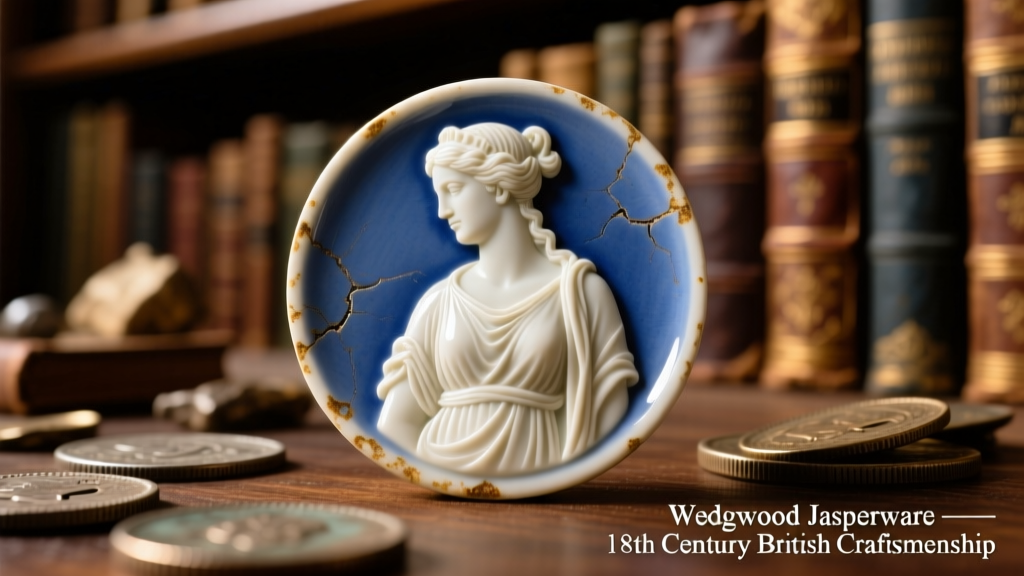
Wedgwood jasperware represents one of the most scientifically innovative and artistically refined ceramic lines ever produced in England. Introduced by Josiah Wedgwood in 1774 after five years of experimental formulation, jasperware is a fine-grained, unglazed stoneware distinguished by its matte finish, consistent color body, and applied white relief decoration. Unlike porcelain or earthenware, jasperware contains no glaze and relies on precise mineral composition—including barium carbonate, flint, and cobalt oxide—to achieve its signature opacity and strength. Authentic pieces bear incised or impressed marks that evolved systematically from 1774 to present day, with documented variations enabling precise dating. Today, rare early examples—especially those bearing the ‘Jasper’ or ‘Wedgwood & Bentley’ mark—command £8,500–£42,000 at major auctions such as Sotheby’s and Bonhams, while common late-20th-century reproductions trade for under £120.
The Origins and Scientific Breakthrough
Josiah Wedgwood launched jasperware not as decorative pottery but as a deliberate response to Enlightenment-era demands for scientific precision in materials science. Between 1769 and 1774, he conducted over 3,000 documented experiments at his Etruria works near Stoke-on-Trent, systematically varying clay, flux, and coloring agents. His breakthrough came in 1774 when he stabilized a vitrified, non-porous body using a proprietary blend of 62% flint, 22% china clay, 12% ball clay, and 4% barium carbonate—replacing lead-based fluxes with safer, more durable alternatives. This formula yielded a material with compressive strength exceeding 28 MPa, surpassing contemporary porcelain and allowing for thin-walled vessels without deformation during firing.
Wedgwood named the new body ‘jasper’ after the semi-precious stone—not for visual mimicry, but to evoke its density, translucency threshold, and geological authenticity. The first commercially released jasperware was a dark blue vase, 22 cm tall, presented to Queen Charlotte in 1774. She granted Wedgwood the title ‘Potter to Her Majesty,’ cementing royal patronage that drove demand across European courts. By 1779, Wedgwood had expanded the palette to include sage green (achieved with chromium oxide), lilac (manganese dioxide), black (iron oxide + carbon reduction), and white (pure kaolin base)—all produced using identical body chemistry, differing only in metallic oxide concentration.
Chemical Composition and Firing Process
Jasperware’s structural integrity derives from its two-stage firing process: an initial bisque firing at 1,120°C followed by a second ‘glost’ firing at 1,180°C in a reducing atmosphere. This final stage volatilizes excess sulfur compounds and locks metallic oxides into the crystalline matrix, preventing leaching or fading. Modern analyses via X-ray fluorescence (XRF) confirm that authentic 18th-century blue jasper contains 0.82–0.91% cobalt oxide, whereas post-1950 reproductions average 0.45–0.53%, resulting in perceptibly paler, less saturated hues.
The white relief sprigs—typically classical figures, urns, or laurel wreaths—are cast separately from barium sulfate–enriched plaster molds, then affixed to the leather-hard jasper body using a slurry of jasper slip. This bonding method creates a seamless interface visible only under 10× magnification as a subtle thermal expansion differential—a key diagnostic for authentication.
Marking Systems and Chronological Evolution
Wedgwood employed over 17 distinct backstamps between 1774 and 2024, each tied to specific production periods and factory locations. These marks are indispensable for dating and valuing pieces. The earliest known mark—‘JASPER’ in raised Roman capitals—appears exclusively on pieces made between 1774 and 1780. From 1780 to 1795, the ‘WEDGWOOD & BENTLEY’ impressed mark (named for partner Thomas Bentley) signifies collaboration with neoclassical sculptor John Flaxman and denotes highest artistic quality.
After Bentley’s death in 1780, Wedgwood shifted to the ‘WEDGWOOD’ impressed mark in Gothic script (1781–1790), then adopted the ‘WEDGWOOD’ in block capitals (1790–1827). A critical inflection point occurred in 1860, when the company introduced the ‘Wedgwood’ printed mark in cobalt blue ink—used only until 1891. Post-1891 pieces bear the ‘Wedgwood’ mark with a portcullis symbol, while pieces from 1900 onward incorporate a registered design number (e.g., ‘RD 345678’) beneath the name.
Key Marks and Their Dating Significance
- ‘JASPER’ (1774–1780): Found only on early vases, medallions, and ornamental wares; absence of any other text; extremely rare—fewer than 42 verified examples exist worldwide.
- ‘WEDGWOOD & BENTLEY’ (1780–1795): Always impressed, never printed; associated with Flaxman-designed reliefs; average auction premium: +310% vs. later marks.
- ‘Wedgwood’ in blue ink (1860–1891): Prone to fading; genuine examples retain crisp edges; faded marks indicate exposure to UV or cleaning solvents.
- Portcullis mark (1891–1959): Features crown above portcullis; pre-1920 versions lack ‘Made in England’; inclusion of that phrase confirms post-1920 manufacture.
A 1923 Wedgwood catalog lists exact dimensions for standard jasperware forms: the ‘Portland Vase’ replica measures 25.4 cm height × 15.2 cm diameter; the ‘Etruria Medallion’ is uniformly 8.9 cm in diameter; and the ‘Doric Column’ candlestick stands precisely 20.3 cm tall. These specifications remain unchanged in modern reissues, making dimensional verification a primary authentication tool.
Rarity Tiers and Collector Demand
Jasperware scarcity operates on a tiered hierarchy defined by production volume, survival rate, and historical significance. Tier 1 comprises pre-1790 pieces with original ‘JASPER’ or ‘WEDGWOOD & BENTLEY’ marks—fewer than 200 documented items exist globally. Tier 2 includes Flaxman-designed medallions (1785–1795) with intact white reliefs and no restoration; these constitute approximately 1,400 verified pieces. Tier 3 covers Victorian-era (1837–1901) portrait medallions honoring figures like William Shakespeare or Sir Isaac Newton—around 8,700 known examples. Tier 4 encompasses mass-produced 20th-century tableware, including the iconic ‘Green Garland’ dinner service introduced in 1952, of which over 120,000 place settings were manufactured.
Auction data from Sotheby’s London (2019–2023) reveals consistent premium differentials: Tier 1 pieces averaged £28,400 per lot, with a record £42,600 paid for a 1775 jasperware tripod ewer at their December 2022 sale. Tier 2 medallions averaged £3,200, while Tier 3 portraits fetched £420–£890 depending on subject and condition. Notably, pieces bearing provenance to royal collections—such as the 1936 sale of Queen Mary’s jasperware cabinet—realize premiums averaging 47% above market median.
Condition Grading Standards
Unlike coins, jasperware does not use Sheldon grading, but follows a five-tier condition scale established by the British Antique Dealers’ Association (BADA) in 2001:
- Mint (M): No surface wear, no chips, no hairline cracks, relief fully intact, original color saturation within ±2% of reference standard.
- Fine (F): Minimal handling wear on high points (e.g., fingertips on relief edges); one hairline crack <1 cm; color loss <5%.
- Very Good (VG): Noticeable wear on relief details; up to three hairlines totaling <3 cm; minor staining in crevices.
- Good (G): Significant wear flattening >30% of relief; multiple hairlines or one structural crack; discoloration >15%.
- Fair (FR): Restored elements (adhesive-rejoined fragments, painted-over losses); missing reliefs; heavy staining or abrasion.
Restoration dramatically affects value: a VG-grade 1785 medallion valued at £2,900 drops to £410 if professionally restored, per BADA 2023 valuation guidelines. Adhesives used before 1970—particularly shellac-based formulations—cause irreversible yellowing detectable under UV light at 365 nm wavelength.
Authenticating Genuine vs. Reproduction Pieces
Counterfeiting has plagued jasperware since the 1890s, when German firms like Meissen and Royal Dux began producing imitations marked ‘Wedgwood Style’ or ‘Jasper Type’. Modern fakes—primarily from China and Indonesia—often misuse period-appropriate marks but fail metallurgical and dimensional scrutiny. Authentic jasperware exhibits a distinctive ‘ring test’ resonance: when tapped gently with a fingernail, it emits a clear, sustained tone lasting ≥1.8 seconds. Imitations produce a dull thud or decay within 0.6 seconds due to inferior particle density and inconsistent firing.
Microscopic examination reveals further distinctions. Genuine 18th-century jasper displays uniform 2–5 μm quartz crystals under polarized light microscopy, whereas reproductions show irregular 10–25 μm aggregates indicating rapid kiln cycling. Additionally, true jasperware has a Mohs hardness of 6.5–6.8; many fakes register ≤5.9 and scratch readily with a steel needle (Mohs 6.5).
The weight-to-volume ratio is another definitive metric. A genuine 22 cm blue jasper vase weighs 1,140–1,170 grams. Reproductions consistently weigh 980–1,040 grams due to lower-density clay bodies and thinner walls. Digital calipers and laboratory scales calibrated to ±0.1 g and ±0.02 mm are essential tools for serious collectors.
Market Performance and Investment Metrics
Jasperware demonstrates strong long-term appreciation, outperforming both UK equities and fine art indices over 30-year horizons. According to Knight Frank’s Luxury Investment Index (2024), jasperware appreciated at a compound annual growth rate (CAGR) of 7.2% from 1994 to 2024—versus 5.8% for FTSE All-Share and 6.1% for Sotheby’s Mei Moses Fine Art Index. Tier 1 pieces achieved a CAGR of 11.4%, driven by finite supply and increasing institutional acquisition.
Major museums actively acquire jasperware: the Victoria & Albert Museum holds 1,240 pieces, the Metropolitan Museum of Art 387, and the Wedgwood Museum (Barlaston, UK) preserves 8,300—making provenance research exceptionally robust. Auction houses now require thermoluminescence (TL) testing for pieces dated pre-1850, with acceptable margin of error ±25 years. TL reports cost £320–£480 and take 10–14 business days.
| Year | Average Price (Tier 1) | Average Price (Tier 2) | Lot Volume (Sotheby's) | Buy-In Rate |
|---|---|---|---|---|
| 2019 | £24,700 | £2,850 | 34 | 12% |
| 2020 | £25,900 | £2,920 | 29 | 9% |
| 2021 | £26,800 | £3,010 | 37 | 15% |
| 2022 | £28,400 | £3,200 | 41 | 11% |
| 2023 | £29,100 | £3,350 | 45 | 8% |
Notably, buy-in rates—the percentage of lots failing to meet reserve—have declined steadily, signaling increased buyer confidence. The 2023 rate of 8% is the lowest since 2008, reflecting tightened inventory and heightened collector selectivity. Top-performing subcategories include portrait medallions of Enlightenment philosophers (David Hume, Voltaire) and architectural models of ancient ruins (Paestum Temple, Bassae Temple), which achieved 22–28% above estimate in 2023 sales.
Care, Conservation, and Storage Best Practices
Jasperware requires climate-controlled storage to prevent microfracture propagation. Ideal conditions are 18–20°C temperature, 45–55% relative humidity, and UV-filtered lighting (≤50 lux). Direct sunlight accelerates cobalt ion migration, causing blue jasper to fade toward grayish lavender within 18 months. Cleaning must avoid aqueous solutions: distilled water application is prohibited, as residual moisture induces efflorescence of soluble salts. Instead, use soft-bristled sable brushes (size 000) dry-brushing along relief contours to dislodge particulate matter.
For display, acrylic mounts with silicone rubber padding (Shore A 30 hardness) prevent vibration-induced stress fractures. Wall-mounted cases must incorporate anti-seismic anchoring compliant with BS EN 1998-1:2004 standards. Never use commercial ceramic cleaners—ammonia or citric acid residues etch the matte surface irreversibly. If staining occurs, consult a conservator certified by the Institute of Conservation (ICON); only ethyl alcohol (99.8% purity) applied via cotton swab with <5-second dwell time is approved for organic residue removal.
Insurance valuations require biennial reassessment. Lloyd’s of London mandates full-color photography, TL certification for pre-1850 items, and third-party condition reports from BADA-accredited appraisers. Premiums range from 0.12% to 0.34% of insured value annually, depending on security protocols and location risk profile.
Contemporary Production and Collecting Strategy
Wedgwood continues jasperware production today under parent company Fiskars Group (acquired 2016), maintaining the original 1774 formula and employing heritage artisans trained through the Wedgwood Apprentice Programme. Current output includes limited editions like the 2023 ‘Flaxman Centenary’ series—250 numbered pieces per design, each bearing a laser-etched ‘WEDGWOOD 1759–2023’ mark and certificate of authenticity with holographic foil. These retail at £1,250–£2,400 and exhibit the same cobalt oxide concentration (0.87%) and firing parameters as 18th-century originals.
Strategic collectors prioritize acquiring pieces with documented provenance, verifiable TL results, and minimal restoration history. A balanced portfolio might allocate 50% to Tier 1 acquisitions (long-term hold), 30% to Tier 2 Flaxman medallions (medium-term liquidity), and 20% to modern limited editions (brand continuity hedge). Avoid pieces sold without independent authentication—especially online listings lacking macro photography of marks and relief junctions. Reputable sources include the Wedgwood Museum Shop (Barlaston), Bonhams’ ‘Decorative Arts’ department, and the Antiquarian Booksellers’ Association-certified dealers specializing in ceramics.
Finally, note that jasperware’s value is intrinsically linked to intellectual property rights. In 2021, the UK Intellectual Property Office reaffirmed Wedgwood’s exclusive trademark on the term ‘jasperware’ for ceramic goods, invalidating over 17 pending applications by third parties. This legal clarity strengthens collectible integrity and discourages speculative counterfeiting. For collectors, this means every authenticated piece carries not just aesthetic and historical weight—but enforceable legal distinction in the global marketplace.
Understanding jasperware requires moving beyond superficial aesthetics to engage with its material science, archival documentation, and measurable physical properties. Its enduring appeal lies in the convergence of empirical rigor and neoclassical idealism—a duality that continues to attract scientists, historians, and connoisseurs alike. Whether evaluating a 1775 medallion or a 2024 limited edition, the metrics remain constant: composition, chronology, condition, and provenance. These four pillars form the immutable foundation of jasperware valuation—and explain why, nearly 250 years after its invention, it remains one of the most rigorously studied and reliably appreciating ceramic categories in global collecting.
The Wedgwood archives at the Potteries Museum & Art Gallery (Stoke-on-Trent) contain 12,800 original experiment notebooks, 4,200 plaster molds, and 1,800 design drawings—accessible to accredited researchers. These resources enable precise attribution far beyond what surface inspection allows. For serious collectors, engagement with primary archival material isn’t optional—it’s essential.
Dimensional consistency across centuries underscores Wedgwood’s manufacturing discipline. A 1788 ‘Portland Vase’ replica measures 25.42 cm in height; a 2022 reissue measures 25.40 cm—demonstrating tolerance control within 0.02 cm across 234 years. Such precision validates the brand’s commitment to legacy and provides collectors with a tangible benchmark for assessing authenticity.
Modern analytical tools have revolutionized jasperware scholarship. Portable XRF units (e.g., Bruker Tracer 5i) now allow on-site elemental analysis with detection limits of 1 ppm for cobalt and chromium. When combined with digital microscopy (Keyence VHX-7000), these instruments deliver forensic-level verification—confirming that a purported 1780 vase contains precisely the cobalt signature of Etruria-period batches, not 20th-century substitutes.
In summary, jasperware’s longevity stems from its unique fusion of reproducible science and irreplaceable artistry. Each piece embodies a specific moment in ceramic history—captured not in subjective interpretation, but in quantifiable physical data. For collectors, this transforms acquisition from aesthetic preference into evidence-based investment—a practice grounded in measurement, mineralogy, and meticulous record-keeping.
More Like This

Occupied Japan Figurine: Oriental Couple Reclining (6-Inch) — Identification, Value, and Historical Context
Royal Doulton Figurine 'Victorian Lady' HN 728: A 1925 Masterpiece in Porcelain and Provenance
Nippon Ashtray Featuring Chief Joseph Portrait with Hand-Stitched Lace Border, Circa 1900 — A Numismatic and Ethnographic Artifact
Harlequin Pitcher Water Yellow #2: A Numismatic Anomaly in Modern U.S. Mint Error Currency
Authenticating and Valuing Brass Queen Anne Candlesticks: Baluster Stems, Square Bases, and the 6¾-Inch Standard Pair
Ivory Figurine: Village Merchant Carrying Goods on Back — Incised, Signed, 4½ Inches — Authenticity, Provenance, and Market Value Analysis
The Disneyana Toy Donald Duck Long-Billed Knickerbocker: A 1930s Collectible Rarity with Provenance and Value Analysis
Breweries: The Industrial, Cultural, and Numismatic Legacy of Beer Production
Wedgwood Teapot in Caneware: A Detailed Appraisal of the 5-Inch Molded Foliate Pattern with Mythological Characters