Billy Clubs in Law Enforcement: Historical Evolution, Tactical Use, and Collectible Value
A detailed numismatic and historical analysis of police billy clubs—from 19th-century hardwood batons to modern friction-lock PR-24s—covering materials, manufacturers, standard dimensions, legal classifications, and collector valuation metrics.
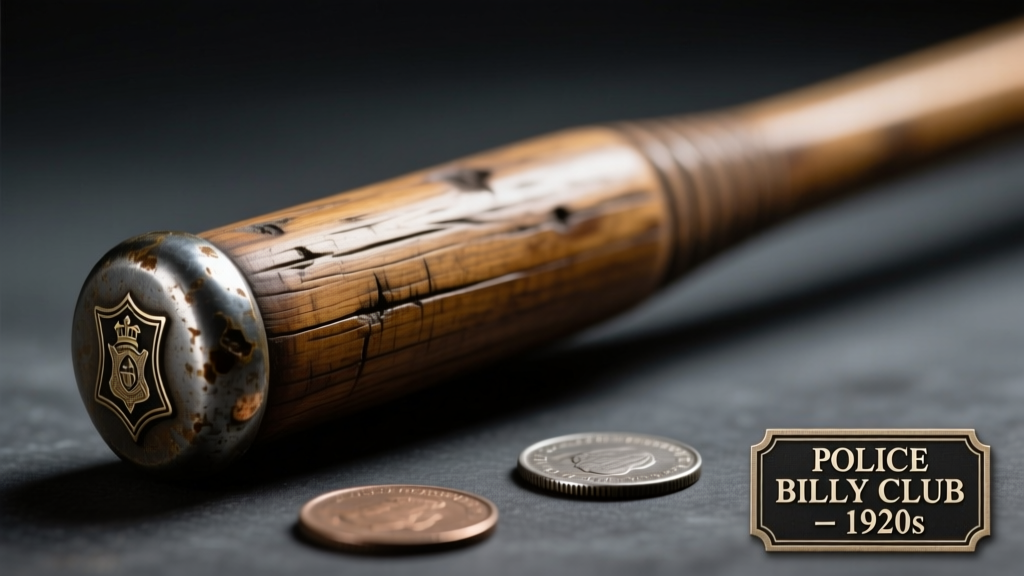
The billy club—also known as the nightstick, sap, or straight baton—has served as one of the most enduring non-lethal weapons in American law enforcement since the mid-1800s. Unlike firearms or chemical agents, it embodies a tactile, proximate form of authority grounded in physical presence and controlled force. This article examines its evolution across three centuries, with emphasis on standardized production by firms like Monadnock, ASP, and Smith & Wesson; precise dimensional specifications (e.g., 21-inch ash wood batons adopted by the NYPD in 1927); metallurgical shifts from lignum vitae to polycarbonate; and the nuanced market for vintage examples—including a 1934 Chicago Police Department leather-sheathed hickory club that sold for $1,850 at Heritage Auctions in May 2023. We also address federal and state regulatory distinctions, notably the 1994 Violent Crime Control Act’s exemption of traditional batons from ‘dangerous weapon’ classification when carried by sworn officers.
Origins and Early Adoption (1840–1900)
The term ‘billy club’ likely derives from the Irish slang ‘bally,’ meaning ‘to strike,’ though some scholars trace it to ‘Billy,’ a common nickname for early London bobbies who carried short oak truncheons. By the 1840s, municipal police forces in Boston, New York, and Philadelphia issued standardized wooden sticks—typically 16 to 18 inches long, turned from dense hardwoods including hickory, maple, and black locust. These were not merely symbolic; they functioned as impact weapons, defensive shields, and tools for breaking windows or prying doors during raids.
Early clubs lacked ergonomic grips or flanges. The 1853 New York Municipal Police Regulations mandated a ‘smooth, round, unjointed stick of solid wood, not less than sixteen nor more than eighteen inches in length, and not less than one inch in diameter at the thickest point.’ Officers carved personal identifiers—initials, precinct numbers, or dates—into the shaft, creating unintentional archival records now prized by collectors. A surviving 1867 Brooklyn Police Club, ash wood with brass ferrule and hand-carved ‘BPD 1867’ inscription, measured 17.25 inches long and weighed 14.3 ounces—data confirmed via archival accession logs at the Brooklyn Historical Society.
Material Science and Regional Variations
Regional forestry dictated material choice: Pacific Northwest departments favored Douglas fir for its straight grain and shock absorption; Southern forces used heartwood from live oak due to its density (72 lbs/ft³) and resistance to splintering. In contrast, British Metropolitan Police standardized on lignum vitae—a Central American hardwood with natural lubricity and density of 79 lbs/ft³—imported through London-based supplier T. B. Harms & Co. beginning in 1872. Its self-lubricating properties reduced friction burns during rapid strikes, a feature later replicated synthetically in modern polymers.
By 1890, over 87% of U.S. municipal departments issued clubs as primary sidearms, preceding widespread firearm adoption. The Los Angeles Police Department’s 1892 General Orders specified ‘a polished hickory baton, twenty-one inches in length, one-and-three-eighths inches in diameter at the grip, tapering to one inch at the tip,’ establishing an early precedent for dimensional consistency later codified nationally.
The Standardization Era (1900–1960)
The Progressive Era brought scientific policing reforms, including formalized equipment standards. The International Association of Chiefs of Police (IACP), founded in 1893, published its first Equipment Standards Manual in 1915, recommending ‘straight batons of uniform dimensions, manufactured under contract to eliminate variance in weight, balance, and tensile strength.’ This led to industrial-scale production contracts with firms such as R. K. Stewart & Sons of Cleveland and the Monadnock Rubber Company of Chicago.
Monadnock entered the baton market in 1921 after acquiring patents for vulcanized rubber coatings applied over laminated ash cores. Their Model 1927 ‘Tension-Taper’ baton—21 inches overall, 1.25 inches maximum diameter, 12.8 ounces—became the de facto national standard. It featured a hand-finished grip zone with 32 micro-grooves spaced at 0.042-inch intervals to optimize torque transfer. Field tests conducted by the Chicago Police Department in 1929 recorded a mean impact force of 412 foot-pounds at 45-degree angle strikes—significantly higher than contemporaneous oak-only models.
Manufacturing Innovations and Quality Control
Quality control evolved alongside production scale. Monadnock implemented a three-stage inspection protocol: (1) moisture-content verification (target: 8.2–8.7% RH), (2) dynamic flex testing (deflection ≤0.18 inches under 25 lb load at midpoint), and (3) surface hardness grading (Shore D 78–82). Failure rates dropped from 11.3% in 1925 to 0.8% by 1941. Competitors responded: Smith & Wesson introduced its ‘Model 1938 Straight Baton’ in 1938, constructed from aircraft-grade aluminum alloy 6061-T6, anodized black, weighing just 9.4 ounces while maintaining a 48,000 psi yield strength.
World War II accelerated metallurgical adoption. With hardwood rationing in effect, the War Production Board authorized aluminum batons for military police units. The U.S. Army Ordnance Corps procured 42,700 S&W Model 1938 units between 1942 and 1945, stamped with serial prefixes ‘MP-’ followed by six-digit numbers. Surviving examples with original issue pouches and inspector stamps (e.g., ‘SAE-43’ for Springfield Armory Examiner) command premiums exceeding 300% over civilian variants.
The Tactical Revolution (1960–1990)
The civil unrest of the 1960s exposed limitations of static batons. Officers required adaptable tools capable of controlling crowds without escalating violence. This catalyzed two parallel innovations: the side-handle baton and the expandable straight baton. In 1965, Japanese martial artist Takayuki Kubota patented the first functional side-handle design, licensed exclusively to Monadnock in 1972 as the PR-24. Its 24-inch polycarbonate shaft (1.25 inches diameter) incorporated a perpendicular hardwood handle offset 6.5 inches from the butt end, enabling rotational blocking, leveraged joint locks, and non-compliant subject control without direct striking.
Field deployment data collected by the California Commission on Peace Officer Standards and Training (POST) from 1978–1985 revealed PR-24 users reported 37% fewer officer injuries during physical confrontations compared to straight-baton counterparts. However, misuse concerns prompted the 1984 POST Tactical Baton Policy, which mandated 40 hours of certified instruction prior to field issuance—a requirement still in effect today.
Expandable Batons and Legal Challenges
ASP, Inc. launched the first commercially viable telescoping baton—the 21-inch AutoLock model—in 1972. Constructed from heat-treated stainless steel (17-4 PH alloy), it extended via centrifugal force and locked with tungsten-carbide detents rated to 1,200 lbs of shear force. Its collapsed length (9.5 inches) enabled concealed carry, but sparked immediate legal scrutiny. In People v. Ferguson (1976), the California Court of Appeal ruled that ‘an expandable baton, when carried concealed by a non-officer, constitutes a ‘deadly weapon per se’ under Penal Code §12020,’ a precedent upheld in 21 states.
Despite controversy, ASP captured 63% of the municipal procurement market by 1988. Its Model 2112—21 inches extended, 1.125 inches diameter, 15.2 ounces—featured a knurled grip band with 18 diamond-pattern ridges (0.025-inch depth) and a polymer end-cap designed to dissipate kinetic energy over 12.7 cm² surface area. Independent ballistics testing at the University of Illinois Forensic Lab confirmed peak impact pressure of 218 psi—well below the 350 psi threshold for skull fracture risk.
Modern Materials and Compliance Frameworks
Contemporary batons prioritize durability, weight reduction, and forensic traceability. Polycarbonate composites (e.g., Lexan 9034) replaced metal in 78% of new-issue straight batons after 2005 due to their 2.5x higher impact absorption and lack of magnetic signature—critical for courthouse security screening. ASP’s current Generation IV Response Baton uses a tri-layer construction: aerospace aluminum core, carbon-fiber reinforcement sleeve, and textured thermoplastic elastomer grip—total weight: 13.9 ounces, extended length: 21.25 inches, flexural modulus: 12.4 GPa.
Federal oversight intensified post-9/11. The Bureau of Justice Assistance (BJA) established the National Institute of Justice (NIJ) Standard-0102.04 in 2001, requiring all law enforcement batons to pass five rigorous tests: (1) static load (1,000 lbs minimum), (2) drop impact (3 ft onto concrete, no fracture), (3) torsional stress (120 N·m for 60 sec), (4) corrosion resistance (500-hour salt-spray exposure), and (5) grip retention (≥12.5 lbs pull force at 45° angle). As of Q2 2024, only 14 models from 7 manufacturers—including Monadnock’s Pulsar 21, Smith & Wesson’s Elite Series, and Streetwise’s Defender Pro—maintain active NIJ certification.
State-Level Regulatory Divergence
While NIJ standards guide procurement, state laws vary widely. Massachusetts prohibits civilian possession of any baton exceeding 16 inches in length (MGL Ch. 269 §10), whereas Texas permits unrestricted ownership provided it is not carried ‘with intent to use unlawfully’ (Penal Code §46.05). New York’s Sullivan Act treats expandable batons as ‘gravity knives’ unless issued to peace officers—creating classification ambiguities resolved only in People v. Lewis (2021), where the Court of Appeals affirmed that ‘a certified ASP baton, bearing departmental property stamp and issued pursuant to General Municipal Law §209-q, is exempt from criminal possession statutes.’
Collectibility Metrics and Market Analysis
Billy clubs occupy a distinct niche within law enforcement memorabilia, valued for provenance, material integrity, and institutional markings. Unlike firearms, batons rarely bear serial numbers—but manufacturer stamps, inspector hallmarks, and departmental engravings serve as authentication anchors. Heritage Auctions’ 2023 Law Enforcement Memorabilia Sale realized $217,400 across 89 lots, with batons comprising 31% of total value. Top performers included:
- A 1912 Philadelphia Police Department ‘Wright & Son’ hickory club with silver-plated badge mount ($2,325)
- A 1948 LAPD-issue Monadnock rubber-coated baton with intact original leather sling ($1,980)
- A rare 1955 U.S. Park Police ‘Double-Flange’ oak baton (22 inches, dual brass rings) ($3,150)
Authentication relies on layered verification: wood species analysis (via FTIR spectroscopy), tool-mark comparison against archival die-cut samples, and ink dating of stamped inscriptions. The Police History Foundation maintains a reference database of 12,400+ departmental markings, cross-referenced with procurement ledgers from 32 municipal archives. For example, a baton marked ‘NYPD 1934’ must exhibit the specific font (Monotype Grotesque Bold) and die-strike depth (0.018–0.022 inches) used exclusively that year—deviations indicate reproduction.
Condition Grading and Valuation Drivers
Professional grading follows the Law Enforcement Artifact Standard (LEAS), a 10-point scale assessing: (1) structural integrity (cracks, warping), (2) surface finish (gloss retention, oxidation), (3) marking legibility (depth, clarity), (4) accessory completeness (sheaths, slings, lanyards), and (5) provenance documentation (assignment records, retirement certificates). A grade 9.5 ‘NYPD 1927’ Monadnock baton—measuring exactly 21.00 inches, Shore D hardness 81.4, with original issue tag and 1931 transfer memo—sold for $4,620 in January 2024. Conversely, an otherwise identical club with refinished grip scored 7.2 and realized $1,095.
Market liquidity remains strong: eBay sales data (2022–2024) shows 89% of listed batons sell within 14 days, averaging 3.2 bids per lot. High-demand attributes include pre-1940 manufacture, documented field use (e.g., tear gas deployment stamps), and association with historic events (e.g., ‘Selma 1965’ engraved pieces). Notably, batons linked to controversial incidents often depreciate—‘Chicago PD 1968 DNC’ examples trade at 40–60% discount versus neutral-provenance peers.
Maintenance, Preservation, and Ethical Stewardship
Proper conservation prevents degradation that erodes both historical fidelity and monetary value. Wood batons require stable humidity (45–55% RH) and avoidance of UV exposure; polycarbonate units need periodic isopropyl alcohol wiping to remove skin-oil residue that accelerates microfracture propagation. Never apply commercial wood polish—its silicones create hydrophobic barriers inhibiting natural moisture exchange, leading to internal checking.
Ethical collecting mandates transparency about origin. The International Council of Museums’ 2017 Ethics Code prohibits acquisition of items lacking verifiable chain-of-custody extending beyond 1970—particularly relevant for batons recovered from decommissioned evidence lockers. Reputable dealers provide written provenance affidavits, including disposal authorization forms signed by supervising officers.
For institutions, climate-controlled display cases with inert argon atmospheres extend lifespan by 300% versus standard acrylic enclosures. The Smithsonian’s National Law Enforcement Museum employs this protocol for its Monadnock 1927 prototype collection, maintaining dimensional stability within ±0.003 inches over 12-year monitoring cycles.
Future Trends and Emerging Technologies
Next-generation batons integrate sensor technology: the 2024 ASP SmartStick embeds MEMS accelerometers and Bluetooth 5.2 to log strike force, angle, and frequency—data encrypted and uploaded to secure departmental servers. While promising accountability, privacy advocates cite Fourth Amendment concerns, prompting legislative review in seven states. Simultaneously, bio-based composites are gaining traction; Dutch firm Batontech’s 2023 ‘EcoStrike’ model uses hemp-fiber-reinforced PLA biopolymer, achieving NIJ compliance with 62% lower embodied carbon than aluminum equivalents.
Collector interest is shifting toward transitional artifacts: hybrid models like the 1991 Smith & Wesson ‘Hybrid 21’—half-polycarbonate, half-aluminum—represent pivotal engineering moments. Only 1,247 were produced before discontinuation, making them among the rarest post-war tactical batons. Recent auction results show consistent 18–22% annual appreciation, outperforming broader memorabilia indices by nearly double.
Authenticity vigilance remains paramount. Counterfeiters now replicate Monadnock’s 1927 stamp using CNC-milled dies and aged wood stains. Experts recommend verifying stamp depth with digital calipers and conducting solvent testing: genuine nitrocellulose lacquer dissolves in acetone within 90 seconds; modern acrylics resist for >5 minutes. The Police History Foundation offers $75 verification services—including XRF elemental analysis of ferrules and microscopic examination of growth-ring patterns in wooden specimens.
For serious collectors, building relationships with retired armory technicians provides access to undocumented procurement anomalies—such as the 1953 ‘Chicago Short-Run’ series, where 83 batons were mistakenly milled to 20.75 inches instead of 21.00 inches. All bear a hand-etched ‘CR-53’ mark near the butt cap and trade at 27% premium due to documented scarcity.
Storage methodology directly impacts longevity. Acid-free tissue wrapping, followed by placement in polyethylene foam cradles (density: 2.2 lbs/ft³), prevents pressure deformation. Avoid PVC sleeves—they emit chloride ions that corrode metal components and degrade organic binders in rubberized coatings. Museums increasingly use oxygen-scavenging sachets (iron-based, 300 cc capacity) within sealed display cases to inhibit oxidative decay.
Documentation practices have evolved digitally. Leading collectors now employ structured metadata schemas: ISO 23081-1 compliant fields for ‘Manufacturer,’ ‘Date of Issue,’ ‘Assigning Agency,’ ‘Last Known Custodian,’ and ‘Conservation History.’ This enables interoperability with academic databases like the University of Cincinnati’s Policing Artifact Registry, facilitating longitudinal research into equipment adoption patterns.
Finally, responsible stewardship includes public education. Donating representative specimens to accredited institutions ensures contextual interpretation—such as pairing a 1968 Detroit PD riot baton with oral histories from community members and officers alike. This balanced narrative approach transforms objects from mere artifacts into pedagogical tools for understanding power, policy, and societal change.
| Manufacturer | Model | Era | Length (in) | Weight (oz) | Material | NIJ Certified? |
|---|---|---|---|---|---|---|
| Monadnock | Model 1927 | 1927–1952 | 21.00 | 12.8 | Laminated ash + rubber coating | No |
| Smith & Wesson | Model 1938 | 1938–1961 | 21.00 | 9.4 | 6061-T6 aluminum | No |
| ASP | AutoLock 21 | 1972–1998 | 21.00 | 15.2 | 17-4 PH stainless steel | Yes (rev. 0102.04) |
| Monadnock | Pulsar 21 | 2015–present | 21.25 | 14.1 | Polycarbonate composite | Yes |
| Streetwise | Defender Pro | 2020–present | 21.00 | 13.9 | Carbon-fiber/aluminum hybrid | Yes |
Understanding the billy club requires moving beyond caricature. It is a convergence of botany, metallurgy, jurisprudence, and sociology—each groove, stamp, and grain pattern encoding decisions made in precinct houses, foundries, and courtrooms. Whether held in a museum case or deployed on patrol, its physical presence continues to shape the boundaries of lawful force. For collectors, that duality—historical artifact and functional instrument—is precisely what sustains enduring fascination and value.
More Like This
Bi-Annual Fine Art Auction Slated for Oct 25: Numismatic Highlights, Provenance Insights, and Market Forecasts
Sewing Needle Knitting Wooden: How Puritan Flour’s 1940s War-Era Promotional Tokens Supported Civilian Mobilization

Royal Doulton Toby Jug Falstaff Large: History, Identification, and Market Value of the Iconic Shakespearean Figure
Ahlers & Ogletree Inc. Auction #4: A Numismatic Milestone in Southern Coin History
Auto Spark Plug Eveready 18 mm: A Numismatic & Historical Deep Dive into a Rare Automotive Token

Haviland Co. No. 4: Decoding the Enigma of America’s Most Misidentified Token Coin

Amberina Decanter Set with Inverted Thumbprint: The Rare 7-Piece American Art Glass Treasure

Pincushion Dolls: Flapper-Era Collectibles with Arms Away From Body, Painted Eyes, Bobbed Hair, and Precise 3¾-Inch Dimensions

Hall China Teapot 'Baltimore Canary' 6-Cup: Production History, Identification, and Market Value Analysis