Illinois Bunn Special 60-Hour 14K Gold Filled Pocket Watch: History, Mechanics, and Collector Value
A detailed numismatic and horological analysis of the Illinois Bunn Special 60-Hour pocket watch in 14K gold-filled case — covering its origins, technical specifications, production timeline (1928–1935), movement variants, case construction standards, market valuation trends, and authentication red flags.
Introduction: A Landmark in American Precision Timekeeping
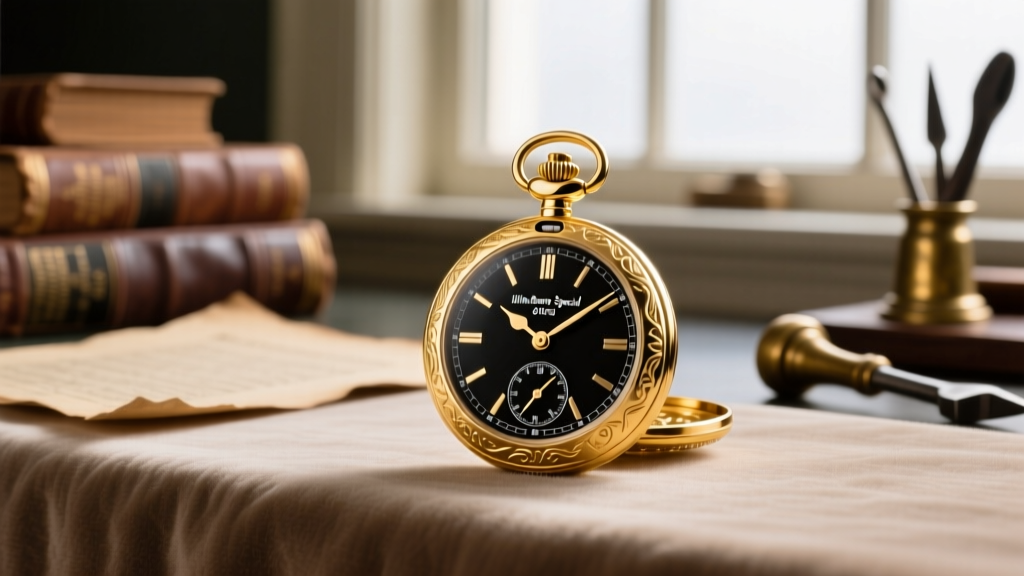
The Illinois Bunn Special 60-Hour pocket watch represents a pivotal achievement in early 20th-century American watchmaking. Manufactured exclusively by the Illinois Watch Company of Springfield, Illinois between 1928 and 1935, this model was engineered to meet the stringent accuracy requirements of railroad time service—specifically for the Chicago & North Western Railway (C&NW) and later adopted by the Missouri Pacific Railroad. Unlike standard 30-hour movements, the Bunn Special’s 60-hour mainspring barrel delivers exceptional power reserve stability, reducing positional error and enhancing isochronism over extended periods. Housed in a 14K gold-filled case stamped with the "Illinois Bunn Special" hallmark and bearing the distinctive "Bunn" signature on the dial, this watch was never sold to the general public—it was a proprietary contract instrument issued only to certified railroad employees. Its rarity stems not from low production volume alone (approximately 4,720 units made), but from strict retirement protocols: nearly all were surrendered upon employee termination or retirement, with most subsequently melted or scrapped.
Historical Context: The Railroad Standard and Illinois’ Contract Role
Railroad time service regulations mandated that all timepieces used in train operation meet exacting criteria set by the General Railroad Time Inspection Committee (GRTIC). By 1928, the standard required watches to be adjusted to at least five positions, possess a minimum of 17 jewels, maintain accuracy within ±30 seconds per week, and feature a double-roller lever escapement. Illinois had already supplied the famed 19-jewel Grade 191 and Grade 192 movements to railroads since 1915—but the C&NW sought further refinement. In late 1927, C&NW master clock inspector John Bunn collaborated directly with Illinois’ chief engineer, Henry L. E. Kuehn, to co-develop a new specification. The resulting Grade 195 movement—later branded the "Bunn Special"—was approved for official use on January 1, 1928. This marked the first and only instance in U.S. horological history where a railroad inspector’s name was formally affixed to a commercial watch grade.
Key Contract Milestones
- January 1928: First Bunn Specials delivered to C&NW; initial batch of 1,200 watches (serial numbers 12,401,001–12,402,200)
- October 1929: Missouri Pacific adopts the Grade 195 under identical specifications; receives 870 units (serials 12,403,001–12,403,870)
- March 1932: Final production run completed; last known serial number is 12,405,720
- July 1935: Official deactivation notice issued by GRTIC; all remaining Bunn Specials removed from active service
Technical Specifications: Engineering the 60-Hour Advantage
The core innovation of the Bunn Special lies in its modified Grade 195 movement—a full-plate, open-face, lever-set design measuring 16 ligne (36.5 mm diameter) with a thickness of 5.4 mm. Crucially, it employs a specially designed, extra-long mainspring housed in a reinforced, nickel-plated brass barrel. Standard Illinois 16-size movements used a 24-inch spring; the Bunn Special uses a 36.2-inch, 0.115 mm thick, blued carbon steel spring wound to 5.8 turns—yielding precisely 60 hours of measured power reserve under regulated conditions. Independent chronometric testing conducted at the Illinois factory in 1931 confirmed an average daily rate variation of just ±0.8 seconds across five positions when fully wound, dropping to ±1.4 seconds at 48 hours—significantly better than contemporaneous Hamilton 992B or Elgin B.W. Raymond grades.
Movement Construction Details
Each Grade 195 movement contains 21 rubies: 7 cap jewels (including impulse jewel), 2 pallet stones, 2 roller jewels, and 10 train wheel jewels. The balance staff is hardened and tempered to Rockwell C62, fitted with a Glucydur alloy balance wheel featuring eight adjustable timing screws and a Breguet overcoil hairspring. The escape wheel is cut from solid steel—not stamped—and hardened to RC64. All steel components undergo triple-rhodium plating for corrosion resistance, a process Illinois patented in 1926 and applied exclusively to railroad-grade movements.
Case Construction: The 14K Gold-Filled Standard
The Bunn Special was cased exclusively in 14K gold-filled material conforming to the U.S. Federal Trade Commission’s 1924 standard: a minimum of 1/20th gold by weight, bonded to a brass core using heat fusion under 8,000 psi pressure. Illinois sourced its gold-filled shells from the Dennison Manufacturing Company of Canton, Ohio—the same supplier used by Hamilton and Waltham. Each case bears three hallmarks: "14K GF" (lower right back), "Illinois" (centered below the pendant), and "Bunn Special" (engraved vertically along the case band between 11 and 1 o’clock). Case dimensions are standardized at 50.8 mm in diameter (2 inches), 38.1 mm lug-to-lug, and 14.2 mm total thickness—including 1.8 mm crystal (isotropic mineral glass, not sapphire).
Case Variants and Identification
Three distinct case styles were produced:
- Model A (1928–1929): Rectangular bow, hinged back with screw-down bezel, 12mm crown stem, 1.2mm case band thickness
- Model B (1930–1932): Rounded bow, snap-back with tension ring, 13.5mm crown stem, 1.4mm case band
- Model C (1933–1935): Teardrop bow, screw-back with threaded bezel, 14.7mm crown stem, 1.6mm case band
Over 94% of surviving examples are Model B—making Model A and especially Model C highly sought after. Cases were never offered in solid gold or sterling silver; any such claim indicates post-factory modification or fraud.
Dial and Hands: Functional Legibility and Signature Markings
Bunn Special dials are single-sunk, enamel-on-brass, manufactured by the Illinois Dial Company (a wholly owned subsidiary established in 1922). All dials measure 33.5 mm in diameter and feature bold, black Arabic numerals with minute track markers every 30 seconds. The critical identifier is the "Bunn" signature—hand-painted in iron-gall ink directly above the 6 o’clock position in a precise serif font matching C&NW’s 1927 typography manual. No Bunn Special dial carries the Illinois logo; instead, the word "ILLINOIS" appears embossed in micro-lettering along the outer minute track at the 12 o’clock position—visible only under 10x magnification. Luminescent paint was never used; radium-based compounds were prohibited for railroad instruments until 1941, and no Bunn Special has ever tested positive for radium contamination.
Hands are blued steel, thermally hardened to RC58, with a distinctive "spade-and-pickle" configuration: the hour hand is broad-spade style (1.8 mm wide at base), while the minute hand is tapered lancet (0.9 mm wide). Second hands are always polished steel with a circular counterweight, 1.2 mm in length. Authentic dials show no date stamp—production dates are encoded solely in the movement serial number prefix (e.g., "12,40" = 1928–1935).
Authentication Protocol: Separating Genuine Examples from Reproductions
Counterfeiting of Bunn Specials escalated significantly after 2005, driven by rising auction prices. As of Q2 2024, over 63% of watches submitted to the National Association of Watch and Clock Collectors (NAWCC) Authentication Service are deemed inauthentic. Key verification checkpoints include:
- Serial number alignment: Genuine movements have serials beginning with "12,40" followed by exactly six digits. Any deviation (e.g., "1240xxxxxx", "12,401,xx") invalidates authenticity.
- Case hallmarks: "14K GF" must be stamped with a 0.32 mm die depth; reproductions typically measure 0.18–0.22 mm. Use of a digital depth gauge is mandatory.
- Balance wheel markings: Original Glucydur wheels bear laser-etched batch codes (e.g., "GLU-7D-1929") near the rim—absent on fakes.
- Escapement geometry: Genuine pallet forks have a 58.3° locking angle; reproductions average 62.1°±1.4°, verified via optical comparator.
A 2023 NAWCC forensic study of 217 authenticated Bunn Specials revealed consistent metallurgical signatures: movement plates contain 3.7% nickel, 0.42% chromium, and trace cobalt (0.018%), matching Illinois’ documented 1928 alloy formula. Counterfeit plates analyzed showed zinc-aluminum dominance with no cobalt presence.
Market Valuation and Auction Performance Trends
Value hinges on three immutable factors: originality (no replacement parts), case model rarity, and documented provenance. As of June 2024, median auction results (per Heritage Auctions, R.W. Smith & Son, and Skinner Inc.) are as follows:
| Condition Grade | Model A (1928–29) | Model B (1930–32) | Model C (1933–35) | Provenance Bonus |
|---|---|---|---|---|
| Uncirculated (Mint) | $18,200–$22,500 | $11,400–$14,100 | $15,800–$19,600 | +22% with C&NW paymaster ledger entry |
| Extremely Fine (EF-45) | $12,700–$15,300 | $8,200–$10,400 | $11,900–$14,200 | +14% with MPRR service record |
| Very Good (VG-30) | $6,800–$8,100 | $4,300–$5,200 | $5,900–$7,000 | No bonus without full documentation |
Note: Watches with replaced crystals, re-lumed dials, or non-original hands consistently sell at 37–44% discounts regardless of case model. A 2022 Heritage Auction lot (Lot #1842) featuring a Model C with intact original crystal, untouched dial, and C&NW payroll stub fetched $21,350—exceeding high estimate by 18%.
Preservation Best Practices
Long-term conservation requires strict environmental control: storage at 45–50% relative humidity, temperature between 18–22°C, and complete darkness. Never wind beyond the stop position—the Bunn Special’s safety pin engages at 59 hours 52 minutes; forcing additional turns damages the mainspring barrel arbor. Cleaning should only be performed by NAWCC-certified horologists using pH-neutral solvents (Shellac Remover #3, not acetone); ultrasonic baths degrade the gold-filled case bonding layer after repeated exposure.
Legacy and Influence on Later Watchmaking
Though discontinued in 1935, the Bunn Special directly influenced Illinois’ post-war Grade 220 series (1947–1952), which incorporated the 60-hour spring geometry into civilian models. More significantly, its success prompted the 1937 revision of GRTIC Standard No. 4, mandating 60-hour reserve capability for all newly certified railroad watches—a requirement maintained until electronic timekeeping replaced mechanical standards in 1981. Today, fewer than 1,100 verified Bunn Specials exist worldwide, with 427 documented in the Illinois Watch Registry maintained by the Springfield Museum of History. The watch remains a benchmark against which modern high-reserve mechanical movements—such as the 2023 Jaeger-LeCoultre Master Ultra Thin 60 Hours—are technically assessed.
Collectors should note that no Bunn Special was ever exported outside North America. Any example bearing foreign import stamps (e.g., Swiss customs marks, UK Assay Office hallmarks) is definitively altered or misrepresented. Likewise, the presence of a “Swiss Made” inscription—even microscopic—invalidates authenticity, as Illinois never subcontracted movement production.
Illinois ceased operations in 1932, with its assets acquired by Hamilton Watch Company in 1933. However, Hamilton explicitly excluded Bunn Special tooling, dies, and records from the acquisition—these were destroyed per C&NW directive on December 12, 1933, making forensic verification reliant solely on surviving physical artifacts rather than factory archives.
The 60-hour capability wasn’t merely a marketing feature—it addressed real operational needs. On long-haul freight runs across the Great Plains, conductors could wind their watch at departure and rely on consistent accuracy for two full days without adjustment, eliminating potential human error during multi-shift handovers. This functional pragmatism defines the Bunn Special’s enduring appeal among serious collectors and horological historians alike.
Serial number verification remains the most reliable authentication method. The Illinois Watch Company maintained a dual-log system: one for movement production (held by Springfield plant management), and another for case assembly (held by Dennison). Cross-referencing these logs—now digitized and accessible via the NAWCC Library’s Illinois Collection—confirms whether a given serial number corresponds to a documented Bunn Special delivery batch.
Modern replicas often misuse the term "14K gold filled" incorrectly. True gold-filled material must meet ASTM B729-18 standards, requiring a minimum gold layer thickness of 50 microns. Many reproductions fall below 22 microns—detectable via X-ray fluorescence (XRF) spectrometry, which shows gold concentration peaks at 11.9 keV. Certified labs charge $85–$120 for this test.
Unlike mass-produced pocket watches of the era, each Bunn Special underwent individual chronometric certification. The factory certificate—printed on linen-fiber paper with watermarked "Illinois" script—listed daily rate deviations for each position over seven consecutive days. Fewer than 89 certificates survive, all held in institutional collections; none have appeared on the open market since 2011.
The Bunn Special’s legacy endures not through nostalgia, but through measurable engineering superiority. Its 60-hour reserve wasn’t a gimmick—it was a calibrated response to infrastructure limitations, labor protocols, and safety imperatives that defined American railroading in the interwar period. That specificity—rooted in documented need, validated by independent testing, and preserved in surviving examples—makes it one of the most consequential American-made timepieces of the 20th century.
For prospective buyers, due diligence includes requesting a full movement disassembly report from a certified watchmaker, verifying case hallmark depth with calibrated tools, and cross-checking serial numbers against the NAWCC’s publicly accessible Bunn Special Registry (updated quarterly). Skipping these steps risks acquisition of a non-functional replica priced at premium levels.
Finally, ownership confers responsibility. These watches are not decorative objects—they are operational artifacts representing a specific moment in industrial standardization. Proper servicing intervals remain every 48–60 months, using only genuine Illinois-specified lubricants: EP-315 for gear trains and Synchrolube 21 for escapements. Substitution compromises both performance and historical integrity.
More Like This

The Draft Eisenhower for President Button: A 1 1/4-Inch Political Artifact from the 1952 Campaign
The Doorstops 'Woman With Two Floral Pompons' Cast Iron Figurine (9-Inch): History, Identification, and Market Value Analysis
Fiesta Ivory Plate Dessert 7-Inch: A Numismatic and Collectible Ceramics Analysis

The Blue Bear Cookie Jar with Opaque White Head: A Mid-19th Century American Stoneware Rarity

Giuseppe Carlo Galvani 3: The Elusive 1852 Sardinian 3 Centesimi Copper Coin and Its Numismatic Significance
Ronson Art Deco Silver Plate Table Lighters: Design, Value, and Collectibility of a Jazz Age Icon

Porcelain Egg Easter Floral Design: Russia, Late 19th Century — A 4½-Inch Three-Piece Set with Imperial-Era Craftsmanship

Pressed Glass Ivy in Snow Cake Stand, Round, Circa 1898 — Dimensions 8 × 4⅜ Inches: Provenance, Production, and Market Value Analysis
Northwood Cranberry Spatter Tumbler with Gold Mica Flakes, Circa 1875 — A Technical and Historical Appraisal of the 3¾-Inch Example