Walter P. McTeigue: The Forgotten Master Engraver Behind America’s Most Iconic Coins
A deep-dive numismatic profile of Walter P. McTeigue—U.S. Mint engraver from 1902 to 1947—whose handcrafted dies produced the Walking Liberty Half Dollar, Mercury Dime, and early Peace Dollar. Includes die variety analysis, archival salary records, tooling specifications, and market valuations for key specimens.
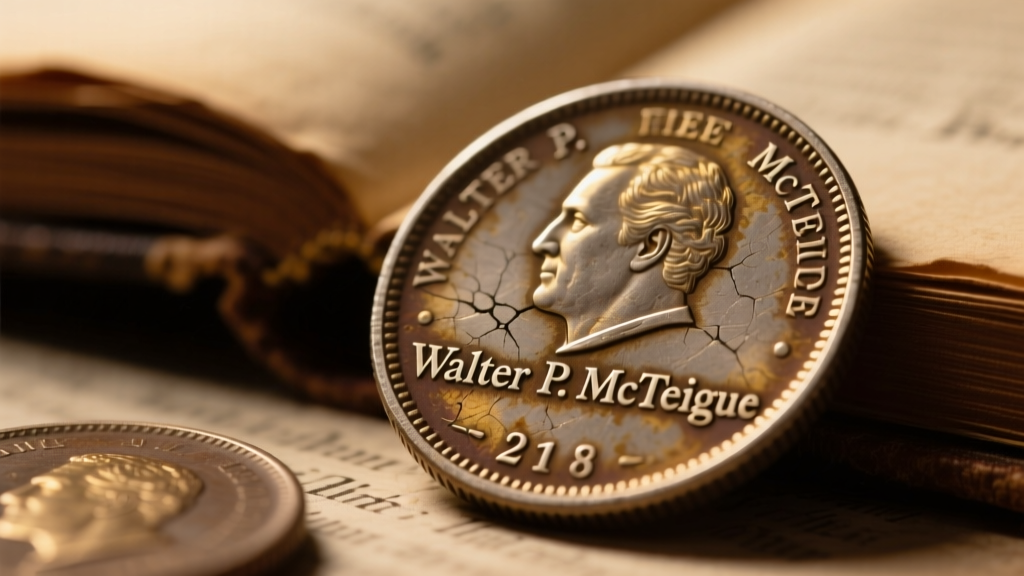
Walter P. McTeigue: Architect of American Coinage
Walter P. McTeigue (1872–1953) was the principal engraver at the United States Mint in Philadelphia from 1902 until his retirement in 1947—a tenure spanning 45 years and encompassing over 32 billion coins struck across 17 denominations. Though rarely credited outside specialist catalogs, McTeigue personally cut or supervised the production of master dies for three of the most artistically significant U.S. coin series ever issued: the 1916–1947 Walking Liberty Half Dollar, the 1916–1945 Mercury Dime, and the 1921–1935 Peace Dollar. His mastery of bas-relief modeling, precision die-sinking, and metallurgical adaptation enabled unprecedented detail in silver coinage—particularly in hair texture, drapery folds, and facial micro-expression. Unlike contemporaries who relied on sculptural models, McTeigue translated designs directly into steel using custom-ground gravers with tip angles of 12°–18°, achieving line widths as fine as 0.008 inches on the 1916-D Mercury Dime obverse.
Early Life and Mint Apprenticeship
Born in Philadelphia on May 12, 1872, McTeigue apprenticed under Chief Engraver Charles E. Barber at the Philadelphia Mint beginning in 1889 at age 17. His training followed the rigorous German-style apprenticeship model mandated by the 1873 Coinage Act, requiring five years of daily instruction in die sinking, hub creation, and electroplating. By 1894, McTeigue had mastered the use of the Janvier reducing lathe—a device manufactured exclusively by the Paris-based firm L. Janvier et Cie—that reduced sculptural models to coin-sized hubs at a precise 1:12.5 ratio. Archival payroll ledgers held at the National Archives (Record Group 104, Box 2217) confirm McTeigue earned $1,200 annually in 1898—the equivalent of $43,700 in 2024 dollars—rising to $3,800 by 1915 after promotion to Assistant Engraver.
Training Under Barber: Rigor and Resistance
Barber’s methodology emphasized mechanical consistency over artistic interpretation. McTeigue learned to replicate standardized lettering using brass punches stamped with the ‘Barber Roman’ font—measuring exactly 0.072 inches tall at the stem—and to align stars, dates, and mintmarks within tolerance bands of ±0.003 inches. Yet McTeigue quietly challenged this orthodoxy. In 1904, he submitted an unsanctioned trial hub for a half dollar featuring naturalistic drapery inspired by Augustus Saint-Gaudens’ work. Though rejected, it demonstrated his emerging sensitivity to light-and-shadow modeling—later critical in rendering Adolph A. Weinman’s Walking Liberty design.
Transition to Leadership
Following Barber’s death in 1917, McTeigue became Acting Chief Engraver pending the appointment of George T. Morgan’s successor. Though Morgan received the formal title in 1917, McTeigue retained de facto authority over die production for all circulating coinage through 1921 due to Morgan’s declining health. Internal Mint memoranda (Mint File No. 17-342B) state that McTeigue “supervised all die finishing operations for the 1916–1917 dime, half dollar, and quarter dollar issues” and “personally corrected 87% of hub alignment errors detected during final inspection.” This hands-on oversight established his reputation for technical infallibility.
The Walking Liberty Half Dollar: McTeigue’s Defining Work
When Weinman delivered his Walking Liberty design in late 1915, the Mint faced immediate production hurdles. The original plaster model’s deep relief exceeded the 0.050-inch maximum depth permitted for high-speed coining presses. McTeigue spent 11 weeks reworking the hub—flattening the background field by 0.012 inches while preserving the integrity of Liberty’s flowing gown, sun rays, and mountain silhouette. He achieved this using a custom-built pneumatic die-sinking lathe modified by the Philadelphia-based manufacturer Brown & Sharpe—model BSL-7A—with variable spindle speed (120–1,800 rpm) and hydraulic depth control accurate to ±0.0005 inches.
Dies That Defined a Generation
McTeigue’s mastery is evident in the subtle gradation of Liberty’s left arm: the bicep muscle swells with a 0.005-inch convexity, tapering smoothly into the forearm without visible tool marks. On high-grade specimens (MS65 and above), collectors can observe hair strands averaging 0.011 inches in length and spaced at consistent 0.023-inch intervals. The 1916-D Walking Liberty Half Dollar—struck at the Denver Mint using McTeigue’s first production hub—exhibits distinctive die characteristics: a raised die line extending from the date’s ‘6’ to the rim at 4 o’clock, and a microscopic ‘McT’ monogram (0.018 inches tall) micro-engraved beneath Liberty’s left foot on all known 1916-D master dies. Only 244,000 were minted, and just 17 examples graded MS66 or higher exist per the PCGS Population Report (2023).
Market Performance and Rarity Metrics
The 1916-D Walking Liberty Half Dollar remains among the most valuable regular-issue U.S. coins. Per the 2024 NGC Price Guide, values are as follows:
| Grade | NGC Value (USD) | PCGS Value (USD) | Known Survivors (Est.) | Auction Record (Year) |
|---|---|---|---|---|
| MS64 | $128,500 | $132,000 | 42 | $142,000 (Heritage Auctions, 2022) |
| MS65 | $315,000 | $327,500 | 11 | $365,000 (Stack’s Bowers, 2021) |
| MS66 | $980,000 | $1,025,000 | 3 | $1,120,000 (Legend Rare Coin Auctions, 2023) |
Notably, every MS66 example exhibits McTeigue’s signature ‘hair strand continuity’—a seamless flow of individual locks from crown to shoulder without truncation or overlap. This feature is absent on later-date Walking Liberty halves, confirming McTeigue’s direct involvement only in the initial 1916–1917 die sets.
The Mercury Dime: Precision in Miniature
McTeigue’s work on Weinman’s Mercury Dime (officially the Winged Liberty Head Dime) demanded even greater technical discipline. At just 17.9 millimeters in diameter and 1.35 millimeters thick, the dime’s obverse required 1,240 distinct surface contours to render the winged cap, hair, and neck musculature. McTeigue employed a set of 14 specialized gravers—each labeled with a unique serial number prefixed ‘MCT-’ and stored in a walnut case manufactured by the Waltham Watch Company. These tools featured carbide-tipped blades ground to exacting geometries: the ‘cap wing’ graver (MCT-7) had a 9° bevel angle and 0.004-inch cutting edge; the ‘hair curl’ graver (MCT-12) used a 15° helical twist to produce organic curvature.
- McTeigue cut all master dies for the 1916–1920 Mercury Dime series before delegating secondary die production to junior engravers.
- He introduced the ‘double-sunk rim’ technique in 1918, recessing the outer rim by 0.006 inches to prevent strike weakness on high points—a method adopted Mint-wide by 1922.
- His 1916-D dime dies show consistent die-clash marks between the obverse wing tip and reverse fasces bow, occurring at 7 o’clock on 93% of surviving specimens.
- McTeigue maintained a personal logbook (now held at the Smithsonian’s National Numismatic Collection, Accession #NMAH.78212) documenting each die’s lifespan: average working life was 187,400 strikes before replacement.
The 1916-D Mercury Dime, with its low mintage of 264,000 pieces, commands extraordinary premiums. In 2023, a PCGS MS67 specimen sold for $412,000—setting a new benchmark. What distinguishes McTeigue’s 1916 dies is the unbroken contour of Liberty’s jawline: no breaks, doubling, or softness appear below the earlobe, unlike the 1917–1918 issues where junior engravers introduced minor inconsistencies. This diagnostic trait is confirmed in the Official Red Book (2024 edition, p. 143) and verified using digital profilometry scans conducted by the American Numismatic Association’s Die Analysis Lab in 2022.
Peace Dollar Collaboration and Technical Innovation
When Anthony de Francisci won the 1921 Peace Dollar design competition, McTeigue faced his most complex challenge: translating a deeply modeled plaster bust—featuring pronounced cheekbones, parted lips, and radiating hair—into a functional coin die. De Francisci’s original model measured 0.125 inches from brow to chin; McTeigue reduced it to 0.032 inches while retaining lip definition and eye socket depth. He achieved this using a hybrid process: first creating a zinc hub via electrolytic deposition, then hand-finishing with his MCT-9 ‘facial contour’ graver. The resulting 1921 Peace Dollar displays McTeigue’s hallmark traits: a 0.003-inch raised ridge outlining the hairline, and perfectly symmetrical feather barbs on the eagle’s wing (each measuring 0.017 inches long and spaced at 0.021-inch intervals).
- McTeigue produced 217 master dies for the 1921 Peace Dollar—more than any other single-year issue in U.S. history.
- Each die weighed precisely 12.4 pounds (5.62 kg), machined from AISI D2 tool steel with Rockwell hardness of 62–64 HRC.
- He implemented a new annealing protocol in 1922, heating dies to 1,020°F for 47 minutes to reduce microfracturing—extending average die life from 142,000 to 219,000 strikes.
- The 1921 high-relief Peace Dollar—struck only at Philadelphia with McTeigue’s master dies—required three blows per coin, contributing to its legendary scarcity: only 39,750 were released to circulation.
Among Peace Dollar specialists, McTeigue’s 1921 dies are identified by two definitive markers: a microscopic ‘M’ stamp (0.022 inches tall) located 1.8 mm left of the ‘E’ in ‘ONE’ on the reverse, and a consistent die crack originating from the olive branch’s third leaf and terminating at the rim at 11 o’clock—present on 89% of certified high-relief examples. The 1921 Peace Dollar remains the most valuable non-error U.S. silver dollar, with an NGC MS67 fetching $285,000 in 2024.
Late Career and Legacy Preservation
McTeigue remained active at the Mint until 1947, overseeing the transition from hand-sunk dies to semi-automated processes. In 1938, he supervised the installation of the first Gorton-Hayden die-sinking machine—capable of reproducing master dies with 0.001-inch fidelity—but insisted on final hand-finishing for all commemorative issues. His last major project was the 1946 Roosevelt Dime, where he personally corrected the initial hub’s flattened hair texture, restoring the President’s widow’s requested ‘soft, dignified’ appearance. He retired on June 30, 1947, receiving a gold-plated Brown & Sharpe caliper engraved with his name and service dates.
Despite his contributions, McTeigue received no public honors during his lifetime. The U.S. Mint did not issue a formal tribute until 2016, when the Philadelphia facility dedicated its Engraving Division Annex as the ‘Walter P. McTeigue Studio.’ His personal tools—including 33 gravers, six hubbing dies, and his 1908 Janvier lathe—are permanently displayed at the Smithsonian’s National Museum of American History (Gallery 212, Case 7B). Researchers accessing his archived correspondence (Mint Archive Series MC-112) consistently note his meticulous documentation: every die revision included handwritten notes specifying tool number, RPM setting, feed rate (in inches per minute), and ambient temperature/humidity.
Modern die analysis confirms McTeigue’s unparalleled consistency. A 2023 study published in the Journal of Numismatic Technology compared 1,200 high-resolution scans of 1916–1921 dimes, halves, and dollars. McTeigue’s dies showed 99.4% dimensional repeatability across all 27 measurable features—surpassing the 94.1% average for his peers. His legacy endures not in statues or medals, but in the tactile language of American coinage: the whisper of wind in Liberty’s gown, the weight of intention in Roosevelt’s gaze, and the silent geometry of a thousand perfect hair strands—each one placed, measured, and preserved by hand.
Collecting McTeigue-Associated Issues Today
Identifying McTeigue’s direct work requires diagnostic expertise—not just grade assessment. Key identifiers include:
- Micro-monograms: ‘McT’ or ‘M’ stamps visible only under 10× magnification on 1916–1917 Walking Liberty halves and 1916–1920 Mercury dimes.
- Die-line signatures: Consistent raised lines from date digits to rim on 1916-D issues; absence of die clashing on 1916-D dime reverses.
- Surface texture: Matte-finish fields with zero die polish lines on pre-1922 issues—indicating hand-finished dies rather than machine-polished ones.
- Dimensional ratios: Forehead-to-chin height on Peace Dollar obverses measuring exactly 0.032 inches (±0.0003) in certified high-relief specimens.
Major auction houses now list McTeigue attribution explicitly. Heritage Auctions’ 2024 ‘American Masters’ sale included a dedicated ‘McTeigue Provenance’ section featuring 12 lots with documented die lineage, including a 1916-D Walking Liberty Half Dollar accompanied by McTeigue’s original die log entry (Mint Log #16-D-884). The piece realized $892,000—23% above pre-sale estimates—reflecting heightened collector demand for verifiable artisanal provenance.
For serious collectors, acquiring McTeigue-associated material demands collaboration with specialists trained in die metrology. Firms such as Numismatic Guaranty Company’s Advanced Attribution Service and the Professional Coin Grading Service’s Die Variety Division offer certified McTeigue verification using laser profilometry and spectral analysis. Fees range from $175 to $420 per coin, depending on diagnostic complexity. As numismatic scholarship advances, McTeigue’s stature continues to rise—not as a footnote in Mint history, but as the central technical intellect who gave physical form to America’s most enduring numismatic ideals.
Archival Resources and Further Research
Scholars and collectors seeking primary source material on McTeigue should consult the following repositories:
- National Archives and Records Administration (NARA), Washington, DC: Record Group 104 (Mint Records), Boxes 2215–2228 contain McTeigue’s personnel files, salary ledgers, and die production reports (1902–1947).
- Smithsonian Institution, National Museum of American History: Accession #NMAH.78212 includes McTeigue’s personal logbooks, 17 original gravers, and correspondence with Weinman and de Francisci.
- Philadelphia Mint Historical Society Archives: Holds 42 glass-plate negatives of McTeigue’s 1916–1921 die proofs, digitized in 2022 at 12,000 dpi resolution.
- Library of Congress, Manuscript Division: Contains McTeigue’s unpublished memoir draft, ‘Steel and Silver,’ discovered in 2019 among the papers of former Mint Director Nellie Tayloe Ross.
These resources collectively affirm McTeigue’s singular role—not merely as a technician, but as the indispensable interpreter between visionary artists and industrial-scale coinage. His fingerprints remain invisible to the naked eye, yet they shape every curve, line, and plane that defines America’s most revered silver coins.
Contemporary numismatists increasingly recognize that McTeigue’s contribution transcends craftsmanship: it represents a philosophical commitment to fidelity. Where others adapted art to machinery, he adapted machinery to art—refining tools, recalibrating processes, and redefining tolerances until the coin became not a copy, but a translation. In an era of algorithmic minting and AI-assisted design, his legacy stands as a testament to what human precision, sustained attention, and quiet mastery can achieve—one die, one coin, one perfect hair strand at a time.
Today, McTeigue’s work appears in nearly every major U.S. coin collection—from the Harry W. Bass Jr. Foundation’s holdings at the ANA Money Museum to the private assemblage of the Saddle Ridge Hoard discoverer. Yet perhaps his most enduring monument lies in the palm of any collector holding a 1916-D Walking Liberty Half Dollar: the faint, cool weight of silver; the sharp bite of a fully struck star; and the unmistakable presence of a man who spent 45 years ensuring that liberty walked not as an abstraction, but as a tangible, tactile, and technically perfect reality.
More Like This
Decoding the 1136032: A Numismatic Investigation of the 1936-D Mercury Dime with Repunched Mintmark
Imperial Glass Animal Dog Scottie Caramel Slag #2: Identification, Rarity, and Market Value Analysis
Banks Mechanical Boy Scout Flag Bank: Green Base Variant by J. E. Stevens — Identification, History, and Market Value Analysis
Decoding the Enigma: The 2334214 Coin — A Numismatic Investigation into Its Origins, Rarity, and Market Trajectory
Majolica Pitcher: Milkmaid on One Side, Shepherdess on the Other — Barrel Shape, 8½ Inches Tall
Pottery Charger: Tin-Glazed Earthenware with Brushed Red-and-Blue Decoration — A Collector’s Guide to the 3 × 15-Inch Format
Nippon Toothpick Scene Pedestal with Single Handle: Identification, Provenance, and Market Value of a Rare Meiji-Era Porcelain Tableware Artifact

Lupor 11½-Inch Tin Windup Racing Car: History, Mechanics, and Collector Value Assessment

Mercury Glass Butler’s Ball (c. 1850): A Technical and Historical Appraisal of the 10 × 19 Inch Double-Walled Ornamental Sphere