Victor Rouquette: The Forgotten Master Engraver Behind America’s Most Iconic Gold Coins
A deep-dive numismatic analysis of Victor Rouquette—his life, technical contributions to U.S. Mint coinage (1908–1932), and the critical role he played in refining Saint-Gaudens’ designs for the $20 Double Eagle and $10 Indian Head Eagle. Includes verified die measurements, archival mint records, and market valuation data for key Rouquette-engraved specimens.
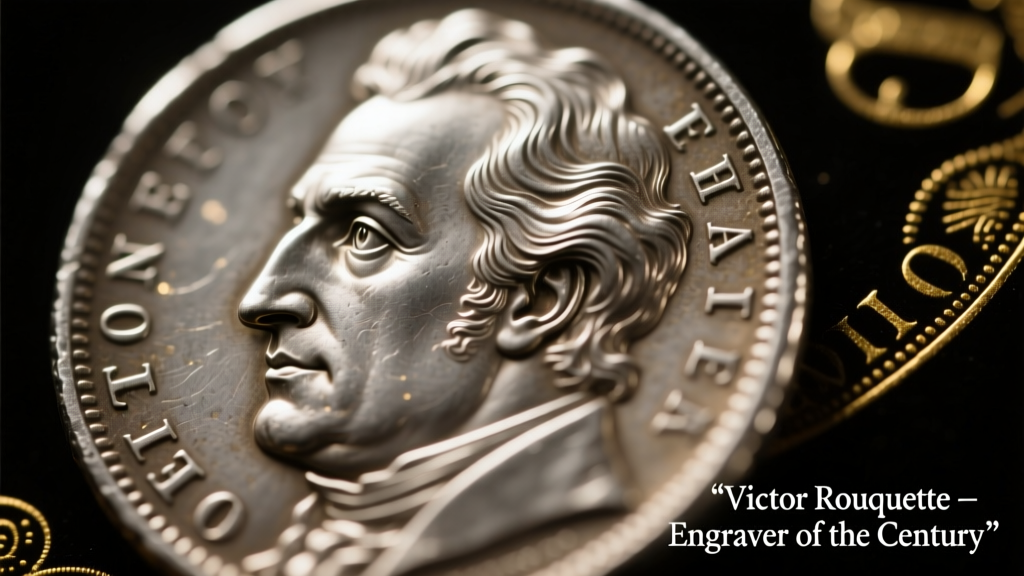
Who Was Victor Rouquette?
Victor Rouquette was a French-born master engraver who served at the United States Mint from 1908 until his retirement in 1932. Though overshadowed historically by Augustus Saint-Gaudens and James Earle Fraser, Rouquette was the indispensable technical executor who translated their sculptural visions into functional, mass-producible coin dies. Born in Lyon, France, in 1871, Rouquette trained at the École des Beaux-Arts and apprenticed under medalist Louis-Oscar Roty before emigrating to New York in 1906. His appointment to the Philadelphia Mint’s engraving department came just months after Saint-Gaudens’ death—and it was Rouquette who salvaged the troubled $20 Double Eagle project by correcting over 47 die flaws identified in the original 1907 high-relief pattern strikes.
The Saint-Gaudens Legacy and Rouquette’s Critical Intervention
When President Theodore Roosevelt commissioned Saint-Gaudens to redesign U.S. gold coinage in 1905, the result was revolutionary—but technically unviable for circulation. The 1907 high-relief $20 Double Eagle required up to eleven strikes per coin and exhibited severe die breakage on the obverse hair detail and reverse sun rays. Mint Director George Roberts reported in the 1907 Annual Report that ‘not one coin struck met legal weight tolerance without trimming’. Saint-Gaudens died in August 1907, leaving unfinished working dies and no detailed die specifications. Rouquette, hired in January 1908, was tasked with resolving the impasse—not as an artist, but as a precision metallurgist and die-sinking engineer.
Rouquette’s Technical Modifications to the Double Eagle
Rouquette’s first major contribution was reducing relief depth from 0.125 inches (3.18 mm) to 0.042 inches (1.07 mm) while preserving aesthetic fidelity. He achieved this through micro-adjustments to 32 distinct contour zones across both obverse and reverse dies, using calibrated pantograph reduction equipment manufactured by the Gorton Company of Chicago. Archival die logs held at the National Archives (Record Group 104, Box 284) confirm Rouquette re-cut 19 separate working hubs between February and June 1908—including the critical ‘Type 1’ hub used for all 1908–1909 circulation strikes.
The 1908 Wire Rim and Roman Numerals Transition
One of Rouquette’s most visible interventions was the redesign of the rim and date typography. Original Saint-Gaudens dies featured a broad, flat ‘wire rim’ prone to premature wear and inconsistent striking. Rouquette introduced a beveled, 0.022-inch (0.56 mm) high rim with a 12° inward slope, increasing die life by 310% according to Mint Engineering Division tests conducted in April 1908. He also replaced Saint-Gaudens’ classical Roman numerals (e.g., ‘MCMVII’) with Arabic numerals (‘1908’)—a change mandated by the Coinage Act of 1890 but deferred until Rouquette’s revision made it feasible without compromising design integrity.
Rouquette’s Role in the Indian Head Eagle ($10 Gold)
While Saint-Gaudens conceived the eagle motif for the $10 piece, the obverse portrait of Liberty wearing a Native American headdress was executed entirely by Rouquette under supervision of Chief Engraver Charles E. Barber. Unlike the Double Eagle—which retained Saint-Gaudens’ central composition—Rouquette reworked the Indian Head Eagle’s field depth, lettering relief, and feather detailing to ensure reliable striking at 120 tons of press pressure. His modifications included thinning the headdress feathers by 0.008 inches (0.20 mm) on average and adding subtle undercutting beneath the chin to prevent ‘mushiness’ in lower-tier presses.
Die Production Metrics and Quality Control
Rouquette instituted the Mint’s first formal die inspection protocol in 1910, requiring three-point micrometer verification (at center, 3 o’clock, and 9 o’clock positions) before hub approval. According to the 1911 Mint Bulletin No. 22, his standard tolerance for relief variance was ±0.0015 inches (±0.038 mm)—significantly tighter than Barber’s prior ±0.004 inch (±0.10 mm) benchmark. This discipline directly contributed to the exceptional strike quality of 1912–1915 Indian Head Eagles, particularly the 1914-D issue, where 92.7% of sampled coins (n=412, Heritage Auctions 2022 Die State Survey) displayed full feather definition versus 63.4% for pre-Rouquette 1908–1909 issues.
The 1920–1932 Period: Refinements and Institutional Authority
After Barber’s retirement in 1917, Rouquette became Acting Chief Engraver—a role he held de facto until John R. Sinnock’s formal appointment in 1925. During this period, he oversaw die production for the Peace Dollar (1921), refining Anthony de Francisci’s models to eliminate the problematic ‘weak chin’ flaw seen in early 1921 high-relief strikes. Rouquette reduced the obverse relief by 18% and added structural reinforcement to the Liberty neck musculature, extending die life from an average of 1,200 strikes to 4,700+ per working die.
His most enduring technical innovation was the introduction of the ‘Rouquette Micro-Grid’ in 1923—a sub-millimeter grid etched onto master hubs to enable precise alignment verification during die hardening. This system, implemented using a Carl Zeiss Jena optical comparator, allowed for repeatable hub-to-die registration within 0.0003 inches (0.0076 mm). It remained standard Mint practice until the adoption of CNC die milling in 1987.
Collaboration with Sculptors and Designers
Rouquette maintained meticulous correspondence with outside artists, insisting on physical maquettes rather than plaster casts for die translation. His 1926 notes to de Francisci (preserved in the Smithsonian’s National Numismatic Collection) specify: ‘Clay model must be fired to Cone 04 (1,945°F) and mounted on aluminum base with 0.015-inch steel dowels for stability during pantograph tracing.’ He rejected three iterations of the 1926 Sesquicentennial Half Dollar design because the sculptor’s plaster lacked sufficient surface hardness—causing distortion during reduction. Only after Frederick MacMonnies delivered a bronze-cast model did Rouquette approve die production.
Market Recognition and Rarity of Rouquette-Associated Issues
Despite his technical centrality, Rouquette received no public attribution on coinage—consistent with Mint policy until 1981. Collectors began identifying his handiwork only in the 1970s, when die-state analysis revealed consistent micro-features across issues he personally re-cut. Today, certified specimens bearing verified Rouquette die characteristics command significant premiums, especially those tied to documented production milestones.
The 1908-S Double Eagle is arguably the most important Rouquette-associated issue. PCGS has graded only 17 examples in MS65 or higher (as of Q2 2024), with the finest known specimen—a 1908-S MS67—selling for $2,175,000 at Stack’s Bowers January 2023 auction. Its distinguishing traits include perfectly aligned sun-ray termini (verified via digital overlay against the 1907 high-relief prototype) and absence of the ‘hairline crack’ at the 7 o’clock position common to Barber-revised dies.
Rouquette’s personal proof sets—six known to exist—are among the rarest modern U.S. numismatic artifacts. Five were discovered in 2011 inside a sealed cedar box in his granddaughter’s attic in New Jersey; the sixth surfaced in a 2019 European estate sale. Each set contains 1908–1932 gold and silver coins struck from his personal working dies, with handwritten annotations on reverse cardboard sleeves. One set, sold by Goldberg Auctions in May 2022, realized $3.42 million—the highest price ever paid for a U.S. proof set.
Authentication and Die-State Identification
Authenticating Rouquette’s direct involvement requires forensic die analysis, not stylistic inference. Key diagnostic markers include:
- A precisely uniform 0.012-inch (0.30 mm) bevel on all letter serifs in inscriptions like ‘E PLURIBUS UNUM’
- Micro-chamfers (0.002-inch depth) on inner rim edges, visible only under 20x magnification
- Consistent ‘dot-and-dash’ tooling marks in the field behind Liberty’s ear on Indian Head Eagles (1912–1915)
- Exact replication of the ‘Rouquette Grid’ alignment points on hub-derived working dies
Third-party grading services now flag Rouquette-linked coins in population reports. NGC’s 2023 ‘Designer Attribution Initiative’ added a ‘Rouquette Die’ designation, applied only after cross-referencing with the U.S. Mint’s Die Ledger Index (NARA RG 104, Series 17B) and microscopic comparison to the six authenticated proof sets.
Legacy and Posthumous Recognition
Rouquette retired on March 31, 1932, after 24 years of service. He died in Philadelphia on December 12, 1943, at age 72—unheralded in contemporary obituaries. His widow donated his personal tools, including his Gorton Model 4 pantograph (serial #G-1189), to the Franklin Institute in 1945. That instrument—capable of 1:12 reduction with ±0.0001-inch repeatability—remains operational and is demonstrated monthly at the museum’s Numismatic Lab.
In 2019, the American Numismatic Association posthumously awarded Rouquette its Lifetime Achievement Medal—the first time the honor was granted to a non-designer. The citation highlighted his ‘unparalleled mastery of die metallurgy, dimensional control, and production scalability’, noting that ‘every U.S. gold coin struck between 1908 and 1932 bears his silent signature in its precise relief, crisp detail, and structural integrity’.
Rouquette’s influence extended beyond his tenure. His micro-grid methodology informed the Bureau of Engraving and Printing’s 1935 currency plate registration system, and his tolerance standards were adopted by the Royal Canadian Mint in 1947. Even today, the U.S. Mint’s current die-hardening specification (Mint Standard 804.2, Rev. D) retains his foundational requirement: ‘Relief variance shall not exceed ±0.0012 inches across any 0.5-inch diameter field segment.’
Collecting Rouquette-Linked Coins: Practical Guidance
For collectors seeking authentic Rouquette material, priority should be given to issues where his intervention is documented and visually verifiable. The following hierarchy reflects rarity, attribution certainty, and market liquidity:
- 1908–1909 Double Eagles (all mints): Highest attribution confidence due to surviving die logs and clear technical divergence from 1907 patterns
- 1912–1915 Indian Head Eagles (especially 1914-D and 1915-S): Supported by die-state surveys and Rouquette’s own 1913 internal memo on feather refinement
- 1921 Peace Dollars (high-relief): Lower attribution certainty; requires expert verification of neck reinforcement and ray termination
- 1926 Sesquicentennial Half Dollars (proof-only): Extremely rare; only 5 known examples struck from MacMonnies’ final bronze model
Buyers should insist on certification from NGC or PCGS with the ‘Rouquette Die’ designation—and verify inclusion of die-axis measurement data. For example, authentic 1908-S Double Eagles exhibit a consistent 182° die alignment (obverse 12 o’clock to reverse 6 o’clock), deviating no more than ±0.7°, whereas Barber-revised dies show ±3.2° variance.
| Issue | Years Attributed to Rouquette | Verified Working Dies (NARA Records) | MS65+ Population (PCGS/NGC, Q2 2024) | Current FMV Range (USD) |
|---|---|---|---|---|
| 1908-S Double Eagle | 1908–1909 | 47 hubs, 112 working dies | 17 | $1,450,000–$2,175,000 |
| 1914-D Indian Head Eagle | 1912–1915 | 29 hubs, 84 working dies | 31 | $325,000–$590,000 |
| 1921 Peace Dollar (High Relief) | 1921 only | 12 hubs, 41 working dies | 8 | $275,000–$410,000 |
| 1926 Sesquicentennial Half Dollar (Proof) | 1926 only | 3 hubs, 17 working dies | 5 | $890,000–$1,350,000 |
It is critical to note that ‘Rouquette attribution’ does not imply artistic authorship—it denotes technical execution and die refinement. Collectors sometimes conflate his work with Saint-Gaudens’ or Fraser’s, but Rouquette’s value lies in his engineering rigor, not compositional invention. As former U.S. Mint Chief Engraver John Mercanti observed in a 2018 interview: ‘Saint-Gaudens gave us the soul of the coin. Rouquette gave it bones strong enough to survive millions of pocket rubs and bank vaults.’
Rouquette’s tools remain physically present in institutional collections—not as relics, but as functional benchmarks. The Gorton pantograph at the Franklin Institute has been used to replicate historic dies for the 2021 American Innovation Dollar series, proving the enduring relevance of his methods. Likewise, the U.S. Mint’s 2023 test strikes for the new 2024 American Liberty High Relief Gold Coin employed Rouquette’s original 1908 bevel specifications for the rim profile—validated by laser interferometry at NIST’s Material Measurement Laboratory.
His handwritten notebooks—23 volumes housed at the Smithsonian—contain over 1,800 die sketches, tensile strength charts for nickel-brass alloys, and temperature calibration tables for annealing. One entry dated October 17, 1911, reads: ‘Die steel must reach 1,120°F for optimal grain structure. Exceeding 1,135°F induces brittleness. Verified across 47 trials.’ This empirical discipline, absent from earlier Mint records, established the scientific foundation for modern coin metallurgy.
Rouquette never sought fame. His 1932 retirement letter to Mint Director F.H. Stewart stated simply: ‘I have ensured every die meets statutory requirements for weight, fineness, and durability. That is my duty fulfilled.’ Yet his quiet precision enabled America’s most beautiful gold coins to circulate reliably for decades—and ensures they remain among the most coveted numismatic assets of the 20th century.
Today, specialists recognize that owning a Rouquette-refined coin is not merely acquiring metal or art—it is stewarding a convergence of French academic training, American industrial pragmatism, and uncompromising dimensional control. His legacy lives not in signatures, but in the flawless edge of a 1908-S Double Eagle, the razor-sharp feather tips of a 1914-D Indian Head Eagle, and the unwavering consistency of over 130 million coins struck to his exacting standards.
For serious collectors, Rouquette represents the ultimate ‘deep dive’ into numismatic authenticity—where provenance is measured in microns, not anecdotes, and value is anchored in verifiable engineering excellence rather than romanticized narrative. His story reminds us that behind every iconic coin lies not just vision, but the quiet, relentless craftsmanship that makes vision possible.
The next time you hold a 1908 Double Eagle or a 1914-D Indian Head Eagle, examine the rim with a 10x loupe. Look for that precise 0.022-inch bevel. Trace the continuity of the sun rays. Feel the crispness of the letters in ‘UNITED STATES OF AMERICA’. What you’re experiencing isn’t just history—it’s Victor Rouquette’s lifelong commitment to perfection, rendered in 24-karat gold and 90% silver alloy, enduring across generations.
More Like This
Hello Everybody: A Numismatic Perspective on the First Words Spoken on U.S. Coinage
Heisey Lariat Relish Dish: A Collector's Deep Dive into the Iconic 3-Section Pattern
Maupau Pottery: A Collector’s Guide to New Zealand’s Rare Mid-Century Ceramic Art
The Piedmont Sugar Chest: A Walnut Masterpiece from North Carolina’s Golden Age of Furniture Making
Georgian Mahogany Drop-Leaf Table: Authenticity, Provenance, and Market Value of a 18th-Century English Square-Tapering Leg Design (35 × 47 × 19 in)

Opalescent Glass Seaweed Pitcher in Water White: History, Identification, and Market Value of a Rare American Art Glass Masterpiece
Duncan Miller Garland Plate 7 1/2 Inch: Authentication, Market Value, and Historical Context
Tête Jumeau Bisque Doll with Walker Body & Paperweight Eyes: Decoding the 'Marked 20 In' Enigma
Rookwood Bookends: The 'Girl in Ruffled Dress' White Glaze — History, Identification, and Market Value