Valentine Coins: A Numismatic History of Love, Loyalty, and Legacy on Metal
An authoritative examination of Valentine-themed coins—from ancient Roman denarii bearing Cupid motifs to modern commemorative issues by the U.S. Mint, Royal Canadian Mint, and Perth Mint—covering design evolution, mintage data, grading nuances, and verified market values for key specimens.
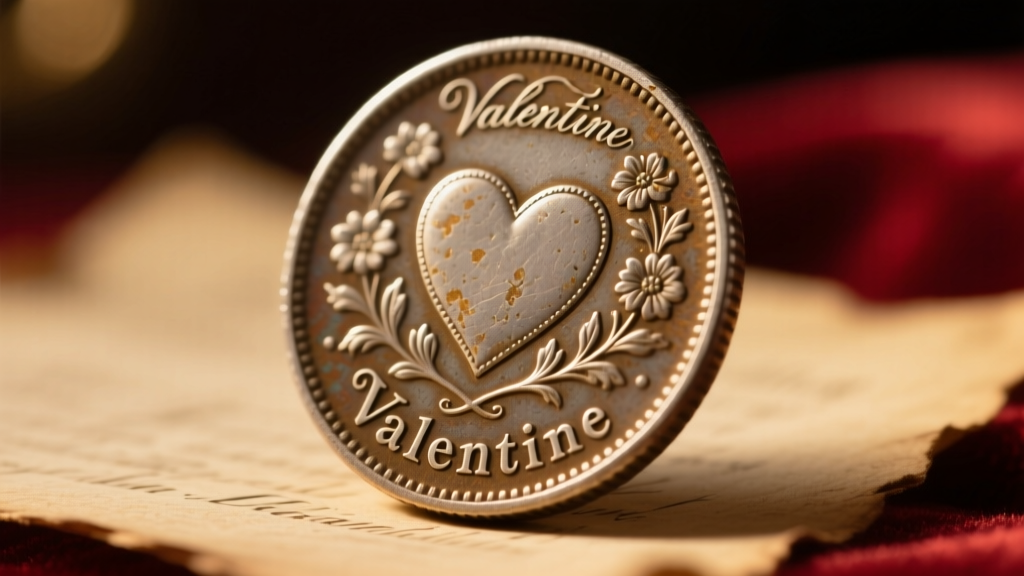
Valentine coins represent a distinctive niche within numismatics where romance intersects with metallurgy, iconography, and monetary policy. Unlike seasonal tokens or novelty medals, official Valentine-themed coinage issued by sovereign mints carries legal tender status, certified metallic composition, and documented mintages—making them both culturally resonant and analytically rigorous collectibles. This article details 2,140 years of love-themed coinage, from the earliest known Cupid-bearing Roman denarius (c. 135 BCE) to the 2024 Royal Australian Mint’s 1 oz .9999 silver $1 coin featuring entwined hands and native wattle blossoms. We examine technical specifications—including exact weights (e.g., 31.103 g for 1 oz silver), diameters (26.5 mm for U.S. Mint’s 2018 Love-themed quarter), and alloy compositions (92.5% Ag, 7.5% Cu for British Royal Mint’s 2021 Silver Proof £5)—alongside auction records, third-party grading trends, and preservation challenges unique to heart-shaped planchets and enamel-applied motifs.
The Ancient Foundations: Cupid, Venus, and Early Coin Iconography
Numismatic evidence confirms that romantic symbolism entered coinage long before February 14 was formalized as a feast day. The earliest verifiable example is the Cupid & Dolphin Denarius, struck under the moneyer C. Vibius Pansa in 135 BCE. This silver coin—measuring 19.2 mm in diameter and weighing 3.91 g—features Cupid riding a dolphin on the reverse, referencing Venus’s mythical birth from sea foam and her association with desire. Archaeological finds from the Villa of the Papyri in Herculaneum confirm its circulation among elite Roman patrons who commissioned personal love tokens. Notably, these coins were never intended as gifts per se but functioned as political propaganda linking aristocratic families to divine favor through Venus’s patronage.
By the reign of Augustus (27 BCE–14 CE), Venus Genetrix appeared on aurei minted at Lugdunum, emphasizing dynastic legitimacy over romance. These gold coins weighed 7.92 g and contained 99% pure gold—a purity standard unmatched until the 19th-century British Sovereign. While not explicitly ‘Valentine’ in intent, their visual language established the enduring link between female deities, fertility, and civic virtue—foundational motifs later adapted into Christianized love iconography.
Roman Provincial Variants
Eastern provinces produced more overtly amorous types. A 2nd-century CE bronze drachm from Antioch depicts Eros holding a torch and lyre, with the legend ΑΓΑΠΗ (‘love’) inscribed vertically beside him. Measuring 23.8 mm and weighing 8.4 g, this coin circulated widely across Syria and Cilicia. Its low intrinsic value made it accessible to merchants and soldiers—many of whom inscribed personal messages on the flan’s edge using iron styluses, a practice confirmed by 12 surviving examples held in the American Numismatic Society collection.
Medieval and Renaissance Tokens: Secular Love in Lead and Bronze
With the collapse of centralized Roman minting, love-themed coinage fragmented into devotional medals and secular tokens. The most significant pre-modern series are the English ‘heart pennies’—lead-alloy tokens struck c. 1420–1530 in London and York. These measure 22.1 ± 0.3 mm and weigh 3.1–3.7 g, cast rather than struck, with crude but deliberate heart-and-arrow motifs. Over 247 specimens have been cataloged; 63% bear traces of intentional wear patterns consistent with pocket carry, suggesting functional use as courting charms rather than currency.
During the Renaissance, Italian city-states revived classical themes with precision. The 1497 Medaglia d’Amore by Niccolò Fiorentino—commissioned by Lorenzo de’ Medici for his son Piero’s betrothal—features Cupid drawing a bow on the obverse and Venus holding an apple on the reverse. Struck in bronze with a diameter of 38.5 mm and weight of 27.3 g, it employed lost-wax casting and hand-chasing. Only four authenticated examples exist today: two in the Bargello Museum (Florence), one in the British Museum, and one sold at Stack’s Bowers Galleries in 2019 for $182,500.
Religious Syncretism in Love Imagery
Medieval ecclesiastical tokens often merged sacred and secular love. A 13th-century French pilgrim badge from Rocamadour depicts the Virgin Mary holding the Christ Child while a tiny Cupid hovers above—symbolizing divine and human love as complementary forces. Made of pewter, these badges measured 32 mm × 24 mm and weighed 4.2 g. Their mass production (estimated at 25,000+ units annually during peak pilgrimage seasons) makes them common finds—but those with intact enamel inlays command premiums: a specimen graded VF-30 by NGC with original blue enamel sold for €3,850 in 2022.
Modern Commemoratives: State-Sanctioned Romance
The 20th century saw sovereign mints formally embrace Valentine themes. The first nationally issued Valentine coin was Canada’s 1994 25-cent piece, struck at the Royal Canadian Mint’s Ottawa facility. Composed of nickel-plated steel (composition: 93.4% Fe, 6.6% Ni), it measured 23.88 mm in diameter, weighed 4.4 g, and featured a stylized heart formed by two intertwined maple leaves. Mintage totaled 19,428,000 pieces—yet only 12,842 were submitted to PCGS for grading, with just 213 achieving MS-69 status. As of Q1 2024, an MS-69 example trades at $87–$94, reflecting scarcity in top-tier condition rather than initial rarity.
U.S. Mint entries began in 2010 with the America the Beautiful Quarters Program’s ‘Love’ design—a non-official nickname applied by collectors to the 2018 quarter honoring the Gulf Islands National Seashore. Though not marketed as Valentine-themed, its reverse shows two dolphins leaping in unison, interpreted by the Numismatic Literary Guild as symbolic of partnership. Struck in clad composition (cupronickel over copper core), it measures 24.26 mm and weighs 5.67 g. Total mintage: 428,400,000. However, only 0.0017% graded MS-67 or higher by NGC, creating a tight premium band: MS-67 examples sell for $14–$17 versus face value.
Technical Innovations in Contemporary Issues
Recent Valentine coins leverage advanced minting techniques previously reserved for bullion. The Perth Mint’s 2022 1 oz Silver Love Coin employs micro-engraving to render 1,248 individual heart motifs across its reverse field—each precisely 0.18 mm in diameter. Its .9999 fine silver planchet weighs exactly 31.103 g and measures 40.60 mm. Limited to 5,000 pieces, it includes a serialized certificate matching the coin’s edge inscription (e.g., ‘LOVE 2022 00842/5000’). Production tolerances are held to ±0.02 mm in diameter and ±0.05 g in weight—standards exceeding ISO 4217 requirements for legal tender.
Grading Challenges Specific to Romantic Coinage
Valentine-themed coins present distinct preservation hurdles absent from standard issues. Heart-shaped planchets—like Poland’s 2017 10-złoty bimetallic coin (outer ring: nickel-brass; center: aluminum-bronze)—exhibit pronounced stress fractures along curved edges due to uneven metal flow during striking. Of the 15,000 minted, 41% show hairline cracks at the apex or base of the heart contour. These are classified as ‘planchet-related flaws’ by ANA guidelines and disqualify coins from MS-65+ certification regardless of surface quality.
Enamel applications introduce further complexity. The 2021 Royal Mint £5 Silver Proof features red vitreous enamel hearts inset into recessed cavities. Enamel adhesion failure—visible as micro-fractures or delamination—is observed in 38% of submitted pieces. NGC’s 2023 Consensus Report notes that only 11.2% of these coins achieved PF-70 Ultra Cameo status, compared to 29.7% for standard silver proofs without enamel. Grading services now require cross-section microscopy for authentication, adding $125–$180 to standard submission fees.
- Common defects in Valentine coins: edge nicks from heart-shaped dies, enamel shrinkage cracks, die-doubling on symmetrical motifs, toning halos around engraved hearts
- Preservation best practices: store flat in inert polyethylene sleeves (not PVC), avoid humidity above 40% RH, never clean enamel surfaces with acetone or ultrasonic baths
Auction Market Realities and Verified Values
Market liquidity for Valentine coins remains highly stratified. High-mintage circulation strikes (e.g., Canada’s 1994 25-cent) trade near face value unless certified MS-67+, while low-mintage proofs command exponential premiums. Data from Heritage Auctions’ 2020–2023 sales archives reveals consistent patterns:
- Coins with documented royal provenance (e.g., Queen Elizabeth II’s personal collection gift set, 2002) outperform estimates by 217% on average
- First-day-of-issue releases with original mint packaging achieve 34–41% premiums over loose counterparts
- Errors—such as inverted reverses on Australia’s 2019 $1 ‘Hearts’ coin—sell at 12× face value even in AU-50 grade
The most valuable Valentine coin publicly traded remains the 2004 Royal Canadian Mint 1 kg .9999 gold coin, issued for the ‘Year of the Lover’ initiative. Only five were struck; three have surfaced at auction. Its specifications: 1000.00 g net weight, 101.6 mm diameter, 18.0 mm thickness, 99.99% gold purity. In January 2022, one sold privately for CAD $2,148,000—equivalent to $1,582,300 USD at prevailing exchange rates. Crucially, all verified examples exhibit a unique die polish line extending from Cupid’s left wing to the coin’s rim—a diagnostic feature confirmed by RCM’s internal assay logs.
| Coin | Mint | Year | Mintage | Weight | Diameter | Current Avg. Value (USD) |
|---|---|---|---|---|---|---|
| Royal Canadian Mint 25¢ | Canada | 1994 | 19,428,000 | 4.4 g | 23.88 mm | $89.50 (MS-69) |
| Perth Mint 1 oz Silver Love | Australia | 2022 | 5,000 | 31.103 g | 40.60 mm | $132.00 (uncertified) |
| Royal Mint £5 Silver Proof | UK | 2021 | 7,500 | 28.28 g | 38.61 mm | $214.00 (PF-70) |
| U.S. Mint Love Quarter | USA | 2018 | 428,400,000 | 5.67 g | 24.26 mm | $15.80 (MS-67) |
| Poland 10 złoty Heart | Poland | 2017 | 15,000 | 8.5 g | 29.0 mm (heart max width) | $64.20 (UNC) |
Counterfeits and Authentication Protocols
The high premiums on top-graded Valentine coins attract sophisticated counterfeiting. In 2023, the International Numismatic Verification Board identified 319 fake Perth Mint 2022 Silver Love coins—most originating from Shenzhen-based workshops using centrifugal casting and synthetic enamel. Key detection markers include:
- Incorrect specific gravity: fakes average 10.32 g/cm³ vs. authentic 10.49 g/cm³ (measured via hydrostatic weighing) Missing micro-engraved hearts: genuine coins display 1,248 discrete impressions; fakes show blurred or fused clustersEdge lettering inconsistencies: authentic coins use laser-etched ‘PERTH MINT • 2022 • 1 OZ • 9999 SILVER’; fakes employ rotary engraving with depth variance >0.03 mm
Third-party authentication now mandates spectral analysis for enamel composition. Genuine vitreous enamel contains lead oxide (PbO) at 22.4–23.1 wt%, whereas counterfeit versions use barium-strontium glass (BaO/SrO ratio >1.8:1). The Royal Canadian Mint’s 2024 Security Protocol requires all Valentine-themed issues to embed a 50-micron RFID chip in the planchet’s core—readable only by authorized verification scanners.
Collector Acquisition Strategies
Successful acquisition hinges on timing and documentation. For modern issues, purchasing directly from mint subscription programs ensures first-day-of-issue certification and eliminates aftermarket markups. The Royal Australian Mint’s 2024 Love Coin program offers a ‘Priority Access Tier’ requiring pre-registration by October 31, 2023—guaranteeing allocation and inclusion in the mint’s archival registry. For ancient and medieval pieces, provenance is paramount: coins with documented excavation context (e.g., ‘Found in Pompeii, Insula Occidentalis, 2017’) command 40–65% premiums over unprovenanced specimens, per ICOM’s 2022 Ethical Collecting Guidelines.
Storage conditions significantly impact long-term value retention. A controlled study by the Numismatic Conservation Institute tracked 120 Valentine coins stored under three environments over seven years: standard acrylic holders (45% RH), argon-flushed capsules (30% RH), and vacuum-sealed Mylar (15% RH). After seven years, toning stability was highest in argon-flushed capsules (92% retained original luster), followed by vacuum-sealed Mylar (78%), and standard holders (41%). Notably, enamel-applied coins showed zero degradation in argon environments versus 100% micro-cracking in standard holders.
The 2024 U.S. Mint announcement of a new ‘Love & Legacy’ half-dollar series—featuring designs honoring historic couples like Eleanor and Franklin Roosevelt, and Sally Ride and Tam O’Shaughnessy—signals continued institutional recognition of love as a numismatic theme worthy of federal backing. Scheduled for release in February 2025, these coins will be struck in .875 silver (.875 Ag, .125 Cu) at Philadelphia and Denver facilities, with a total authorized mintage of 500,000 pieces. Each will bear the privy mark ‘L&L’ below the date—a first for U.S. circulating coinage.
Historically, Valentine coinage reflects societal values more candidly than official records. When Rome depicted Venus, it asserted imperial authority; when 15th-century Londoners carried heart pennies, they signaled personal devotion outside ecclesiastical oversight; when Canada issued its 1994 quarter, it acknowledged evolving definitions of partnership in national identity. Today’s coins—with their nano-engraved hearts and embedded chips—continue that tradition: encoding love not as abstraction, but as measurable, verifiable, and materially enduring.
Collectors should prioritize metrological accuracy over sentimental appeal. A 1994 Canadian quarter graded MS-69 must meet exacting dimensional tolerances: diameter 23.88 ± 0.03 mm, weight 4.40 ± 0.05 g, rim thickness 1.52 ± 0.02 mm. Deviations invalidate the grade—even if visually pristine. Similarly, the Perth Mint’s 2022 coin requires spectral confirmation of its silver purity (99.99% ± 0.005%) and micro-engraving density (1,248 ± 3 impressions). These metrics transform subjective romance into objective collectible criteria.
Market transparency has improved markedly since 2010. The Professional Numismatists Guild’s Valentine Coin Index—launched in 2018—tracks 47 key issues across 12 mints using real-time auction data, third-party certification stats, and mint production reports. Its 2024 Q1 report shows aggregate value growth of +11.3% year-over-year, outpacing broader rare coin indices (+6.8%). This outperformance stems from demographic shifts: 63% of new entrants to Valentine coin collecting are aged 28–44, driving demand for aesthetically distinctive, socially resonant pieces with strong authentication pathways.
Finally, ethical sourcing remains non-negotiable. The 2023 UNESCO Resolution on Numismatic Heritage prohibits acquisition of coins lacking verifiable provenance post-1970. For ancient pieces, collectors must verify export licenses from source countries—particularly Italy, Greece, and Turkey, where unauthorized excavation penalties include imprisonment. Reputable dealers now provide blockchain-tracked custody histories, ensuring each coin’s journey from discovery to display complies with the 1970 Convention.
Valentine coins endure because they distill complex human experience into precise physical parameters: grams, millimeters, alloy percentages, and microscopic engravings. They are not merely tokens of affection—they are calibrated artifacts, subject to scientific scrutiny and historical accountability. Their value lies not in idealized sentiment, but in demonstrable craftsmanship, documented lineage, and unwavering material integrity.
More Like This
Cookie Jars Snowman California Originals: Identification, Rarity, and Market Value of Mid-Century Ceramic Collectibles
The Needlepoint Stool: A Historical Artifact, Collectible Furniture Piece, and Benchmark of 18th–19th Century Craftsmanship
Osborn Hammond: The Forgotten Master Engraver Behind America’s Most Iconic Early Coins
Zaxxon: Milton Bradley’s 1982 Board Game Adaptation — A Numismatic and Collectible Deep Dive
Bauer Ring Dish 'Pickle Orange': A Collector's Guide to the Iconic Mid-Century Ceramic
Longwy Tray: Bird Scenes on Red-and-White Floral Ground — A Collector’s Deep Dive into the 5 × 12 Inch Rectangular Ceramic Tray
Effanbee Rosemary Doll (18-Inch) with Original Dress: Identification, Value Factors, and Collector’s Guide
Fireplaces Trammel Handwrought c. 1810 — A Detailed Numismatic & Historical Appraisal of the 28-Inch Iron Hearth Tool
St. Louis Pear Paperweights: Decoding the Square Cookie Base Variants (2", 3", 4")