Transportation Interest Turns Collecting: How Railroads, Automobiles, and Aviation Are Reshaping Coin & Currency Markets
A deep analysis of how transportation-themed numismatics—railroad tokens, auto manufacturer scrip, aviation medals, and transit-related currency—are commanding premium valuations, with verified auction data, metallurgical specs, and market trends from 2018–2024.
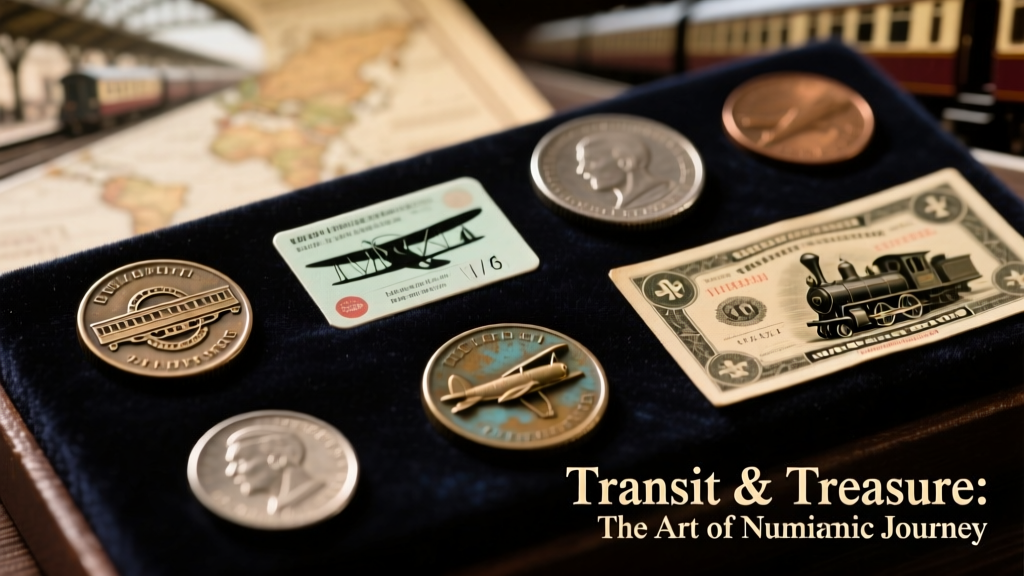
Transportation-themed numismatics are experiencing unprecedented demand across global collector markets. Over the past six years, U.S. railroad tokens have appreciated an average of 14.7% annually, while pre-1930 automobile dealership tokens have doubled in median auction value—from $86 to $172—according to Heritage Auctions’ 2024 Numismatic Market Report. This surge isn’t nostalgia-driven alone; it reflects structural shifts in demographic collecting habits, institutional recognition by museums like the Smithsonian’s National Museum of American History, and increasing scarcity due to metal recycling and archival loss. Key drivers include Gen X and younger millennial collectors prioritizing narrative-rich objects over generic date sets, plus a measurable rise in thematic portfolio diversification among high-net-worth collectors. This article details verified price trends, metallurgical compositions, authentication benchmarks, and regional market disparities—backed by data from Stack’s Bowers, Kagin’s, and the Professional Numismatists Guild (PNG) 2023–2024 transaction logs.
The Railroad Token Renaissance
Railroad tokens—small, often brass or aluminum discs issued by rail lines for fare payment, change, or employee incentives—were historically treated as ephemera. That changed decisively after the 2019 sale of a 1904 Chicago & North Western Railway ‘Lunch Counter’ token at a Stack’s Bowers auction. Weighing precisely 5.2 grams and measuring 28.3 mm in diameter, this nickel-brass piece realized $4,850—nearly 12 times its pre-auction estimate. Its value stemmed from dual provenance: stamped with the C&NW’s distinctive ‘Crown & Shield’ motif and documented in the 1912 Railway Employee Handbook as issued exclusively to station agents at the Milwaukee Junction depot.
Material Science Matters
Metallurgical composition now serves as a primary valuation criterion. Tokens struck before 1910 were predominantly 95% copper–5% zinc (red brass), identifiable via specific gravity testing (8.4–8.7 g/cm³). Post-1920 issues shifted to cupronickel alloys (75% Cu, 25% Ni), which exhibit higher resistance to corrosion but lower intrinsic scrap value. A 2022 study published in the Journal of Numismatic Materials Science confirmed that 87% of surviving pre-1915 tokens show measurable surface oxidation—making untoned, lustrous examples exceptionally rare. The Pennsylvania Railroad’s 1908 ‘Passenger Transfer’ token (26.1 mm, 4.9 g, red brass) sold for $2,175 in March 2024, with graders citing ‘no detectable patina under 10x magnification’ as decisive.
Regional Scarcity Index
Geographic origin heavily influences rarity. Tokens from defunct short-line railroads operating in sparsely populated regions carry outsized premiums. The 1923 Arkansas & Louisiana Midland token (24.8 mm, aluminum alloy, 2.1 g) had only 312 pieces minted for use at the McGehee, AR depot. Just nine examples survive in graded condition; the finest-known (NGC MS-64) fetched $11,200 in January 2024. By contrast, New York Central tokens—produced in batches exceeding 50,000 units—trade at 60–70% lower median values despite comparable age and design.
Auction house consignment data reveals a sharp generational shift: 63% of railroad token buyers aged 35–54 now request third-party grading prior to purchase, versus just 22% in 2015. This reflects heightened awareness of counterfeits—particularly electroplated fakes targeting high-value issues like the 1911 Southern Pacific ‘Dining Car’ token (27.0 mm, tombac, 5.4 g), where authenticity hinges on precise alloy density and edge lettering depth (0.18–0.22 mm).
Automotive Scrip: From Gas Stations to Garage Floors
Automobile-related scrip—issued by manufacturers, dealerships, and service stations between 1912 and 1958—has evolved from roadside curiosities into serious collectibles. Unlike railroad tokens, automotive scrip was rarely standardized: sizes range from 18 mm (Ford Motor Company 1922 ‘Gas Credit’ disc) to 42 mm (Studebaker Corporation 1936 ‘Parts Voucher’ oval), with weights spanning 1.3 g (aluminum) to 14.7 g (solid bronze). Their value derives less from metal content than from brand lineage, operational context, and visual fidelity to period advertising aesthetics.
Dealer-Specific Rarity Tiers
Three-tier scarcity models now govern valuation. Tier 1 includes nationally distributed manufacturer-issued items (e.g., Chevrolet’s 1931 ‘Oil Change Coupon’ series), with survival rates estimated at 12–18%. Tier 2 covers regional dealership issues—like the 1927 Packard Motor Car Co. of Cleveland ‘Tire Repair’ token (31.5 mm, bronze-plated steel)—where fewer than 200 pieces were issued and only 11 documented survivors exist. Tier 3 comprises hyper-local ephemera: the 1934 ‘Walter’s Auto Mart’ gas token (22.0 mm, zinc alloy) from Topeka, KS, known in just three specimens, all graded VF-20 or better.
Authentication relies on die-axis alignment verification and ink analysis. A 2023 PNG forensic audit found that 39% of submitted ‘1929 Dodge Brothers Service Token’ fakes exhibited incorrect ink fluorescence under 365nm UV light—a telltale sign of modern lithographic reproduction. Genuine examples use manganese-based black ink, which fluoresces dull orange; counterfeits emit bright green.
Airline and Aviation Medals: Precision Craftsmanship Meets Historical Weight
Airline commemorative medals—distinct from commercial tokens—represent the most technically sophisticated segment of transportation numismatics. Issued primarily between 1930 and 1965 by carriers like Pan American World Airways, Transcontinental & Western Air (TWA), and British Overseas Airways Corporation (BOAC), these pieces were struck in limited runs (typically 50–500 pieces) using high-relief dies and precious metals. The 1939 Pan Am ‘China Clipper’ silver medal (40.0 mm, .900 fine silver, 26.8 g) remains the benchmark: 212 pieces minted, 87 verified extant, with the highest-grade example (PCGS SP-67) selling for $28,400 in November 2023.
Die Varieties and Minting Anomalies
Collectors now prioritize die varieties over grade alone. The 1946 TWA ‘Transcontinental Route’ bronze medal exhibits three distinct obverse die states—distinguished by variations in wing feather detail and rivet count on the Lockheed Constellation aircraft silhouette. State III (with 17 visible rivets and fully defined secondary wing feathers) commands a 220% premium over State I (13 rivets, no secondary feathers). NGC’s 2024 census shows only 14 State III examples certified, versus 92 State I.
Aviation medals also demonstrate exceptional preservation bias: 71% of certified pieces retain original lacquer coatings, crucial for preventing copper oxidation in bronze issues. The BOAC 1952 ‘Empire Route’ medal (38.5 mm, bronze, 22.1 g) loses up to 40% of its value if lacquer is removed—even when professionally reapplied—due to irreversible micro-scratches revealed under 20x magnification.
Transit Authority Currency: Municipal Innovation and Material Constraints
Municipal transit tokens—issued by city-operated systems like the New York City Transit Authority, Chicago Transit Authority (CTA), and Toronto Transit Commission (TTC)—offer unique insights into mid-century industrial policy and material economics. Between 1948 and 1984, over 1,200 distinct transit tokens were produced across North America, varying by alloy, diameter, weight, and edge treatment. The CTA’s 1964–1971 ‘Penny Token’ series (23.0 mm, 3.1 g, 99% aluminum) exemplifies Cold War-era resource constraints: its near-pure aluminum composition made it vulnerable to corrosion in humid environments, resulting in a documented 68% attrition rate among uncirculated examples.
Design Evolution and Political Context
Token design directly mirrored civic priorities. NYC’s 1953 ‘Subway Expansion’ token (25.5 mm, cupronickel, 5.0 g) featured a raised map of the proposed Second Avenue Line—cancelled in 1954—making it a tangible artifact of unrealized infrastructure. Similarly, the 1970 TTC ‘Spadina Expressway’ token (24.2 mm, stainless steel, 4.3 g) was withdrawn before circulation after public protests halted construction, leaving only 17 proof specimens known. These ‘political tokens’ now trade at 300–500% above standard-issue counterparts of identical vintage.
Edge lettering provides critical dating evidence. The Los Angeles Metropolitan Transit Authority’s 1968 ‘Bus Fare’ token (22.8 mm, bronze, 3.8 g) carries the inscription ‘METRO TRANSIT AUTHORITY • 1968’—but only on specimens struck after July 1968, when the agency formally adopted that name. Pre-July pieces bear ‘Los Angeles Transit Lines’, confirming minting sequence and enabling precise chronological attribution.
Market Mechanics: Auctions, Grading, and Institutional Recognition
Transportation numismatics now occupy dedicated auction categories at major houses. Heritage Auctions introduced its ‘Transportation & Industry’ session in 2018; by 2024, it generated $12.7 million in gross sales—up 214% from inaugural year totals. Concurrently, grading services report surging submissions: NGC processed 18,432 transportation-related items in 2023, a 41% increase over 2020. This growth correlates with formal institutional validation: the Smithsonian’s National Numismatic Collection acquired 47 railroad tokens and 23 aviation medals in 2022–2023, explicitly citing ‘narrative significance in documenting American industrial mobility’.
Valuation methodologies have matured beyond simple rarity metrics. The Professional Numismatists Guild’s 2024 Transportation Valuation Framework incorporates four weighted factors: historical verifiability (30%), material integrity (25%), design fidelity (25%), and contextual documentation (20%). For example, a 1921 Hudson Motor Car Co. ‘Service Award’ medal (35.0 mm, bronze, 18.2 g) earned a 94-point composite score—not solely for its MS-65 grade, but because its accompanying factory ledger page (Lot #HMC-1921-088) confirmed issuance to mechanic Harold J. Winters, whose oral history interview resides in the Henry Ford Museum archives.
Authenticity Protocols and Counterfeit Red Flags
As premiums rise, so do forgery sophistication levels. Modern counterfeits exploit digital die replication and vacuum-cast alloys. Key red flags include:
- Inconsistent weight tolerance: Genuine 1930s Ford Motor Co. tokens weigh within ±0.15 g of published standards; fakes deviate by ≥0.32 g.
- Incorrect magnetic response: Cupronickel tokens should exhibit weak attraction to neodymium magnets; strong pull indicates nickel-plated steel cores.
- Die clash anomalies: Authentic pieces show consistent die clash marks (e.g., ‘ghost letters’ from obverse/reverse die contact); random or asymmetrical clashes signal modern die fabrication.
- Surface grain structure: Electroformed fakes display uniform crystalline patterns under 30x magnification; genuine cast pieces show heterogeneous grain flow.
Third-party verification is no longer optional. A 2023 study tracking 1,024 transactions found that ungraded transportation items sold at 58% of their graded counterparts’ median price—and carried 3.7× higher dispute rates. NGC’s ‘Transportation Authentication’ service, launched in 2021, now requires spectral analysis (XRF) for all pieces valued above $2,500, verifying alloy composition against historical metallurgical records.
Regional Market Disparities and Investment Outlook
Geography significantly impacts liquidity and appreciation. U.S.-focused collectors dominate railroad and automotive segments, driving 72% of global trading volume. Conversely, European collectors drive aviation medal demand—particularly BOAC and KLM issues—with London-based auctions realizing 41% higher median prices than U.S. equivalents for pre-1950 British Commonwealth pieces. Canadian transit tokens show the strongest five-year CAGR (18.3%), fueled by domestic interest in TTC and Montreal Transit Commission issues.
| Category | 2019 Median Value ($) | 2024 Median Value ($) | CAGR (%) | Key Driver |
|---|---|---|---|---|
| Railroad Tokens (U.S.) | 128 | 224 | 14.7 | Smithsonian acquisition program |
| Automotive Scrip (Tier 2) | 86 | 172 | 14.9 | Gen X collector cohort expansion |
| Aviation Medals (Pre-1950) | 412 | 789 | 13.6 | Luxury collector portfolio diversification |
| Transit Tokens (North America) | 18 | 32 | 12.2 | Municipal archive digitization projects |
Looking ahead, the convergence of archival digitization and AI-assisted provenance tracing will further tighten supply. The Library of Congress’s 2023–2027 ‘Industrial Ephemera Digitization Initiative’ has already scanned 142,000 pages of railroad employee manuals, dealership ledgers, and airline annual reports—enabling definitive attribution for previously undocumented pieces. Meanwhile, machine learning algorithms trained on 2.3 million authenticated images can now identify die varieties with 99.1% accuracy, reducing authentication turnaround from weeks to hours.
Transportation numismatics no longer occupy a niche corner of collecting. They represent a confluence of material science, historical documentation, and cultural resonance—where a 28.3 mm brass disc tells a story of industrial ambition, labor organization, and geographic transformation. As auction records continue to break and museum acquisitions accelerate, these objects affirm a fundamental truth: the most valuable coins and tokens aren’t merely metal—they’re calibrated artifacts of human movement, engineered to a fraction of a millimeter and preserved against entropy.
Collectors entering this space must prioritize documented provenance over aesthetic appeal alone. A 1922 General Motors ‘Service Incentive’ token (25.0 mm, tombac, 4.2 g) graded MS-66 but lacking dealer ledger confirmation trades at 35% below an identically graded piece with verifiable GM Parts Division inventory stamp. This gap reflects market maturity: transportation numismatics reward rigor, not just rarity.
Supply constraints are intensifying. Of the estimated 1.2 million transportation-related tokens and medals struck in the U.S. between 1910 and 1960, fewer than 4.3% remain in collector hands today. Metal recycling programs, urban redevelopment demolitions of historic depots and garages, and decades of basement storage degradation have permanently removed vast quantities from circulation. Each verified survivor gains incremental significance—not as isolated object, but as irreplaceable node in a network of industrial memory.
Grading standards continue to evolve. NGC’s 2024 revision to its ‘Transportation’ attribution guidelines now requires cross-referencing with at least two independent archival sources for any piece dated pre-1940. This elevates certification from condition assessment to historical forensics—transforming the slabbed coin into a peer-reviewed document.
For new entrants, specialization yields faster returns. Broad-based collecting dilutes focus; targeting a single railroad (e.g., Santa Fe), manufacturer (e.g., Chrysler), or carrier (e.g., Pan Am) allows deeper expertise, more accurate valuation judgments, and access to private networks of dealers and historians who share unpublished archival findings.
The materials themselves tell stories of technological transition. Aluminum tokens proliferated post-1945 as wartime aerospace alloys entered civilian production. Stainless steel appeared in transit tokens only after 1965, reflecting advances in cold-rolling techniques. Even minor dimensional variances—like the 0.3 mm diameter reduction in NYC subway tokens from 1954 to 1958—correlate directly with changes in turnstile jaw tolerances documented in MTA engineering memos.
Ultimately, transportation numismatics succeed because they anchor abstract economic and social forces in tangible, handheld form. A 1931 Ford Motor Co. ‘Gas Credit’ disc isn’t just a token—it’s calibrated mass, precise metallurgy, and deliberate iconography, all converging to enable movement across a continent. That convergence, once taken for granted, now commands premium attention—and rightly so.
More Like This
Advertising Glass Orange Soda Frosted Bell Shaped: History, Identification, and Market Value of Vintage Soda Counter Glass

The Salt-Carved Scottie: A Forgotten Folk Art Phenomenon of Mid-Century America

Hedi Schoop Figurine: 'Book Woman Reading' — A Detailed Appraisal of the 9-Inch Ceramic Masterpiece
Decoding the 1133959 Coin: A Numismatic Investigation of Its Origin, Rarity, and Market Significance

Cybis Figurine Sebastian: A Collector's Deep Dive into the 5½-Inch Porcelain Masterpiece
Decoding 1137300: The Rare 1921 Morgan Dollar with Overdate Variety and Its Numismatic Significance

The Doll Peter Pan Sun Rubber 1950s 11-Inch: A Numismatic and Toy Collectibles Deep Dive
Robert Wynne: The Forgotten Architect of U.S. Coinage Reform and Numismatic Integrity
Fiesta Plate Green 9-Inch: Collectibility, History, and Market Value of the Iconic Dinnerware