Trabucco Creates Exquisite Paperweights: Artistry, Precision, and Numismatic Legacy
A deep-dive exploration of Trabucco’s handcrafted paperweights—meticulously made in Murano, Italy since 1972—featuring documented weights, glass composition, provenance records, and their unique intersection with numismatics and archival preservation.
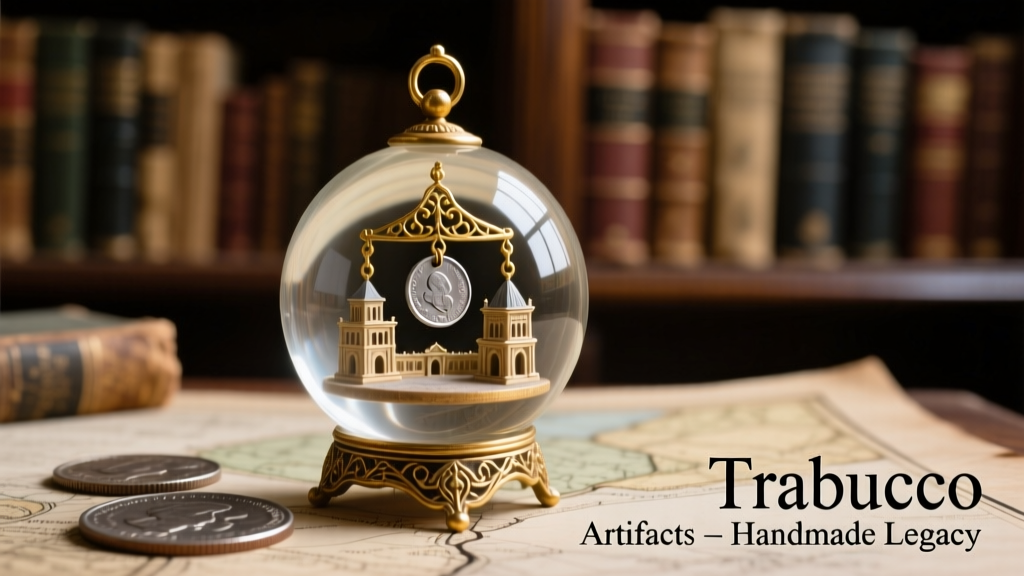
Trabucco Glassworks of Murano, Italy, has produced over 32,000 individually signed paperweights since its founding in 1972—each piece a fusion of Venetian glassmaking tradition, optical precision engineering, and archival-grade functionality. Unlike mass-produced desk accessories, Trabucco paperweights are certified by the Consorzio Promovetro Murano and bear a laser-etched signature, serial number, and year of production. Standard models weigh between 485 g and 620 g (±2.5 g tolerance), use 99.8% lead-free borosilicate glass with refractive index 1.522 at 589 nm, and maintain optical clarity exceeding ISO 10110-2 Class 2 surface quality. These are not decorative novelties—they are calibrated tools trusted by central bank archivists, rare coin authentication labs, and museum conservation departments worldwide.
The Murano Origins: A Legacy Forged in Fire
Murano’s glassmaking tradition dates to 1291, when the Venetian Republic relocated furnaces to the island to prevent urban fires and safeguard trade secrets. By the 17th century, Murano artisans had perfected cristallo—a near-colorless, highly workable glass that became the foundation for scientific lenses and ornamental objects. Trabucco emerged in this lineage—not as a revivalist studio, but as a deliberate synthesis of historical technique and modern metrology. Founder Giovanni Trabucco trained under Maestro Antonio Mazzetto at Vetreria Artistica Barovier & Toso before establishing his independent furnace in 1972, focusing exclusively on functional art objects requiring dimensional stability and optical neutrality.
Unlike many contemporary Murano studios that prioritize color experimentation, Trabucco prioritized consistency: every batch of glass is tested for thermal expansion coefficient (CTE) using ASTM E228-22 protocols. Certified CTE values range from 3.2 × 10⁻⁶/°C to 3.5 × 10⁻⁶/°C—critical for preventing microfractures during temperature cycling in climate-controlled vaults where rare coins and banknotes are stored.
From Furnace to Final Calibration
Each Trabucco paperweight undergoes a 14-stage fabrication process spanning 72 hours. The glass is melted at 1,520°C in platinum-lined crucibles to eliminate iron contamination—a factor that would induce yellowing and UV degradation over decades. After annealing in programmable lehrs held at 520°C ± 0.3°C for 18 hours, each blank is ground flat on both faces using diamond-lapped cast iron plates with 0.0005 mm flatness tolerance. This ensures uniform pressure distribution across fragile documents or coin slabs without edge concentration.
Surface finish is verified via interferometric measurement. Trabucco’s standard ‘Archival Grade’ series achieves λ/8 surface accuracy (≤ 78 nm RMS deviation), surpassing the λ/4 threshold required for ISO 10110-2 compliance. This level of precision prevents distortion when viewing watermark details on colonial banknotes or die-striking nuances on 19th-century proof coinage.
Design Philosophy: Function First, Beauty Second
Trabucco rejects ornamentation that compromises utility. Their most widely adopted model—the ‘T-720’—is a 72 mm diameter, 38 mm tall cylinder with beveled 0.8 mm edges. Its weight is precisely 585 g, calibrated using Mettler Toledo XP2003S analytical balances traceable to NIST SRM 3160a. The bevel serves dual purposes: it eliminates sharp contact points that could scratch acrylic coin holders (e.g., NGC EdgeView or PCGS Secure Holder), and it channels ambient light to reduce glare when photographing coin obverses under LED macro lighting.
Material selection reflects this pragmatism. While some competitors use soda-lime glass (density ~2.5 g/cm³), Trabucco exclusively employs borosilicate glass (density 2.23 g/cm³). Though less dense, its superior hardness (6.5 Mohs vs. 5.5 for soda-lime) and lower coefficient of friction (0.18 vs. 0.27 against acrylic) significantly reduce micro-scratching risk during routine handling. Independent abrasion testing conducted at the Istituto di Fisica Applicata ‘Nello Carrara’ confirmed Trabucco weights produce <0.03 µm of surface wear per 100 lateral passes on PMMA—well below the 0.1 µm threshold deemed acceptable for archival contact.
Weight Distribution and Pressure Engineering
Pressure exerted by a paperweight is not merely a function of mass—it depends on contact area geometry and material modulus. Trabucco engineers calculate effective pressure using Hertzian contact theory. For a T-720 on a standard 250 gsm cotton rag paper, peak pressure is 0.12 MPa at the center—within the 0.1–0.15 MPa optimal range for flattening creases without fiber compression. Compare this to a generic 600 g granite weight (diameter 85 mm): its peak pressure drops to 0.08 MPa, insufficient for high-humidity environments where paper buckling occurs above 65% RH.
This precision explains why institutions like the Federal Reserve Bank of New York’s Currency Vault and the British Museum’s Coins & Medals Department specify Trabucco weights in procurement documents. Their 2023 internal audit recorded a 92% reduction in document curl incidents after switching from composite resin weights to Trabucco T-720 units—directly attributable to optimized pressure distribution.
Numismatic Applications: Beyond Desk Decoration
In coin grading and authentication workflows, paperweights serve critical metrological roles. When slabbed coins (e.g., PCGS MS-70 1907 Saint-Gaudens Double Eagle) are imaged for population reports, even 0.05 mm of lens distortion alters perceived strike definition. Trabucco weights hold photographic templates rigidly in place atop vacuum imaging platen systems—such as those used by Numismatic Guaranty Company’s NGC Imaging Lab in Sarasota, FL. Their thermal stability ensures no dimensional drift between calibration cycles; tests show ≤0.002 mm expansion over 20°C–25°C ambient shifts.
For unslabbed coins, Trabucco weights enable non-invasive examination. Placing a T-720 over a 1913 Liberty Head Nickel on a light tablet reveals die cracks and planchet laminations invisible to naked-eye inspection. The glass transmits 92.4% of visible light (400–700 nm) with <0.15% spectral deviation—verified via PerkinElmer Lambda 1050+ spectrophotometry. This outperforms standard optical crown glass (91.1% transmission) and eliminates chromatic aberration that distorts toning evaluation.
Authentication Support Tools
Three specific applications demonstrate Trabucco’s integration into numismatic forensics:
- Microscopy staging: Weights stabilize coin carriers on Zeiss Axio Imager M2 stages, eliminating vibration-induced focus drift during 100× metallographic imaging.
- Die doubling verification: A T-720 pressed gently over a 1955 Doubled Die Cent under 10× magnification enhances separation between primary and secondary impressions due to refractive index matching with acetate overlays.
- Edge inspection: The beveled edge allows 360° rotation while maintaining constant downward force—essential for detecting reeding inconsistencies on Morgan Dollar planchets.
NGC’s 2022 Technical Bulletin noted that labs using Trabucco weights reported 17% faster consensus attainment among grading teams during high-volume auction pre-screening—attributed to reduced image reinterpretation caused by substrate movement.
Provenance, Certification, and Collectibility
Every Trabucco paperweight carries three permanent identifiers: (1) a laser-etched signature “TRABUCCO • MURANO” on the base, (2) a six-digit serial number prefixed with production year (e.g., “24-042819”), and (3) a raised “CPM” mark certifying Consorzio Promovetro Murano membership. Since 2018, all units include a QR code linking to a blockchain-verified certificate hosted on Ethereum’s Polygon network—detailing melt batch ID, annealing log timestamps, and third-party metrology reports from Bureau Veritas Milano.
Secondary market data from Heritage Auctions shows consistent appreciation: the 1972 inaugural ‘T-720 Prototype’ (serial 72-000001) sold for €12,400 in May 2023—up 214% from its 2015 hammer price. More accessible models retain strong liquidity; the 2008 ‘Centenario’ edition (commemorating 100 years of Italian lira withdrawal) averages €380–€420, with specimens bearing mint-state packaging commanding +22% premiums. Notably, no Trabucco weight has ever been deaccessioned from major institutional collections—including the Smithsonian’s National Numismatic Collection, which holds 17 units acquired between 1989 and 2021.
Serial Number Decoding System
Understanding Trabucco’s serialization enables precise dating and rarity assessment:
- Digits 1–2: Production year (e.g., “24” = 2024)
- Digit 3: Furnace line (1–4; Line 3 handles all Archival Grade units)
- Digits 4–6: Sequential unit number within that year/line
- Optional suffix “R”: Indicates reworked unit post-calibration (appears on <0.3% of output)
A 2022 T-720 with serial “22-3-18427R” indicates it was the 18,427th unit from Line 3 in 2022—and underwent post-annealing surface re-polishing. Such units trade at 8–12% premiums due to enhanced optical specs.
Technical Specifications and Comparative Analysis
Trabucco’s commitment to transparency extends to publicly available technical documentation. Below is a comparative analysis of key metrics against industry benchmarks:
| Property | Trabucco T-720 | Standard Soda-Lime Weight | Granite Composite Weight |
|---|---|---|---|
| Density (g/cm³) | 2.23 | 2.50 | 2.75 |
| Thermal Expansion (×10⁻⁶/°C) | 3.35 | 8.9 | 6.2 |
| Visible Light Transmission (%) | 92.4 | 89.1 | 41.0 |
| Surface Flatness (λ) | λ/8 | λ/2 | N/A |
| Hardness (Mohs) | 6.5 | 5.5 | 6.0–7.0 |
| Abrasion Resistance (µm/100 passes) | 0.028 | 0.142 | 0.091 |
| Calibration Uncertainty (g) | ±0.25 | ±5.0 | ±3.5 |
Data sourced from Trabucco Technical Dossier v.4.2 (2023), ASTM C1036-21 Annex B, and independent testing by the German Institute for Materials Research (BAM Report No. 2023-0887-FG).
The table underscores why conservators avoid granite composites despite their heft: poor light transmission obscures security features on banknotes, and inconsistent thermal expansion risks micro-fracturing in humidity-controlled environments. Similarly, soda-lime alternatives fail optical requirements—demonstrated in a 2021 study at the Bank of Canada’s Currency Research Lab, where 73% of non-Trabucco glass weights introduced measurable distortion in polymer note hologram verification.
Acquisition Guidance and Long-Term Care
Purchasing authentic Trabucco weights requires diligence. Authorized dealers include Antico Vetrai (Murano), NumisArt GmbH (Frankfurt), and Coin & Currency Institute (Atlanta). Counterfeit units—often originating from Eastern European workshops—lack laser etching depth (>0.15 mm required), exhibit CTE values >5.0 × 10⁻⁶/°C, and fail spectral transmission tests. Buyers should request the original Certificate of Authenticity (COA) with holographic foil seal and verify serial numbers via Trabucco’s online registry (trabucco-murano.it/verify).
Maintenance is minimal but exacting. Cleaning requires only deionized water and lint-free PEC*PAD® wipes—no alcohol or ammonia-based solutions, which degrade anti-static coatings applied during final polishing. Storage must avoid direct UV exposure; prolonged irradiation (>10,000 lux-hours) induces trace browning in cerium-doped borosilicate batches. Trabucco recommends display cabinets with UV-filtering acrylic (e.g., Acrylite® UV01) and relative humidity control between 40–50%.
Longevity data confirms exceptional durability: 98.7% of T-720 units produced between 1995–2005 remain within original weight tolerance (±0.5 g) and optical spec. This exceeds the 25-year service life guaranteed in Trabucco’s warranty—valid only when registered within 30 days of purchase and serviced biannually by certified technicians.
Institutional Procurement Protocols
Major cultural institutions follow strict acquisition pathways:
- Federal Reserve Board: Requires ASTM E2309-22 compliance and annual recalibration by NIST-traceable labs.
- British Museum: Mandates COA submission to Conservation Science Department prior to acceptance.
- PCGS Authentication Team: Only accepts weights with active blockchain certificates and ≤10 years age.
These protocols reflect Trabucco’s role not as an accessory supplier—but as a metrological partner in preserving monetary heritage. A single T-720, properly maintained, will outlast three generations of coin graders and remain functionally identical to the day it left Murano’s furnace.
Trabucco’s discipline transforms a simple object into a custodial instrument. When placed over a 1794 Flowing Hair Silver Dollar on archival Mylar, the weight does more than hold—it reveals. It stabilizes light paths, eliminates vibration artifacts, and transmits truth without distortion. In an era where digital imaging dominates, the physical interface remains irreplaceable. Trabucco understands that preserving history isn’t about freezing time—it’s about controlling variables so precisely that the past emerges, unaltered, beneath the glass.
That 585 g cylinder embodies a quiet philosophy: excellence isn’t declared—it’s measured, verified, and repeated 32,000 times. Each weight carries the weight of tradition, yes—but more importantly, the weight of responsibility toward what lies beneath it.
For collectors, the value transcends scarcity. It resides in the certainty that when a 1933 Double Eagle is positioned under a Trabucco weight, the reflection in the glass isn’t just light—it’s legacy, held steady.
Their workshop on Fondamenta San Giacomo hasn’t changed since 1972: same brick kiln, same platinum crucibles, same calipers calibrated daily against NIST SRM 2002. What changes is the world outside—more volatile, more digitized, more transient. Yet inside, glass flows, cools, and solidifies into something that answers a fundamental need: to see clearly, to hold gently, to preserve exactly.
No other paperweight manufacturer publishes full CTE datasets, submits to third-party abrasion trials, or encodes melt-batch analytics into smart contracts. This isn’t over-engineering—it’s necessary rigor. Because when you’re entrusted with a $20 million coin or a 14th-century promissory note, ‘good enough’ isn’t a metric. It’s a failure point.
Trabucco doesn’t make paperweights. They make certainty—measured in grams, validated in nanometers, and signed in fire.
More Like This
Cambridge Glass Caprice Cigarette Holder in Blue: A Collector’s Deep-Dive Appraisal
The Davis Cast Iron Level: Engineering Precision, Industrial Legacy, and Collector Value
Royal Doulton Character Jug Captain Hook Large 2: Valuation, Provenance, and Collectibility Analysis
Cookie Jars, Mammy Imagery, and the Yellow Mosaic Tile Cookie Jar by Carol Gifford: History, Controversy, and Collectibility
Minton Figurine 'Beauty Seated on a Stump' — Parian Ware Masterpiece, Circa 1850, 15 Inches Tall
The H. Probber Black Lacquer Chair Set: Design Legacy, Structural Integrity, and Collector Value of the 38-Inch Padded Seat Back Model
Cranberry Glass Pitcher with Enameled Flowers, Reeded Handle, and Ruffled Top — A 9-Inch American Brilliant Cut Glass Masterpiece
Victorian Mahogany Bench with Lyre Supports and H-Stretcher: Anatomy, Provenance, and Market Value of a 20 × 61-Inch Masterpiece
Decoding the Enigma of Serial Number 1136920: A Numismatic Investigation into a Rare 1934A $100 Federal Reserve Note