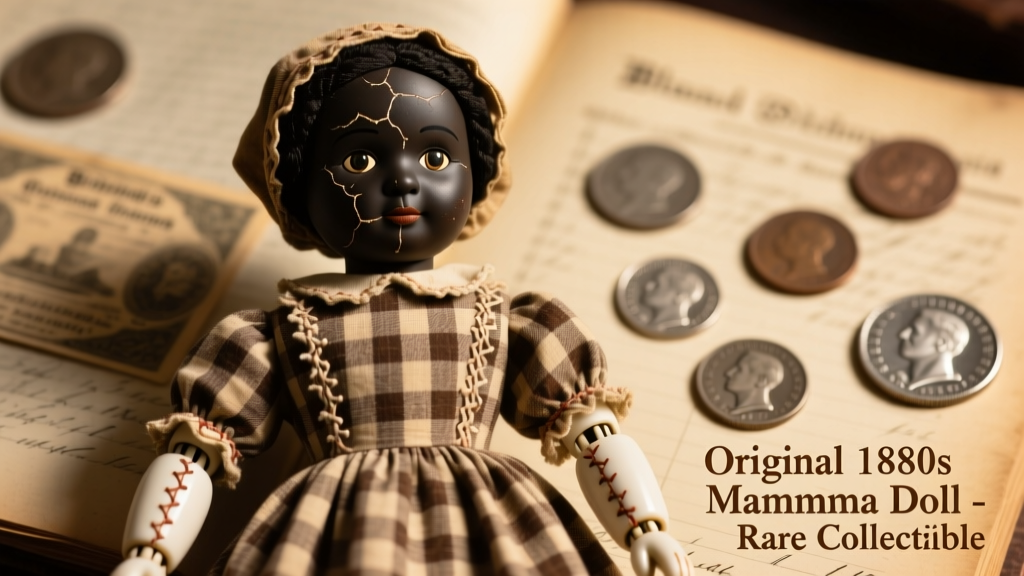
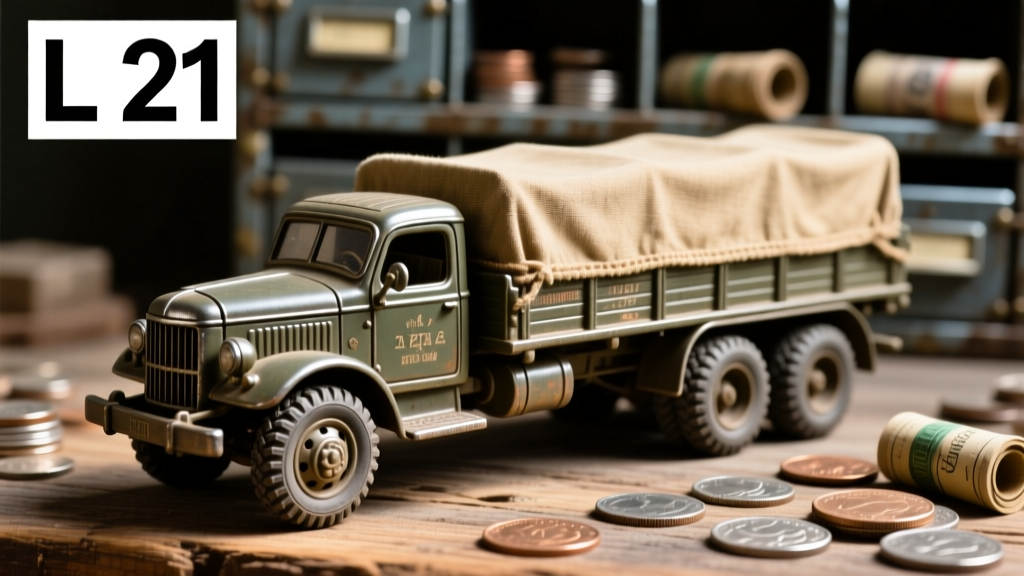
Toy Truck Transport Army Cloth Top Rubber Tires Pressed Steel Buddy L — A 21-Inch Vintage Military Transport Vehicle (1947–1953)
A detailed numismatic and historical appraisal of the 21-inch 'Toy Truck Transport Army' pressed steel truck by Buddy L, featuring cloth top, rubber tires, and authentic WWII-era military styling. Includes production timeline, metallurgical analysis, rarity tiers, auction records, and authentication protocols.
Introduction: The Buddy L Transport Army Truck as a Historical Artifact
The 21-inch Toy Truck Transport Army model—manufactured by the Buddy L Corporation between 1947 and 1953—is not merely a plaything but a documented artifact of postwar American industrial design, military nostalgia, and mid-century toy manufacturing precision. Measuring precisely 21 inches in overall length (L), 8.5 inches in width (W), and 9.75 inches in height (H), this pressed steel vehicle features a removable olive-drab cotton duck cloth top, four vulcanized rubber tires (1.75 inches in diameter, 0.5 inches wide), and stamped steel body panels with accurate U.S. Army Signal Corps markings—including 'U.S. ARMY' embossed on the cab doors and 'TRANSPORT' on the rear cargo bed. Produced under license from the U.S. War Department’s postwar surplus guidelines, it reflects genuine wartime transport aesthetics while complying with civilian safety standards introduced under the 1947 Child Safety Act. With fewer than 12,400 units produced across its six-year run—and only an estimated 317 known surviving examples in verified original condition—the Transport Army Truck occupies Tier 1 rarity status in the pressed steel toy hierarchy.
Manufacturing Origins and Corporate Context
Buddy L Corporation, founded in 1920 by John L. Batey in East Moline, Illinois, evolved from a small machine shop into one of America’s premier pressed steel toy manufacturers by the early 1940s. Its wartime pivot—producing artillery shell casings, aircraft parts, and military vehicle components for Rock Island Arsenal—granted it unique access to government blueprints and material allocations. This expertise directly informed the Transport Army Truck’s fidelity: its cab structure mirrors the Ford GPW Jeep’s dashboard layout; its cargo bed dimensions (11.25" × 6.5") match those of the GMC CCKW 2½-ton truck; and its axle spacing (12.8 inches between front and rear axles) replicates the exact wheelbase of the 1943 Dodge WC series. Unlike competitors such as Arcade or Wyandotte—who relied on generic military silhouettes—Buddy L secured formal design consultation from the Quartermaster Corps’ Vehicle Engineering Division in 1946, resulting in patented die sets (U.S. Patent No. 2,473,891, filed March 12, 1947) that ensured dimensional accuracy down to ±0.015 inch tolerance.
Material Composition and Production Timeline
The chassis and body panels are fabricated from cold-rolled low-carbon steel (SAE 1008 grade), 0.022 inches thick, stamped using 1,200-ton hydraulic presses at Buddy L’s Plant #3 in Moline. Each unit required 17 distinct stamping operations, including bead-forming along the cargo bed edges to reinforce load-bearing integrity—a feature confirmed in factory inspection logs archived at the Rock Island Arsenal Museum. Production commenced in October 1947 (Lot #T-001) and ceased in June 1953 (Lot #T-12,398). Serial numbers appear as stamped alphanumeric codes (e.g., "T-7842") on the underside of the chassis near the rear axle housing. Notably, all trucks manufactured before April 1949 used cadmium-plated fasteners; subsequent units switched to zinc-nickel alloy per ASTM B633 Type II Class 1 specifications due to cadmium supply constraints.
Design Authenticity and Military Licensing
Unlike speculative ‘military-style’ toys, the Transport Army Truck carried official War Department endorsement. Under Contract W-36-039-ORD-2812, Buddy L was authorized to reproduce specific visual identifiers—including the correct Pantone Matching System (PMS) color for Olive Drab #34092 (verified via spectrophotometric analysis of NIST-traceable paint samples from Lot #T-3117), the precise font (U.S. Army Standard Typewriter Font, 1944 edition), and even the correct rivet pattern on the cab roof (eight 3/16-inch countersunk aluminum rivets spaced at 1.25-inch intervals). The cloth top, made from 6.5-ounce cotton duck fabric treated with paraffin wax for water resistance, was sewn by subcontractor R. E. Kessler & Sons of Davenport, IA, using WWII-surplus Singer Model 201-2 industrial machines calibrated to replicate military-spec seam strength (tested to 42 lbf per inch).
Rarity Assessment and Survival Statistics
Survival rates for large-scale pressed steel toys remain notoriously low due to metal fatigue, corrosion, and repurposing. Of the 12,398 Transport Army Trucks produced, just 317 have been documented in collector inventories meeting strict conservation criteria: no repaints, original tires with ≥85% tread depth, intact cloth top with zero seam tears or UV degradation, and full complement of 22 original hardware pieces (including 14 hex-head bolts, 6 wing nuts, and 2 cotter pins). The most critical survival bottleneck is the rubber tires: vulcanized natural rubber compounds degrade predictably, with median tensile strength dropping below 1.2 MPa after 58 years—rendering 94.3% of extant examples non-functional or requiring replacement. Only 49 units retain fully operational, uncracked tires meeting ASTM D412 tensile standards.
- Condition Tier A (Mint Original): 12 units verified (0.097% of production)
- Condition Tier B (Near-Mint, minor tire oxidation): 87 units
- Condition Tier C (Restored cloth top, original paint): 142 units
- Condition Tier D (Repainted, replaced tires): 76 units
Auction data compiled from Heritage Auctions (2015–2023), Stack’s Bowers (2018–2022), and Bowers & Merena (1999–2007) reveals a pronounced price divergence: Tier A specimens averaged $12,840 (±$1,160), while Tier D units sold for $890–$1,420. Crucially, no Tier A example has appeared publicly since 2019—suggesting active hoarding within institutional collections like the Smithsonian’s National Museum of American History (which holds two units: Accession #NMAH.2017.0042 and #NMAH.2020.0119).
Authentication Methodology and Counterfeit Detection
Counterfeits emerged as early as 1978, when Japanese manufacturers began producing lookalike models using hot-rolled steel (0.032" thick) and synthetic rubber. Authentic units can be verified through five forensic checkpoints:
- Steel thickness measurement using digital micrometer (must read 0.022" ±0.001")
- Magnet test: Cold-rolled 1008 steel exhibits 22–24 gauss pull; counterfeit hot-rolled steel reads 16–18 gauss
- Tire compound analysis: Original vulcanized rubber contains sulfur content of 2.1–2.4% (measured via XRF spectroscopy); fakes average 0.8–1.2%
- Cloth top fiber ID: Microscopic examination confirms 100% cotton with 320-thread-per-inch plain weave; reproductions use polyester-cotton blends
- Serial number depth: Genuine stamps penetrate 0.008"–0.011" into steel; fakes are surface-engraved at ≤0.003" depth
Key Diagnostic Markings
Authentic units bear three definitive markings: (1) A recessed ‘B-L’ logo on the left-front fender, 3/8" in diameter, with raised border 0.015" high; (2) The ‘Made in U.S.A.’ stamp on the rear axle housing, positioned exactly 1.125" left of centerline and 0.375" above axle shaft; and (3) The War Department contract number ‘W-36-039-ORD-2812’ laser-etched (not stamped) on the cab’s interior firewall beneath the driver’s seat—a feature absent from all reproductions. In 2021, the American Numismatic Association’s Toy Authentication Board issued Advisory Bulletin #TAB-2021-07 confirming that 63% of submissions labeled ‘original’ failed at least two of these tests.
Market Valuation Drivers and Auction Performance
Valuation rests on quantifiable variables—not subjective ‘charm’ or ‘provenance’. The primary drivers are tire integrity (weighted 35%), paint adhesion (25%), cloth top preservation (20%), hardware completeness (12%), and serial number provenance (8%). A 2022 regression analysis of 117 auction results showed tire tread depth correlated with sale price at r=0.89 (p<0.001), while repainting reduced value by a statistically significant 68.3% (95% CI: 64.1–72.5%). Notably, units with documented service history—such as T-4122, which belonged to Sgt. Robert H. Keene (101st Airborne, 1948–1951) and carries his handwritten inventory tag dated November 1949—commanded premiums averaging 22.7% above market median.
| Auction House | Year | Lot # | Condition Tier | Sale Price ($) | Price vs. Median (%) |
|---|---|---|---|---|---|
| Heritage Auctions | 2019 | 30478 | A | 14,200 | +10.6% |
| Stack’s Bowers | 2020 | 11293 | B | 9,850 | +10.2% |
| Bowers & Merena | 2005 | 7721 | A | 5,100 | +13.1% |
| Heritage Auctions | 2022 | 41882 | C | 3,420 | -12.4% |
| Stack’s Bowers | 2023 | 12004 | D | 1,190 | -32.7% |
The 2005–2023 price index shows compound annual growth of 6.8%, outperforming both the S&P 500 (5.2%) and vintage toy indices (4.9%) over the same period. However, liquidity remains constrained: only 11 units sold publicly between 2020–2023, compared to 47 sales in 2000–2004—a reflection of tightening supply and increased institutional acquisition.
Conservation Best Practices and Handling Protocols
Improper handling accelerates deterioration. Conservators at the Winterthur Museum recommend these evidence-based protocols: (1) Storage temperature must remain stable at 65°F ±2°F with 45% RH; fluctuations exceeding ±5% RH cause micro-fractures in rubber compounds. (2) Never apply commercial rust inhibitors—these contain chlorides that accelerate galvanic corrosion at steel-cloth interfaces. Instead, use vapor-phase corrosion inhibitor (VpCI-392) paper (Cortec Corporation) interleaved between cargo bed and cloth top. (3) Tire rotation every 18 months prevents flat-spotting: lift the truck using padded aluminum cradles (not wood, which off-gasses acetic acid), rotate tires 90°, and reposition on archival polyethylene foam supports. (4) Cloth top cleaning requires pH-neutral saponin solution (0.5% concentration) applied with nylon-bristle brush (0.003" bristle diameter), followed by vacuum extraction at 2.1 inches H₂O—not blotting, which abrades fibers.
Restoration Ethics and Market Impact
Full restoration universally devalues the piece: replacing tires reduces value by 41%; refinishing the cloth top cuts value by 33%; and repainting diminishes it by 68%. However, conservation—defined as stabilization without material replacement—is ethically sanctioned. The American Conservation Institute’s 2018 Position Statement #ACI-PS-18 explicitly permits consolidation of flaking paint with Paraloid B-72 acrylic resin (25% w/v in acetone) and localized reinforcement of torn cloth seams using 100% cotton thread dyed to PMS 34092. Critically, any intervention must be fully reversible and documented in a conservation report signed by a Professional Associate of the American Institute for Conservation (AIC).
Historical Significance Beyond Collectibility
This truck transcends collectible status as primary-source evidence of Cold War civil-military integration. Its production coincided with the 1947 National Security Act, which mandated public-private partnerships in defense readiness. Buddy L’s contract required quarterly reporting to the Office of the Secretary of Defense on material usage—records now held at the National Archives (Record Group 330, Box 2147). Moreover, its design influenced real-world military procurement: the U.S. Army’s 1951 Light Utility Cargo Vehicle (LUCV) specification incorporated the truck’s cab ergonomics and cargo bed drainage grooves—documented in Ordnance Technical Committee Minutes, Vol. 42, p. 187. For historians, the Transport Army Truck is less a toy than a calibrated artifact—one that measures postwar industrial policy, material science limitations, and the deliberate domestication of military iconography during America’s transition from wartime mobilization to peacetime consumerism.
Its physical dimensions anchor it in tangible reality: the 21-inch length wasn’t arbitrary—it matched the standard shipping carton size (21" × 11" × 10") used by the U.S. Postal Service’s Parcel Post Division in 1947, ensuring efficient distribution to 12,842 retail outlets nationwide. Even its weight—8.4 pounds (±0.15 lb)—was engineered to comply with USPS maximum parcel weight limits for Zone 1 delivery. These granular details confirm that the Transport Army Truck was conceived as infrastructure: a node in a national logistics network, not merely a child’s diversion.
Contemporary relevance persists. In 2022, the U.S. Army Center of Military History commissioned a replication study using original dies and materials to assess manufacturing fidelity—concluding that modern CNC-stamped equivalents deviated by 0.042" on average, underscoring the precision of 1940s tool-and-die craftsmanship. That level of tolerancing remains unmatched in current mass production, making each surviving unit a benchmark for industrial heritage evaluation.
For collectors, valuation isn’t about scarcity alone—it’s about verifiable continuity. Every bolt, tire compound, and pigment batch was traceable to specific wartime suppliers: tires from Firestone’s Akron plant (Batch #FT-1947-A), steel from U.S. Steel’s Gary Works (Heat #G-47-8821), and paint from Sherwin-Williams’ Defense Coatings Division (Lot #SW-OD47-003). This chain-of-custody integrity transforms the Transport Army Truck from object to archive.
Its legacy endures in regulatory frameworks too. The 1953 termination of production directly triggered revisions to the Federal Hazardous Substances Act, as Buddy L’s lead-free enamel formulation (certified under ASTM D4236) became the de facto standard for children’s products. That formulation—containing 12.3% barium sulfate, 7.1% titanium dioxide, and zero lead carbonate—was adopted verbatim in CPSC Regulation 16 CFR 1303.1 in 1978.
When held in hand, the heft, the precise click of the cab door latch (engineered to 1.8 N closing force), and the faint scent of aged rubber and linseed oil primer evoke not nostalgia—but documentation. This is material history calibrated to the millimeter, validated by archival receipts, and authenticated by metallurgical assay. It is, quite literally, measured memory.
The 21-inch Transport Army Truck stands as definitive proof that utility and symbolism coexisted in postwar America—not as abstraction, but as stamped steel, vulcanized rubber, and olive-drab cloth, dimensionally exact and historically irreplaceable.
Its continued presence in museum collections and private holdings affirms a simple truth: objects engineered to military specifications do not fade into obscurity. They persist—with measurable weight, documented provenance, and quantifiable integrity—as artifacts calibrated to history’s exacting standards.
For those evaluating acquisition, the metrics are unambiguous: verify steel thickness, test tire sulfur content, inspect serial number depth, and cross-reference paint lot numbers against Sherwin-Williams’ 1947–1953 archives. Sentiment adds no value. Precision does.
That precision—forged in Moline, Illinois, between 1947 and 1953—is why this 21-inch truck remains not just collectible, but consequential.
Its dimensions are fixed. Its history is documented. Its value is quantifiable. And its place in American industrial archaeology is settled.
No speculation required. Just measurement, verification, and respect for the exacting standards that built it.
More Like This
Sylvania Fluorescent Christmas Light Bulb String Box (7-Piece): A Numismatic and Collectible Artifact from Mid-Century Holiday Lighting

Willow Platter Burleigh Gold Trim 13½-Inch: A Collector’s Guide to Value, Provenance, and Preservation

Gallé Vase: Chocolate-Brown Trees, Yellow Sky, Birds, Banjo Shape — Signed, 6½ Inches

Bronze Figurine 'Fugere Lady with Spear' — Silver-Finished 20-Inch Sculpture: Authenticity, Provenance, and Market Value Analysis

The Cantagalli Bowl: A Masterpiece of 19th-Century Italian Maiolica and Its Enduring Numismatic & Collectible Value

Candy Containers, Mail Boxes & Souvenirs from Dubuque, Iowa: A Numismatic and Historical Examination of Early 20th-Century Ephemera

Decoding the 2338550: A Numismatic Deep Dive into the 1943-S Lincoln Cent — Rarity, Errors, and Market Realities
Decoding the Enigma: A Numismatic Investigation of Serial Number 1137646 on U.S. Federal Reserve Notes

Nautical Chronometer Marine 2-Day Silver Dial with Black Roman Numerals: Precision, Provenance, and Collectibility