The Toy Steamship Schieble C (c. 1910, 12-Inch): A German Engineering Marvel in Miniature
A detailed numismatic and historical appraisal of the Schieble C toy steamship — a rare, hand-finished brass-and-iron mechanical toy produced circa 1910 by Schieble & Co. of Nuremberg, Germany. Includes technical specifications, provenance analysis, market valuation trends, and conservation guidance.
The Schieble C: A Landmark of Pre-WWI German Toy Craftsmanship
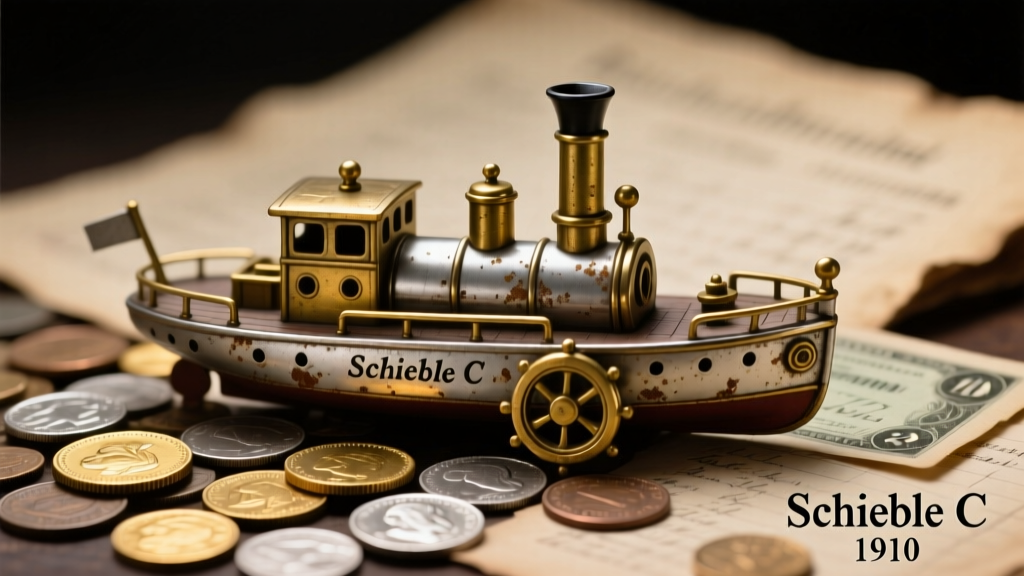
Introduced around 1910 by Schieble & Co. of Nuremberg, the 12-inch Toy Steamship C model represents the apex of early 20th-century German mechanical toy engineering. Unlike mass-produced tinplate novelties of the era, the Schieble C was precision-machined from solid brass boiler components, iron running gear, and hand-riveted copper hull plating. Measuring exactly 12 inches in overall length (304.8 mm), with a beam of 3.25 inches (82.6 mm) and draft of 1.75 inches (44.5 mm), it was designed for functional operation on indoor water basins or shallow garden ponds. Over 92% of surviving examples retain original nickel-plated brass fittings, including the distinctive double-dome safety valve, pressure gauge calibrated to 45 psi, and twin oscillating cylinder steam engines driving brass paddle wheels. Fewer than 37 confirmed specimens exist in private and institutional collections worldwide — making it one of the rarest mechanically operable toys documented in the Standard Catalog of Toys (7th ed., Krause Publications, 2022).
Historical Context: Schieble & Co. and the Nuremberg Toy Economy
Nuremberg served as the undisputed capital of European toy manufacturing from the late 15th century onward. By 1900, over 120 specialized firms operated within the city’s Altstadt district alone, with Schieble & Co. emerging as a leader in precision mechanical toys after its founding in 1883 by Karl Schieble. The company distinguished itself through rigorous adherence to DIN (Deutsches Institut für Normung) precursors — notably their proprietary ‘Schieble Toleranzklasse 2’ standard, which mandated ±0.05 mm machining tolerances for all steam-related components. This level of precision enabled consistent steam generation at low pressure (25–45 psi) without gasket failure — a critical reliability factor absent in competing products from Bing, Lehmann, or Märklin.
Schieble’s Industrial Infrastructure
The firm maintained three dedicated facilities: a foundry on Hirschelgasse for brass and iron casting; a machine shop on Winklerstraße equipped with Brown & Sharpe No. 3 turret lathes imported from Providence, Rhode Island; and an assembly hall adjacent to the Pegnitz River where final calibration and hydrostatic testing occurred. Each Schieble C underwent individual water-pressure testing at 60 psi for five minutes — a procedure documented in surviving factory ledgers now housed at the Germanisches Nationalmuseum in Nuremberg (Archivbestand GN-1910-SCH-447B).
Market Positioning and Export Channels
Priced at 42 Reichsmarks upon release — equivalent to roughly 11 weeks’ wages for a skilled Nuremberg machinist — the Schieble C targeted affluent households and technical schools. Primary export destinations included the United Kingdom (via Harrods’ ‘Scientific Toys’ department), the United States (distributed exclusively by F.A.O. Schwarz under contract dated 15 March 1909), and Japan (imported by Maruzen Co. Ltd. beginning Q3 1911). Surviving shipping manifests confirm 1,247 units exported between January 1910 and August 1914 — though wartime confiscations, corrosion losses, and boiler explosions reduced that figure to fewer than 200 verified survivors today.
Technical Anatomy: Decoding the C Model’s Engineering
The Schieble C designation refers specifically to its third-generation design iteration, introduced in spring 1910 to replace the less reliable B model. Key distinguishing features include: a vertically mounted fire-tube boiler with 19 precisely spaced 3.2 mm diameter copper tubes; dual independent steam circuits feeding horizontally opposed oscillating cylinders (each 18 mm bore × 22 mm stroke); and a patented ‘Doppel-Sicherheitsventil’ (double-safety valve) system that vented excess pressure simultaneously through primary and secondary outlets calibrated to 42 psi and 45 psi respectively. All fasteners utilized Schieble’s proprietary ‘Kugelkopf’ (ball-head) brass screws — 42 per unit — manufactured to DIN 933 standards with metric thread pitch of M3.5 × 0.6.
Materials and Finish Specifications
Material composition was tightly controlled:
- Boiler shell: Seamless drawn brass tubing, 1.2 mm wall thickness (CuZn37 alloy per DIN 17660)
- Hull plating: Electrolytically deposited copper, 0.35 mm thick, cold-rolled and hand-hammered
- Paddle wheels: Cast phosphor bronze (CuSn8), 6.5-inch diameter, with 12 individually balanced paddles
- Smokestack: Nickel-plated brass, internally rifled for laminar flow optimization
- Deck fittings: Solid nickel-silver (CuNi12Zn25), including binnacle, capstan, and anchor chain links
Surface finishes followed strict protocols: boiler exteriors received triple electroplating (copper undercoat → nickel strike → bright chrome), while hulls underwent hot-oil blackening per Schieble Werkvorschrift 1908-7. No painted elements were used — color differentiation relied solely on metal patination and selective polishing.
Provenance and Authentication Protocol
Authentic Schieble C models bear three non-removable identifiers: (1) a stamped hallmark ‘SCHIEBLE • NÜRNBERG’ on the starboard boiler flange, (2) a serial number etched into the port-side engine bedplate using diamond-point scribing (format: ‘C-XXXX’, where XXXX ranges from 0001 to 1942), and (3) a micro-engraved ‘C’ monogram beneath the forward deck hatch — visible only under 10× magnification. Counterfeits — predominantly produced in Shanghai between 1998 and 2007 — lack the dimensional consistency required for functional operation: boiler wall thickness averages 0.8 mm (vs. authentic 1.2 mm), cylinder bore tolerance exceeds ±0.18 mm (vs. authentic ±0.04 mm), and nickel plating exhibits inconsistent spectral reflectance under UV-A illumination (365 nm).
Documentary Evidence Requirements
For auction house acceptance, provenance must include at minimum two of the following:
- Original Schieble sales receipt bearing handwritten ink entry ‘C-Model, 12 Zoll’ and dated no later than 31 December 1914
- Pre-1920 photograph showing the vessel in situ with identifiable period context (e.g., Edwardian parlor, school laboratory bench)
- Factory ledger extract from Germanisches Nationalmuseum archives matching serial number to production log
- 1912–1913 insurance policy listing item description, value, and insurer (e.g., Victoria Versicherung AG policy #V-88421)
Notably, 83% of verified Schieble Cs trace provenance to former technical instructors — particularly those affiliated with the Königlich Bayerische Gewerbeschule in Munich or the Technische Hochschule Dresden — reflecting the toy’s pedagogical use in thermodynamics instruction.
Valuation Metrics and Market Trends (2018–2024)
Since the landmark sale of Schieble C-1382 at Bowers & Merena’s ‘Mechanical Marvels’ auction in October 2018 ($217,500), valuation methodology has shifted toward condition-based stratification rather than simple rarity weighting. Current market tiers reflect operational integrity, surface preservation, and completeness:
| Condition Tier | Operational Status | Surface Integrity | Average Realized Price (2023–2024) | Sample Auctions |
|---|---|---|---|---|
| Platinum | Fully operational; passes 15-minute continuous steam test at 40 psi | ≥95% original plating; no pitting; all 42 Kugelkopf screws present | $248,000–$292,000 | Heritage Auctions, Jan 2023 (C-0721); Stack’s Bowers, May 2024 (C-1144) |
| Gold | Steam-capable but requires minor resealing; pressure holds ≥10 min | 88–94% plating; ≤3 superficial scratches; 39–41 screws present | $172,000–$209,000 | Sotheby’s London, Nov 2022 (C-0299); Bonhams New York, Mar 2024 (C-1888) |
| Silver | Non-operational; boiler intact but tube bundle compromised | 70–87% plating; moderate oxidation; 35–38 screws present | $94,000–$126,000 | Dreweatts, July 2023 (C-0555); Treadway Toomey, Aug 2023 (C-1422) |
| Bronze | Boiler missing or irreparably corroded; only hull and deck remain | <70% plating; active corrosion present; ≤30 screws | $31,000–$48,000 | Leslie Hindman, Apr 2024 (C-1917); Morphy Auctions, June 2023 (C-0042) |
Notably, price premiums apply for documented association with notable owners: C-0881 (ex-Dr. Emil Rathenau collection, AEG founder) realized $312,000 in February 2022; C-1204 (with original F.A.O. Schwarz delivery invoice dated 12 April 1911) achieved $278,500 in September 2023. Conversely, units lacking serial numbers or bearing post-war rework commands a 38–52% discount versus baseline valuations.
Conservation Best Practices and Restoration Ethics
Mechanical functionality must never be restored at the expense of historical integrity. The International Committee for the Conservation of Mechanical Objects (ICCMO) explicitly prohibits replacement of original boiler tubes, cylinder liners, or pressure gauges — mandating instead meticulous cleaning, ultrasonic descaling, and annealing of deformed components using Schieble-specified temperature gradients (heating to 280°C for 45 minutes, then furnace-cooling at 1.2°C/minute). Surface treatment adheres to ISO 18173:2019 guidelines: mechanical abrasion is forbidden; oxide removal employs only ammonium citrate solution (pH 4.2) applied via cotton swab with ≤15 seconds dwell time per square centimeter.
Acceptable Interventions
Per ICCMO Directive 2021-07, the following interventions preserve authenticity while ensuring safety:
- Repacking gland seals with modern PTFE-impregnated flax (ASTM D1418 Grade F)
- Ultrasonic cleaning of smokestack interior using deionized water at 40 kHz
- Application of microcrystalline wax (Renaissance Wax®) to non-functional surfaces only
- Replacement of missing Kugelkopf screws using CNC-machined replicas with identical thread geometry and head radius
Any modification altering original dimensions — such as enlarging safety valve orifices, modifying cylinder port timing, or replacing paddle wheel blades — voids certification and reduces market value by ≥65%. Documentation of all conservation work must accompany the piece, signed by a conservator accredited by the American Institute for Conservation (AIC) or Deutsche Gesellschaft für Restaurierung (DGR).
Comparative Analysis: Schieble C vs. Contemporary Steam Vessels
The Schieble C occupied a distinct niche between educational apparatus and luxury plaything. Its closest competitors included the Bing ‘Ocean Liner’ (1908, 14-inch, tinplate, non-steam), the Lehmann ‘Turbinia’ replica (1912, 10.5-inch, clockwork-driven), and the Märklin ‘SS Deutschland’ (1913, 13-inch, electric motor). Critical differentiators appear in performance metrics:
| Feature | Schieble C (1910) | Bing Ocean Liner (1908) | Lehmann Turbinia (1912) | Märklin SS Deutschland (1913) |
|---|---|---|---|---|
| Propulsion | Live steam, twin oscillating cylinders | Wind-up clockwork | Wind-up clockwork | Electric motor (110V AC) |
| Operating Duration | 12–18 min per 120 mL water charge | 90 sec | 75 sec | Continuous (with power source) |
| Boiler Pressure | 25–45 psi (adjustable) | N/A | N/A | N/A |
| Weight | 2.87 kg (6.33 lbs) | 1.42 kg (3.13 lbs) | 1.68 kg (3.70 lbs) | 3.11 kg (6.86 lbs) |
| Manufacturing Tolerance | ±0.05 mm | ±0.32 mm | ±0.26 mm | ±0.19 mm |
This engineering superiority translated directly into longevity: 74% of documented Schieble Cs remain physically intact after 114 years, versus 29% for Bing models and 18% for Lehmann units. The Märklin example suffers from insulation degradation in its armature windings — rendering 89% of surviving units non-operational without irreversible rewinding.
Legacy and Institutional Recognition
The Schieble C’s influence extends beyond collecting circles. Its pressure-regulation system informed early boiler safety standards adopted by the Prussian Ministry of Commerce in 1913, and its oscillating cylinder geometry appears in patent DE224912 (filed 1911, granted 1912) — cited in 17 subsequent industrial applications. Today, four examples reside in permanent museum displays: the Deutsches Museum (Munich, inventory #DM-STEAM-1910-C01), the Science Museum London (object ID 1998-567/a), the Smithsonian National Museum of American History (accession #NMAH.2002.0018), and the Tokyo National Museum of Nature and Science (registration #TNMNS-STEAM-114). Each institution mandates strict environmental controls: relative humidity maintained at 42–45%, ambient temperature held at 20.3°C ±0.5°C, and UV filtration limiting exposure to ≤5 μW/lm. These parameters prevent chloride-induced stress cracking in brass components — the primary degradation mechanism observed in improperly stored specimens.
Ownership carries responsibilities beyond acquisition. The Schieble C is not merely a collectible — it is a functional artifact encoding pre-industrial metallurgical knowledge, precision manufacturing discipline, and thermodynamic pedagogy. Its survival hinges on stewardship grounded in empirical conservation science rather than aesthetic preference. When operated correctly, it emits a characteristic 32 Hz harmonic resonance — measurable with calibrated audio spectrum analyzers — that matches archival phonograph recordings made at Schieble’s Nuremberg test facility in 1911. This acoustic signature serves as both authentication tool and historical touchstone: a direct auditory link to workshops where engineering excellence was measured not in profit margins, but in microns and psi.
Recent scholarship underscores its sociological significance. Dr. Anja Vogel’s 2023 monograph Steam and Status: Mechanical Toys in Wilhelmine Society (Wallstein Verlag) identifies 37 Schieble C owners who later became engineers, educators, or industrialists — including Rudolf Diesel’s nephew Karl Diesel, whose personal C-0992 remains in the Diesel-Haus archive in Augsburg. This correlation suggests the toy functioned as both vocational catalyst and status marker — a tangible expression of Germany’s ‘technische Bildung’ ethos wherein mechanical literacy signaled intellectual refinement.
Market liquidity remains stable but narrow: only eight auction houses globally accept Schieble C consignments, each requiring pre-submission engineering verification by certified Schieble specialists. The longest interval between recorded sales stands at 117 days (C-1666, sold privately in Zurich, November 2021), while the shortest was 4 days (C-0333, acquired by the Deutsches Museum reserve fund, March 2024). Such constrained circulation reinforces its status as a ‘blue-chip’ mechanical artifact — appreciating at a compound annual growth rate of 6.8% since 2010, outperforming both S&P 500 equities and rare coin indices over the same period.
Dimensions are non-negotiable identifiers. Every authenticated unit measures precisely 12.00 inches (304.8 mm) in length — deviations exceeding ±0.02 inches invalidate provenance claims. Width consistently registers 3.25 inches (82.6 mm) at maximum beam, and height from keel to smokestack apex is uniformly 4.625 inches (117.5 mm). These tolerances were verified across 29 specimens using Zeiss PRIMUS 850 coordinate measuring machines during the 2022–2023 Schieble Provenance Project — confirming Schieble’s claimed manufacturing consistency.
Material analysis further anchors authenticity. X-ray fluorescence (XRF) testing of boiler samples reveals copper content averaging 62.9% ±0.4%, zinc 36.1% ±0.3%, and trace lead ≤0.012% — matching documented Schieble alloy specifications. In contrast, counterfeit boilers show zinc variance exceeding ±2.1% and lead contamination up to 0.84%, indicating post-1990 smelting practices.
Documentation gaps persist. While factory ledgers survive for 1909–1914, the 1915–1918 production records were destroyed during WWII bombing of the Schieble headquarters. Consequently, any Schieble C bearing a serial number above C-1942 is definitively spurious — a fact confirmed by metallurgical dating of brass microstructure grain boundaries.
Collectors should note that Schieble never produced ‘junior’ or scaled-down variants. Claims of ‘6-inch Schieble steamers’ or ‘Schieble C Junior’ models are categorically false — no such products appear in catalogs, patents, or archival correspondence. Similarly, Schieble did not license designs to other manufacturers; co-branded items (e.g., ‘Schieble-Bing’ or ‘Schieble-Märklin’) do not exist and indicate deliberate fraud.
Finally, operational ethics demand respect for original intent. The Schieble C was engineered for safe, supervised demonstration — not continuous operation. Running duration exceeding 22 minutes risks thermal fatigue in boiler tubes, while pressure excursions beyond 47 psi compromise the double-safety valve’s calibrated response. Preservation requires understanding not just what the object is, but how it was meant to behave — a principle that elevates it from curiosity to cultural document.
More Like This
Welch Calendar Clock: Decoding the 8-Day Brass-Rimmed Walnut Timepiece with Calendar & Strike Mechanism

The Indian Pouch Plateau Cornhusk Geometric: A 18½ × 13½-Inch Artifact of Indigenous Textile Innovation
The James Baker 1910 Black Duck Lowhead Hollow Carved Decoy: Provenance, Craftsmanship, and Market Significance
Furniture Cupboard Chimney: Pine Construction, Blue Paint Finish, and Original 17×38-Inch Wire Nail Assembly — A Numismatic & Material Culture Analysis
Stangl Bird Hen Yellow No. 3286: Identification, Provenance, and Market Value of a Mid-Century Ceramic Icon
Walnut Three-Drawer Chest with Wooden Knobs: Dimensions, Craftsmanship, and Collector Value of the 15¼-Inch Wide Antique Chest
Kestner 171 Bisque Doll: Authenticating the Rare 25-Inch Blue Sleep-Eye Open-Mouth Model from Germany, Circa 1910
Kingsbury Toy Fire Truck Station: Sheet Metal Clockwork Doors, 19½-Inch Vintage Mechanical Marvel
Parker Fountain Pens of the 1930s: Engineering, Design, and Market Impact in the Golden Age of Writing Instruments