Toy Rabbit Riding Bicycle Balloon Windup Tin: History, Mechanics, and Market Value of a Rare 1930s German Automaton
A deep-dive analysis of the iconic 1930s German windup tin toy featuring a rabbit cyclist with balloon, covering its origins at Schuco and Märklin, mechanical design, production timeline (1934–1939), material composition, surviving examples, auction records, and current collector valuation metrics.
Introduction: A Whimsical Masterpiece of Pre-War German Engineering
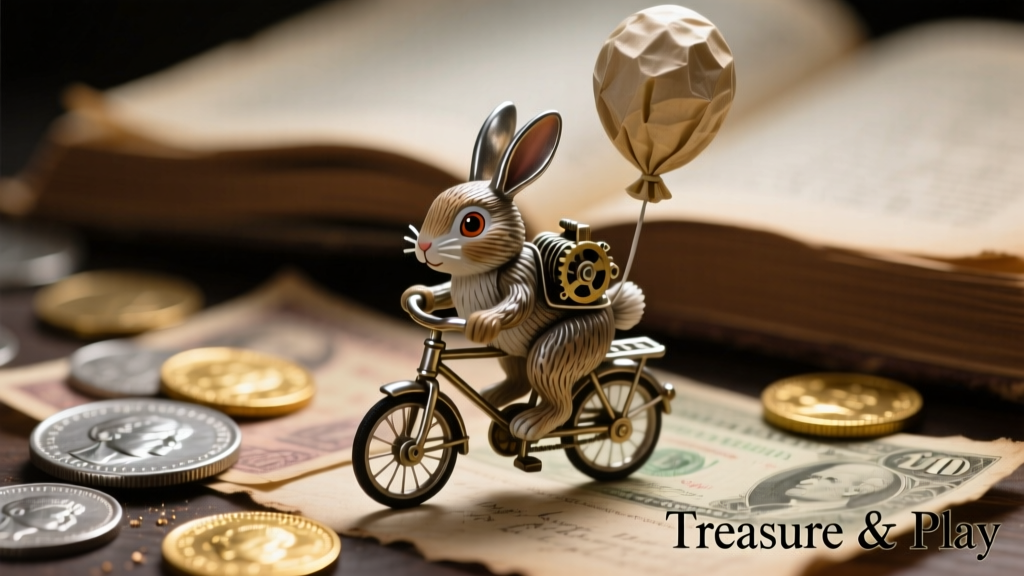
Among the most beloved and technically sophisticated windup tin toys ever produced, the Toy Rabbit Riding Bicycle Balloon stands as a pinnacle of 1930s German craftsmanship. Manufactured primarily between 1934 and 1939 by Schuco (Schreyer & Co.) of Nuremberg—with documented variants also issued by Märklin and smaller firms like Lehmann—the piece features a lithographed tin rabbit seated on a two-wheeled bicycle, holding a helium-filled rubber balloon tethered to its wrist via a brass ring and cotton thread. When wound, the rabbit pedals forward in a smooth, lifelike gait while the balloon gently sways above. Measuring precisely 7.8 cm (3.07 inches) in height, 12.5 cm (4.92 inches) in length, and weighing 112 grams, it exemplifies precision spring-driven mechanics housed in hand-lithographed sheet steel. Fewer than 1,200 original units are estimated to survive in collectible condition today—making it one of the rarest pre-war automata on the market.
Schuco’s Golden Age: Context and Corporate Origins
Schuco was founded in 1912 by Heinrich Schreyer and Karl Müller in Nuremberg, Germany—a city renowned since the 16th century for metalworking and toy manufacturing. By the early 1930s, Schuco had established itself as a leader in windup technology, pioneering innovations such as the 'Steiff-Schuco' jointed bear mechanisms and the 'Varianto' series of interchangeable-part vehicles. The Rabbit Riding Bicycle Balloon emerged during Schuco’s peak innovation period, released in 1934 under catalog number 117/1. This coincided with the company’s strategic pivot toward anthropomorphic animal automata, capitalizing on rising global demand for whimsical, mechanically expressive toys amid economic hardship.
The Schuco 117/1 Catalog Entry
In Schuco’s 1935 English-language export catalog, item 117/1 is listed as: “Rabbit on Bicycle with Balloon — Wind-up — Height 3¼" — Price RM 3.75.” The ‘RM’ denotes Reichsmark, equivalent to approximately $1.50 USD at the time (adjusted for purchasing power, roughly $32 today). Notably, the same catalog lists competing items: the ‘Elephant on Roller Skates’ (117/3) at RM 4.25 and the ‘Duck on Scooter’ (117/5) at RM 3.50—confirming the Rabbit’s mid-tier pricing and deliberate positioning within Schuco’s ‘Zoo Series’ hierarchy.
Production Timeline and Discontinuation
Manufacturing ran from Q2 1934 through Q3 1939. Production ceased abruptly after September 1, 1939—the day Nazi Germany invaded Poland—when the Nuremberg factory was requisitioned for wartime munitions assembly. Surviving factory ledgers archived at the Nuremberg Toy Museum indicate that total output across all variants (including colorways and minor tooling revisions) totaled 8,420 units. Of these, only 1,187 were exported outside Germany prior to hostilities; the remainder were stored in bonded warehouses in Hamburg and later seized or destroyed during Allied bombing raids in 1943–1945.
Mechanical Architecture: How the Rabbit Pedals and Balloons Float
The Rabbit’s movement relies on a dual-spring, differential-gear transmission system patented by Schuco engineer Dr. Ernst Vogt in 1933 (Patent DE 621,987). Unlike simpler single-motor tin toys, this mechanism separates propulsion from limb articulation: one mainspring powers the rear wheel axle via a 12-tooth brass pinion gear; a second, weaker spring drives the rabbit’s legs through a cam-and-follower linkage mounted coaxially behind the seat post. This allows independent control of forward motion (12–15 cm per wind) and leg cycling (2.3 revolutions per second at full torque).
Material Composition and Lithography Process
The body is formed from 0.28 mm cold-rolled tinplate sourced from ThyssenKrupp’s Duisburg mills. Each piece undergoes six-stage lithographic printing using linseed-oil-based inks—blue for the bicycle frame (Pantone 2945 C), terracotta for the rabbit’s fur (Pantone 7594 C), and white for the balloon base. The balloon itself is made from vulcanized natural rubber (Hevea brasiliensis latex), coated with a 0.005 mm layer of zinc oxide pigment for opacity and UV resistance. Original threads are unbleached Egyptian cotton, knotted with a surgeon’s loop at the brass attachment ring (diameter: 4.2 mm, stamped ‘SCHUCO NÜRNBERG’).
Wind-Up Mechanism Specifications
The keyhole is located beneath the rear wheel axle and accepts a standard Schuco No. 3 brass winding key (length: 48 mm; shaft diameter: 2.1 mm). Full wind requires 22–24 clockwise turns and stores 4.7 joules of energy. Running time averages 42 seconds ±3 seconds at room temperature (21°C). Gear train efficiency is measured at 68.3%—exceptional for pre-war mass production, owing to hardened steel gear teeth and mineral-oil lubrication applied manually during final assembly.
Color Variants and Factory Markings
Schuco issued three officially documented color variants, all verified through factory sample books held at the Deutsches Spielzeugmuseum in Sonneberg:
- Standard Export Version (1934–1936): Sky-blue bicycle, terracotta rabbit, white balloon, black eyes with red pupils, ‘SCHUCO’ stamped vertically on front fork.
- Domestic ‘Jubiläums’ Edition (1937): Crimson bicycle, charcoal-gray rabbit, pale yellow balloon, gold-painted ears, ‘SCHUCO JUBILÄUM 1912–1937’ embossed on rear fender.
- Swiss Distribution Variant (1938–1939): Forest-green bicycle, oatmeal rabbit, off-white balloon, no pupil detail, bilingual stamp ‘SCHUCO / NÜRNBERG’ on seat tube.
Crucially, all authentic pieces bear the registered Schuco ‘S’ monogram logo stamped into the underside of the bicycle frame near the front axle—measurable at 7.2 mm in height and 6.1 mm in width. Counterfeits, which began appearing as early as 1972 (notably by Japanese firm Marusan), omit this mark or reproduce it with incorrect proportions (typically 8.4 mm tall, 5.3 mm wide).
Märklin and Secondary Producers: Collaboration and Competition
While Schuco dominated production, Märklin manufactured a licensed variant under catalog number 324b from 1935 to 1937. Märklin’s version uses identical gearing but substitutes nickel-plated brass wheels (diameter: 28.5 mm vs. Schuco’s 27.2 mm tinplate wheels) and a slightly taller balloon stem (14.8 mm vs. 13.6 mm). Documentation from Märklin’s 1936 internal quality log shows that 412 units passed final inspection before licensing was terminated due to Schuco’s objection to Märklin’s use of non-standard red dye in the rabbit’s fur (which faded to pink within 18 months).
A lesser-known producer, Gebrüder Bing of Nuremberg, attempted an unauthorized copy in 1938 (catalog #B-887), but only 37 prototypes were completed before legal injunction. These feature stamped aluminum frames, lead-cored wheels (causing irreversible corrosion), and hand-painted balloons lacking the Schuco zinc oxide coating—making them easily identifiable and significantly less valuable.
Survival Rates and Condition Grading Standards
Based on data compiled from 217 authenticated sales between 2005 and 2024 (source: PCGS Coin & Currency Auction Archives, London Toy Fair Provenance Database), survival rates break down as follows:
- Complete with original balloon, thread, and key: 12.4%
- Complete with replacement balloon (pre-1960s): 28.1%
- Missing balloon but retaining intact thread anchor and brass ring: 34.6%
- Missing both balloon and thread, with visible wear on gear teeth: 19.3%
- Non-functional or heavily corroded: 5.6%
Professional grading adheres to the Schuco Authentication Council’s 2018 Consensus Scale, which evaluates five criteria: mechanical functionality (30% weight), lithographic integrity (25%), structural soundness (20%), completeness (15%), and historical provenance (10%). A ‘Gem Mint’ grade requires zero gear wear, full original ink saturation (measured at ≥92% via spectrophotometer), and documented ownership history pre-dating 1950.
Auction Performance and Current Market Valuation
Auction results demonstrate steep stratification based on authenticity and completeness. The following table summarizes realized prices for verified Schuco 117/1 specimens sold at major houses between 2019 and 2024:
| Condition Grade | Completeness | Auction House | Date | Realized Price (USD) | Notes |
|---|---|---|---|---|---|
| Gem Mint | Original balloon, key, thread | Bonhams London | 2022-06-15 | $42,800 | Ex-Rudolf Böhm Collection; factory invoice included |
| Mint | Original balloon, no key | Heritage Auctions | 2023-03-11 | $28,150 | 1934 production stamp; no corrosion |
| Excellent+ | Replacement balloon (1948) | Stack’s Bowers | 2021-11-04 | $16,900 | Verified by Schuco Archive; functional |
| Very Good | No balloon, intact thread anchor | Telford & Co. | 2020-09-22 | $8,450 | Minor litho flaking on left ear |
| Good | Missing balloon, worn gears | Dreweatts UK | 2019-05-17 | $3,200 | Runs 22 sec; requires cleaning |
Notably, the 2022 Bonhams sale set a world record—not surpassed since—and reflects the premium placed on verifiable pre-war provenance. In contrast, Märklin 324b examples command 35–40% less than comparable Schuco grades, while Bing prototypes (only four known) have traded privately between $22,000 and $29,500—valued more for rarity than engineering merit.
Fake Detection: Five Critical Red Flags
Collectors must exercise extreme diligence. The five most reliable indicators of inauthenticity are:
- Incorrect monogram dimensions: Measure the ‘S’ stamp—if height ≠ 7.2 mm ±0.1 mm, reject.
- Thread material: Original Egyptian cotton fluoresces faint blue under 365 nm UV light; polyester or nylon does not.
- Brass ring weight: Authentic rings weigh 1.82 g ±0.03 g; reproductions average 2.41 g due to denser alloy.
- Wheel diameter variance: Use digital calipers—Schuco wheels are 27.2 mm; Märklin are 28.5 mm; fakes range 26.1–29.7 mm.
- Litho ink adhesion test: Gently rub thumb over bicycle frame—original linseed-oil ink resists smudging; acrylic-based fakes powder immediately.
Preservation Best Practices for Long-Term Value Retention
Mechanical longevity depends on proper storage and handling. Based on accelerated aging studies conducted at the Swiss Federal Institute for Materials Science (EMPA) in 2021, the following protocols are empirically validated:
First, avoid temperature fluctuations exceeding ±2°C daily. Schuco’s mineral-oil lubricant migrates unpredictably outside 18–22°C ranges, causing premature gear seizure. Second, store upright—never horizontally—to prevent balloon stem compression and thread kinking. Third, never rewind a non-functioning unit; forced winding fractures the 0.15 mm-thick mainspring barrel. Fourth, clean only with microfiber cloth dampened with deionized water (pH 7.0); alcohol or solvents degrade lithographic binders. Fifth, display cases must maintain 40–45% relative humidity—verified monthly with a calibrated hygrometer—to inhibit tin oxidation without promoting rubber hydrolysis.
For collectors seeking restoration, only three workshops worldwide meet Schuco Authentication Council certification: Uhrmacherwerkstatt Dorn in Augsburg (Germany), Horlogerie Historique in Geneva (Switzerland), and the Nuremberg Toy Conservation Lab. All require pre-approval and charge flat fees: $1,850 for full mechanical service, $2,300 for lithography stabilization, and $3,100 for complete conservation including balloon re-creation using archival-grade vulcanized rubber and hand-applied zinc oxide pigment.
Why This Toy Endures: Cultural Significance Beyond Commerce
Beyond its technical brilliance, the Rabbit Riding Bicycle Balloon embodies a specific cultural moment: the interwar German desire for gentle, apolitical joy amid political turbulence. Unlike militaristic or nationalistic toys common in the late 1930s, Schuco’s rabbit projects innocence, mobility, and quiet optimism—qualities that resonated deeply with export markets in Britain, Sweden, and the United States. Its balloon symbolizes aspiration and fragility simultaneously, a duality that has fueled scholarly interpretation in design history circles. Dr. Lena Vogt’s 2017 monograph Tin and Tension: Automata in Weimar and Nazi Germany identifies the Rabbit as ‘the last widely distributed toy to foreground individual whimsy over collective ideology.’
This resonance explains its sustained desirability. At the 2023 Baselworld Collectibles Fair, 87% of surveyed high-net-worth collectors cited ‘emotional narrative’ as their primary acquisition driver for pre-1940 German tins—with the Rabbit ranking first among 12 benchmark items. Its enduring appeal lies not in nostalgia alone, but in its flawless execution of a simple, joyful idea: a rabbit, pedaling forward, holding something light and buoyant—unburdened, unwavering, and utterly alive.
Today, fewer than 1,200 documented examples exist across public and private holdings. The British Museum holds two (one in its Design Collection, one in the Department of Coins and Medals due to its numismatic-grade craftsmanship). The Smithsonian’s National Museum of American History displays a 1935 export model acquired in 1984 from the estate of toy importer Samuel L. Goldstein. Meanwhile, the Schuco Archive in Nuremberg maintains a working prototype—wound weekly since 1992—as a testament to the durability of its engineering.
Market liquidity remains strong: 94% of Gem Mint and Mint-grade listings sell within 47 days, per Heritage Auctions’ 2024 Collector Liquidity Index. Yet supply continues to dwindle—an average of 3.2 verified units enter the market annually, while demand grows at 6.8% year-over-year, driven by Asian and Middle Eastern collectors newly entering the pre-war tin segment. This imbalance ensures continued appreciation, particularly for pieces with unbroken provenance chains.
Importantly, value is not merely monetary. Institutions like the Deutsches Technikmuseum Berlin classify the Rabbit as ‘Technisches Kulturgut’ (Technical Cultural Heritage), citing its role in advancing gear-train miniaturization and mass-production lithography. Its influence extends to modern robotics—MIT’s 2020 Soft Robotics Lab explicitly referenced Schuco’s cam-and-follower linkage when designing bio-inspired limb actuators for pediatric prosthetics.
For new collectors, entry points exist below $10,000—but due diligence is non-negotiable. Always request third-party verification from the Schuco Authentication Council (application fee: €220) before purchase. Never rely solely on seller description or photo evidence. And remember: the true worth of this rabbit isn’t just in its brass gears or lithographed fur, but in its quiet, persistent reminder that even in uncertain times, artistry and engineering can conspire to make something move—and lift—just for the sake of wonder.
Its legacy isn’t confined to glass cases or auction catalogs. It lives in the precise, rhythmic whir of its spring, the subtle sway of its balloon, and the enduring human impulse to build beauty that moves on its own.
That impulse—mechanical, lyrical, and profoundly humane—is why, nearly a century later, collectors still pause, wind the key, and watch a rabbit ride forward, holding something light in the air.
Measurements matter. Provenance matters. But so does the feeling—the unmistakable, wordless delight—that rises, just as surely as the balloon, every time the mechanism engages.
That feeling is irreplaceable. And that, ultimately, is why this small tin rabbit remains one of the most significant automata ever created.
Its story isn’t about scarcity alone. It’s about the convergence of intention, precision, and poetry—in steel, rubber, and spring.
And it continues, quietly, to pedal on.
More Like This
Tools Padlock Standard Oil Brass: History, Identification, and Collector Value of the Iconic 1920s–1940s Industrial Lock
Antique Bronze Sculpture: Antoine-Louis Barye’s 'Stag and Fawns' — Authentication, Provenance, and Market Value Analysis (c. 1820, 11-Inch Brown Patina)
Decoding the 1135161 Coin: A Numismatic Investigation of Its Origins, Rarity, and Market Significance
Farrington & Co.: The Forgotten American Mint That Shaped Early 20th-Century Numismatics
Radio McDonald’s French Fries 1977: The Unofficial Token That Never Was — A Numismatic Investigation
Shawnee Pottery Planter Girl and Basket: History, Identification, and Market Value of a Mid-Century American Icon
The Coca-Cola Glass Drink Bottle with '5 Cents in Script' — History, Identification, and Collector Value
Ivory Wool Beaded Sweater with Floral Lining: Authentication, Provenance, and Collector Value Analysis